



Community hub
Recent from talks
Contribute something to knowledge base
Content stats: 0 posts, 0 articles, 1 media, 0 notes
Members stats: 0 subscribers, 0 contributors, 0 moderators, 0 supporters
Subscribers
Supporters
Contributors
Moderators
Hub AI
Mediterranean Sea AI simulator
(@Mediterranean Sea_simulator)
Hub AI
Mediterranean Sea AI simulator
(@Mediterranean Sea_simulator)
Mediterranean Sea
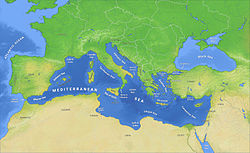
The Mediterranean Sea (/ˌmɛdɪtəˈreɪniən/ MED-ih-tə-RAY-nee-ən) is an intercontinental sea situated between Europe, Asia, and Africa. It is surrounded by the Mediterranean basin and almost completely enclosed by land: on the east by the Levant in West Asia, on the north by Anatolia in West Asia and Southern Europe, and on the south by North Africa. To its west it is connected to the Atlantic Ocean via the Strait of Gibraltar that separates the Iberian Peninsula in Europe from Morocco in Africa by only 14 km (9 mi); additionally, it is connected to the Black Sea through the Bosporus strait that intersects Turkey in the northeast and the Red Sea via the Suez Canal in the southeast.
The Mediterranean Sea covers an area of about 2,500,000 km2 (970,000 sq mi), representing 0.7% of the global ocean surface; it includes fifteen marginal seas, including the Aegean, Adriatic, Tyrrhenian, and Marmara. Geological evidence indicates that around 5.9 million years ago, the Mediterranean was cut off from the Atlantic and was partly or completely desiccated over a period of some 600,000 years during the Messinian salinity crisis before being refilled by the Zanclean flood about 5.3 million years ago.
The history of the Mediterranean region is crucial to understanding the origins and development of many modern societies; it is sometimes described as an "incubator of Western civilization". and saw the emergence of some of the earliest and most advanced civilisations, including those of Egypt, Greece, and the Fertile Crescent. The Levant in the Eastern Mediterranean was among the first regions in the world to display permanent human habitation as early as 12,000 BC. The Mediterranean Sea was an important route for merchants, travellers, and migrants in antiquity, facilitating trade and cultural exchange between various peoples as well as colonisation and conquest. The Roman Empire maintained nautical hegemony over the sea for centuries and is the only state to have ever controlled all of its coast.
The Mediterranean Sea has an average depth of 1,500 m (4,900 ft) and the deepest recorded point is 5,109 ± 1 m (16,762 ± 3 ft) in the Calypso Deep in the Ionian Sea. It lies between latitudes 30° and 46° N and longitudes 6° W and 36° E. Its west–east length, from the Strait of Gibraltar to the Gulf of Alexandretta, on the southeastern coast of Turkey, is about 4,000 kilometres (2,500 mi). The north–south length varies greatly between different shorelines and whether only straight routes are considered. Also including longitudinal changes, the shortest shipping route between the multinational Gulf of Trieste and the Libyan coastline of the Gulf of Sidra is about 1,900 kilometres (1,200 mi). The water temperatures are mild in winter and warm in summer and give name to the Mediterranean climate type due to the majority of precipitation falling in the cooler months. Its southern and eastern coastlines are lined with hot deserts not far inland, but the immediate coastline on all sides of the Mediterranean tends to have strong maritime moderation.
The countries surrounding the Mediterranean and its marginal seas in clockwise order are Spain, France, Monaco, Italy, Slovenia, Croatia, Bosnia and Herzegovina, Montenegro, Albania, Greece, Turkey, Syria, Lebanon, Israel, Palestine (Gaza Strip), Egypt, Libya, Tunisia, Algeria, and Morocco; Cyprus and Malta are island countries in the sea. In addition, Northern Cyprus (de facto state) and two overseas territories of the United Kingdom (Akrotiri and Dhekelia, and Gibraltar) also have coastlines along the Mediterranean Sea. The drainage basin encompasses a large number of other countries, the Nile being the longest river ending in the Mediterranean Sea. The Mediterranean Sea encompasses a vast number of islands, some of them of volcanic origin. The two largest islands, in both area and population, are Sicily and Sardinia.
Major ancient civilisations were located around the Mediterranean. The sea provided routes for trade, colonisation, and war, as well as food (from fishing and the gathering of other seafood) for numerous communities throughout the ages. The earliest advanced civilisations in the Mediterranean were the Egyptians and the Minoans, who traded extensively with each other.[citation needed][original research?] Around 1200 BC the eastern Mediterranean was greatly affected by the Bronze Age Collapse, which resulted in the destruction of many cities and trade routes.
Two other notable Mediterranean civilisations in classical antiquity are the Greek city-states and Phoenicians, both of whom extensively colonised the coastlines of the Mediterranean.
Darius I of Persia, who conquered Ancient Egypt, built a canal linking the Red Sea to the Nile, and thus the Mediterranean. Darius's canal was wide enough for two triremes to pass each other with oars extended and required four days to traverse.
Mediterranean Sea
The Mediterranean Sea (/ˌmɛdɪtəˈreɪniən/ MED-ih-tə-RAY-nee-ən) is an intercontinental sea situated between Europe, Asia, and Africa. It is surrounded by the Mediterranean basin and almost completely enclosed by land: on the east by the Levant in West Asia, on the north by Anatolia in West Asia and Southern Europe, and on the south by North Africa. To its west it is connected to the Atlantic Ocean via the Strait of Gibraltar that separates the Iberian Peninsula in Europe from Morocco in Africa by only 14 km (9 mi); additionally, it is connected to the Black Sea through the Bosporus strait that intersects Turkey in the northeast and the Red Sea via the Suez Canal in the southeast.
The Mediterranean Sea covers an area of about 2,500,000 km2 (970,000 sq mi), representing 0.7% of the global ocean surface; it includes fifteen marginal seas, including the Aegean, Adriatic, Tyrrhenian, and Marmara. Geological evidence indicates that around 5.9 million years ago, the Mediterranean was cut off from the Atlantic and was partly or completely desiccated over a period of some 600,000 years during the Messinian salinity crisis before being refilled by the Zanclean flood about 5.3 million years ago.
The history of the Mediterranean region is crucial to understanding the origins and development of many modern societies; it is sometimes described as an "incubator of Western civilization". and saw the emergence of some of the earliest and most advanced civilisations, including those of Egypt, Greece, and the Fertile Crescent. The Levant in the Eastern Mediterranean was among the first regions in the world to display permanent human habitation as early as 12,000 BC. The Mediterranean Sea was an important route for merchants, travellers, and migrants in antiquity, facilitating trade and cultural exchange between various peoples as well as colonisation and conquest. The Roman Empire maintained nautical hegemony over the sea for centuries and is the only state to have ever controlled all of its coast.
The Mediterranean Sea has an average depth of 1,500 m (4,900 ft) and the deepest recorded point is 5,109 ± 1 m (16,762 ± 3 ft) in the Calypso Deep in the Ionian Sea. It lies between latitudes 30° and 46° N and longitudes 6° W and 36° E. Its west–east length, from the Strait of Gibraltar to the Gulf of Alexandretta, on the southeastern coast of Turkey, is about 4,000 kilometres (2,500 mi). The north–south length varies greatly between different shorelines and whether only straight routes are considered. Also including longitudinal changes, the shortest shipping route between the multinational Gulf of Trieste and the Libyan coastline of the Gulf of Sidra is about 1,900 kilometres (1,200 mi). The water temperatures are mild in winter and warm in summer and give name to the Mediterranean climate type due to the majority of precipitation falling in the cooler months. Its southern and eastern coastlines are lined with hot deserts not far inland, but the immediate coastline on all sides of the Mediterranean tends to have strong maritime moderation.
The countries surrounding the Mediterranean and its marginal seas in clockwise order are Spain, France, Monaco, Italy, Slovenia, Croatia, Bosnia and Herzegovina, Montenegro, Albania, Greece, Turkey, Syria, Lebanon, Israel, Palestine (Gaza Strip), Egypt, Libya, Tunisia, Algeria, and Morocco; Cyprus and Malta are island countries in the sea. In addition, Northern Cyprus (de facto state) and two overseas territories of the United Kingdom (Akrotiri and Dhekelia, and Gibraltar) also have coastlines along the Mediterranean Sea. The drainage basin encompasses a large number of other countries, the Nile being the longest river ending in the Mediterranean Sea. The Mediterranean Sea encompasses a vast number of islands, some of them of volcanic origin. The two largest islands, in both area and population, are Sicily and Sardinia.
Major ancient civilisations were located around the Mediterranean. The sea provided routes for trade, colonisation, and war, as well as food (from fishing and the gathering of other seafood) for numerous communities throughout the ages. The earliest advanced civilisations in the Mediterranean were the Egyptians and the Minoans, who traded extensively with each other.[citation needed][original research?] Around 1200 BC the eastern Mediterranean was greatly affected by the Bronze Age Collapse, which resulted in the destruction of many cities and trade routes.
Two other notable Mediterranean civilisations in classical antiquity are the Greek city-states and Phoenicians, both of whom extensively colonised the coastlines of the Mediterranean.
Darius I of Persia, who conquered Ancient Egypt, built a canal linking the Red Sea to the Nile, and thus the Mediterranean. Darius's canal was wide enough for two triremes to pass each other with oars extended and required four days to traverse.
Recent media
Recent media