


Community hub
Recent from talks
Contribute something
Nothing was collected or created yet.
Berbers
View on Wikipedia
Key Information


Berbers, or the Berber peoples,[a] also known as Amazigh[b] or Imazighen,[c] are a diverse grouping of distinct ethnic groups indigenous to North Africa who predate the arrival of Arabs in the Maghreb.[38][39][40][41] Their main connections are identified by their usage of Berber languages, most of them mutually unintelligible,[40][42] which are part of the Afroasiatic language family.
They are indigenous to the Maghreb region of North Africa, where they live in scattered communities across parts of Morocco, Algeria, Libya, and to a lesser extent Tunisia, Mauritania, northern Mali and northern Niger (Azawagh).[41][43][44] Smaller Berber communities are also found in Burkina Faso and Egypt's Siwa Oasis.[45][46][47]
Descended from Stone Age tribes of North Africa, accounts of the Imazighen were first mentioned in Ancient Egyptian writings.[48][49] From about 2000 BC, Berber languages spread westward from the Nile Valley across the northern Sahara into the Maghreb. A series of Berber peoples such as the Mauri, Masaesyli, Massyli, Musulamii, Gaetuli, and Garamantes gave rise to Berber kingdoms, such as Numidia and Mauretania. Other kingdoms appeared in late antiquity, such as Altava, Aurès, Ouarsenis, and Hodna.[50] Berber kingdoms were eventually suppressed by the Arab conquests of the 7th and 8th centuries AD. This started a process of cultural and linguistic assimilation known as Arabization, which influenced the Berber population. Arabization involved the spread of Arabic language and Arab culture among the Berbers, leading to the adoption of Arabic as the primary language and conversion to Islam. Notably, the Arab migrations to the Maghreb from the 7th century to the 17th century accelerated this process.[51] Berber tribes remained powerful political forces and founded new ruling dynasties in the 10th and 11th centuries, such as the Zirids, Hammadids, various Zenata principalities in the western Maghreb, and several Taifa kingdoms in al-Andalus, and empires of the Almoravids and Almohads. Their Berber successors – the Marinids, the Zayyanids, and the Hafsids – continued to rule until the 16th century. From the 16th century onward, the process continued in the absence of Berber dynasties; in Morocco, they were replaced by Arabs claiming descent from the Islamic prophet Muhammad.[50]
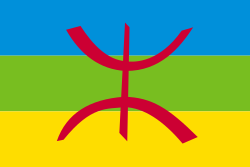
Berbers are divided into several diverse ethnic groups and Berber languages, such as Kabyles, Chaouis and Rifians. Historically, Berbers across the region did not see themselves as a single cultural or linguistic unit, nor was there a greater "Berber community", due to their differing cultures.[52] They also did not refer to themselves as Berbers/Amazigh but had their own terms to refer to their own groups and communities.[53] They started being referred to collectively as Berbers after the Arab conquests of the 7th century and this distinction was revived by French colonial administrators in the 19th century. Today, the term "Berber" is viewed as pejorative by many who prefer the term "Amazigh".[54] Since the late 20th century, a trans-national movement – known as Berberism or the Berber Culture Movement – has emerged among various parts of the Berber populations of North Africa to promote a collective Amazigh ethnic identity and to militate for greater linguistic rights and cultural recognition.[55]
Names and etymology
[edit]The indigenous populations of the Maghreb region of North Africa are collectively known as Berbers or Amazigh in English.[41]
Tribal titles such as Barabara and Beraberata appear in Egyptian inscriptions of 1700 and 1300 BC, and the Berbers were probably intimately related with the Egyptians in very early times. Thus the true ethnic name may have become confused with Barbari, the designation used by classical conquerors.[56][better source needed]
The plural form Imazighen is sometimes also used in English.[43][57] While "Berber" is more widely known among English-speakers, its usage is a subject of debate, due to its historical background as an exonym and present equivalence with the Arabic word for "barbarian".[58][59][44][60] Historically, Berbers did not refer to themselves as Berbers/Amazigh but had their own terms to refer to themselves. For example, the Kabyle use the term "Leqbayel" to refer to their own people, while the Chaoui identified as "Ishawiyen", instead of Berber/Amazigh.[53]
Stéphane Gsell proposed the translation "noble/free" for the term Amazigh based on Leo Africanus's translation of "awal amazigh" as "noble language" referring to the Berber languages; this definition remains disputed and is largely seen as an undue extrapolation.[61][62][63] The term Amazigh also has a cognate in the Tuareg "Amajegh", meaning noble.[64][61] "Mazigh" was used as a tribal surname in Roman Mauretania Caesariensis.[62][65]
Abraham Isaac Laredo proposes that the term Amazigh could be derived from "Mezeg", which is the name of Dedan of Sheba in the Targum.[66][61]
The medieval Arab historian Ibn Khaldun says the Berbers were descendants of Barbar, the son of Tamalla, son of Mazigh, son of Canaan, son of Ham, son of Noah.[67][61]
The Numidian, Mauri and Libu populations of antiquity are typically understood by contemporary writers to have referred to approximately the same population as modern Berbers.[68][69]
History
[edit]The areas of North Africa that have retained the Berber language and traditions best have been, in general, Algeria, Libya, Morocco and Tunisia. Much of Berber culture is still celebrated among the cultural elite in Morocco and Algeria, especially in Kabylia, the Aurès and the Atlas Mountains. The Kabyles were one of the few peoples in North Africa who remained independent during successive rule by the Carthaginians, Romans, Byzantines, Vandals, and the Ottoman Turks.[70][71][72][73] Even after the Arab conquest of North Africa, the Kabyle people still maintained possession of their mountains.[74][75]
Prehistory
[edit]

The Maghreb region in northwestern Africa is believed to have been inhabited by Berbers from at least 10,000 BC.[76] Cave paintings, which have been dated to twelve millennia before present, have been found in the Tassili n'Ajjer region of southeastern Algeria. Other rock art has been discovered at Tadrart Acacus in the Libyan desert. A Neolithic society, marked by domestication and subsistence agriculture and richly depicted in the Tassili n'Ajjer paintings, developed and predominated in the Saharan and Mediterranean region (the Maghreb) of northern Africa between 6000 and 2000 BC (until the classical period).
Prehistoric Tifinagh inscriptions were found in the Oran region.[77] During the pre-Roman era, several successive independent states (Massylii) existed before King Masinissa unified the people of Numidia.[78][79][80][full citation needed]
Mythology
[edit]According to the Roman historian Gaius Sallustius Crispus, the original people of North Africa are the Gaetulians and the Libyans, they were the prehistoric peoples that crossed to Africa from the Iberian Peninsula, then much later, Hercules and his army crossed from Iberia to North Africa where his army intermarried with the local populace and settled the region permanently, the Medes of his army that married the Libyans formed the Maur people, while the other part of his Army formed the Nomadas or as they are today known as the Numidians which later on united all of Berber tribes of North Africa under the rule of Massinissa.
Other sources
[edit]According to the Al-Fiḥrist, the Barber (i.e. Berbers) comprised one of seven principal races in Africa.[81]
The medieval Tunisian scholar Ibn Khaldun (1332–1406), recounting the oral traditions prevalent in his day, sets down two popular opinions as to the origin of the Berbers: according to one opinion, they are descended from Canaan, son of Ham, and have for ancestors Berber, son of Temla, son of Mazîgh, son of Canaan, son of Ham, a son of Noah;[82] alternatively, Abou-Bekr Mohammed es-Souli (947 AD) held that they are descended from Berber, the son of Keloudjm (Casluhim), the son of Mesraim, the son of Ham.[82]
They belong to a powerful, formidable, brave and numerous people; a true people like so many others the world has seen – like the Arabs, the Persians, the Greeks and the Romans. The men who belong to this family of peoples have inhabited the Maghreb since the beginning.
— Ibn Khaldun[83]
Ancestry and DNA
[edit]As of about 5000 BC, the populations of North Africa were descended primarily from the Iberomaurusian and Capsian cultures, with a more recent intrusion being associated with the Neolithic Revolution.[84] The proto-Berber tribes evolved from these prehistoric communities during the late Bronze- and early Iron ages.[85]
Uniparental DNA analysis has established ties between Berbers and other Afroasiatic speakers in Africa. Most of these populations belong to the E1b1b paternal haplogroup, with Berber speakers having among the highest frequencies of this lineage.[86]
Additionally, genomic analysis found that Berber and other Maghreb communities have a high frequency of an ancestral component that originated in the Near East. This Maghrebi element peaks among Tunisian Berbers.[87] This ancestry is related to the Coptic/Ethio-Somali component, which diverged from these and other West Eurasian-affiliated components before the Holocene.[88]
In 2013, Iberomaurusian skeletons from the prehistoric sites of Taforalt and Afalou in the Maghreb were also analyzed for ancient DNA. All of the specimens belonged to maternal clades associated with either North Africa or the northern and southern Mediterranean littoral, indicating gene flow between these areas since the Epipaleolithic.[89] The ancient Taforalt individuals carried the mtDNA haplogroups U6, H, JT, and V, which points to population continuity in the region dating from the Iberomaurusian period.[90]

Human fossils excavated at the Ifri n'Amr ou Moussa site in Morocco have been radiocarbon dated to the Early Neolithic period, c. 5000 BC. Ancient DNA analysis of these specimens indicates that they carried paternal haplotypes related to the E1b1b1b1a (E-M81) subclade and the maternal haplogroups U6a and M1, all of which are frequent among present-day communities in the Maghreb. These ancient individuals also bore an autochthonous Maghrebi genomic component that peaks among modern Berbers, indicating that they were ancestral to populations in the area. Additionally, fossils excavated at the Kelif el Boroud site near Rabat were found to carry the broadly distributed paternal haplogroup T-M184 as well as the maternal haplogroups K1, T2 and X2, the latter of which were common mtDNA lineages in Neolithic Europe and Anatolia. These ancient individuals likewise bore the Berber-associated Maghrebi genomic component. This altogether indicates that the late-Neolithic Kehf el Baroud inhabitants were ancestral to contemporary populations in the area, but also likely experienced gene flow from Europe.[91]
The late-Neolithic Kehf el Baroud inhabitants were modelled as being of about 50% local North African ancestry and 50% Early European Farmer (EEF) ancestry. It was suggested that EEF ancestry had entered North Africa through Cardial Ware colonists from Iberia sometime between 5000 and 3000 BC. They were found to be closely related to the Guanches of the Canary Islands. The authors of the study suggested that the Berbers of Morocco carried a substantial amount of EEF ancestry before the establishment of Roman colonies in Berber Africa.[91]
Antiquity
[edit].jpg)
The great tribes of Berbers in classical antiquity (when they were often known as ancient Libyans)[92][d] were said to be three (roughly, from west to east): the Mauri, the Numidians near Carthage, and the Gaetulians. The Mauri inhabited the far west (ancient Mauretania, now Morocco and central Algeria). The Numidians occupied the regions between the Mauri and the city-state of Carthage. Both the Mauri and the Numidians had significant sedentary populations living in villages, and their peoples both tilled the land and tended herds. The Gaetulians lived to the near south, on the northern margins of the Sahara, and were less settled, with predominantly pastoral elements.[93][94][95]: 41f
For their part, the Phoenicians (Semitic-speaking Canaanites) came from perhaps the most advanced multicultural sphere then existing, the western coast of the Fertile Crescent region of West Asia. Accordingly, the material culture of Phoenicia was likely more functional and efficient, and their knowledge more advanced, than that of the early Berbers. Hence, the interactions between Berbers and Phoenicians were often asymmetrical. The Phoenicians worked to keep their cultural cohesion and ethnic solidarity, and continuously refreshed their close connection with Tyre, the mother city.[92]: 37
The earliest Phoenician coastal outposts were probably meant merely to resupply and service ships bound for the lucrative metals trade with the Iberians,[96] and perhaps at first regarded trade with the Berbers as unprofitable.[97] However, the Phoenicians eventually established strategic colonial cities in many Berber areas, including sites outside of present-day Tunisia, such as the settlements at Oea, Leptis Magna, Sabratha (in Libya), Volubilis, Chellah, and Mogador (now in Morocco). As in Tunisia, these centres were trading hubs, and later offered support for resource development, such as processing olive oil at Volubilis and Tyrian purple dye at Mogador. For their part, most Berbers maintained their independence as farmers or semi-pastorals, although, due to the example of Carthage, their organized politics increased in scope and sophistication.[95]

In fact, for a time their numerical and military superiority (the best horse riders of that time) enabled some Berber kingdoms to impose a tribute on Carthage, a condition that continued into the 5th century BC.[96]: 64–65 Also, due to the Berbero-Libyan Meshwesh dynasty's rule of Egypt (945–715 BC),[98] the Berbers near Carthage commanded significant respect (yet probably appearing more rustic than the elegant Libyan pharaohs on the Nile). Correspondingly, in early Carthage, careful attention was given to securing the most favourable treaties with the Berber chieftains, "which included intermarriage between them and the Punic aristocracy".[99] In this regard, perhaps the legend about Dido, the foundress of Carthage, as related by Trogus is apposite. Her refusal to wed the Mauritani chieftain Hiarbus might be indicative of the complexity of the politics involved.[100]
Eventually, the Phoenician trading stations would evolve into permanent settlements, and later into small towns, which would presumably require a wide variety of goods as well as sources of food, which could be satisfied through trade with the Berbers. Yet, here too, the Phoenicians probably would be drawn into organizing and directing such local trade, and also into managing agricultural production. In the 5th century BC, Carthage expanded its territory, acquiring Cape Bon and the fertile Wadi Majardah,[101] later establishing control over productive farmlands for several hundred kilometres.[102] Appropriation of such wealth in land by the Phoenicians would surely provoke some resistance from the Berbers; although in warfare, too, the technical training, social organization, and weaponry of the Phoenicians would seem to work against the tribal Berbers. This social-cultural interaction in early Carthage has been summarily described:
Lack of contemporary written records makes the drawing of conclusions here uncertain, which can only be based on inference and reasonable conjecture about matters of social nuance. Yet it appears that the Phoenicians generally did not interact with the Berbers as economic equals, but employed their agricultural labour, and their household services, whether by hire or indenture; many became sharecroppers.[92]: 86
For a period, the Berbers were in constant revolt, and in 396 there was a great uprising.
Thousands of rebels streamed down from the mountains and invaded Punic territory, carrying the serfs of the countryside along with them. The Carthaginians were obliged to withdraw within their walls and were besieged.
Yet the Berbers lacked cohesion; and although 200,000 strong at one point, they succumbed to hunger, their leaders were offered bribes, and "they gradually broke up and returned to their homes".[96]: 125, 172 Thereafter, "a series of revolts took place among the Libyans [Berbers] from the fourth century onwards".[92]: 81
The Berbers had become involuntary 'hosts' to the settlers from the east, and were obliged to accept the dominance of Carthage for centuries. Nonetheless, therein they persisted largely unassimilated,[citation needed] as a separate, submerged entity, as a culture of mostly passive urban and rural poor within the civil structures created by Punic rule.[103] In addition, and most importantly, the Berber peoples also formed quasi-independent satellite societies along the steppes of the frontier and beyond, where a minority continued as free 'tribal republics'. While benefiting from Punic material culture and political-military institutions, these peripheral Berbers (also called Libyans)—while maintaining their own identity, culture, and traditions—continued to develop their own agricultural skills and village societies, while living with the newcomers from the east in an asymmetric symbiosis.[e][105]
As the centuries passed, a society of Punic people of Phoenician descent but born in Africa, called Libyphoenicians emerged there. This term later came to be applied also to Berbers acculturated to urban Phoenician culture.[92]: 65, 84–86 Yet the whole notion of a Berber apprenticeship to the Punic civilization has been called an exaggeration sustained by a point of view fundamentally foreign to the Berbers.[94]: 52, 58 A population of mixed ancestry, Berber and Punic, evolved there, and there would develop recognized niches in which Berbers had proven their utility. For example, the Punic state began to field Berber–Numidian cavalry under their commanders on a regular basis. The Berbers eventually were required to provide soldiers (at first "unlikely" paid "except in booty"), which by the fourth century BC became "the largest single element in the Carthaginian army".[92]: 86

Yet in times of stress at Carthage, when a foreign force might be pushing against the city-state, some Berbers would see it as an opportunity to advance their interests, given their otherwise low status in Punic society.[citation needed] Thus, when the Greeks under Agathocles (361–289 BC) of Sicily landed at Cape Bon and threatened Carthage (in 310 BC), there were Berbers, under Ailymas, who went over to the invading Greeks.[96]: 172 [f] During the long Second Punic War (218–201 BC) with Rome (see below), the Berber King Masinissa (c. 240 – c. 148 BC) joined with the invading Roman general Scipio, resulting in the war-ending defeat of Carthage at Zama, despite the presence of their renowned general Hannibal; on the other hand, the Berber King Syphax (d. 202 BC) had supported Carthage. The Romans, too, read these cues, so that they cultivated their Berber alliances and, subsequently, favored the Berbers who advanced their interests following the Roman victory.[106]
Carthage was faulted by her ancient rivals for the "harsh treatment of her subjects" as well as for "greed and cruelty".[92]: 83 [g][107] Her Libyan Berber sharecroppers, for example, were required to pay half of their crops as tribute to the city-state during the emergency of the First Punic War. The normal exaction taken by Carthage was likely "an extremely burdensome" one-quarter.[92]: 80 Carthage once famously attempted to reduce the number of its Libyan and foreign soldiers, leading to the Mercenary War (240–237 BC).[96]: 203–209 [108][109] The city-state also seemed to reward those leaders known to deal ruthlessly with its subject peoples, hence the frequent Berber insurrections. Moderns fault Carthage for failure "to bind her subjects to herself, as Rome did [her Italians]", yet Rome and the Italians held far more in common perhaps than did Carthage and the Berbers. Nonetheless, a modern criticism is that the Carthaginians "did themselves a disservice" by failing to promote the common, shared quality of "life in a properly organized city" that inspires loyalty, particularly with regard to the Berbers.[92]: 86–87 Again, the tribute demanded by Carthage was onerous.[110]
[T]he most ruinous tribute was imposed and exacted with unsparing rigour from the subject native states, and no slight one either from the cognate Phoenician states. ... Hence arose that universal disaffection, or rather that deadly hatred, on the part of her foreign subjects, and even of the Phoenician dependencies, toward Carthage, on which every invader of Africa could safely count as his surest support. ... This was the fundamental, the ineradicable weakness of the Carthaginian Empire ...[110]
The Punic relationship with the majority of the Berbers continued throughout the life of Carthage. The unequal development of material culture and social organization perhaps fated the relationship to be an uneasy one. A long-term cause of Punic instability, there was no melding of the peoples. It remained a source of stress and a point of weakness for Carthage. Yet there were degrees of convergence on several particulars, discoveries of mutual advantage, occasions of friendship, and family.[111]

The Berbers gain historicity gradually during the Roman era. Byzantine authors mention the Mazikes (Amazigh) as tribal people raiding the monasteries of Cyrenaica. Garamantia was a notable Berber kingdom that flourished in the Fezzan area of modern-day Libya in the Sahara desert between 400 BC and 600 AD.
Roman-era Cyrenaica became a center of early Christianity. Some pre-Islamic Berbers were Christians[112] (there is a strong correlation between adherence to the Donatist doctrine and being a Berber, ascribed to the doctrine matching their culture, as well as their being alienated from the dominant Roman culture of the Catholic church),[83] some perhaps Jewish, and some adhered to their traditional polytheist religion. The Roman-era authors Apuleius and St. Augustine were born in Numidia, as were three popes, one of whom, Pope Victor I, served during the reign of Roman emperor Septimius Severus, who was a North African of Roman/Punic ancestry (perhaps with some Berber blood).[113]
Numidia
[edit]
Numidia (202 – 46 BC) was an ancient Berber kingdom in modern Algeria and part of Tunisia. It later alternated between being a Roman province and being a Roman client state. The kingdom was located on the eastern border of modern Algeria, bordered by the Roman province of Mauretania (in modern Algeria and Morocco) to the west, the Roman province of Africa (modern Tunisia) to the east, the Mediterranean to the north, and the Sahara Desert to the south. Its people were the Numidians.
The name Numidia was first applied by Polybius and other historians during the third century BC to indicate the territory west of Carthage, including the entire north of Algeria as far as the river Mulucha (Muluya), about 160 kilometres (100 mi) west of Oran. The Numidians were conceived of as two great groups: the Massylii in eastern Numidia, and the Masaesyli in the west. During the first part of the Second Punic War, the eastern Massylii, under King Gala, were allied with Carthage, while the western Masaesyli, under King Syphax, were allied with Rome.
In 206 BC, the new king of the Massylii, Masinissa, allied himself with Rome, and Syphax, of the Masaesyli, switched his allegiance to the Carthaginian side. At the end of the war, the victorious Romans gave all of Numidia to Masinissa. At the time of his death in 148 BC, Masinissa's territory extended from Mauretania to the boundary of Carthaginian territory, and southeast as far as Cyrenaica, so that Numidia entirely surrounded Carthage except towards the sea.[114]
Masinissa was succeeded by his son Micipsa. When Micipsa died in 118 BC, he was succeeded jointly by his two sons Hiempsal I and Adherbal and Masinissa's illegitimate grandson, Jugurtha, of Berber origin, who was very popular among the Numidians. Hiempsal and Jugurtha quarreled immediately after the death of Micipsa. Jugurtha had Hiempsal killed, which led to open war with Adherbal.
After Jugurtha defeated him in open battle, Adherbal fled to Rome for help. The Roman officials, allegedly due to bribes but perhaps more likely out of a desire to quickly end conflict in a profitable client kingdom, sought to settle the quarrel by dividing Numidia into two parts. Jugurtha was assigned the western half. However, soon after, conflict broke out again, leading to the Jugurthine War between Rome and Numidia.

Mauretania
[edit]In antiquity, Mauretania (3rd century BC – 44 BC) was an ancient Mauri Berber kingdom in modern Morocco and part of Algeria. It became a client state of the Roman empire in 33 BC, after the death of king Bocchus II, then a full Roman province in AD 40, after the death of its last king, Ptolemy of Mauretania, a member of the Ptolemaic dynasty.
Middle Ages
[edit]
According to historians of the Middle Ages, the Berbers were divided into two branches, Butr and Baranis (known also as Botr and Barnès), descended from Mazigh ancestors, who were themselves divided into tribes and subtribes. Each region of the Maghreb contained several fully independent tribes (e.g., Sanhaja, Houaras, Zenata, Masmuda, Kutama, Awraba, Barghawata, etc.).[115][full citation needed][116]
The Mauro-Roman Kingdom was an independent Christian Berber kingdom centred in the capital city of Altava (present-day Algeria) which controlled much of the ancient Roman province of Mauretania Caesariensis. Berber Christian communities within the Maghreb all but disappeared under Islamic rule. The indigenous Christian population in some Nefzaoua villages persisted until the 14th century.[117]
Several Berber dynasties emerged during the Middle Ages in the Maghreb and al-Andalus. The most notable are the Zirids (Ifriqiya, 973–1148), the Hammadids (Western Ifriqiya, 1014–1152), the Almoravid dynasty (Morocco and al-Andalus, 1040–1147), the Almohads (Morocco and al-Andalus, 1147–1248), the Hafsids (Ifriqiya, 1229–1574), the Zianids (Tlemcen, 1235–1556), the Marinids (Morocco, 1248–1465) and the Wattasids (Morocco, 1471–1554).

Before the eleventh century, most of Northwest Africa had become a Berber-speaking Muslim area. Unlike the conquests of previous religions and cultures, the spread of Islam, which was spread by Arabs, was to have extensive and long-lasting effects on the Maghreb. The new faith, in its various forms, would penetrate nearly all segments of Berber society, bringing with it armies, learned men, and fervent mystics, and in large part replacing tribal practices and loyalties with new social norms and political idioms. A further Arabization of the region was in large part due to the arrival of the Banu Hilal, a tribe sent by the Fatimids of Egypt to punish the Berber Zirid dynasty for having abandoned Shiism. The Banu Hilal reduced the Zirids to a few coastal towns and took over much of the plains, resulting in the spread of nomadism to areas where agriculture had previously been dominant.
Besides the Arabian influence, North Africa also saw an influx, via the Barbary slave trade, of Europeans, with some estimates placing the number of European slaves brought to North Africa during the Ottoman period to be as high as 1.25 million.[118] Interactions with neighboring Sudanic empires, traders, and nomads from other parts of Africa also left impressions upon the Berber people.
Islamic conquest
[edit].jpg)
The first Arabian military expeditions into the Maghreb, between 642 and 669, resulted in the spread of Islam. These early forays from a base in Egypt occurred under local initiative rather than under orders from the central caliphate. But when the seat of the caliphate moved from Medina to Damascus, the Umayyads (a Muslim dynasty ruling from 661 to 750) recognized that the strategic necessity of dominating the Mediterranean dictated a concerted military effort on the North African front. In 670, therefore, an Arab army under Uqba ibn Nafi established the town of Qayrawan about 160 kilometres south of modern Tunis and used it as a base for further operations.
Abu al-Muhajir Dinar, Uqba's successor, pushed westward into Algeria and eventually worked out a modus vivendi with Kusaila, the ruler of an extensive confederation of Christian Berbers. Kusaila, who had been based in Tlemcen, became a Muslim and moved his headquarters to Takirwan, near Al Qayrawan. This harmony was short-lived; Arabian and Berber forces controlled the region in turn until 697. Umayyad forces conquered Carthage in 698, expelling the Byzantines, and in 703 decisively defeated Dihya's Berber coalition at the Battle of Tabarka. By 711, Umayyad forces helped by Berber converts to Islam had conquered all of North Africa. Governors appointed by the Umayyad caliphs ruled from Kairouan, capital of the new wilaya (province) of Ifriqiya, which covered Tripolitania (the western part of modern Libya), Tunisia, and eastern Algeria.
The spread of Islam among the Berbers did not guarantee their support for the Arab-dominated caliphate, due to the discriminatory attitude of the Arabs. The ruling Arabs alienated the Berbers by taxing them heavily, treating converts as second-class Muslims, and, worst of all, by enslaving them. As a result, widespread opposition took the form of open revolt in 739–740 under the banner of Ibadi Islam. The Ibadi had been fighting Umayyad rule in the East, and many Berbers were attracted by the sect's seemingly egalitarian precepts.
After the revolt, Ibadis established a number of theocratic tribal kingdoms, most of which had short and troubled histories. But others, such as Sijilmasa and Tlemcen, which straddled the principal trade routes, proved more viable and prospered. In 750, the Abbasids, who succeeded the Umayyads as Muslim rulers, moved the caliphate to Baghdad and reestablished caliphal authority in Ifriqiya, appointing Ibrahim ibn al Aghlab as governor in Kairouan. Though nominally serving at the caliph's pleasure, Al Aghlab and his successors, the Aghlabids, ruled independently until 909, presiding over a court that became a center of learning and culture.
Just to the west of Aghlabid lands, Abd ar Rahman ibn Rustam ruled most of the central Maghreb from Tahert, south-west of Algiers. The rulers of the Rustamid imamate (761–909), each an Ibadi imam, were elected by leading citizens. The imams gained a reputation for honesty, piety, and justice. The court at Tahert was noted for its support of scholarship in mathematics, astronomy, astrology, theology, and law. The Rustamid imams failed, by choice or by neglect, to organize a reliable standing army. This important factor, accompanied by the dynasty's eventual collapse into decadence, opened the way for Tahert's demise under the assault of the Fatimids.
Mahdia was founded by the Fatimids under the Caliph Abdallah al-Mahdi in 921, and made the capital city of Ifriqiya by caliph Abdallah El Fatimi.[119] It was chosen as the capital because of its proximity to the sea, and the promontory on which an important military settlement had been since the time of the Phoenicians.[120]
In al-Andalus under the Umayyad governors
[edit]

The Muslims who invaded the Iberian Peninsula in 711 were mainly Berbers, and were led by a Berber, Tariq ibn Ziyad, under the suzerainty of the Arab Caliph of Damascus Abd al-Malik ibn Marwan and his North African Viceroy, Musa ibn Nusayr.[121] Due to subsequent antagonism between Arabs and Berbers, and due to the fact that most of the histories of al-Andalus were written from an Arab perspective, the Berber role is understated in the available sources.[121] The biographical dictionary of Ibn Khallikan preserves the record of the Berber predominance in the invasion of 711, in the entry on Tariq ibn Ziyad.[121] A second mixed army of Arabs and Berbers came in 712 under Ibn Nusayr himself. They supposedly helped the Umayyad caliph Abd ar-Rahman I in al-Andalus, because his mother was a Berber.
English medievalist Roger Collins suggests that if the forces that invaded the Iberian peninsula were predominantly Berber, it is because there were insufficient Arab forces in Africa to maintain control of Africa and attack Iberia at the same time.[121]: 98 Thus, although north Africa had only been conquered about a dozen years previously, the Arabs already employed forces of the defeated Berbers to carry out their next invasion.[121]: 98 This would explain the predominance of Berbers over Arabs in the initial invasion. In addition, Collins argues that Berber social organization made it possible for the Arabs to recruit entire tribal units into their armies, making the defeated Berbers excellent military auxiliaries.[121]: 99 The Berber forces in the invasion of Iberia came from Ifriqiya or as far away as Tripolitania.[122]
Governor As-Samh distributed land to the conquering forces, apparently by tribe, though it is difficult to determine from the few historical sources available.[121]: 48–49 It was at this time that the positions of Arabs and Berbers were regularized across the Iberian peninsula. Berbers were positioned in many of the most mountainous regions of Spain, such as Granada, the Pyrenees, Cantabria, and Galicia. Collins suggests this may be because some Berbers were familiar with mountain terrain, whereas the Arabs were not.[121]: 49–50 By the late 710s, there was a Berber governor in Leon or Gijon.[121]: 149 When Pelagius revolted in Asturias, it was against a Berber governor. This revolt challenged As-Samh's plans to settle Berbers in the Galician and Cantabrian mountains, and by the middle of the eighth century it seems there was no more Berber presence in Galicia.[121]: 49–50 The expulsion of the Berber garrisons from central Asturias, following the battle of Covadonga, contributed to the eventual formation of the independent Asturian kingdom.[122]: 63
Many Berbers were settled in what were then the frontier lands near Toledo, Talavera, and Mérida,[121]: 195 Mérida becoming a major Berber stronghold in the eighth century.[121]: 201 The Berber garrison in Talavera would later be commanded by Amrus ibn Yusuf and was involved in military operations against rebels in Toledo in the late 700s and early 800s.[121]: 210 Berbers were also initially settled in the eastern Pyrenees and Catalonia.[121]: 88–89, 195 They were not settled in the major cities of the south, and were generally kept in the frontier zones away from Cordoba.[121]: 207
Roger Collins cites the work of Pierre Guichard to argue that Berber groups in Iberia retained their own distinctive social organization.[121]: 90 [123][124] According to this traditional view of Arab and Berber culture in the Iberian peninsula, Berber society was highly impermeable to outside influences, whereas Arabs became assimilated and Hispanized.[121]: 90 Some support for the view that Berbers assimilated less comes from an excavation of an Islamic cemetery in northern Spain, which reveals that the Berbers accompanying the initial invasion brought their families with them from north Africa.[122][125]
In 731, the eastern Pyrenees were under the control of Berber forces garrisoned in the major towns under the command of Munnuza. Munnuza attempted a Berber uprising against the Arabs in Spain, citing mistreatment of Berbers by Arabic judges in north Africa, and made an alliance with Duke Eudo of Aquitaine. However, governor Abd ar-Rahman attacked Munnuza before he was ready, and, besieging him, defeated him at Cerdanya. Because of the alliance with Munnuza, Abd ar-Rahman wanted to punish Eudo, and his punitive expedition ended in the Arab defeat at Poitiers.[121]: 88–90
By the time of the governor Uqba, and possibly as early as 714, the city of Pamplona was occupied by a Berber garrison.[121]: 205–206 An eighth-century cemetery has been discovered with 190 burials all according to Islamic custom, testifying to the presence of this garrison.[121]: 205–206 [126] In 798, however, Pamplona is recorded as being under a Banu Qasi governor, Mutarrif ibn Musa. Ibn Musa lost control of Pamplona to a popular uprising. In 806 Pamplona gave its allegiance to the Franks, and in 824 became the independent Kingdom of Pamplona. These events put an end to the Berber garrison in Pamplona.[121]: 206–208
Medieval Egyptian historian Al-Hakam wrote that there was a major Berber revolt in north Africa in 740–741, led by Masayra. The Chronicle of 754 calls these rebels Arures, which Collins translates as 'heretics', arguing it is a reference to the Berber rebels' Ibadi or Khariji sympathies.[121]: 107 After Charles Martel attacked Arab ally Maurontus at Marseille in 739, governor Uqba planned a punitive attack against the Franks, but news of a Berber revolt in north Africa made him turn back when he reached Zaragoza.[121]: 92 Instead, according to the Chronicle of 754, Uqba carried out an attack against Berber fortresses in Africa. Initially, these attacks were unsuccessful; but eventually Uqba destroyed the rebels, secured all the crossing points to Spain, and then returned to his governorship.[121]: 105–106
Although Masayra was killed by his own followers, the revolt spread and the Berber rebels defeated three Arab armies.[121]: 106–108 After the defeat of the third army, which included elite units of Syrians commanded by Kulthum and Balj, the Berber revolt spread further. At this time, the Berber military colonies in Spain revolted.[121]: 108 At the same time, Uqba died and was replaced by Ibn Qatan. By this time, the Berbers controlled most of the north of the Iberian peninsula, except for the Ebro valley, and were menacing Toledo. Ibn Qatan invited Balj and his Syrian troops, who were at that time in Ceuta, to cross to the Iberian peninsula to fight against the Berbers.[121]: 109–110
The Berbers marched south in three columns, simultaneously attacking Toledo, Cordoba, and the ports on the Gibraltar strait. However, Ibn Qatan's sons defeated the army attacking Toledo, the governor's forces defeated the attack on Cordoba, and Balj defeated the attack on the strait. After this, Balj seized power by marching on Cordoba and executing Ibn Qatan.[121]: 108 Collins points out that Balj's troops were away from Syria just when the Abbasid revolt against the Umayyads broke out, and this may have contributed to the fall of the Umayyad regime.[121]: 121
In Africa, the Berbers were hampered by divided leadership. Their attack on Kairouan was defeated, and a new governor of Africa, Hanzala ibn Safwan, proceeded to defeat the rebels in Africa and then to impose peace between Balj's troops and the existing Andalusi Arabs.[121]: 110–111
Roger Collins argues that the Great Berber revolt facilitated the establishment of the Kingdom of Asturias and altered the demographics of the Berber population in the Iberian peninsula, specifically contributing to the Berber departure from the northwest of the peninsula.[121]: 150–151 When the Arabs first invaded the peninsula, Berber groups were situated in the northwest. However, due to the Berber revolt, the Umayyad governors were forced to protect their southern flank and were unable to mount an offense against the Asturians. Some presence of Berbers in the northwest may have been maintained at first, but after the 740s there is no more mention of the northwestern Berbers in the sources.[121]: 150–151, 153–154
In al-Andalus during the Umayyad emirate
[edit]When the Umayyad Caliphate was overthrown in 750, a grandson of Caliph Hisham, Abd ar-Rahman, escaped to north Africa[121]: 115 and hid among the Berbers of north Africa for five years. A persistent tradition states that this is because his mother was Berber[121]: 117–118 and that he first took refuge with the Nafsa Berbers, his mother's people. As the governor Ibn Habib was seeking him, he then fled to the more powerful Zenata Berber confederacy, who were enemies of Ibn Habib. Since the Zenata had been part of the initial invasion force of al-Andalus, and were still present in the Iberian peninsula, this gave Abd ar-Rahman a base of support in al-Andalus,[121]: 119 although he seems to have drawn most of his support from portions of Balj's army that were still loyal to the Umayyads.[121]: 122–123 [122]: 8
Abd ar-Rahman crossed to Spain in 756 and declared himself the legitimate Umayyad ruler of al-Andalus. The governor, Yusuf, refused to submit. After losing the initial battle near Cordoba,[121]: 124–125 Yusuf fled to Mérida, where he raised a large Berber army, with which he marched on Seville, but was defeated by forces loyal to Abd ar-Rahman. Yusuf fled to Toledo, and was killed either on the way or after reaching that place.[121]: 132 Yusuf's cousin Hisham ibn Urwa continued to resist Abd ar-Rahman from Toledo until 764,[121]: 133 and the sons of Yusuf revolted again in 785. These family members of Yusuf, members of the Fihri tribe, were effective in obtaining support from Berbers in their revolts against the Umayyad regime.[121]: 134
As emir of al-Andalus, Abd ar-Rahman I faced persistent opposition from Berber groups, including the Zenata. Berbers provided much of Yusuf's support in fighting Abd ar-Rahman. In 774, Zenata Berbers were involved in a Yemeni revolt in the area of Seville.[121]: 168 Andalusi Berber Salih ibn Tarif declared himself a prophet and ruled the Bargawata Berber confederation in Morocco in the 770s.[121]: 169
In 768, a Miknasa Berber named Shaqya ibn Abd al-Walid declared himself a Fatimid imam, claiming descent from Fatimah and Ali.[121]: 168 He is mainly known from the work of the Arab historian Ibn al-Athir,[121]: 170 who wrote that Shaqya's revolt originated in the area of modern Cuenca, an area of Spain that is mountainous and difficult to traverse. Shaqya first killed the Umayyad governor of the fortress of Santaver (near Roman Ercavica), and subsequently ravaged the district surrounding Coria. Abd ar-Rahman sent out armies to fight him in 769, 770, and 771; but Shaqya avoided them by moving into the mountains. In 772, Shaqya defeated an Umayyad force by a ruse and killed the governor of the fortress of Medellin. He was besieged by Umayyads in 774, but the revolt near Seville forced the besieging troops to withdraw. In 775, a Berber garrison in Coria declared allegiance to Shaqya, but Abd ar-Rahman retook the town and chased the Berbers into the mountains. In 776, Shaqya resisted sieges of his two main fortresses at Santaver and Shebat'ran (near Toledo); but in 777 he was betrayed and killed by his own followers, who sent his head to Abd ar-Rahman.[121]: 170–171
Roger Collins notes that both modern historians and ancient Arab authors have had a tendency to portray Shaqya as a fanatic followed by credulous fanatics, and to argue that he was either self-deluded or fraudulent in his claim of Fatimid descent.[121]: 169 However, Collins considers him an example of the messianic leaders that were not uncommon among Berbers at that time and earlier. He compares Shaqya to Idris I, a descendant of Ali accepted by the Zenata Berbers, who founded the Idrisid dynasty in 788, and to Salih ibn Tarif, who ruled the Bargawata Berber in the 770s. He also compares these leaders to pre-Islamic leaders Dihya and Kusaila.[121]: 169–170
In 788, Hisham I succeeded Abd ar-Rahman as emir; but his brother Sulayman revolted and fled to the Berber garrison of Valencia, where he held out for two years. Finally, Sulayman came to terms with Hisham and went into exile in 790, together with other brothers who had rebelled with him.[121]: 203, 208 In north Africa, Sulayman and his brothers forged alliances with local Berbers, especially the Kharijite ruler of Tahert. After the death of Hisham and the accession of Al-Hakam, Hisham's brothers challenged Al-Hakam for the succession. Abd Allah[who?] crossed over to Valencia first in 796, calling on the allegiance of the same Berber garrison that sheltered Sulayman years earlier.[122]: 30 Crossing to al-Andalus in 798, Sulayman based himself in Elvira (now Granada), Ecija, and Jaen, apparently drawing support from the Berbers in these mountainous southern regions. Sulayman was defeated in battle in 800 and fled to the Berber stronghold in Mérida, but was captured before reaching it and executed in Cordoba.[121]: 208
In 797, the Berbers of Talavera played a major part in defeating a revolt against Al-Hakam in Toledo.[122]: 32 A certain Ubayd Allah ibn Hamir of Toledo rebelled against Al-Hakam, who ordered Amrus ibn Yusuf, the commander of the Berbers in Talavera, to suppress the rebellion. Amrus negotiated in secret with the Banu Mahsa faction in Toledo, promising them the governorship if they betrayed Ibn Hamir. The Banu Mahsa brought Ibn Hamir's head to Amrus in Talavera. However, there was a feud between the Banu Mahsa and the Berbers of Talavera, who killed all the Banu Mahsa. Amrus sent the heads of the Banu Mahsa along with that of Ibn Hamir to Al-Hakam in Cordoba. The Toledo rebellion was sufficiently weakened that Amrus was able to enter Toledo and convince its inhabitants to submit.[122]: 32–33
Collins argues that unassimilated Berber garrisons in al-Andalus engaged in local vendettas and feuds, such as the conflict with the Banu Mahsa.[122]: 33 This was due to the limited power of the Umayyad emir's central authority. Collins states that "the Berbers, despite being fellow Muslims, were despised by those who claimed Arab descent".[122]: 33–34 As well as having feuds with Arab factions, the Berbers sometimes had major conflicts with the local communities where they were stationed. In 794, the Berber garrison of Tarragona massacred the inhabitants of the city. Tarragona was uninhabited for seven years until the Frankish conquest of Barcelona led to its reoccupation.[122]: 34
Berber groups were involved in the rebellion of Umar ibn Hafsun from 880 to 915.[122]: 121–122 Ibn Hafsun rebelled in 880, was captured, then escaped in 883 to his base in Bobastro. There he formed an alliance with the Banu Rifa' tribe of Berbers, who had a stronghold in Alhama.[122]: 122 He then formed alliances with other local Berber clans, taking the towns of Osuna, Estepa, and Ecija in 889. He captured Jaen in 892.[122]: 122 He was only defeated in 915 by Abd ar-Rahman III.[122]: 125
Throughout the ninth century, the Berber garrisons were one of the main military supports of the Umayyad regime.[122]: 37 Although they had caused numerous problems for Abd ar-Rahman I, Collins suggests that by the reign of Al-Hakam the Berber conflicts with Arabs and native Iberians meant that Berbers could only look to the Umayyad regime for support and patronage and developed solid ties of loyalty to the emirs. However, they were also difficult to control, and by the end of the ninth century the Berber frontier garrisons disappear from the sources. Collins says this might be because they migrated back to north Africa or gradually assimilated.[122]: 37
In al-Andalus during the Umayyad caliphate
[edit]
New waves of Berber settlers arrived in al-Andalus in the 10th century, brought as mercenaries by Abd ar-Rahman III, who proclaimed himself caliph in 929, to help him in his campaigns to restore Umayyad authority in areas that had overthrown it during the reigns of the previous emirs.[122]: 103, 131, 168 These new Berbers "lacked any familiarity with the pattern of relationships" that had existed in al-Andalus in the 700s and 800s;[122]: 103 thus they were not involved in the same web of traditional conflicts and loyalties as the previously already existing Berber garrisons.[122]: 168
_room_in_Morocco.jpg)
New frontier settlements were built for the new Berber mercenaries. Written sources state that some of the mercenaries were placed in Calatrava, which was refortified.[122]: 168 Another Berber settlement called Vascos, west of Toledo, is not mentioned in the historical sources, but has been excavated archaeologically. It was a fortified town, had walls, and a separate fortress or alcazar. Two cemeteries have also been discovered. The town was established in the 900s as a frontier town for Berbers, probably of the Nafza tribe. It was abandoned soon after the Castilian occupation of Toledo in 1085. The Berber inhabitants took all their possessions with them.[122]: 169 [127]
In the 900s, the Umayyad caliphate faced a challenge from the Fatimids in North Africa. The Fatimid Caliphate of the 10th century was established by the Kutama Berbers.[128][129] After taking the city of Kairouan and overthrowing the Aghlabids in 909, the Mahdi Ubayd Allah was installed by the Kutama as Imam and Caliph,[130][131] which posed a direct challenge to the Umayyad's own claim.[122]: 169 The Fatimids gained overlordship over the Idrisids, then launched a conquest of the Maghreb. To counter the threat, the Umayyads crossed the strait to take Ceuta in 931,[122]: 171 and actively formed alliances with Berber confederacies, such as the Zenata and the Awraba. Rather than fighting each other directly, the Fatimids and Umayyads competed for Berber allegiances. In turn, this provided a motivation for the further conversion of Berbers to Islam, many of the Berbers, particularly farther south, away from the Mediterranean, being still Christian and pagan.[122]: 169–170 In turn, this would contribute to the establishment of the Almoravid dynasty and Almohad Caliphate, which would have a major impact on al-Andalus and contribute to the end of the Umayyad caliphate.[122]: 170

With the help of his new mercenary forces, Abd ar-Rahman launched a series of attacks on parts of the Iberian peninsula that had fallen away from Umayyad allegiance. In the 920s he campaigned against the areas that rebelled under Umar ibn Hafsun and refused to submit until the 920s. He conquered Mérida in 928–929, Ceuta in 931, and Toledo in 932.[122]: 171–172 In 934 he began a campaign in the north against Ramiro II of Leon and Muhammad ibn Hashim al-Tujibi, the governor of Zaragoza. According to Ibn Hayyan, after inconclusively confronting al-Tujibi on the Ebro, Abd ar-Rahman briefly forced the Kingdom of Pamplona into submission, ravaged Castile and Alava, and met Ramiro II in an inconclusive battle.[122]: 171–172 From 935 to 937, he confronted the Tujibids, defeating them in 937. In 939, Ramiro II defeated the combined Umayyad and Tujibid armies in the Battle of Simancas.[122]: 146–147
Umayyad influence in western North Africa spread through diplomacy rather than conquest.[122]: 172 The Umayyads sought out alliances with various Berber confederacies. These would declare loyalty to the Umayyad caliphate in opposition to the Fatimids. The Umayyads would send gifts, including embroidered silk ceremonial cloaks. During this time, mints in cities on the Moroccan coast—Fes, Sijilmasa, Sfax, and al-Nakur—occasionally issued coins with the names of Umayyad caliphs, showing the extent of Umayyad diplomatic influence.[122]: 172 The text of a letter of friendship from a Berber leader to the Umayyad caliph has been preserved in the work of 'Isa al-Razi.[132]
During Abd ar-Rahman's reign, tensions increased between the three distinct components of the Muslim community in al-Andalus: Berbers, Saqaliba (European slaves), and those of Arab or mixed Arab and Gothic descent.[122]: 175 Following Abd ar-Rahman's proclamation of the new Umayyad caliphate in Cordoba, the Umayyads placed a great emphasis on the Umayyad membership of the Quraysh tribe.[122]: 180 This led to a fashion, in Cordoba, for claiming pure Arab ancestry as opposed to descent from freed slaves.[122]: 181 Claims of descent from Visigothic noble families also became common.[122]: 181–182 However, an "immediately detrimental consequence of this acute consciousness of ancestry was the revival of ethnic disparagement, directed in particular against the Berbers and the Saqaliba".[122]: 182
When the Fatimids moved their capital to Egypt in 969, they left north Africa in charge of viceroys from the Zirid clan of Sanhaja Berbers, who were Fatimid loyalists and enemies of the Zenata.[122]: 170 The Zirids in turn divided their territories, assigning some to the Hammadid branch of the family to govern. The Hammadids became independent in 1014, with their capital at Qal'at Beni-Hammad. With the withdrawal of the Fatimids to Egypt, however, the rivalry with the Umayyads decreased.[122]: 170
Al-Hakam II sent Muhammad Ibn Abī 'Āmir to north Africa in 973–974 to act as qadi al qudat (chief justice) to the Berber groups that had accepted Umayyad authority. Ibn Abī 'Āmir was treasurer of the household of the caliph's wife and children, director of the mint at Madinat al-Zahra, commander of the Cordoba police, and qadi of the frontier. During his time as qadi in north Africa, Ibn Abi Amir developed close ties with the North African Berbers.[122]: 186
Considerable resentment arose in Cordoba against the increasing numbers of Berbers brought from north Africa by al-Mansur and his children Abd al-Malik and Sanchuelo.[122]: 198 It was said that Sanchuelo ordered anyone attending his court to wear Berber turbans, which Roger Collins suggests may not have been true, but shows that hostile anti-Berber propaganda was being used to discredit the sons of al-Mansur. In 1009, Sanchuelo had himself proclaimed Hisham II's successor, and then went on military campaign. However, while he was away a revolt took place. Sanchuelo's palace was sacked and his support fell away. As he marched back to Cordoba his own Berber mercenaries abandoned him.[122]: 197–198 Knowing the strength of ill feeling against them in Cordoba, they thought Sanchuelo would be unable to protect them, and so they went elsewhere in order to survive and secure their own interests.[122]: 198 Sanchuelo was left with only a few followers, and was captured and killed in 1009. Hisham II abdicated and was succeeded by Muhammad II al-Mahdi.
Having abandoned Sanchuelo, the Berbers who had formed his army turned to support another ambitious Umayyad, Sulayman. They obtained logistical support from Count Sancho Garcia of Castile. Marching on Cordoba, they defeated Saqaliba general Wadih and forced Muhammad II al-Mahdi to flee to Toledo. They then installed Sulayman as caliph, and based themselves in the Madinat al-Zahra to avoid friction with the local population.[122]: 198–199 Wadih and al-Mahdi formed an alliance with the Counts of Barcelona and Urgell and marched back on Cordoba. They defeated Sulayman and the Berber forces in a battle near Cordoba in 1010. To avoid being destroyed, the Berbers fled towards Algeciras.[122]: 199
Al-Mahdi swore to exterminate the Berbers and pursued them. However, he was defeated in battle near Marbella. With Wadih, he fled back to Cordoba while his Catalan allies went home. The Berbers turned around and besieged Cordoba. Deciding that he was about to lose, Wadih overthrew al-Mahdi and sent his head to the Berbers, replacing him with Hisham II.[122]: 199 However, the Berbers did not end the siege. They methodically destroyed Cordoba's suburbs, pinning the inhabitants inside the old Roman walls and destroying the Madinat al-Zahra. Wadih's allies killed him, and the Cordoba garrison surrendered with the expectation of amnesty. However, "a massacre ensued in which the Berbers took revenge for many personal and collective injuries and permanently settled several feuds in the process".[122]: 200 The Berbers made Sulayman caliph once again. Ibn Idhari said that the installation of Sulayman in 1013 was the moment when "the rule of the Berbers began in Cordoba and that of the Umayyads ended, after it had existed for two hundred and sixty eight years and forty-three days".[122]: 200 [133]
In al-Andalus in the Taifa period
[edit]During the Taifa era, the petty kings came from a variety of ethnic groups; some—for instance the Zirid kings of Granada—were of Berber origin. The Taifa period ended when a Berber dynasty—the Moroccan Almoravids—took over al-Andalus; they were succeeded by the Almohad dynasty of Morocco, during which time al-Andalus flourished.
After the fall of Cordoba in 1013, the Saqaliba fled from the city to secure their own fiefdoms. One group of Saqaliba seized Orihuela from its Berber garrison and took control of the entire region.[122]: 201
Among the Berbers who were brought to al-Andalus by al-Mansur were the Zirid family of Sanhaja Berbers. After the fall of Cordoba, the Zirids took over Granada in 1013, forming the Zirid kingdom of Granada. The Saqaliba Khayran, with his own Umayyad figurehead Abd ar-Rahman IV al-Murtada, attempted to seize Granada from the Zirids in 1018, but failed. Khayran then executed Abd ar-Rahman IV. Khayran's son, Zuhayr, also made war on the Zirid kingdom of Granada, but was killed in 1038.[122]: 202
In Cordoba, conflicts continued between the Berber rulers and those of the citizenry who saw themselves as Arab.[122]: 202 After being installed as caliph with Berber support, Sulayman was pressured into distributing southern provinces to his Berber allies. The Sanhaja departed from Cordoba at this time. The Zenata Berber Hammudids received the important districts of Ceuta and Algeciras. The Hammudids claimed a family relation to the Idrisids, and thus traced their ancestry to the caliph Ali. In 1016 they rebelled in Ceuta, claiming to be supporting the restoration of Hisham II. They took control of Málaga, then marched on Cordoba, taking it and executing Sulayman and his family. Ali ibn Hammud al-Nasir declared himself caliph, a position he held for two years.[122]: 203
For some years, Hammudids and Umayyads fought one another and the caliphate passed between them several times. Hammudids also fought among themselves. The last Hammudid caliph reigned until 1027. The Hammudids were then expelled from Cordoba, where there was still a great deal of anti-Berber sentiment. The Hammudids remained in Málaga until expelled by the Zirids in 1056.[122]: 203 The Zirids of Granada controlled Málaga until 1073, after which separate Zirid kings retained control over the taifas of Granada and Malaga until the Almoravid conquest.[134]
During the taifa period, the Aftasid dynasty, based in Badajoz, controlled a large territory centered on the Guadiana River valley.[134] The area of Aftasid control was very large, stretching from the Sierra Morena and the taifas of Mértola and Silves in the south, to the Campo de Calatrava in the west, the Montes de Toledo in the northwest, and nearly as far as Oporto in the northeast.[134]
According to Bernard Reilly,[134]: 13 during the taifa period genealogy continued to be an obsession of the upper classes in al-Andalus. Most wanted to trace their lineage back to the Syrian and Yemeni Arabs who accompanied the invasion. In contrast, tracing descent from the Berbers who came with the same invasion "was to be stigmatized as of inferior birth".[134]: 13 Reilly notes, however, that in practice the two groups had by the 11th century become almost indistinguishable: "both groups gradually ceased to be distinguishable parts of the Muslim population, except when one of them actually ruled a taifa, in which case his low origins were well publicized by his rivals".[citation needed]
Nevertheless, distinctions between Arab, Berber, and slave were not the stuff of serious politics, either within or between the taifas. It was the individual family that was the unit of political activity."[134]: 13 The Berber that arrived towards the end of the caliphate as mercenary forces, says Reilly, amounted to only about 20 thousand people in a total al-Andalusi population of six million. Their high visibility was due to their foundation of taifa dynasties rather than large numbers.[134]: 13
In the power hierarchy, Berbers were situated between the Arabic aristocracy and the Muladi populace. Ethnic rivalry was one of the most important factors driving Andalusi politics. Berbers made up as much as 20% of the population of the occupied territory.[135]
In al-Andalus under the Almoravids
[edit]
During the taifa period, the Almoravid empire developed in northwest Africa, whose core was formed by the Lamtuna branch of the Sanhaja Berber.[134]: 99 In the mid-11th century, they allied with the Guddala and Massufa Berber. At that time, the Almoravid leader Yahya ibn Ibrahim went on a hajj. On his way back he met Malikite preachers in Kairouan, and invited them to his land. Malikite disciple Abd Allah ibn Yasin accepted the invitation. Traveling to Morocco, he established a military monastery or ribat where he trained a highly motivated and disciplined fighting force. In 1054 and 1055, employing these specially trained forces, Almoravid leader Yahya ibn Umar defeated the Kingdom of Ghana and the Zenata Berber. After Yahya ibn Umar died, his brother Abu Bakr ibn Umar pursued an Almoravid expansion. Forced to resolve a Sanhaja civil war, he left control of the Moroccan conquests to his brother, Yusuf ibn Tashfin. Yusuf continued to conquer territory; and following Abu Bakr's death in 1087, he became the Almoravid leader.[134]: 100–101
After their loss of Cordoba, the Hammudids had occupied Algeciras and Ceuta. In the mid-11th century, the Hammudids lost control of their Iberian possessions, but retained a small taifa kingdom based in Ceuta. In 1083, Yusuf ibn Tashufin conquered Ceuta. In the same year, al-Mutamid, king of the Taifa of Seville, traveled to Morocco to appeal to Yusuf for help against King Alfonso VI of Castile. Earlier, in 1079, the king of Badajoz, al-Mutawakkil, had appealed to Yusuf for help against Alfonso. After the fall of Toledo to Alfonso VI in 1085, al-Mutamid appealed again to Yusuf. This time, financed by the taifa kings of Iberia, Yusuf crossed to al-Andalus and took direct personal control of Algeciras in 1086.[134]: 102–103
Modern history
[edit]
The Kabylians were independent of outside control during the period of Ottoman Empire rule in North Africa. They lived primarily in three states or confederations: the Kingdom of Ait Abbas, Kingdom of Kuku, and the principality of Aït Jubar.[136] The Kingdom of Ait Abbas was a Berber state of North Africa, controlling Lesser Kabylie and its surroundings from the sixteenth century to the nineteenth century. It is referred to in the Spanish historiography as reino de Labes;[137] sometimes more commonly referred to by its ruling family, the Mokrani, in Berber At Muqran (Arabic: أولاد مقران Ouled Moqrane). Its capital was the Kalâa of Ait Abbas, an impregnable citadel in the Biban mountain range.
The most serious native revolt against colonial power in French Algeria since the time of Abd al-Qadir broke out in 1871 in the Kabylie and spread through much of Algeria. By April 1871, 250 tribes had risen, or nearly a third of Algeria's population.[138] In the aftermath of this revolt and until 1892, the Kabyle myth, which supposed a variety of stereotypes based on a binary between Arabs and Kabyle people, reached its climax.[139][140]
In 1902, the French penetrated the Hoggar Mountains and defeated Ahaggar Tuareg in the battle of Tit.

In 1912, Morocco was divided into French and Spanish zones.[141] The Rif Berbers rebelled, led by Abd el-Krim, a former officer of the Spanish administration. In July 1921, the Spanish army in northeastern Morocco, under Manuel Silvestre, were routed by the forces of Abd el-Krim, in what became known in Spain as the Disaster of Annual. The Spaniards may have lost up to 22,000 soldiers at Annual and in subsequent fighting.[142]
During the Algerian War (1954–1962), the FLN and ALN's reorganisation of the country created, for the first time, a unified Kabyle administrative territory, wilaya III, being as it was at the centre of the anti-colonial struggle.[143] From the moment of Algerian independence, tensions developed between Kabyle leaders and the central government.[144]
Soon after gaining independence in the middle of the twentieth century, the countries of North Africa established Arabic as their official language, replacing French, Spanish, and Italian; although the shift from European colonial languages to Arabic for official purposes continues even to this day. As a result, most Berbers had to study and know Arabic, and had no opportunities until the twenty-first century to use their mother tongue at school or university. This may have accelerated the existing process of Arabization of Berbers, especially in already bilingual areas, such as among the Chaouis of Algeria. Tamazight is now taught in Aurès since the march led by Salim Yezza in 2004.
While Berberism had its roots before the independence of these countries, it was limited to the Berber elite. It only began to succeed among the greater populace when North African states replaced their European colonial languages with Arabic and identified exclusively as Arabian nations, downplaying or ignoring the existence and the social specificity of Berbers. However, Berberism's distribution remains uneven. In response to its demands, Morocco and Algeria have both modified their policies, with Algeria redefining itself constitutionally as an "Arab, Berber, Muslim nation".
There is an identity-related debate about the persecution of Berbers by the Arab-dominated regimes of North Africa through both Pan-Arabism and Islamism,[145] their issue of identity is due to the pan-Arabist ideology of former Egyptian president, Gamal Abdel Nasser. Some activists have claimed that "[i]t is time—long past overdue—to confront the racist arabization of the Amazigh lands."[146]

The Black Spring was a series of violent disturbances and political demonstrations by Kabyle activists in the Kabylie region of Algeria in 2001. In the 2011 Libyan civil war, Berbers in the Nafusa Mountains were quick to revolt against the Gaddafi regime. The mountains became a stronghold of the rebel movement, and were a focal point of the conflict, with much fighting occurring between rebels and loyalists for control of the region.[4] The Tuareg Rebellion of 2012 was waged against the Malian government by rebels with the goal of attaining independence for the northern region of Mali, known as Azawad.[147] Since late 2016, massive riots have spread across Moroccan Berber communities in the Rif region. Another escalation took place in May 2017.[148]
In Morocco, after the constitutional reforms of 2011, Berber has become an official language, and is now taught as a compulsory language in all schools regardless of the area or the ethnicity. In 2016, Algeria followed suit and changed the status of Berber from "national" to "official" language.
Although Berberists who openly show their political orientations rarely reach high positions, Berbers have reached high positions in the social and political hierarchies across the Maghreb. Examples are the former president of Algeria, Liamine Zeroual; the former prime minister of Morocco, Driss Jettou; and Khalida Toumi, a feminist and Berberist militant, who has been nominated as head of the Ministry of Communication in Algeria.
Arabization
[edit]The Arabization of the indigenous Berber populations was a result of the centuries-long Arab migrations to the Maghreb which began since the 7th century, in addition to changing the population's demographics. The early wave of migration prior to the 11th century contributed to the Berber adoption of Arab culture. Furthermore, the Arabic language spread during this period and drove Latin into extinction in the cities. The Arabization took place around Arab centres through the influence of Arabs in the cities and rural areas surrounding them.[149]
The migration of Banu Hilal and Banu Sulaym in the 11th century had a much greater influence on the process of Arabization of the population. It played a major role in spreading Bedouin Arabic to rural areas such as the countryside and steppes, and as far as the southern areas near the Sahara.[149] It also heavily transformed the culture in the Maghreb into Arab culture, and spread nomadism in areas where agriculture was previously dominant.[150] These Bedouin tribes accelerated and deepened the Arabization process, since the Berber population was gradually assimilated by the newcomers and had to share with them pastures and seasonal migration paths. By around the 15th century, the region of modern-day Tunisia had already been almost completely Arabized.[51] As Arab nomads spread, the territories of the local Berber tribes were moved and shrank. The Zenata were pushed to the west and the Kabyles were pushed to the north. The Berbers took refuge in the mountains whereas the plains were Arabized.[151]
Currently, most Arabized Berbers identify as Berber, although the prominence of Arab influences has fully assimilated them into the Arab cultural sphere.[152]
Contemporary demographics
[edit]
Ethnic groups
[edit]Ethnically, Berbers comprise a minority population in the Maghreb. Berbers comprise 15%[153] to 25%[154] the population of Algeria, 10%[155] of Libya, 31%[156] to 35%[157] of Morocco, and 1%[158] of Tunisia. Berber language speakers in the Maghreb comprise 30%[4] to 40%[159][better source needed][16][better source needed] of the Moroccan population, and 15%[160] to 35%[16][better source needed] of the Algerian population, with smaller communities in Libya and very small groups in Tunisia, Egypt and Mauritania.[161] Berber languages in total are spoken by around 14 million[162] to 16 million[163] people in Africa.

Prominent Berber ethnic groups include the Kabyles—from Kabylia, a historical autonomous region of northern Algeria—who number about six million and have kept, to a large degree, their original language and society; and the Shilha or Chleuh—in High and Anti-Atlas and Sous Valley of Morocco—who number about eight million.[citation needed] Other groups include the Riffians of northern Morocco, the Chaoui people of eastern Algeria, the Chenouas in western Algeria and the Nafusis of the Nafusa Mountains.
Outside the Maghreb, the Tuareg in Mali (early settlement near the old imperial capital of Timbuktu),[164] Niger, and Burkina Faso number some 850,000,[20] 1,620,000,[165] and 50,000, respectively. Tuaregs are a Berber ethnic group with a traditionally nomadic pastoralist lifestyle and are the principal inhabitants of the vast Sahara Desert.[166][167]
| Ethnic group | Country | Regions | Ethnic population | Linguistic population |
|---|---|---|---|---|
| Chaouis |  ALG ALG |
Aurès Mountains, eastern Algeria | 2,870,000[168] | Including 2,130,000 speakers of Shawiya language[169] |
| Chenouas | ALG |
Mount Chenoua, western Algeria | 106,000[170] | Including 76,000 speakers of Shenwa language[171] |
| Chleuhs |  MAR MAR |
High Atlas, Anti-Atlas and the Sous valley, southern Morocco | 3,500,000[172] | |
| Djerbas |  TUN TUN |
Djerba, southern Tunisia | 11,000[173] | |
| Ghomaras | MAR |
Western Rif, northern Morocco | 12,000[174] | Including 10,000 speakers of Ghomara language[citation needed] |
| Guezula |  MRT MRT |
Southern Mauritania | Unknown | |
| Kabyles | ALG |
Kabylia, northern Algeria | 6,000,000[175] | Including 3,000,000 speakers of Kabyle language[176] |
| Matmatas | TUN |
Matmata, southern Tunisia | 3,700 | |
| Mozabites | ALG |
M'zab Valley, central Algeria | 200,000[177] | Including 150,000 speakers of Mozabite language[178] |
| Nafusis |  LBY LBY |
Jabal Nafusa, western Libya | 186,000[179] | Including 140,000 speakers of Nafusi language[180] |
| Riffians | MAR |
Rif, northern Morocco | 1,500,000 | Including 1,271,000 speakers of Tarifit language[181] |
| Siwi |  EGY EGY |
Siwa Oasis, western Egypt | 24,000[46] | Including 20,000 speakers of Siwi language[182] |
| Tuareg | ALG MLI MLI NIG NIG |
Sahara, northern Mali and Niger, and southern Algeria | 4,000,000 | |
| Central Atlas Amazigh | MAR |
Middle Atlas, Morocco | 2,867,000[183] | Including 2,300,000 speakers of Central Atlas Tamazight[181] |
| Zuwaras | LBY |
Zuwarah, northwestern Libya | 280,000 | 247,000 speakers of Zuwara language[184] |
Genetics
[edit]Genetically, the Berbers form the principal indigenous ancestry in the region.[185][186] Haplogroup E1b1b is the most frequent among Maghrebi groups, especially the downstream lineage of E1b1b1b1a, which is typical of the indigenous Berbers of North-West Africa. On the other hand, Haplogroup J1 is the second most frequent among Maghrebi groups and is more indicative of Middle East origins, and has its highest distribution among populations in the southern Arabian Peninsula. E1b1b1b accounts for 45% of North Africans, while Haplogroup J1-M267 accounts for 30% of North Africans, and has spread from Arabia.[187]
The Semitic-speaking presence in the Maghreb is mainly due to the migratory movements of Phoenicians in the 3rd century BC and large scale migrations of Arab Bedouin tribes in the 11th century AD such as Banu Hilal and Banu Sulaym, as well as other waves that occurred during the Arab migrations to the Maghreb (c. 7th century – 17th century). The results of a study from 2017 suggest that these Arab migrations to the Maghreb were mainly a demographic process that heavily implied gene flow and remodeled the genetic structure of the Maghreb.[188]
DNA studies of Iberomaurusian peoples at Taforalt, Morocco dating to around 15,000 years ago have found them to have a distinctive Maghrebi ancestry formed from a mixture of Near Eastern and African ancestry, which is still found as a part of the genome of modern Northwest Africans.[189] A 2025 study sequenced individuals from Takarkori (7,000 YBP) and discovered that most of their ancestry was from an unknown Ancestral North African lineage, related to the African admixture component found in Iberomaurusians.[190] According to the study, the Takarkori people were distinct from both contemporary sub-Saharan Africans and non-Africans/Eurasians. They had "only a minor component of non-African ancestry" but did "not carry sub-Saharan African ancestry, suggesting that, contrary to previous interpretations, the Green Sahara was not a corridor connecting Northern and sub-Saharan Africa."[191]
Later during the Neolithic, from around 7,500 years ago onwards, there was a migration into Northwest Africa of European Neolithic Farmers from the Iberian Peninsula (who had originated in Anatolia several thousand years prior), as well as pastoralists from the Levant, both of whom also significantly contributed to the ancestry of modern Northwest Africans.[192] The proto-Berber tribes evolved from these prehistoric communities during the late Bronze- and early Iron ages.[193]
Diaspora
[edit]![[icon]](https://en.wikipedia.org/wiki/File:Wiki_letter_w_cropped.svg) |

According to a 2004 estimate, there were about 2.2 million Berber immigrants in Europe, especially the Riffians in Belgium, the Netherlands, and France; and Algerians of Kabyles and Chaouis heritage in France.[194]
Politics
[edit]Berberism
[edit]Since the 1970s,[195]: 209 a political movement, initially led by the Kabyles of Algeria, has developed among various parts of the Berber populations of North Africa to promote a collective Amazigh ethnic identity.[55] It is variously referred to as Amazighism,[196] Berberism,[195] the Berber identity movement, or the Berber Culture Movement.[55] The movement does not have a specific organization and cuts across both modern national boundaries and traditional tribal divisions. It is generally consistent in its demands, which include greater linguistic rights for Berber languages and greater official and social recognition of Amazigh culture.[55] These Berberists also aimed to counter the image that Berbers were a mere collection of disparate tribes speaking mutually incomprehensible languages. They did this by introducing "Imazighen" as a collective term of self-referral and claimed that the various Berber languages once constituted a single language.[53]
The political outcomes have been different in each country of the Maghreb and are shaped by other factors such as geography and socioeconomic circumstances. In Algeria, the politics of the movement were focused in Kabylie, were more overtly political, and have sometimes been confrontational. In Morocco, where Amazigh populations are spread across a wider area, the movement has been less overtly political and confrontational.[55][195]: 213 In the 1990s, both states made concessions to this movement or attempted to ally itself with it, partly in response to the challenge of other political forces such as Islamism.[195]: 214
Political tensions
[edit]Over the past few decades, political tensions have arisen between some Berber groups (especially the Kabyles and Rifians) and North African governments, partly over linguistic and social issues. For example, in Morocco, Algeria, Tunisia, and Libya, giving children Berber names was banned.[197][198][199] In Morocco, the Arabic language and Arab culture occupied a superior position in official and social domains. The Arabist ideology was popular among Moroccan society, as well as within bureaucratic cadres and the political parties.[200] The regime of Muammar Gaddafi in Libya also banned the teaching of Berber languages, and, in a 2008 leaked diplomatic cable, the Libyan leader warned Berber minorities: "You can call yourselves whatever you want inside your homes – Berbers, Children of Satan, whatever – but you are only Libyans when you leave your homes."[201] He denied the existence of Berbers as a separate ethnicity, and called them a "product of colonialism" created by the West to divide Libya.[202][203] As a result of the persecution suffered under Gaddafi's rule, many Berbers joined the Libyan opposition in the 2011 Libyan civil war.[204]
In contrast, many Berber students in Morocco supported Nasserism and Arabism, rather than Berberism. Many educated Berbers were attracted to the leftist National Union of Popular Forces rather than the Berber-based Popular Movement.[200]
Languages
[edit]

The Berber languages form a branch of the Afroasiatic language family, a large family that also includes Semitic languages like Arabic and the Ancient Egyptian language.[205][206] Most Berbers speak Arabic and French.[207]
Tamazight is a generic name for all of the Berber languages, which consist of many closely related varieties and dialects. Among these Berber languages are Riffian, Zuwara, Kabyle, Shilha, Siwi, Zenaga, Sanhaja, Tazayit (Central Atlas Tamazight), Tumẓabt (Mozabite), Nafusi, and Tamasheq, as well as the ancient Guanche language.
Most Berber languages have a high percentage of borrowing and influence from the Arabic language, as well as from other languages.[208] For example, Arabic loanwords represent 35%[209] to 46%[210] of the total vocabulary of the Kabyle language and represent 51.7% of the total vocabulary of Tarifit.[211] The least influenced are the Tuareg languages.[208] Almost all Berber languages took from Arabic the pharyngeal fricatives /ʕ/ and /ħ/, the (nongeminated) uvular stop /q/, and the voiceless pharyngealized consonant /ṣ/.[212] In turn, Berber languages have influenced local dialects of Arabic. Although Maghrebi Arabic has a predominantly Semitic and Arabic vocabulary,[213] it contains a few Berber loanwords which represent 2–3% of the vocabulary of Libyan Arabic, 8–9% of Algerian Arabic and Tunisian Arabic, and 10–15% of Moroccan Arabic.[214]
Berber languages in total are spoken by around 14 million[162] to 16 million[163] people in Africa (see population estimation). These Berber speakers are mainly concentrated in Morocco and Algeria, followed by Mali, Niger, and Libya. Smaller Berber-speaking communities are also found as far east as Egypt, with a southwestern limit today at Burkina Faso.
Religion
[edit]

The Berber identity encompasses language, religion, and ethnicity, and is rooted in the entire history and geography of North Africa. Berbers are not an entirely homogeneous ethnicity, and they include a range of societies, ancestries, and lifestyles. The unifying forces for the Berber people may be their shared language or a collective identification with Berber heritage and history.
As a legacy of the spread of Islam, the Berbers are now mostly Sunni Muslim. However, the Mozabite Berbers of the M'zab Valley in the town of Ghardaïa in Algeria and some Libyan Berbers in the Nafusa Mountains and Zuwara are primarily adherents of Ibadi Islam.
In antiquity, before the arrival of Abrahamic faiths into North Africa, the Berber people adhered to the traditional Berber religion. This traditional religion emphasized ancestor veneration, polytheism, and animism. Many ancient Berber beliefs were developed locally. Whereas others were influenced over time through contact with other traditional African religions (such as the Ancient Egyptian religion), or borrowed during antiquity from the Punic religion, Judaism, Iberian mythology, and the Hellenistic religion. The most recent influence came from Islam and pre-Islamic Arab religion during the medieval period. Some of the ancient Berber beliefs still subtly exist today within the Berber popular culture and tradition.
Until the 1960s, there was also a significant Jewish Berber minority in Morocco,[215] but emigration (mostly to Israel and France) dramatically reduced their number to only a few hundred individuals.
Following Christian missions, the Kabyle community in Algeria has a recently constituted Christian minority, both Protestant and Roman Catholic; and a 2015 study estimates that 380,000 Muslim Algerians have converted to Christianity in Algeria.[30] There are Berbers among the 8,000[216]–40,000[217] Moroccans who have converted to Christianity in the last decades, some of whom explain their conversion as an attempt to go back to their "Christian sources".[218] The International Religious Freedom Report for 2007 estimates that thousands of Tunisian Berber Muslims have converted to Christianity.[219][220]
Architecture
[edit]Antiquity
[edit]Some of the earliest evidence of original Amazigh culture in North Africa has been found in the highlands of the Sahara and dates from the second millennium BC, when the region was much less arid than it is today and when the Amazigh population was most likely in the process of spreading across North Africa.[221]: 15–22 Numerous archaeological sites associated with the Garamantes have been found in the Fezzan (in present-day Libya), attesting to the existence of small villages, towns, and tombs. At least one settlement dates from as early as 1000 BC. The structures were initially built in dry stone, but around the middle of the millennium (c. 500 BC) they began to be built with mudbrick instead.[221]: 23 By the second century AD there is evidence of large villas and more sophisticated tombs associated with the aristocracy of this society, in particular at Germa.[221]: 24
Further west, the kingdom of Numidia was contemporary with the Phoenician civilization of Carthage and the Roman Republic. Among other things, the Numidians have left thousands of pre-Christian tombs. The oldest of these is Medracen in present-day Algeria, believed to date from the time of Masinissa (202–148 BC). Possibly influenced by Greek architecture further east, or built with the help of Greek craftsmen, the tomb consists of a large tumulus constructed in well-cut ashlar masonry and featuring sixty Doric columns and an Egyptian-style cornice.[221]: 27–29 Another famous example is the Tomb of the Christian Woman in western Algeria. This structure consists of columns, a dome, and spiral pathways that lead to a single chamber.[222] A number of "tower tombs" from the Numidian period can also be found in sites from Algeria to Libya. Despite their wide geographic range, they often share a similar style: a three-story structure topped by a convex pyramid. They may have initially been inspired by Greek monuments but they constitute an original type of structure associated with Numidian culture. Examples of these are found at Siga, Soumaa d'el Khroub, Dougga, and Sabratha.[221]: 29–31
Mediterranean empires of Carthage and Rome left their mark in the material culture of North Africa as well. Phoenician and Punic (Carthaginian) remains can be found at Carthage itself and at Lixus. Numerous remains of Roman architecture can be found across the region, such as the amphitheatre of El Jem and the archaeological sites of Sabratha, Timgad, and Volubilis, among others.[223]
-
 Remains of Germa, a capital of the Garamantes (first millennium BC)
 -
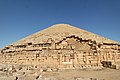
-
 Numidian mausoleum of Dougga, example of a "tower tomb" (2nd century BC)
_-_Ruinen_der_antiken_Stadt_Garma_02.jpg)


After the Muslim conquest
[edit]After the Arab-Muslim conquest of the Maghreb in the 7th and early 8th centuries, Islamic architecture developed in the region. Various dynasties, either based in North Africa or beyond it, contributed to the architecture of the region, including the Aghlabids, the Fatimids, and the Umayyads of Cordoba. In addition to the general "Moorish" style prevalent in North Africa during the Islamic period, some architectural styles and structures in North Africa are distinctively associated with areas that have maintained strong Berber populations and cultures, including but not limited to the Atlas Mountain regions of Morocco, the Aurès and M'zab regions of Algeria, and southern Tunisia.[224] They do not form one single architectural style but rather a diverse variety of local vernacular styles.[224] Berber ruling dynasties also contributed to the formation and patronage of western Islamic art and architecture through their political domination of the region between the 11th and 16th centuries (during the rule of the Almoravids, Almohads, Marinids and Hafsids, among others).[225][224][226]
In Morocco, the largely Berber-inhabited rural valleys and oases of the Atlas and the south are marked by numerous kasbahs (fortresses) and ksour (fortified villages), typically flat-roofed structures made of rammed earth and decorated with local geometric motifs, as with the famous example of Ait Benhaddou.[224][227][228] Likewise, southern Tunisia is dotted with hilltop ksour and multi-story fortified granaries (ghorfa), such as the examples in Medenine and Ksar Ouled Soltane, which are typically built with loose stone bound by a mortar of clay.[224] Fortified granaries also exist in the Aures region of Algeria,[229] or in the form of agadirs of which numerous examples can be found in Morocco.[224][230] The island of Jerba in Tunisia, traditionally dominated by Ibadi Berbers,[231] has a traditional style of mosque architecture that consists of low-lying structures built in stone and covered in whitewash. Their prayer halls are domed and they have short, often round minarets.[231][224] The mosques are often described as "fortified mosques" because the island's flat topography made it vulnerable to attacks and as a result the mosques were designed in part to act as watch posts along the coast or in the countryside.[232][233] The M'zab region of Algeria (e.g. Ghardaïa) also has distinctive mosques and houses that are completely whitewashed, but built in rammed earth. The structures here also make frequent use of domes and barrel vaults. Unlike in Jerba, the distinctive minarets in this region are tall and have a square base, tapering towards the end and crowned with "horn"-like corners.[231][224]
-

-
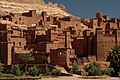 The ksar of Aït Benhaddou in Morocco
 -
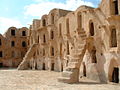 Ksar Ouled Soltane, an example of a multi-level ghorfa in southern Tunisia
 -
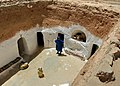 Subterranean house in Matmata (Tunisia)
 -
 The Fadhloun Mosque in Djerba (Tunisia), an example of a traditional "fortified mosque"
 -


.jpg)


Culture and arts
[edit]Social context
[edit]The traditional social structure of the Berbers has been tribal. A leader is appointed to command the tribe. In the Middle Ages, many women had the power to govern, such as Dihya and Tazoughert Fatma in the Aurès Mountains, Tin Hinan in the Hoggar, and Chemci in Aït Iraten. Lalla Fatma N'Soumer was a Berber woman in Kabylie who fought against the French.
The majority of Berber tribes currently have men as heads of the tribe. In Algeria, the el Kseur platform in Kabylie gives tribes the right to fine criminal offenders. In areas of Chaoui, tribal leaders enact sanctions against criminals.[234] The Tuareg have a king who decides the fate of the tribe and is known as Amenokal; it is a very hierarchical society. The Mozabites are governed by the spiritual leaders of Ibadism and lead communal lives. During the crisis of Berriane between the Maliki and Ibadite movements, the heads of each tribe began talks to end the crisis and resolved the problem.[235][full citation needed]

In marriages, the man usually selects the woman, and depending on the tribe, the family often makes the decision. In contrast, in the Tuareg culture, the woman chooses her future husband. The rites of marriage are different for each tribe. Families are either patriarchal or matriarchal, according to the tribe.[236]
Traditionally, men take care of livestock. They migrate by following the natural cycle of grazing, and seeking water and shelter. They are thus assured of an abundance of wool, cotton, and plants used for dyeing. For their part, women look after the family and handicrafts – first for their personal use, and secondly for sale in the souqs in their locality.
Visual arts
[edit]The Berber tribes traditionally weave kilims (tapestry-woven carpets), whose designs maintain the traditional appearance and distinctiveness of the region of origin of each tribe, which has in effect its own repertoire of drawings. The plain weave textile designs include a wide variety of stripes and, more rarely, geometrical patterns such as triangles and diamonds. Additional decorations such as sequins or fringes, are typical of Berber weave in Morocco. The nomadic and semi-nomadic lifestyle of the Berbers is suitable for weaving kilims.[237] In Algeria, the cloak-like kachabia is typical Berber masculine clothing.
Traditional Berber jewelry is a style of jewellery, originally worn by women and girls of different rural Berber groups of Morocco, Algeria and other North African countries. It is usually made of silver and includes elaborate triangular plates and pins, originally used as clasps for garments, necklaces, bracelets, earrings and similar items. In modern times, these types of jewellery are produced also in contemporary variations and sold as a commercial product of ethnic-style fashion.[238]
From December 2004 to August 2006, the Peabody Museum of Archeology and Ethnology at Harvard University presented the exhibition Imazighen! Beauty and Artisanship in Berber Life, curated by Susan Gilson Miller and Lisa Bernasek, with an accompanying catalogue on artifacts from the Berber regions Kabylia in northeastern Algeria, the Rif mountains of northeastern Morocco and the Tuareg regions of the Algerian Sahara.[239][240]
From June to September 2007, the Musée du quai Branly in Paris showed an exhibition on the history of traditional ceramics in Algeria, titled Ideqqi, art de femmes berbères (Art of Berber women), and published an accompanying catalogue. The exhibition highlighted the originality of these pieces compared to urban earthenware, underlining their African roots as well as close relationship with the ancient art of the Mediterranean.[241]
-
 Berber henna decoration
 -
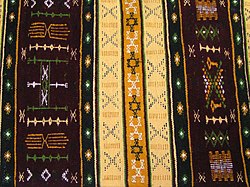 Detail of a traditional Berber carpet
 -
 Algerian Berber calendar
 -
 Ancient Tifinagh scripts in Algeria
 -
 Jewelry from Kabylia region, Algeria


Cuisine
[edit] |
Berber cuisine is a traditional cuisine that has evolved little over time. It differs from one area to another between and within Berber groups.
Principal Berber foods are:
- Couscous, a semolina staple dish
- Tajine, a stew made in various forms
- Pastilla, a meat pie traditionally made with squab (fledgling pigeon); today often made using chicken
- Bread made with traditional yeast
- Bouchiar, fine yeastless wafers soaked in butter and natural honey
- Bourjeje, pancake containing flour, eggs, yeast, and salt
- Baghrir, light and spongy pancake made from flour, yeast, and salt; served hot and soaked in butter and tment ('honey').
- Tahricht, sheep offal (brains, tripe, lungs, and heart) rolled up with the intestines on an oak stick and cooked on embers in specially designed ovens. The meat is coated with butter to make it even tastier. This dish is served mainly at festivities.
Although they are the original inhabitants of North Africa, and in spite of numerous incursions by Phoenicians, Romans, Byzantines, Ottomans, and French, Berber groups lived in very contained communities. Having been subject to limited external influences, these populations lived free from acculturating factors.


Music
[edit] |

Berber music has a wide variety of regional styles. The best known are Moroccan music, the popular Gasba, Kabyle and Chawi music of Algeria, and the widespread Tuareg music of Burkina Faso, Niger, and Mali. Instruments used include the bendir (large drums) and the guembri (a lute). There are three varieties of Berber folk music: village music, ritual music, and the music performed by professional musicians. Village music is performed collectively for dancing, including ahidus and ahouach dances, which each begin with a chanted prayer. Ritual music is performed at regular ceremonies to celebrate marriages and other important life events, and is also used as protection against evil spirits. Professional musicians (imdyazn) travel in groups of four, led by a poet (amydaz). The amydaz recites improvised poems, often accompanied by drums and a rabab (a one-stringed fiddle), along with a bou oughanim who plays a double clarinet and acts as a clown for the group. The Chleuh Berbers have professional musicians called rwais who play in ensembles consisting of lutes, rababs, and cymbals, with any number of vocalists. The leader, or rayes, leads the group in its music and choreography. These performances begin with an instrumental astara on rabab, which also gives the notes of the melody which follows. The next phase is the amarg, or sung poetry, and then ammussu, a danced overture, tammust, an energetic song, aberdag, a dance, and finally the rhythmically swift tabbayt. There is some variation in the order of the presentation, but the astara is always at the beginning, and the tabbayt always at the end.

Traditional Berber festivals include Fantasia, Imilchil marriage festival and Udayn n Acur.
Role in tourism
[edit]In recent decades, Berber communities and culture have become involved in the tourism industries of some North African countries, such as Morocco and Tunisia.[242][243] Images and descriptions of Berber culture play a central role in the tourism industry of Morocco, where they are prominently featured in the marketing of products and locations.[244][245]
See also
[edit]Notes
[edit]- ^ Arabic: بربر, romanized: Barbar.
- ^ /ˌæməˈziːk, -iːx/ AM-ə-ZEEK(H); Arabic: أمازيغ, romanized: Amāzīgh; Berber languages: Amaziɣ (ⴰⵎⴰⵣⵉⵖ or ⵎⵣⵗ), singular.
- ^ Berber languages: Imaziɣen (ⵉⵎⴰⵣⵉⵖⵏ or ⵎⵣⵗⵏ), plural.
- ^ Warmington uses "Libyans of Tunisia" (an anachronistic term) on page 46; compare with page 61 (citing Herodotus, Diodorus Siculus, and Polybius).
- ^ "Pro-Berber" viewpoints (contrary to prevailing "Punicophilia" literature) are presented by Abdullah Laroui in his L'Histoire du Maghreb: Un essai de synthèse.[104][94]: 42–44
- ^ The Picards, however, remark that the resulting Greek defeat showed "how strong was the hold of Carthage over her African territory".
- ^ Warmington page 83, citing Plutarch (46–120 CE), Moralia 799D.
References
[edit]- ^ Williams, Victoria R. (24 February 2020). Indigenous Peoples: An Encyclopedia of Culture, History, and Threats to Survival [4 volumes]. Bloomsbury Publishing USA. ISBN 979-8-216-10219-9.
However, there may be around twenty-five million Berbers in total, with fifteen million Berbers living in Morocco; six million in Algeria; one million each in Libya, Mali, and Niger; thirty thousand in Egypt; one hundred thousand in Tunisia; and ten thousand in Mauritania.
- ^ Steven L. Danver (2015). Native Peoples of the World: An Encyclopedia of Groups, Cultures and Contemporary Issues. Routledge. p. 23. ISBN 978-1-317-46400-6.
The Berber population numbers approximately 36 million people.
- ^ "Berber people". Retrieved 17 August 2016.
- ^ a b c "North Africa's Berbers get boost from Arab Spring". Fox News. 5 May 2012. Retrieved 8 December 2013.
- ^ Bhatia, Tej K.; Ritchie, William C. (2006). The Handbook of Bilingualism. John Wiley & Sons. p. 860. ISBN 0-631-22735-0. Retrieved 16 July 2016.
- ^ Rubin, Barry (17 March 2015). The Middle East: A Guide to Politics, Economics, Society and Culture. Routledge. p. 554. ISBN 978-1-317-45578-3.
- ^ "Berber Marginalization in North Africa Fuels Identity Movements". The MENA Chronicle | Fanack. Retrieved 11 February 2025.
- ^ "Berber | people | Britannica.com". 4 July 2018. Archived from the original on 4 July 2018. Retrieved 15 December 2022.
- ^ [6][7][8]
- ^ Rosen, Lawrence (2 December 2015). Two Arabs, a Berber, and a Jew: Entangled Lives in Morocco. University of Chicago Press. p. 202. ISBN 978-0-226-31751-9.
He accepts the undocumented estimate that nearly half the Moroccan population—perhaps as many as fifteen million people—identify themselves as Berber...
- ^ Williams, Victoria R. (24 February 2020). Indigenous Peoples: An Encyclopedia of Culture, History, and Threats to Survival [4 volumes]. Bloomsbury Publishing USA. ISBN 979-8-216-10219-9.
However, there may be around twenty-five million Berbers in total, with fifteen million Berbers living in Morocco; six million in Algeria; one million each in Libya, Mali, and Niger; thirty thousand in Egypt; one hundred thousand in Tunisia; and ten thousand in Mauritania.
- ^ "AP PHOTOS: Berbers live on in Morocco's Atlas Mountains". AP News. 3 March 2016. Retrieved 11 February 2025.
At least 15 million Moroccans are Amazigh, divided into different groups according to their dialects.
- ^ Ennaji, Moha (20 January 2005). Multilingualism, Cultural Identity, and Education in Morocco. Springer Science & Business Media. p. 72. ISBN 978-0-387-23979-8.
- ^ [10][11][12][13]
- ^ Rubin, Barry (17 March 2015). The Middle East: A Guide to Politics, Economics, Society and Culture. Routledge. p. 554. ISBN 978-1-317-45578-3.
- ^ a b c "Les Berbères en Afrique du Nord". Chaire pour le développement de la recherche sur la culture d'expression française en Amérique du Nord., Université Laval Québec, 2016.
- ^ "Algeria reinstates term limit and recognises Berber language". BBC News. 7 February 2016.
- ^ "The World Factbook". Central Intelligence Agency. Retrieved 8 October 2016., Niger: 11% of 23.6 million
- ^ Les langues de France: un patrimoine méconnu, une réalité vivante Archived 29 September 2014 at the Wayback Machine, originally published by CultureComm unication.gouv.fr.
- ^ a b "Mali". The World Factbook. 5 November 2021.
- ^ Zurutuza, Karlos, Libya's Berbers fear ethnic conflict, Aljazeera, retrieved 11 November 2021
- ^ Truong, Nicolas (23 March 2016). "Au cœur des réseaux djihadistes européens, le passé douloureux du Rif marocain". Le Monde.fr (in French). ISSN 1950-6244. Retrieved 16 November 2016.
- ^ "The World Factbook". Central Intelligence Agency. Retrieved 12 October 2021., Burkina Faso: 1.9% of 21.4 million
- ^ Williams, Victoria R. (24 February 2020). Indigenous Peoples: An Encyclopedia of Culture, History, and Threats to Survival [4 volumes]. Bloomsbury Publishing USA. ISBN 979-8-216-10219-9.
However, there may be around twenty-five million Berbers in total, with fifteen million Berbers living in Morocco; six million in Algeria; one million each in Libya, Mali, and Niger; thirty thousand in Egypt; one hundred thousand in Tunisia; and ten thousand in Mauritania.
- ^ Government of Canada, Statistics Canada (8 February 2017). "Census Profile, 2016 Census – Canada". www12.statcan.gc.ca.
- ^ Williams, Victoria R. (24 February 2020). Indigenous Peoples: An Encyclopedia of Culture, History, and Threats to Survival [4 volumes]. Bloomsbury Publishing USA. ISBN 979-8-216-10219-9.
However, there may be around twenty-five million Berbers in total, with fifteen million Berbers living in Morocco; six million in Algeria; one million each in Libya, Mali, and Niger; thirty thousand in Egypt; one hundred thousand in Tunisia; and ten thousand in Mauritania.
- ^ Williams, Victoria R. (24 February 2020). Indigenous Peoples: An Encyclopedia of Culture, History, and Threats to Survival [4 volumes]. Bloomsbury Publishing USA. ISBN 979-8-216-10219-9.
However, there may be around twenty-five million Berbers in total, with fifteen million Berbers living in Morocco; six million in Algeria; one million each in Libya, Mali, and Niger; thirty thousand in Egypt; one hundred thousand in Tunisia; and ten thousand in Mauritania.
- ^ Moshe Shokeid: The Dual Heritage: Immigrants from the Atlas Mountains in an Israeli Village. Manchester University Press, 1971.
- ^ US Census Bureau. "The Arab Population: 2000" (PDF). Archived (PDF) from the original on 13 January 2004. Retrieved 5 May 2013.
- ^ a b Miller, Duane Alexander; Johnstone, Patrick (2015). "Believers in Christ from a Muslim Background: A Global Census". Interdisciplinary Journal of Research on Religion. 11 (10). ISSN 1556-3723. Retrieved 27 March 2016 – via academia.edu.
- ^ (in French) Sadek Lekdja: Christianity in Kabylie, Radio France Internationale, 7 mai 2001 Archived 18 October 2017 at the Wayback Machine.
- ^ Blench, Roger (2006). Archaeology, Language, and the African Past. African Archaeology Series. AltaMira Press. ISBN 978-0-7591-0466-2.
- ^ Diakonoff, Igor (1 October 1998). "The Earliest Semitic Society: Linguistic Data". Journal of Semitic Studies. XLIII (2): 209–219. doi:10.1093/jss/XLIII.2.209. ISSN 0022-4480.
- ^ Shirai, Noriyuki. The Archaeology of the First Farmer-Herders in Egypt: New Insights into the Fayum Epipalaeolithic and Neolithic. Leiden University Press, 2010. ISBN 978-9087280796.
- ^ Ehret, C; Keita, SOY; Newman, P (2004). "The Origins of Afroasiatic a response to Diamond and Bellwood (2003)". Science. 306 (5702): 1680. doi:10.1126/science.306.5702.1680c. PMID 15576591. S2CID 8057990.
- ^ Bender ML (1997), Upside Down Afrasian, Afrikanistische Arbeitspapiere 50, pp. 19–34
- ^ "Militarev A (2005) Once more about glottochronology and comparative method: the Omotic-Afrasian case, Аспекты компаративистики – 1 (Aspects of comparative linguistics – 1). FS S. Starostin. Orientalia et Classica II" (PDF). Moscow. pp. 339–408.
- ^ Andrews, Jonathan (2019). The Missiology behind the Story: Voices from the Arab World. Langham Publishing. ISBN 978-1-78368-599-8.
Berber: A collective term for the indigenous peoples of North Africa who predate the arrival of Arabs during the expansion of the Arab empire in the seventeenth century.
- ^ Skutsch, Carl (2013). Encyclopedia of the World's Minorities. Routledge. p. 211. ISBN 978-1-135-19388-1.
Berber is a generic name given to numerous heterogenous ethnic groups that share similar cultural, political, and economic practices.
- ^ a b Fields, Nic (2011). Roman Conquests: North Africa. Casemate Publishers. ISBN 978-1-84884-704-0.
It must be said that modern Berbers are a very diverse group of peoples whose main connections are linguistic.
- ^ a b c "Berber | Definition, People, Languages, & Facts". www.britannica.com. Retrieved 13 December 2022.
- ^ Baldauf, Richard B.; Kaplan, Robert B. (2007). Language Planning and Policy in Africa. Multilingual Matters. p. 49. ISBN 978-1-84769-011-1.
Most languages of the Berber branch are mutually unintelligible.
- ^ a b Aïtel, Fazia (2014). We are Imazigen: the development of Algerian Berber identity in twentieth-century literature and culture. Gainesville, FL: University of Florida Press. ISBN 978-0-8130-4895-6. OCLC 895334326.
- ^ a b Vourlias, Christopher (25 January 2010). "Moroccan minority's net gain". Variety. Vol. 417, no. 10. Penske Business Media, LLC.
- ^ "Berber". Encyclopædia Britannica. Retrieved 2 May 2015.
- ^ a b Project, Joshua. "Berber, Siwa in Egypt". joshuaproject.net. Retrieved 1 June 2022.
- ^ Margaret M. Vale (2015). Siwa: Jewelry, Costume, and Life in an Egyptian Oasis. American University in Cairo Press.
- ^ History of the Amazigh People study.com
- ^ Fischer-Lichte, Erika; Sugiera, Małgorzata; Jost, Torsten; Hartung, Holger; Soltani, Omid (2022). Entangled Performance Histories: New Approaches to Theater Historiography. Taylor & Francis. ISBN 978-1-000-82592-3.
- ^ a b "Berber | Definition, People, Languages, & Facts | Britannica". 23 May 2023.
- ^ a b Holes, Clive (2018). Arabic Historical Dialectology: Linguistic and Sociolinguistic Approaches. Oxford University Press. p. 42. ISBN 978-0-19-100506-0.
- ^ Probst, Peter; Spittler, Gerd (2004). Between Resistance and Expansion: Explorations of Local Vitality in Africa. LIT Verlag Münster. p. 71. ISBN 978-3-8258-6980-9.
It is difficult to speak of any cultural unity among the Berbers. Historically the indigenous Berbers of Morocco did not see themselves as a single linguistic unit, nor was there any greater "Berber community".
- ^ a b c Goodman, Jane E. (2005). Berber Culture on the World Stage: From Village to Video. Indiana University Press. pp. 7 and 11. ISBN 978-0-253-21784-4.
- ^ Maddy-Weitzman, Bruce (2011). The Berber Identity Movement and the Challenge to North African States. University of Texas Press. p. 2. ISBN 978-0-292-74505-6.
- ^ a b c d e Maddy-Weitzman, Bruce (2011). The Berber Identity Movement and the Challenge to North African States. University of Texas Press. pp. 7–9. ISBN 978-0-292-74505-6.
- ^ . Encyclopædia Britannica. Vol. 3 (11th ed.). 1911. pp. 764–767.
- ^ Ilahiane, Hsain (2017). Historical dictionary of the Berbers (Imazighen) (2nd ed.). Lanham, Maryland: Rowman & Littlefield. ISBN 978-1-4422-8182-0. OCLC 966314885.
- ^ Tressy Arts, ed. (2014). Oxford Arabic dictionary: Arabic-English · English-Arabic (First ed.). Oxford: Oxford University Press. pp. 979, 990. ISBN 978-0-19-958033-0. OCLC 881018992.
- ^ Maddy-Weitzman, Bruce (2011). The Berber Identity Movement and the Challenge to North African States. University of Texas Press. pp. 14–17. ISBN 978-0-292-74505-6.
- ^ ""Respecting Identity: Amazigh Versus Berber"". Society for Linguistic Anthropology. 23 September 2019. Archived from the original on 25 October 2022. Retrieved 25 October 2022.
- ^ a b c d Stepanova, Anastasia (15 June 2018). "Who Conquered Spain? The Role of the Berbers in the Conquest of the Iberian Peninsula". Written Monuments of the Orient. 4 (1): 78–87. doi:10.17816/wmo35149. ISSN 2410-0145.
- ^ a b Chaker, S. (1 September 1986). "Amaziɣ (le/un Berbère)". Encyclopédie berbère (in French) (4): 562–568. doi:10.4000/encyclopedieberbere.2465. ISSN 1015-7344.
- ^ Gsell, Stéphane (1929). Histoire ancienne de l'Afrique du Nord. Tome 5 (in French). Paris: Hachette. p. 119.
- ^ Hureiki, Jacques (1 January 2003). Essai sur les origines des Touaregs: herméneutique culturelle des Touaregs de la région de Tombouctou (in French). KARTHALA Editions. ISBN 978-2-84586-442-9.
- ^ Desanges, Jehan (1962). Catalogue des tribus africaines de l'antiquité classique à l'ouest du Nil (in French). Dakar: Université de Dakar. p. 63.
- ^ Laredo, Abraham Isaac (1954). Bereberes y Hebreos en Marruecos: sus orígenes, según las leyendas, tradiciones y fuentes hebraicas antiguas (in Spanish). Instituto de Estudios Africanos, Consejo Superior de Investigaciones Científicas.
- ^ Stepanova, Anastasia V. (5 September 2018). "Origin of the Berber Tribal Confederation of Ṣanhādja". Oriental Studies (in Russian). 11 (2): 2–13. ISSN 2619-1008.
- ^ Maddy-Weitzman, Bruce (2022). Amazigh politics in the wake of the Arab Spring. Austin: University of Texas Press. ISBN 978-1-4773-2482-0. OCLC 1255524815.
- ^ Zimmermann, K. (2008). "Lebou/Libou". Encyclopédie berbère. Vol. 28–29 | Kirtēsii – Lutte. Aix-en-Provence: Edisud. pp. 4361–4363. doi:10.4000/encyclopedieberbere.319.
- ^ Eur. The Middle East and North Africa: Pg 156. Psychology Press. ISBN 978-1-85743-132-2.
- ^ Walmsley, Hugh Mulleneux (1858). "Sketches of Algeria During the Kabyle War By Hugh Mulleneux Walmsley: Pg 118".
- ^ Wysner, Glora M. (30 January 2013). The Kabyle People By Glora M. Wysner. Read Books. ISBN 978-1-4474-8352-6.
- ^ The Encyclopedia Americana, Volume 1: Pg 568. Grolier. 1990. ISBN 978-0-7172-0121-1.
- ^ "The art journal London, Volume 4: Pg 45". 1865.
- ^ Field, Henry Martyn (1893). "The Barbary Coast By Henry Martyn Field: Pg 93".
- ^ Hsain Ilahiane (17 July 2006). Historical Dictionary of the Berbers (Imazighen). Scarecrow Press. p. 112. ISBN 978-0-8108-6490-0.
- ^ Tiliouine, Habib; Estes, Richard J., eds. (2016). The State of Social Progress of Islamic Societies: Social, Economic, Political, and Ideological Challenges. Springer. p. 115. ISBN 978-3-319-24772-4.
- ^ Histoire de l'émigration kabyle en France au XXe siècle: réalités culturelles ... De Karina Slimani-Direche
- ^ Les cultures du Maghreb. Maria Àngels Roque, Paul Balta, Mohammed Arkoun
- ^ Dialogues d'histoire ancienne à l'Université de Besançon, Centre de recherches d'histoire ancienne
- ^ Ibn al-Nadim. Al-Fiḥrist, Book I, pp. 35–36
- ^ a b Ibn Khaldun (1925). Histoire des Berbères et des dynasties musulmanes de l'Afrique septentrionale (in French). Vol. 1. Translated by de Slane, William MacGuckin. Paris: P. Geuthner. p. 176. OCLC 556514510.
- ^ a b "The Berbers", BBC World Service | The Story of Africa
- ^ J. Desanges, "The proto-Berbers", pp. 236–245, especially p. 237, in General History of Africa, vol. II: Ancient Civilizations of Africa (UNESCO 1990).
- ^ Mário Curtis Giordani, História da África. Anterior aos descobrimentos. Editora Vozes, Petrópolis (Brasil) 1985, pp. 42f., 77f. Giordani references Bousquet, Les Berbères (Paris 1961).
- ^ Trombetta, Beniamino; D'Atanasio, Eugenia; Massaia, Andrea; Ippoliti, Marco; Coppa, Alfredo; Candilio, Francesca; Coia, Valentina; Russo, Gianluca; Dugoujon, Jean-Michel; Moral, Pedro; Akar, Nejat; Sellitto, Daniele; Valesini, Guido; Novelletto, Andrea; Scozzari, Rosaria; Cruciani, Fulvio (24 June 2015). "Phylogeographic Refinement and Large Scale Genotyping of Human Y Chromosome Haplogroup E Provide New Insights into the Dispersal of Early Pastoralists in the African Continent". Genome Biology and Evolution. 7 (7): 1940–1950. doi:10.1093/gbe/evv118. PMC 4524485. PMID 26108492.
- ^ Henn, Brenna M.; Botigué, Laura R.; Gravel, Simon; Wang, Wei; Brisbin, Abra; Byrnes, Jake K.; Fadhlaoui-Zid, Karima; Zalloua, Pierre A.; Moreno-Estrada, Andres; Bertranpetit, Jaume; Bustamante, Carlos D.; Comas, David (12 January 2012). "Genomic Ancestry of North Africans Supports Back-to-Africa Migrations". PLOS Genetics. 8 (1) e1002397. doi:10.1371/journal.pgen.1002397. PMC 3257290. PMID 22253600.
- ^ Hodgson, Jason A.; Mulligan, Connie J.; Al-Meeri, Ali; Raaum, Ryan L. (12 June 2014). "Early Back-to-Africa Migration into the Horn of Africa". PLOS Genetics. 10 (6) e1004393. doi:10.1371/journal.pgen.1004393. PMC 4055572. PMID 24921250.; "Supplementary Text S1: Affinities of the Ethio-Somali ancestry component". PLOS Genetics. doi:10.1371/journal.pgen.1004393.s017.
- ^ Kefi, R.; Bouzaid, E.; Stevanovitch, A.; Beraud-Colomb, E. "Mitochondrial DNA and Phylogenetic Analysis of Prehistoric North African Populations" (PDF). International Society for Applied Biological Sciences. Archived from the original (PDF) on 11 March 2016. Retrieved 21 April 2016.
- ^ Secher, Bernard; Fregel, Rosa; Larruga, José M.; Cabrera, Vicente M.; Endicott, Phillip; Pestano, José J.; González, Ana M. (19 May 2014). "The history of the North African mitochondrial DNA haplogroup U6 gene flow into the African, Eurasian and American continents". BMC Evolutionary Biology. 14 (109): 109. Bibcode:2014BMCEE..14..109S. doi:10.1186/1471-2148-14-109. PMC 4062890. PMID 24885141.
- ^ a b Fregel, Rosa; Méndez, Fernando L.; Bokbot, Youssef; Martín-Socas, Dimas; Camalich-Massieu, María D.; Santana, Jonathan; Morales, Jacob; Ávila-Arcos, María C.; Underhill, Peter A.; Shapiro, Beth; Wojcik, Genevieve; Rasmussen, Morten; Soares, Andre E. R.; Kapp, Joshua; Sockell, Alexandra; Rodríguez-Santos, Francisco J.; Mikdad, Abdeslam; Trujillo-Mederos, Aioze; Bustamante, Carlos D. (12 June 2018). "Ancient genomes from North Africa evidence prehistoric migrations to the Maghreb from both the Levant and Europe". Proceedings of the National Academy of Sciences. 115 (26): 6774–6779. Bibcode:2018PNAS..115.6774F. bioRxiv 10.1101/191569. doi:10.1073/pnas.1800851115. PMC 6042094. PMID 29895688.
- ^ a b c d e f g h i Warmington, Brian Herbert (1969) [1960]. Carthage (2nd ed.). London: Robert Hale. p. 46.
- ^ Sallust (86–35), Bellum Iugurthinum (c. 42 BC), 19–20, translated by S. A. Handford as The Jugurthine War (Penguin 1963), p. 55f.
- ^ a b c Laroui, Abdallah (19 April 2016) [1977]. The History of the Maghrib: An Interpretive Essay. Translated by Manheim, Ralph. Princeton University Press. pp. 55, 60, 65. ISBN 978-0-691-63585-9.
- ^ a b Brett, Michael; Fentress, E. W. B. (1996). The Berbers. Blackwell Publishing. pp. 24f. ISBN 978-0-631-16852-2.
- ^ a b c d e Picard, Gilbert Charles; Picard, Colette (1968). The Life and Death of Carthage: A Survey of Punic History and Culture from Its Birth to Its Final Tragedy. Sidgwick & Jackson. p. 15ff.
- ^ Cf. Perkins, Tunisia (1986), p. 15.
- ^ The 22nd Dynasty. Erik Hornung, History of Ancient Egypt. An introduction ([1978]; Cornell University 1999) at 128–131.
- ^ Jamil M. Abun-Nasr, A History of the Maghrib (Cambridge University 1971) at 20.
- ^ E.g., Soren, Ben Khader, Slim, Carthage. Uncovering the mysteries and splendours of ancient Tunisia (New York: Simon & Schuster 1990) at 18–20, observes imperial pretensions.
- ^ The Wadi Majardah was anciently called the Bagradas. Lancel, Carthage (1992, 1995), p. 270.
- ^ B. H. Warmington, "The Carthaginian Period" at 246–260, 248–249, in General History of Africa, volume II. Ancient Civilizations of Africa (UNESCO 1981, 1990), edited by G. Mokhtar.
- ^ Cf., Richard Miles, Carthage must be destroyed (NY: Viking 2010), p. 80.
- ^ Laroui, Abdullah (1970). L'Histoire du Maghreb: Un essai de synthèse (in French). Paris: Librairie François Maspero.
- ^ Cf., Le Berbère, lumière de l'Occident (Nouvelles Editions, 1984).
- ^ The Romans also met with instances of "disloyalty" by Berber leaders, witness their long war against Jugurtha (c. 160 – c. 104 BC), the Berber King of Numidia. Sallust (86–c. 35 BC), The Jugurthine War (Penguin 1963), translated by Handford.
- ^ Charles-Picard, Daily life in Carthage (Paris: Hachette 1958; London: Geo. Allen & Unwin 1961), p. 123. The Khamessat contract "gave the landowner four-fifths of the income".
- ^ Polybius (203–120), The Histories at I, 72.
- ^ The Mercenary revolt occurred after the First Punic War (see below).
- ^ a b R. Bosworth Smith, Carthage and the Carthaginians (London: Longmans, Green 1878, 1908) at 45–46
- ^ Compare the contradictions described in Brett & Fentress, The Berbers (1996) at 24–25 (Berber adoption of elements of Punic culture), 49–50 (Berber persistence in their traditional belief).
- ^ Phillips, Andrew. "The Last Christians of North-West Africa: Some Lessons For Orthodox Today". Retrieved 2 May 2015.
- ^ "Berbers: ... The best known of them were the Roman author Apuleius, the Roman emperor Septimius Severus, and St. Augustine", Encyclopedia Americana, 2005, v.3, p.569
- ^ Appian, The Punic Wars, 106
- ^ Ibn Khaldun. Histoire des Berbères et des dynasties musulmanes de l'Afrique septentrionale (in French). Translated by de Slane, William MacGuckin.
- ^ Ibn Khaldun (1852). "Introduction". Histoire des Berbères et des dynasties musulmanes de l'Afrique septentrionale (in French). Vol. 1. Translated by de Slane, William MacGuckin. Imprimerie du Gouvernement. p. ii.
- ^ Hrbek, Ivan (1992). Africa from the Seventh to the Eleventh Century. Unesco. International Scientific Committee for the Drafting of a General History of Africa. J. Currey. p. 34. ISBN 0-85255-093-6.
- ^ European slaves in North Africa, Washington Times, 10 March 2004
- ^ "Mahdia: Historical Background". Commune-mahdia.gov.tn. Archived from the original on 9 November 2013. Retrieved 15 July 2012.
- ^ "MAHDIA:Finger pointing at the sea". Lexicorient.com. Archived from the original on 26 December 2016. Retrieved 15 July 2012.
- ^ a b c d e f g h i j k l m n o p q r s t u v w x y z aa ab ac ad ae af ag ah ai aj ak al am an ao ap aq ar as at au av aw Collins, Roger (1994). Arab Conquest of Spain, 710–797 (Paperback ed.). Blackwell. p. 97.
- ^ a b c d e f g h i j k l m n o p q r s t u v w x y z aa ab ac ad ae af ag ah ai aj ak al am an ao ap aq ar as at au av aw ax ay Collins, Roger (2014). Caliphs and Kings: Spain, 796–1031 (Paperback ed.). Wiley Blackwell. p. 9.
- ^ Guichard, Pierre (1973). Tribus arabes et berbères en al-Andalus. Paris: De Gruyter Mouton.
- ^ Guichard, Pierre (1976). Al-andalus: estructura antropológica de una sociedad islámica en occidente (Spanish translation of French original ed.). Barcelona: Barral Editores.
- ^ Sénac, Philippe (2007). Villes et campagnes de Tarraconaise et d'al-Andalus (VIe-XIe siècle): la transition. Toulouse: Presses universitaires du Midi. pp. 114–124.
- ^ Sénac, Philippe (2007). Villes et campagnes de Tarraconaise et d'al-Andalus (VIe-XIe siècle): la transition. Toulouse: Presses universitaires du Midi. pp. 97–138.
- ^ Izquierdo Bonito, Ricardo (1994). Excavaciones en la ciudad hispanomusulmana de Vascos (Navalmoralejo, Toledo): campañas 1983–1988 [Excavations in the Spanish-Muslim city of Vascos (Navalmoralejo, Toledo): 1983–1988] (in Spanish). Toledo: Servicio de Publicaciones, Junta de Comunidades de Castilla-La Mancha. ISBN 978-84-7788-301-2.
- ^ Nanjira, Daniel Don (2010). African Foreign Policy and Diplomacy from Antiquity to the 21st Century, Volume 1: Pg 92. Bloomsbury Academic. ISBN 978-0-313-37982-6.
- ^ Fage, J. D. (1958). "An Atlas of African History by J. D. Fage: Pg 11".
- ^ Gall, Timothy L.; Hobby, Jeneen (2009). Worldmark Encyclopedia of Cultures and Daily Life: Africa: Pg 329. ISBN 978-1-4144-4883-1.
- ^ "Algeria, a Country StudyBy American University (Washington, D.C.). Foreign Area Studies: Pg 15". 1979.
- ^ Anales Palatinos del Califa de Córdoba al-Hakam II, por 'Isa ibn Ahmad al-Razi (360–364 H. = 971–975 J.C.) (Spanish translation by Emilio García Gómez ed.). Madrid. 1967. pp. 160–161.
{{cite book}}: CS1 maint: location missing publisher (link) - ^ Ibn Idhari (1901). Histoire de l'Afrique du Nord et de l'Espagne musulmane intitulée Kitab al-Bayan al-Mughrib par Ibn 'Idhari al-Marrakushi et fragments de la chronique de 'Arib (French translation by Edmond Fagnan ed.). Algiers. pp. II, ah 403.
{{cite book}}: CS1 maint: location missing publisher (link) - ^ a b c d e f g h i j Reilly, Bernard F. (1992). Contest of Christian and Muslim Spain 1031–1157 (1995 Paperback ed.). Blackwell. p. 4.
- ^ Spain – Al Andalus, Library of Congress
- ^ E. J. Brill's First Encyclopaedia of Islam, 1913–1936, Volume 4, publié par M. Th. Houtsma, Page 600
- ^ Afrique barbaresque dans la littérature française aux XVIe et XVIIe siècles (l'). Par Guy Turbet-Delof. page 25
- ^ Bernard Droz, «Insurrection de 1871: la révolte de Mokrani», dans Jeannine Verdès-Leroux (dir.), L'Algérie et la France, Paris, Robert Laffont 2009, p. 474–475 ISBN 978-2-221-10946-5
- ^ Lazreg, Marnia. "The Reproduction of Colonial Ideology: The Case of the Kabyle Berbers." Arab Studies Quarterly, vol. 5, no. 4, 1983, pp. 380–95. JSTOR, http://www.jstor.org/stable/41857696. Accessed 31 August 2022.
- ^ Islam in the West. OUP India. 2018. p. 250. ISBN 978-0-19-909366-3.
- ^ Miller, S. (2013). France and Spain in Morocco. In A History of Modern Morocco (pp. 88–119). Cambridge: Cambridge University Press. doi:10.1017/CBO9781139045834.008
- ^ David S. Woolman, page 96 "Rebels in the Rif", Stanford University Press
- ^ Stora, Benjamin (5 July 2004). "Veillée d'armes en Kabylie". Le Monde.fr (in French). ISSN 1950-6244. Retrieved 22 March 2017.
- ^ Le Saout, Didier; Rollinde, Marguerite (1999). Émeutes et Mouvements sociaux au Maghreb. Karthala. p. 46. ISBN 978-2-865-37998-9.
- ^ "Official request for an autonomy status for Kabylia". Kabylia Observer. 28 June 2004. Archived from the original on 20 February 2009. Retrieved 26 September 2021.
- ^ "Arabization". 9 October 2008. Archived from the original on 11 January 2010.
- ^ "Mali Tuareg rebels declare independence in the north". BBC News. 6 April 2012. Archived from the original on 30 October 2012.
- ^ "Scores arrested in connection with Morocco Rif protests". www.aljazeera.com. 30 May 2017.
- ^ a b Duri, A. A. (2012). The Historical Formation of the Arab Nation (RLE: the Arab Nation). Routledge. pp. 70–74. ISBN 978-0-415-62286-8.
- ^ el-Hasan, Hasan Afif (1 May 2019). Killing the Arab Spring. Algora Publishing. p. 82. ISBN 978-1-62894-349-8.
- ^ Farida, Benouis; Houria, Chérid; Lakhdar, Drias; Amine, Semar. An Architecture of Light. Islamic Art in Algeria. Museum With No Frontiers, MWNF (Museum Ohne Grenzen). p. 9. ISBN 978-3-902966-14-8.
- ^ "The Arabized Berbers" (PDF). International Journal of Frontier Missions. April 1997.
- ^ "Algeria", The World Factbook, Central Intelligence Agency, 14 June 2023, retrieved 19 June 2023
- ^ "Algeria reinstates term limit and recognises Berber language". BBC News. 7 February 2016. Retrieved 19 June 2023.
- ^ Zurutuza, Karlos. "Berbers fear ethnic conflict". www.aljazeera.com. Retrieved 12 December 2022.
- ^ The Report: Morocco 2012. Oxford Business Group. 2012. ISBN 978-1-907065-54-5.
- ^ Danver, Steven L. (10 March 2015). Native Peoples of the World: An Encyclopedia of Groups, Cultures and Contemporary Issues. Routledge. ISBN 978-1-317-46400-6.
- ^ "Q&A: The Berbers". 12 March 2004. Retrieved 12 December 2022.
- ^ "Morocco – Berber". World Directory of Minorities and Indigenous Peoples. 19 June 2015.
- ^ "Ethnic groups". The World Factbook. Archived from the original on 6 January 2019. Retrieved 24 January 2016.
- ^ "Historical Dictionaries: North Africa". Retrieved 2 May 2015.
- ^ a b "Berber languages | Britannica". www.britannica.com. Retrieved 30 May 2023.
- ^ a b Stolz, Christel (10 March 2015). Language Empires in Comparative Perspective. Walter de Gruyter GmbH & Co KG. p. 45. ISBN 978-3-11-040847-8.
- ^ David Prescott Barrows (2004). Berbers and Blacks: Impressions of Morocco, Timbuktu and Western Sudan. Kessinger. ISBN 978-1-4179-1742-6.
- ^ "Niger". The World Factbook. 3 March 2022.
- ^ "Q&A: Tuareg unrest". BBC. 7 September 2007. Retrieved 22 May 2016.
- ^ "Who are the Tuareg? | Art of Being Tuareg: Sahara Nomads in a Modern World". africa.si.edu. Archived from the original on 27 September 2011. Retrieved 22 May 2016.
- ^ "Chaouia". www.centrederechercheberbere.fr. Centre de Recherche Berbère. Retrieved 31 May 2023.
- ^ "Tachawit". Ethnologue Free. Retrieved 31 May 2023.
- ^ "Chenoua in Algeria". Joshua Project. Retrieved 29 May 2023.
- ^ "Shenwa". Ethnologue. 2015.
- ^ Project, Joshua. "Berber, Southern Shilha in Morocco". Joshua Project. Retrieved 31 May 2023.
- ^ "Amazigh, Djerba in Tunisia". Joshua Project. Retrieved 31 May 2023.
- ^ "Berber, Ghomara in Morocco". Joshua Project. Retrieved 31 May 2023.
- ^ Pereltsvaig, Asya (3 September 2020). Languages of the World: An Introduction. Cambridge University Press. doi:10.1017/9781108783071. ISBN 978-1-108-78307-1. Retrieved 26 August 2023.
- ^ "Algérie: situation géographique et démolinguistique". L'aménagement linguistique dans le monde (in French). Retrieved 31 May 2023.
- ^ "Berber, Mozabite in Algeria". Joshua Project. Retrieved 31 May 2023.
- ^ "Tumzabt". Ethnologue. Retrieved 31 May 2023.
- ^ PeopleGroups.org. "Nefusa Berbers of Libya". peoplegroups.org. Retrieved 31 May 2023.[permanent dead link]
- ^ Brown, E. K. (2006). Encyclopedia of Language & Linguistics. Amsterdam; Heidelberg: Elsevier. p. 155. ISBN 978-0-08-044299-0.
- ^ a b Maaroufi, Youssef. "Recensement général de la population et de l'habitat 2004". Site institutionnel du Haut-Commissariat au Plan du Royaume du Maroc (in French). Archived from the original on 5 July 2011. Retrieved 2 June 2022.
- ^ "Siwi". Ethnologue. Retrieved 31 May 2023.
- ^ "Berber, Imazighen in Morocco". Joshua Project. Retrieved 31 May 2023.
- ^ "Nafusi". Ethnologue. Retrieved 4 November 2022.
- ^ Stokes, Jamie (2009). Encyclopedia of the Peoples of Africa and the Middle East: L to Z. Infobase Publishing. p. 21. ISBN 978-1-4381-2676-0.
- ^ The Report: Algeria 2011. Oxford Business Group. 2011. p. 9. ISBN 978-1-907065-37-8.
- ^ Elkamel, Sarra; Marques, Sofia L.; Alvarez, Luis; Gomes, Veronica; Boussetta, Sami; Mourali-Chebil, Soufia; et al. (August 2021). "Insights into the Middle Eastern paternal genetic pool in Tunisia: high prevalence of T-M70 haplogroup in an Arab population". Scientific Reports. 11 (1): 15728. Bibcode:2021NatSR..1115728E. doi:10.1038/s41598-021-95144-x. PMC 8333252. PMID 34344940.
- ^ Arauna, Lara R.; Mendoza-Revilla, Javier; Mas-Sandoval, Alex; Izaabel, Hassan; Bekada, Asmahan; Benhamamouch, Soraya; et al. (February 2017). "Recent Historical Migrations Have Shaped the Gene Pool of Arabs and Berbers in North Africa". Molecular Biology and Evolution. 34 (2): 318–329. doi:10.1093/molbev/msw218. PMC 5644363. PMID 27744413.
- ^ van de Loosdrecht, Marieke; Bouzouggar, Abdeljalil; Humphrey, Louise; Posth, Cosimo; Barton, Nick; Aximu-Petri, Ayinuer; Nickel, Birgit; Nagel, Sarah; Talbi, El Hassan; El Hajraoui, Mohammed Abdeljalil; Amzazi, Saaïd; Hublin, Jean-Jacques; Pääbo, Svante; Schiffels, Stephan; Meyer, Matthias (4 May 2018). "Pleistocene North African genomes link Near Eastern and sub-Saharan African human populations". Science. 360 (6388): 548–552. Bibcode:2018Sci...360..548V. doi:10.1126/science.aar8380. ISSN 0036-8075. PMID 29545507.
- ^ Salem, Nada; van de Loosdrecht, Marieke S.; Sümer, Arev Pelin; Vai, Stefania; Hübner, Alexander; Peter, Benjamin; Bianco, Raffaela A.; Lari, Martina; Modi, Alessandra; Al-Faloos, Mohamed Faraj Mohamed; Turjman, Mustafa; Bouzouggar, Abdeljalil; Tafuri, Mary Anne; Manzi, Giorgio; Rotunno, Rocco (2 April 2025). "Ancient DNA from the Green Sahara reveals ancestral North African lineage". Nature. 641 (8061): 144–150. doi:10.1038/s41586-025-08793-7. ISSN 1476-4687. PMC 12043513.
- ^ "Sahara desert, once lush and green, was home to mysterious human lineage". Reuters. 4 April 2025.
- ^ Simões, Luciana G.; Günther, Torsten; Martínez-Sánchez, Rafael M.; Vera-Rodríguez, Juan Carlos; Iriarte, Eneko; Rodríguez-Varela, Ricardo; Bokbot, Youssef; Valdiosera, Cristina; Jakobsson, Mattias (15 June 2023). "Northwest African Neolithic initiated by migrants from Iberia and Levant". Nature. 618 (7965): 550–556. Bibcode:2023Natur.618..550S. doi:10.1038/s41586-023-06166-6. ISSN 0028-0836. PMC 10266975. PMID 37286608.
- ^ Mário Curtis Giordani, História da África. Anterior aos descobrimentos. Editora Vozes, Petrópolis (Brasil) 1985, pp. 42f., 77f. Giordani references Bousquet, Les Berbères (Paris 1961).
- ^ Pour une histoire sociale du berbèRe en France Archived 12 November 2012 at the Wayback Machine, Les Actes du Colloque Paris – Inalco, octobre 2004
- ^ a b c d Willis, Michael (2014). Politics and Power in the Maghreb: Algeria, Tunisia and Morocco from Independence to the Arab Spring. Oxford University Press. pp. 209–217. ISBN 978-0-19-936820-4.
- ^ Naylor, Phillip C. (2006). "Amazighism". Historical Dictionary of Algeria. Scarecrow Press. p. 76. ISBN 978-0-8108-6480-1.
- ^ "Amazigh: Morocco Upholds Ban of Traditional Names". Unpo. 2 November 2009.
- ^ Arbaoui, Larbi. "Morocco lifts the ban on Amazigh names". moroccoworldnew.
- ^ Zurutuza, Karlos. "The Amazigh of Libya revive their previously banned language". middleeasteye.
- ^ a b Aslan, Senem (2015). Nation Building in Turkey and Morocco. Cambridge University Press. p. 111. ISBN 978-1-107-05460-8.
- ^ "Small rebel victory big moment for persecuted Berber tribes". The Globe and Mail. Archived from the original on 25 September 2015. Retrieved 2 May 2015.
- ^ "Libya: Gaddafi Rails Against 'No Fly' Attacks and Berbers". allAfrica.com. 20 March 2011.
- ^ "Libyan rebels seize western border crossing, as fighting in mountains intensifies". The Washington Post. 21 April 2011.
- ^ "Amid a Berber Reawakening in Libya, Fears of Revenge". NYTimes. 8 August 2011. Retrieved 1 May 2014.
- ^ Campbell, George L.; King, Gareth (2020). Compendium of the World's Languages (3rd ed.). Routledge. p. 223. ISBN 978-1-136-25846-6.
- ^ Lyovin, Anatole; Kessler, Brett; Leben, William Ronald (2017). An Introduction to the Languages of the World (2nd ed.). Oxford University Press. pp. 198–208. ISBN 978-0-19-514988-3.
- ^ Strazny, Philipp (1 February 2013). Encyclopedia of Linguistics. Routledge. p. 35. ISBN 978-1-135-45522-4.
- ^ a b Mattar, Philip (2004). Encyclopedia of the Modern Middle East & North Africa: Aaronsohn-Cyril VI. Macmillan Reference USA. p. 463. ISBN 978-0-02-865769-1.
Most Berber languages have a high percentage of borrowing from Arabic, as well as from other languages.
- ^ Baldauf, Richard B.; Kaplan, Robert B. (1 January 2007). Language Planning and Policy in Africa. Multilingual Matters. ISBN 978-1-84769-011-1.
- ^ Kossmann, Maarten (18 July 2013). The Arabic Influence on Northern Berber. BRILL. p. 98. ISBN 978-90-04-25309-4.
- ^ Haspelmath, Martin; Tadmor, Uri (2009). Loanwords in the World's Languages: A Comparative Handbook. Walter de Gruyter. p. 56. ISBN 978-3-11-021843-5.
- ^ Kossmann, Maarten (29 March 2017), "Berber-Arabic Language Contact", Oxford Research Encyclopedia of Linguistics, doi:10.14711/spcol/b706487, ISBN 978-0-19-938465-5, retrieved 30 May 2023
- ^ Elimam, Abdou (2009). Du Punique au Maghribi :Trajectoires d'une langue sémito-méditerranéenne (PDF). Synergies Tunisie.
- ^ Wexler, Paul (1 February 2012). The Non-Jewish Origins of the Sephardic Jews. State University of New York Press. p. 174. ISBN 978-1-4384-2393-7.
Zavadovskij gives statistics for the percentage of Berber words in North African Muslim Arabic dialects: 10–15 percent Berber components in the Moroccan Arabic lexicon, 8–9 percent in Algerian and Tunisian Arabic, and only 2–3 percent in Libyan Arabic.
- ^ "Udayen imazighen — Les Juifs amazighs — The Amazigh Jews". Mondeberbere.com. Archived from the original on 27 October 2005.
- ^ Morning Star News (9 May 2013). "Christian Converts in Morocco Fear Fatwa Calling for Their Execution". Christianity Today.
- ^ Goverde, Rick (23 March 2015). "'House-Churches' and Silent Masses—The Converted Christians of Morocco Are Praying in Secret". Vice News. Archived from the original on 7 July 2018. Retrieved 21 June 2016.
- ^ Topper, Ilya U. (27 December 2008). "Marokkos unsichtbare Kirche" [Morocco invisible church]. Die Welt (in German). Retrieved 5 November 2015.
- ^ Bureau of Democracy, Human Rights, and Labor (14 September 2007). Tunisia: International Religious Freedom Report 2007. Archive. U.S. Department of State (Report). Retrieved 24 July 2022. This article incorporates text from this source, which is in the public domain.
- ^ Johnstone, Patrick; Miller, Duane Alexander (2015). "Believers in Christ from a Muslim Background: A Global Census". Interdisciplinary Journal of Research on Religion. 11: 8. Retrieved 30 October 2015.
- ^ a b c d e Brett, Michael; Fentress, Elizabeth (1996). The Berbers. Blackwell. ISBN 978-0-631-20767-2.
- ^ Davidson, Basil (1995). Africa in History. Simon & Schuster. p. 50. ISBN 978-0-684-82667-7.
- ^ Ennabli, Abdelmajid (2000). "North Africa's Roman art. Its future". UNESCO World Heritage Centre. Archived from the original on 12 September 2014. Retrieved 11 January 2022.
- ^ a b c d e f g h L. Golvin, « Architecture berbère », Encyclopédie berbère [online], 6 (1989), document A264, published online on 1 December 2012, accessed on 10 April 2020. URL : http://journals.openedition.org/encyclopedieberbere/2582
- ^ Bennison, Amira K. (2016). The Almoravid and Almohad Empires. Edinburgh University Press. ISBN 978-0-7486-4682-1.
- ^ Marçais, Georges (1954). L'architecture musulmane d'Occident. Paris: Arts et métiers graphiques.
- ^ Naji, Salima (2009). Art et Architectures berbères du Maroc. Editions la Croisée des Chemins. ISBN 978-2-35270-057-9.
- ^ "Ksar of Ait-Ben-Haddou". UNESCO World Heritage Centre. Retrieved 16 April 2020.
- ^ Ould-Braham, Ouahmi (1999). "Mission scientifique de Masqueray dans l'Aurès et ses dépendances (1875–1878)". Études et Documents Berbères (in French). 17 (1): 19–129. doi:10.3917/edb.017.0019. ISSN 0295-5245.
- ^ Strebe, Matthew (12 May 2018). "Collective Granaries, Morocco". Global Heritage Fund. Archived from the original on 11 January 2022. Retrieved 11 January 2022.
- ^ a b c M. Bloom, Jonathan; S. Blair, Sheila, eds. (2009). "Berber". The Grove Encyclopedia of Islamic Art and Architecture. Oxford University Press. ISBN 978-0-19-530991-1.
- ^ Polimeni, Beniamino (2018). "Describing a Unique Urban Culture: Ibadi Settlements of North Africa". In Calabrò, F.; Della Spina, L.; Bevilacqua, C. (eds.). International Symposium on New Metropolitan Perspectives. Springer. pp. 416–425. ISBN 978-3-319-92101-3.
- ^ "Sites and monuments". Djerba Museum. Archived from the original on 7 June 2021. Retrieved 7 June 2021.
- ^ "Honneur à la tribu". El Watan. Archived from the original on 18 June 2010. Retrieved 2 May 2015.
- ^ "A la une". El Watan. Archived from the original on 12 February 2018. Retrieved 2 May 2015.
- ^ "The Berber Community, a story". African American Registry. Retrieved 20 October 2021.
- ^ ABC Amazigh. An editorial experience in Algeria, 1996–2001 experience, Smaïl Medjeber
- ^ Stewart, Courtney A. (4 December 2017). "Remarkable Berber Jewelry at The Met". Metropolitan Museum of Art. Retrieved 30 January 2021.
- ^ Cynthia Becker (1 January 2010). "Artistry of the Everyday: Beauty and Craftsmanship in Berber Art Lisa Bernasek Susan G. Miller". The International Journal of African Historical Studies. 43 (1): 200–202. JSTOR 25741422.
- ^ Bernasek, Lisa (2008). Artistry of the everyday: beauty and craftsmanship in Berber art. Cambridge Mass: Peabody Museum Press, Harvard University. pp. 60–111. ISBN 978-0-87365-405-0. OCLC 182662537.
- ^ Vivier, Marie-France; et al. (2007). Ideqqi, art de femmes berbères (in French). Paris: Musée du quai Branly. ISBN 978-2-915133-59-2. OCLC 147638431.
- ^ Timothy, Dallen J., ed. (2018). Routledge Handbook on Tourism in the Middle East and North Africa. Routledge. ISBN 978-1-317-22923-0.
- ^ Danver, Steven L. (2015). Native Peoples of the World: An Encyclopedia of Groups, Cultures and Contemporary Issues. Routledge. ISBN 978-1-317-46399-3.
- ^ Boum, Aomar (2009). "Dancing for the Moroccan state: ethnic folk dances and the production of national hybridity". In Boudraa, Nabil; Krause, Joseph (eds.). North African Mosaic: A Cultural Reappraisal of Ethnic and Religious Minorities. Cambridge Scholars Publishing. pp. 215–216. ISBN 978-1-4438-0768-5.
- ^ Scholze, Marko; Bartha, Ingo (2004). "Trading Cultures: Berbers and Tuareg as Souvenir Vendors". In Probst, Peter; Spittler, Gerd (eds.). Between Resistance and Expansion: Explorations of Local Vitality in Africa. LIT Verlag Münster. pp. 70–77. ISBN 978-3-8258-6980-9.
Further reading
[edit]- Brett, Michael; Fentress, Elizabeth (1997). The Berbers (The Peoples of Africa) (1996 hardcover ed.). Blackwell. ISBN 0-631-16852-4.
- Celenko, Theodore, ed. (December 1996). Egypt In Africa. Indianapolis Museum of Art. ISBN 978-0-253-33269-1.
- Cabot-Briggs, L. (28 October 2009). "The Stone Age Races of Northwest Africa". American Anthropologist. 58 (3): 584–585. doi:10.1525/aa.1956.58.3.02a00390.
- Hiernaux, Jean (1975). The people of Africa. People of the world series. ISBN 0-684-14040-3.
- Encyclopædia Britannica. 2004.
- Encarta. 2005.
- Blanc, S. H. (1854). Grammaire de la langue basque (d'apres celle de Larramendi). Lyons & Paris.
- Cruciani, F.; La Fratta, B.; Santolamazza; Sellitto; Pascone; Moral; Watson; Guida; Colomb (May 2004). "Phylogeographic Analysis of Haplogroup E3b (E-M215) Y Chromosomes Reveals Multiple Migratory Events Within and Out Of Africa". American Journal of Human Genetics. 74 (5): 1014–1022. doi:10.1086/386294. ISSN 0002-9297. PMC 1181964. PMID 15042509.
- Ekonomou, Andrew J. (2007). Byzantine Rome and the Greek Popes: Eastern Influences on Rome and the Papacy from Gregory the Great to Zacharias, A.D. 590–752. Lexington Books. ISBN 978-0-7391-1977-8.
- Entwistle, William J. (1936). The Spanish Language. London. ISBN 0-571-06404-3.
{{cite book}}: ISBN / Date incompatibility (help)CS1 maint: location missing publisher (link) (as cited in Michael Harrison's work, 1974) - Gans, Eric Lawrence (1981). The Origin of Language. Berkeley: University of California Press. ISBN 0-520-04202-6.
- Gèze, Louis (1873). Eléments de grammaire basque (in French). Beyonne: Bayonne Lamaignère.
- Hachid, Malika (2001). Les Premiers Berberes. EdiSud. ISBN 2-7449-0227-6.
- Harrison, Michael (1974). The Roots of Witchcraft. Secaucus, NJ: Citadel Press. ISBN 0-426-15851-2.
- Hoffman, Katherine E.; Miller, Susan Gilson; McDougall, James; El Mansour, Mohamed; Silverstein, Paul A.; Goodman, Jane E.; Crawford, David; Ghambou, Mokhtar; Bernasek, Lisa; Becker, Cynthia (June 2010). Hoffman, Katherine E.; Miller, Susan Gilson (eds.). Berbers and Others: Beyond Tribe and Nation in the Maghrib. Indiana University Press. ISBN 978-0-253-22200-8.
- Hualde, J. I. (1991). Basque Phonology. London & New York: Routledge. ISBN 0-415-05655-1.
- Martins, J. P. de Oliveira (1930). A History of Iberian Civilization. Oxford University Press. ISBN 0-8154-0300-3.
{{cite book}}: ISBN / Date incompatibility (help) - Myles, S; Bouzekri; Haverfield; Cherkaoui; Dugoujon; Ward (June 2005). "Genetic evidence in support of a shared Eurasian-North African dairying origin". Human Genetics. 117 (1): 34–42. doi:10.1007/s00439-005-1266-3. ISSN 0340-6717. PMID 15806398. S2CID 23939065.
- Nebel, A.; Landau-Tasseron; Filon; Oppenheim; Faerman (June 2002). "Genetic Evidence for the Expansion of Arabian Tribes into the Southern Levant and North Africa". American Journal of Human Genetics. 70 (6): 1594–1596. doi:10.1086/340669. ISSN 0002-9297. PMC 379148. PMID 11992266.
- Osborn, Henry Fairfield (1915–1923). Men of the Old Stone Age. New York: New York, C. Scribner's sons.
- Renan, Ernest (1873) [First published Paris, 1858]. De l'Origine du Langage (in French). Paris: La société berbère.
- Ripley, W. Z. (1899). The Races of Europe. New York: D. Appleton & Co.
- Ryan, William; Pitman, Walter (1998). Noah's Flood: The new scientific discoveries about the event that changed history. New York: Simon & Schuster. ISBN 0-684-81052-2.
- Saltarelli, Mario (1988). Basque. New York: Croom Helm. ISBN 0-7099-3353-3.
- Semino, O.; Magri, P. J.; Benuzzi; Lin; Al-Zahery; Battaglia; MacCioni; Triantaphyllidis; Shen (May 2004). "Origin, Diffusion, and Differentiation of Y-Chromosome Haplogroups E and J: Inferences on the Neolithization of Europe and Later Migratory Events in the Mediterranean Area". American Journal of Human Genetics. 74 (5): 1023–1034. doi:10.1086/386295. ISSN 0002-9297. PMC 1181965. PMID 15069642.
- Silverstein, Paul A. (2004). Algeria in France: Transpolitics, Race, and Nation. Bloomington: Indiana University Press. ISBN 0-253-34451-4.
External links
[edit]

- Portail des Amazighs (Berbères)
- Amazigh/Berber Culture
- Amazigh Oral Narratives Digital Archive from Princeton University Library
- Culture Amazighe (Berbère) Archived 25 February 2021 at the Wayback Machine
- The New Mass Media and the Shaping of Amazigh Identity
- Number Systems and Calendars of the Berber Populations of Grand Canary and Tenerife
- World Haplogroups Maps
| International | |
|---|---|
| National | |
| Artists | |
| Other | |

Berbers
View on GrokipediaNomenclature and etymology
Self-designations and regional variants
The Berbers collectively self-identify as Imazighen (singular Amazigh), an endonym rooted in their Afroasiatic languages that translates to "free people," reflecting assertions of indigenous autonomy predating Arab conquests in the 7th–8th centuries CE.[8][9] This designation gained prominence in 20th-century revivalist movements, such as the Algerian War of Independence (1954–1962), where it symbolized resistance to both colonial and Arabizing policies, though some groups historically emphasized tribal over pan-ethnic labels.[8] Regional self-designations vary by dialect clusters and tribal confederations, often incorporating kel ("people of") prefixes to denote subgroups, as seen in over 30 distinct Berber languages spoken by an estimated 20–30 million people across North Africa as of 2023.[10] In the Sahara, Tuareg nomads—numbering around 2–3 million—refer to themselves as Kel Tamasheq ("speakers/people of Tamasheq"), with subgroups like the Kel Ahaggar in Algeria's Hoggar Mountains or Kel Adrar in Mauritania maintaining patrilineal clan identities tied to pastoral mobility.[10][3] In Algeria, comprising about 25% of the population (roughly 10 million as of 2020 estimates), Kabyles in the northern Kabylia region self-identify as Leqbayel or Izwawen, speaking Taqbaylit, a dialect with over 5 million speakers that features unique oral traditions preserved amid French colonial suppression from 1830–1962.[3] Eastern Chaouis use Tacawit and identify via Aurès Mountain confederacies, while Mzab Valley Mozabites employ Tumẓabt in Ibadi Muslim theocratic communities established around 1012 CE.[3] Morocco hosts the largest Berber population, estimated at 40–50% of 37 million inhabitants in 2023, with southern Souss Valley groups self-designating as Išəlḥiyen (Shilha) and speaking Tashelhit, the most spoken Berber dialect with 7–8 million users; northern Rifians as Iriwayen, using Tarifit in rugged terrain that facilitated resistance during the Rif Republic (1921–1926); and central Middle Atlas tribes via Tamazight, often without distinct ethnic labels beyond clan ties.[11][10] Smaller Libyan communities, such as Nafusi speakers in the Nafusa Mountains (around 150,000 as of 2010), and Tunisian Zuwara groups retain Imazighen identities amid marginalization, with dialects showing Punic substrate influences from pre-146 BCE Carthage.[3] These variants underscore linguistic divergence, with mutual intelligibility limited outside subgroups, fostering localized rather than uniform self-conceptions until recent standardization efforts like Morocco's 2001 recognition of Tamazight.[11]External historical terms and misconceptions
In ancient Greek sources, the indigenous peoples of North Africa west of Egypt were collectively termed Libyes (Λίβυες), a designation applied broadly to Berber-speaking groups inhabiting the region from Cyrenaica to the Atlantic, without distinguishing ethnic subgroups.[12] This term, appearing in Herodotus's Histories around 440 BCE, reflected Greek perceptions of these pastoralists and farmers as distinct from Egyptians and Phoenicians, often portraying them as nomadic warriors allied with or against Carthage.[13] Roman nomenclature further subdivided these populations, using Numidae for eastern groups in modern Algeria and Tunisia, noted for their skilled horsemen and kingdoms under rulers like Masinissa (r. 202–148 BCE); Mauri for western tribes in Morocco and western Algeria, from which the later European term "Moors" derives; and Gaetuli for southern nomadic peoples.[12][14] These labels, documented in texts like Pliny the Elder's Natural History (77 CE) and Tacitus's Annals (c. 116 CE), emphasized tribal affiliations and military roles rather than a unified ethnic identity, with Romans viewing them as semi-autonomous allies or rebels.[15] The modern exonym "Berber" emerged post-Arab conquests, derived from Arabic barbār (sing. barbar), a term used by 8th-century Muslim chroniclers like Ibn Abd al-Hakam to denote unconverted or resistant North African tribes, echoing the Greek bárbaros for non-Greek speakers and the Latin barbarus for uncivilized outsiders.[16][17] Initially neutral as a phonetic descriptor of Berber languages' "r"-heavy sounds to Arabic ears, it acquired pejorative connotations of savagery only later in European usage, such as in medieval Iberian texts referring to North African invaders.[16] A persistent misconception holds that "Berber" inherently signifies barbarism as a deliberate ethnic slur unique to these peoples, but linguistic evidence shows it as a generic ancient label for any non-Indo-European or non-Semitic speakers, applied similarly to Celts, Germans, and Persians; Berber societies, including urbanized Numidian capitals like Cirta (founded c. 3rd century BCE), demonstrated advanced metallurgy, agriculture, and statecraft contradicting simplistic "barbarian" stereotypes.[16][12] Another error conflates Berbers with Arabs due to shared Islamic history, ignoring archaeological continuity from Capsian culture (c. 10,000–6,000 BCE) and distinct Afro-Asiatic linguistics; Arabization post-7th century CE affected nomenclature but not indigenous genetic or cultural cores, as nomadic Berbers often adopted Arab tribal claims for prestige without full assimilation.[18][12] Colonial-era French scholarship (19th–20th centuries) propagated myths of Berber "European" or "Aryan" affinities—e.g., linking them to Vandals or Iberomaurusians—to portray them as civilizable allies against Arab majorities, justifying policies like the 1930 Berber Dahir decree restricting Islamic law; this ignored Berber phenotypic diversity and pre-colonial syncretism with Punic and Roman elements.[19]Origins and genetic ancestry
Archaeological and prehistoric evidence
Archaeological evidence indicates that human occupation in the Maghreb, the core region of modern Berber populations, extends to the Late Pleistocene, with the Iberomaurusian culture (ca. 21,000–11,000 BP) representing a key industry characterized by backed bladelets and found at coastal sites in Morocco, Algeria, and Tunisia.[20] Human remains from the Taforalt cave in Morocco, associated with this culture, have been dated to approximately 15,000 years ago through ancient mitogenome analysis, providing direct skeletal evidence of these early inhabitants.[21] The Iberomaurusian is marked by semi-sedentary settlements, shellfish exploitation, and possible early wild plant use, though debates persist on whether it directly contributed to later North African populations or represented a genetic discontinuity.[22] Transitioning into the Holocene, the Capsian culture (ca. 10,000–6,000 BP) emerged in the eastern Maghreb, particularly in modern Tunisia and Algeria, featuring microlithic tools, escargotières (midden heaps of land snails), and evidence of hunting small game alongside gathering.[23] Divided into Typical Capsian (older, more mobile) and Aterian-influenced variants, it reflects adaptation to post-glacial environments and is linked by some researchers to the ethnogenesis of Berber-speaking groups due to regional continuity in material culture.[24] By the Neolithic phase around 7,000 BP, Capsian sites show introductions of domesticated sheep, goats, and cereals, likely via diffusion from the Levant or local innovation, with cardial pottery appearing in coastal areas by 6,000 BP.[25] Prehistoric rock art in the central Sahara, including sites like Tassili n'Ajjer in Algeria, provides visual evidence of cultural practices among these ancient North Africans, with engravings and paintings dating from 12,000 years ago depicting "Round Head" humanoid figures, wild animals, and later pastoral scenes with cattle and chariots by 5,000–3,000 BP.[26] These artworks, spanning the Bubalus (10,000–9,000 BC), Round Head (9,000–6,000 BC), and Pastoral (7,000–2,500 BC) periods, illustrate a shift from hunter-gatherer to herding lifestyles amid the "Green Sahara" phase of increased humidity until ca. 5,000 BP, aligning with the environmental context for Capsian-Neolithic transitions in Berber ancestral territories.[27] Such motifs of cattle pastoralism recur in later Berber traditions, suggesting cultural persistence despite climatic aridification.[28]Genetic studies and population continuity
Genetic studies of Berber populations, also known as Amazigh, reveal a predominant paternal lineage of haplogroup E-M81 (specifically its subclade E-M183), which reaches frequencies of 79.1% to 98.5% among Berber-speaking males in northwestern Africa, underscoring a strong autochthonous North African paternal continuity predating major historical invasions.[29] This haplogroup's expansion is estimated to have occurred approximately 2,300 years ago, aligning with the Bronze Age in the region, though its deeper roots trace to earlier North African populations associated with the Iberomaurusian culture.[30] In contrast, maternal lineages (mtDNA) exhibit greater diversity, with haplogroup U6 comprising 5-30% in various Berber groups, reflecting a Paleolithic back-migration from Eurasia to North Africa around 20,000-30,000 years ago, while L haplogroups indicate variable sub-Saharan African admixture, particularly higher in southern Berber groups like the Tuareg.[31][32] Autosomal DNA analyses confirm that modern Berbers derive substantial ancestry from ancient North African hunter-gatherers, akin to the Iberomaurusian individuals from sites like Taforalt (dated ~15,000 years ago), who show genetic continuity with contemporary Maghrebi populations despite subsequent Neolithic influxes from the Levant and Europe.[33] This continuity is evidenced by principal component analyses where Berber samples cluster closely with other indigenous North Africans, distinct from Middle Eastern or sub-Saharan profiles, with admixture events—including minor Levantine Neolithic (~10-20%) and recent Arab (~5-15% in eastern groups)—not substantially diluting the core prehistoric substrate.[34] Regional variation exists; for instance, Algerian Chaoui Berbers display mitogenome profiles with elevated Eurasian-derived haplogroups (e.g., H, J), suggesting bidirectional gene flow across the Mediterranean, while Moroccan Berbers like those from Asni and Figuig retain higher proportions of North African-specific variants.[32][31] Population continuity is further supported by low levels of replacement from historical conquerors: Arab expansions post-7th century CE introduced J1 haplogroups at low frequencies (<10%) in most Berber cohorts, indicating limited male-mediated gene flow and cultural assimilation without wholesale genetic turnover, as Berber groups maintain higher E-M81 frequencies than Arabized North Africans.[34] Ancient DNA from Iron Age sites corroborates this, showing Berber-like profiles with minimal external overlay until late antiquity, challenging narratives of extensive demographic disruption.[33] Heterogeneity among Berber subgroups—e.g., higher sub-Saharan components (up to 20-30% autosomal) in Saharan nomads versus coastal isolates—reflects geographic isolation and trans-Saharan exchanges rather than a uniform origin, yet the shared E-M81 dominance and Iberomaurusian affinity affirm overarching indigenous persistence across the Maghreb.[21][34]Linguistic and cultural precursors
The Berber languages constitute a branch of the Afro-Asiatic language family, indigenous to North Africa, with Proto-Berber reconstructible through comparative linguistics showing low internal diversity indicative of a relatively recent common ancestor around 0-200 AD.[35] This reconstruction includes phonological features such as a single mid vowel *e and short vowels */ă/ and */ə/, alongside evidence of early loanwords from Punic and Latin, suggesting interactions during the late prehistoric and early historic periods.[36] Linguistic evidence points to an earlier divergence from other Afro-Asiatic branches, such as Semitic, estimated at approximately 6500 BP, without compelling support for external origins like the Middle East or East Africa despite historical theories.[35] Culturally, precursors to Berber societies trace to prehistoric North African traditions, including the Iberomaurusian culture of the Late Paleolithic (circa 25,000-10,000 BP), characterized by hunter-gatherer lifeways and associated with the Mechta-Afalou skeletal type, which exhibits genetic continuity with later North African populations.[21] This transitioned into the Capsian culture (circa 10,000-6000 BP), a Mesolithic complex in the Maghreb featuring microlithic tools, seasonal camps, and burials indicative of beliefs in an afterlife, often linked to ancestral Berber-speaking groups through archaeological and genetic correlations.[37] Saharan rock art from the Round Head period (9500-7500 BP) depicts early pastoral motifs, reflecting a shift toward mobile herding economies that prefigured Berber pastoralism, with engravings and paintings in sites like Tassili n'Ajjer evidencing environmental adaptations during the Neolithic wet phase.[38] These linguistic and cultural elements coalesced amid broader Neolithic developments, including the introduction of pastoralism around 5000-4000 BP, which facilitated Berber expansion across the Sahara and Maghreb, though uncertainties persist regarding the elimination of potential earlier dialect diversity through sociolinguistic leveling.[35] Megalithic structures and early agricultural practices in North Africa further underscore continuity from these precursors to the ethnolinguistic Berber identity emerging by the first millennium BCE.[37]Ancient history
Numidian and Mauretanian kingdoms
The Numidian kingdom emerged as a unified Berber state in the 3rd century BCE, encompassing territories in modern-day eastern Algeria, western Tunisia, and parts of Libya, inhabited by tribes such as the Massylii and Masaesyli known for their horsemanship and cavalry forces.[39] These pastoralist societies initially allied with Carthage during its conflicts with Greek colonies and later Rome, providing elite light cavalry that proved decisive in battles.[39] King Masinissa (c. 238–148 BCE), initially a Massylii leader, shifted allegiance to Rome during the Second Punic War (218–201 BCE), defeating rival king Syphax of the Masaesyli at the Battle of the Great Plains in 204 BCE and contributing cavalry at the Battle of Zama in 202 BCE, which ended Carthaginian power in the region.[40] Following the Roman victory, Masinissa consolidated power over a expanded Numidia, ruling for 54 years and introducing sedentary agriculture, urban development at sites like Cirta, and economic reforms that transformed nomadic tribes into settled farmers, laying foundations for later prosperity.[40] [39] Succession after Masinissa's death in 148 BCE led to internal strife under his son Micipsa (r. 148–118 BCE), whose nephew Jugurtha (c. 160–104 BCE) seized control around 118 BCE through assassinations and civil war, prompting Roman intervention in the Jugurthine War (112–105 BCE).[39] Jugurtha's forces, leveraging Numidian mobility, prolonged the conflict against Roman legions until his betrayal by Mauretanian king Bocchus I in 105 BCE, resulting in Jugurtha's capture and execution in Rome.[39] Numidia's military relied on javelin-armed horsemen without saddles or stirrups, enabling rapid maneuvers that influenced Roman tactics, while its economy shifted from herding to grain and olive production under royal initiative.[39] The Mauretanian kingdom, west of Numidia in modern western Algeria and Morocco, was ruled by the Berber Mauri tribes, semi-nomadic pastoralists who traded ivory, gold, and livestock across Saharan routes and produced goods like Tyrian purple dye.[41] Emerging as a cohesive entity by the 3rd century BCE, it featured clan-based governance under chieftains, with early rulers like Baga (c. 225 BCE) aiding Numidian unification efforts.[41] Bocchus I (r. c. 110–91 BCE) expanded influence by allying with Jugurtha against Rome but pragmatically betrayed him in 105 BCE, securing western Numidia as a reward and establishing Mauretania as a Roman client state.[41] This opportunistic diplomacy preserved autonomy temporarily, though internal tribal divisions and reliance on light infantry and cavalry mirrored Numidian structures, fostering a culture of adaptation to Mediterranean powers.[41] By the late 1st century BCE, Mauretania's rulers, including Bogud II and Bocchus II, navigated civil wars in Rome, aligning variably until full integration under client kings like Juba II from 25 BCE.[41] Both kingdoms exemplified Berber resilience through fluid alliances and martial prowess, with Numidia's unification under Masinissa representing a peak of indigenous state-building before Roman dominance curtailed independence, while Mauretania's strategic betrayals extended its viability amid encroaching empires.[39] [41]Relations with Carthage, Rome, and early empires
Berber tribes, particularly the Numidians inhabiting eastern Algeria and parts of Tunisia, engaged in tributary and military relations with Carthage from its founding circa 814 BC, supplying grain, livestock, and cavalry forces essential to Carthaginian expansion.[42] Carthage's reliance on Berber manpower intensified during conflicts, with Numidian horsemen renowned for their mobility and skirmishing tactics serving as key auxiliaries.[39] However, exploitation bred resentment; following Carthage's defeat in the First Punic War (264–241 BC), unpaid Berber mercenaries and Libyan subjects revolted in the Mercenary War (241–238 BC), seizing Tunis and nearly toppling the weakened state until Hamilcar Barca's campaigns restored control.[43] During the Second Punic War (218–201 BC), Numidian factions divided loyalties: King Syphax of the Masaesyli supported Carthage, while Massinissa of the Massylii initially fought alongside Hannibal before defecting to Rome in 206 BC after Roman victories in Spain. Massinissa's cavalry proved decisive, aiding Scipio Africanus in defeating Syphax at Cirta in 203 BC and contributing to Hannibal's loss at Zama in 202 BC.[44] Post-war, Rome rewarded Massinissa with expanded territories, enabling Numidian encroachments on Carthaginian holdings that precipitated the Third Punic War and Carthage's destruction in 146 BC.[39] Under Roman hegemony, Berber kingdoms transitioned to client states, with Massinissa ruling Numidia until 148 BC and fostering a centralized monarchy blending indigenous and Hellenistic elements. Successors faced Roman scrutiny; Jugurtha, Massinissa's grandson, waged the Jugurthine War (112–105 BC) against perceived Roman corruption and interference, employing guerrilla tactics before his capture and execution by Marius.[45] Mauretania, under kings like Bocchus I—who betrayed Jugurtha to Rome—and later Juba II (r. 25 BC–23 AD), remained allied, providing troops and stability until annexation in 40 AD. Berber revolts persisted, exemplified by Tacfarinas' insurgency (17–24 AD), a coalition of tribes resisting land seizures and tribute demands through hit-and-run warfare, ultimately quelled by Roman legions under Publius Cornelius Dolabella.[46] Despite tensions, integration advanced: Numidian and Mauritanian cavalry supplemented Roman forces in campaigns across the empire, while Berber elites adopted Roman citizenship, urbanized, and participated in provincial governance, contributing to North Africa's prosperity as a breadbasket via olive and grain exports.[45] Roman infrastructure, including roads and cities like Cirta, facilitated this synthesis, though tribal autonomy endured in interior regions beyond direct control.[42]Roman-Berber synthesis and late antiquity
The Roman conquest of North Africa following the Third Punic War in 146 BC incorporated Berber territories into provinces such as Africa Proconsularis, Numidia, and Mauretania, where local elites often retained semi-autonomy as client kings before full annexation by the 1st century AD.[47] Berber rulers like Masinissa of Numidia allied with Rome during the Punic Wars, providing cavalry forces renowned for their javelin skills and horsemanship, which later became a staple of Roman auxiliary units across the empire.[48] This military integration facilitated economic prosperity, with Berber-inhabited regions contributing significantly to Rome's grain supply from fertile coastal plains and olive groves, while interior tribes maintained traditional pastoralism. Cultural synthesis manifested in urban centers like Leptis Magna and Thagaste, where Berber elites adopted Latin nomenclature, intermarried with Roman settlers, and syncretized deities—equating local gods such as Gurzil with Roman Mars—evident in bilingual inscriptions and hybrid sanctuaries.[49] Romanization was uneven, strongest among coastal and urban Berbers who served in the legions or bureaucracy, but weaker in mountainous interiors where Punic-Berber linguistic elements persisted alongside Latin.[50] Rebellions, such as Tacfarinas' war from 17 to 24 AD, highlighted tensions, as former Numidian cavalrymen exploited Roman overextension to rally tribes against taxation and conscription.[46] In late antiquity, Christianity permeated Berber society, with figures like Augustine of Hippo (354–430 AD), born in Thagaste to a Romanized father and Berber mother Monica, embodying the fusion of local heritage and imperial theology through his writings on grace and predestination.[51] The Donatist schism, emerging after 311 AD over the validity of sacraments administered by traditores during Diocletian's persecution, gained traction among rural Berbers as a marker of indigenous purity against "imperial" clergy, blending Christian doctrine with resistance to centralized Roman ecclesiastical authority.[52] By the 5th century, as Vandal invasions disrupted Roman control from 429 AD, Berber moors increasingly asserted autonomy in the hinterlands, preserving linguistic and customary continuity amid declining urban Roman-Berber elites.[53]Medieval history
Arab conquests and Berber resistance
The Arab conquest of North Africa began after the completion of the Muslim conquest of Egypt in 642 CE, with initial raids into Berber territories west of Egypt, known as Bilād al-Maghrib.[54] In 670 CE, Uqba ibn Nafi led a major expedition from Egypt, establishing the garrison city of Kairouan in modern Tunisia as a base for further advances, and pushed westward through present-day Libya, Algeria, and into Morocco, reaching the Atlantic Ocean without decisive opposition until encountering organized Berber forces.[55] Uqba's campaign involved rapid cavalry maneuvers across hundreds of miles, imposing tribute on Berber tribes and destroying Byzantine remnants, but it provoked unified resistance from Berber confederations wary of Arab demands for submission and resources.[56] Berber opposition crystallized under Kusaila, a chieftain of the Awrāba tribe based near Tlemcen in western Algeria, who allied with Byzantine forces and mobilized Romano-Berber warriors. In 682 or 683 CE, Kusaila ambushed and killed Uqba near Biskra (ancient Vescera), effectively halting Arab momentum and allowing Berbers to recapture Kairouan temporarily.[57] Kusaila's forces, leveraging knowledge of the terrain and tribal networks, exploited Arab overextension, marking one of the most effective early resistances to the Umayyad expansion. Following Uqba's death, Arab reinforcements under Abu al-Muhajir Dinar briefly subdued Kusaila, who converted to Islam, but internal Umayyad politics delayed full reconquest until 693 CE. In 693 CE, Hassan ibn al-Nu'man arrived from Egypt with a reinforced army, recapturing Carthage from Byzantine-Berber holdouts and defeating Kusaila, who had rejoined resistance efforts, around 688-690 CE. Leadership then passed to Dihya, known as al-Kahina ("the soothsayer"), a Berber prophetess from the Jarawa or Zenata tribes in the Aurès Mountains region of eastern Algeria, who unified disparate Berber groups including Christians, pagans, and possibly Jewish elements.[58] Al-Kahina inflicted severe defeats on Hassan's forces in 695 CE near modern Constantine, employing guerrilla tactics and a scorched-earth policy that devastated agricultural lands to deny Arabs sustenance, reportedly telling her people, "We must burn everything to leave nothing for the enemy."[57] This strategy temporarily expelled Arabs from much of Ifriqiya, but it alienated some Berber allies dependent on the land, contributing to her downfall. Hassan regrouped with Umayyad support, importing Syrian troops and Berber converts to outmaneuver al-Kahina's coalitions. By 702-703 CE, he decisively defeated her at a battle in the Tabarka region or near the Nemencha Mountains, where al-Kahina was killed, effectively ending large-scale organized Berber resistance to Arab political control.[59] Despite military subjugation, Berber adoption of Islam proceeded unevenly, with many tribes converting to evade taxes or jizya but retaining autonomy and later rebelling against Arab fiscal impositions, as seen in the Great Berber Revolt of 740 CE; the conquest thus sowed seeds for ongoing cultural and political tensions rather than total assimilation.[60]Rise of Berber Islamic dynasties
The rise of Berber Islamic dynasties occurred in the centuries following the Arab conquests of the 7th and 8th centuries, as Berber tribes converted to Islam and leveraged tribal confederations to establish autonomous states in the Maghreb amid weakening Abbasid authority. These dynasties often drew on puritanical interpretations of Islam to unify disparate groups, fostering military expansion and cultural patronage while resisting external Arab dominance. Early examples included heterodox Ibadi states, followed by Sunni Sanhaja and Masmuda-led empires that projected power across North Africa and into Iberia.[61] One of the earliest was the Rustamid dynasty (776–909), founded by ʿAbd al-Raḥmān ibn Rustam, a Persian-origin Ibadi scholar, in Ṭāhart (modern Algeria), where it governed a tolerant theocracy emphasizing Kharijite egalitarianism and trade networks linking the Mediterranean to sub-Saharan Africa. Supported by local Berber tribes who had embraced Ibadi Islam during 8th-century revolts against Umayyad orthodoxy, the Rustamids maintained independence until their overthrow by the Fatimid invasion in 909, which scattered Ibadi communities southward into the Sahara.[62] In the 10th century, Sanhaja Berbers established the Zirid dynasty (972–1148), initially as Fatimid governors in Ifriqiyya (eastern Algeria and Tunisia), with Buluggin ibn Ziri founding the capital at Achir before relocating to al-Qalʿa and later Mahdiyya. A branch, the Hammadids (1014–1152), split off under Hammad ibn Buluggin, ruling northeastern Algeria from Qalʿat Bani Hammad and promoting architecture and scholarship until Almohad conquest. The Zirids' declaration of independence from the Fatimids in 1048 provoked the unleashing of Banu Hilal Arab tribes, devastating agriculture and urban centers, which fragmented Sanhaja power.[63][64] The Almoravids (c. 1040–1147), originating from Sanhaja nomads of the Sahara (Lamtuna and Gudala tribes), rose through the religious reform of Mālikī preacher ʿAbd Allāh ibn Yāsīn, who established a ribāṭ (fortified monastery) to enforce strict moral codes. Under leaders like Yahya ibn ʿUmar and Yusuf ibn Tashfin, they conquered Sijilmasa in 1054, founded Marrakesh as capital in 1070, subdued Morocco by 1072, and extended into al-Andalus by aiding Muslim taifas against Christian reconquista forces, culminating in the victory at Zallaqa in 1086. Their empire facilitated trans-Saharan gold trade and urban development but faced internal tribal divisions.[65][66] Opposing Almoravid perceived laxity, the Almohads (1121–1269) emerged among Masmuda Berbers of the High Atlas, led by Muḥammad ibn Tūmart, who proclaimed himself Mahdi and advocated unitarian tawḥīd (divine unity), rejecting anthropomorphism and promoting rationalist theology. After ibn Tūmart's death in 1130, his successor ʿAbd al-Muʾmin unified tribes, captured Marrakesh in 1147, and built a caliphate spanning from Libya to Portugal by 1160, with victories like Alarcos in 1195. Almohad rule emphasized doctrinal purity, infrastructure such as the Giralda minaret, and administrative centralization, though it enforced conversions and faced revolts.[67][68] These dynasties marked Berber agency in Islamic history, blending tribal military prowess with religious ideology to create transient but influential states that shaped Maghreb identity before fragmentation under later Marinid and Hafsid successors.[61]Expansion to Iberia, Sicily, and trans-Saharan trade
Sanhaja Berber tribes exerted significant control over medieval trans-Saharan trade routes, leveraging camel caravans to transport gold from West African states like Ghana, salt from northern mines, and enslaved people northward to Mediterranean markets. This commerce, intensified after the 8th century with Islamic expansion, generated wealth that underpinned Berber military capabilities, as nomads secured oases such as Sijilmasa and Audaghost to monopolize exchanges and mint dinars from imported gold.[69][70] The Almoravids, emerging from these Sanhaja networks around 1040 under religious reformer Abdullah ibn Yasin, initially consolidated power by capturing trade hubs, which funded their unification of Moroccan territories by 1070 and the founding of Marrakech as capital.[71] Almoravid expansion into Iberia began in 1086 when Yusuf ibn Tashfin crossed the Strait of Gibraltar at the urging of Muslim taifa rulers facing Christian advances, culminating in victory over Alfonso VI of Castile at the Battle of Zallaqa on October 23. This intervention preserved al-Andalus temporarily, with Almoravids annexing taifa kingdoms by 1094 and imposing centralized Berber rule, though their rigid policies alienated local Arab elites.[71] The dynasty's empire, spanning from the Senegal River to central Iberia, relied on trans-Saharan revenues but declined amid internal revolts and Christian offensives, falling to the Almohads by 1147.[71] The Almohads, a Masmuda Berber movement founded by Ibn Tumart circa 1121, succeeded the Almoravids through doctrinal reform emphasizing tawhid and anti-Anthropomorphism, conquering North Africa under Abd al-Mu'min by 1160 and extending to Iberia via invasions starting in 1146. By 1172, they dominated al-Andalus, defeating taifa remnants and briefly checking Reconquista momentum until defeats at Las Navas de Tolosa in 1212 eroded their holdings.[72] Almohad governance fused Berber tribal structures with caliphal authority, sustaining trans-Saharan trade but facing overextension. Berber elements contributed to the Muslim conquest of Sicily from 827 to 902, as Aghlabid forces incorporated Berber recruits and later Fatimid Kutama tribes supported expeditions, fostering Berber settlements amid Arab dominance. These communities influenced Sicilian agriculture and crafts until Norman conquest in 1072, though Berber-led expansions there remained limited compared to Iberian campaigns. Almohad fleets raided Sicily in 1159–1160 against Normans but achieved no territorial gains.[73]Early modern and colonial periods
Fragmentation under Ottoman and local rule
During the 16th to 19th centuries, Berber societies in North Africa exhibited significant political fragmentation, with tribal structures dominating governance amid nominal Ottoman oversight in regions like Algeria, Tunisia, and Libya, and independent local dynasties in Morocco. Berber communities, primarily in mountainous and desert peripheries, operated through decentralized tribal confederations and village assemblies rather than unified polities, often resisting central taxation and military conscription. This era saw no emergence of overarching Berber states, as inter-tribal rivalries and geographic isolation perpetuated localized rule by chiefs (caids or sheikhs) enforcing customary law known as azref.[74][75] In Ottoman Algeria, the Regency of Algiers (established 1516) exerted control mainly over coastal and urban areas, leaving interior Berber groups like the Kabyles in Kabylia largely autonomous. Kabyle tribes, organized into clans and federations such as the Aït Fraoussen or Aït Menghellat, governed via democratic assemblies (jemaa) that elected leaders and resolved disputes without submitting taxes to Ottoman deys. This independence stemmed from the rugged Tell Atlas terrain, which hindered Ottoman expeditions, allowing Kabyles to raid lowland Arab territories while maintaining internal self-rule until French forces subdued the region in 1857. Similar patterns held in the Aurès Mountains, where Chaoui Berbers formed loose confederations resisting Ottoman incursions, with local emirs wielding authority over perhaps 50,000-100,000 adherents per major group by the late 18th century.[76][77] Berber resistance to Ottoman dominance was recurrent, as tribes viewed Turkish governors as foreign imposers threatening traditional autonomy. In the 17th century, Kabyle and Zenata Berber coalitions launched raids on Algiers, prompting Ottoman retaliatory campaigns that failed to impose lasting control, reinforcing fragmentation into over 100 semi-independent villages in Kabylia alone. Further east in Tunisia under the Husaynid beys (from 1705), southern Berber tribes like the Djerba islanders or Matmata dwellers paid nominal tribute but retained self-governance through tribal councils, while in Ottoman Libya, Jabal Nafusa Berbers maintained fortified independence against Tripolitanian pashas. These dynamics preserved Berber linguistic and customary practices but hindered collective action, as confederations prioritized local feuds over unified opposition.[78][79] In Morocco, outside Ottoman reach, the Alaouite dynasty (ruling from 1666) faced analogous challenges from Berber tribes in the High and Middle Atlas, Rif, and Anti-Atlas ranges. Sultans like Moulay Ismail (r. 1672-1727) sought to centralize power via the makhzen system, allying with submissive Arab tribes to subdue dissident Berber groups classified as siba (unruly lands), yet authority remained nominal in remote areas encompassing roughly 40% of the territory. Tribes such as the Aït Atta or Chleuh confederations operated under elected assemblies and segmentary lineages, engaging in trade across the Sahara or raiding for tribute, with populations per major tribe numbering 10,000-50,000 by the 19th century. This tribal balkanization, exacerbated by the sultans' divide-and-rule tactics, prevented Berber unification, as seen in periodic revolts like those against Moulay Sulayman (r. 1792-1822), where Masmuda and Sanhaja subgroups clashed internally rather than coalescing.[80][81] Overall, Ottoman and local rule fostered Berber fragmentation by exploiting tribal divisions, with governance relying on kinship-based alliances rather than bureaucracies, enabling cultural continuity but vulnerability to European encroachment by the early 19th century. Estimates suggest Berber populations comprised 30-50% of the Maghreb's total, yet their disunity—rooted in ecological adaptation to marginal lands and historical aversion to lowland hierarchies—ensured no revival of ancient kingdoms like Numidia.[82][83]European penetration and resistance movements
Spanish forces established coastal presidios in Berber-inhabited regions of North Africa during the early 16th century, including Oran in present-day Algeria in 1509 and Melilla in Morocco in 1497, aiming to counter Ottoman influence and secure Mediterranean trade routes. These enclaves faced persistent raids and guerrilla resistance from local Berber tribes, often allied with Ottoman corsairs, which limited deeper inland penetration until the 19th century.[84] The French invasion of Algiers in 1830 marked the onset of systematic European penetration into Berber territories, prompting widespread resistance across Algeria's interior. In Kabylia, a stronghold of Berber identity, mountain terrain and clan-based organization enabled prolonged guerrilla warfare; the region was the last to be subdued between 1854 and 1857 despite fierce opposition from leaders such as Lalla Fatma N'Soumer, who mobilized thousands against French forces until her capture in 1849. French policies exploited perceived cultural differences between Berbers and Arabs to divide resistance, portraying Kabyles as more amenable to assimilation, though this "Kabyle myth" did not prevent uprisings like the 1871 Mokrani revolt, which united Kabyle tribes under Sheikh Mokrani and briefly captured major towns before being crushed.[78][85][86] In Morocco, European influence intensified after the 1904-1906 agreements granting France and Spain spheres of control, leading to the Rif War of 1921-1926. Berber Riffian tribes under Muhammad Abd el-Krim launched coordinated guerrilla attacks, annihilating a Spanish army of over 20,000 at Annual in July 1921 through ambushes and captured weaponry, establishing the short-lived Republic of the Rif as a theocratic state enforcing tribal unity against colonial rule. Spanish retaliation involved chemical weapons, while French forces joined in 1925, deploying 500,000 troops to suppress the insurgency by 1926, forcing Abd el-Krim's surrender; this conflict highlighted Berber military innovation, including early use of trench warfare learned from World War I.[87][88] Among Saharan Berbers, Tuareg confederations mounted significant rebellions against French expansion from the late 19th century, with the Kaocen revolt of 1916-1917 in Niger's Aïr Mountains uniting clans under Firhoun ag Almakt to challenge colonial garrisons through mobile raids, though ultimately defeated by superior firepower after initial successes. French conquest of Tuareg lands spanned decades of brutal campaigns, relying on divide-and-rule tactics amid the nomads' vast desert mobility, setting precedents for post-colonial insurgencies.[89]Colonial administration and identity formation
During the French conquest of Algeria beginning in 1830, colonial administrators implemented policies that differentiated Berber (Amazigh) communities from Arab populations, granting Berber regions such as Kabylia greater judicial and administrative autonomy to exploit perceived ethnic divisions for control. French officials propagated the "Kabyle myth," portraying Berbers as racially distinct from Arabs—often as descendants of ancient Indo-European Vandals or Numidians—and more predisposed to assimilation due to their supposed secularism, industriousness, and linguistic ties to non-Semitic roots, which justified preferential access to French education and military recruitment.[86][90] This approach, rooted in divide-and-rule tactics, involved separate legal codes for Berbers under customary 'adat rather than Islamic sharia, fostering a sense of Berber exceptionalism while suppressing unified Muslim resistance.[91] In the French protectorate of Morocco established in 1912, Resident-General Hubert Lyautey extended indirect rule to Berber tribes in the Atlas Mountains and Rif, administering them through traditional caids and jemaa councils while isolating them from Arab urban centers like Fez. The 1930 Berber Dahir, which formalized the application of non-Islamic customary law to Berbers and barred them from religious courts, exemplified this segregation by aiming to "civilize" Berbers outside Arab-Islamic influence, but it provoked widespread riots in 1930–1931, uniting nationalists against perceived cultural erasure.[92] Despite backlash, the policy inadvertently galvanized proto-Berberist intellectuals, such as those in the L'Étoile Nord-Africaine, who began articulating Berber cultural distinctiveness in response to colonial categorization.[93] Spanish administration in northern Morocco's Rif zone from 1912 emphasized military pacification over cultural policy, recruiting Berber regulares troops for suppression duties but facing fierce resistance in the Rif War (1921–1926), where tribes under Abd el-Krim rejected colonial mining concessions and governance. Italian rule in Libya's Cyrenaica (1911–1943) targeted Sanusi-led Berber-Arab confederations with brutal reconquests, including concentration camps holding up to 10,000 by 1930, prioritizing demographic Italianization over ethnic differentiation and eroding tribal structures without promoting distinct Berber identity.[94][95] These colonial strategies, by imposing racial and legal binaries on fluid North African identities, contributed to the emergence of modern Berberism as an ethnonationalist response, though empirical evidence from linguistic and genetic continuity suggests pre-colonial Berber cohesion predated such impositions, with colonial emphasis amplifying rather than originating group consciousness.[90][96]Modern history and Arabization
Independence, pan-Arabism, and cultural suppression
Following the independence of North African states in the mid-20th century—Morocco and Tunisia in 1956, Algeria in 1962, and Libya under Muammar Gaddafi's 1969 coup—governing elites embraced pan-Arabist ideologies inspired by figures like Egypt's Gamal Abdel Nasser, prioritizing Arabic as the unifying language and Arab-Islamic identity as the foundation of nation-building.[97][98] This approach, aimed at consolidating power against colonial legacies and internal divisions, systematically marginalized indigenous Berber (Amazigh) culture, viewing it as a relic incompatible with the envisioned homogeneous Arab state. Policies enforced Arabization in education, administration, and media, effectively suppressing Tamazight languages and traditions to foster assimilation, though Berber populations, estimated at 20-40% in Algeria and Morocco, resisted through informal cultural preservation.[97][9] In Algeria, Arabization accelerated under President Ahmed Ben Bella's government, which in 1963 designated Arabic as the sole official language via Ordinance 63-144, replacing French in public spheres and initiating a shift in schooling where Berber dialects were excluded from curricula.[99] This intensified under Houari Boumediene after 1965, with policies demonizing Berber identity as divisive and tied to colonial favoritism toward Kabyles, leading to the closure of Berber cultural associations and censorship of non-Arabic media by the 1970s.[92] Berbers, who had comprised a disproportionate share of FLN fighters during the independence war, faced job discrimination in state institutions favoring Arabic speakers, exacerbating resentment in Kabylia where protests against cultural erasure occurred as early as 1968 but were quashed.[100][101] Morocco's King Hassan II reinforced pan-Arabist narratives post-independence, framing the monarchy's legitimacy in Arab-Islamic terms while downplaying Berber linguistic and customary elements through state media and education reforms that mandated Arabic instruction from primary school onward in the 1960s.[102] Berber oral traditions and Tifinagh script were sidelined in favor of Modern Standard Arabic, with rural Berber communities pressured to adopt Arabic names and attire for urban integration; this cultural homogenization, justified as national unity, alienated Amazigh groups in the Rif and Atlas regions, where informal resistance via music and poetry persisted despite surveillance.[103][9] Libya under Gaddafi exemplified extreme suppression, with the 1973 Cultural Revolution banning Berber personal names, forcing thousands to Arabize them under threat of imprisonment, and prohibiting Tamazight in schools, publications, or broadcasts to enforce a pan-Arab vision of Libya as an undivided Arab nation.[104] Activists faced arbitrary arrests and torture, as Berbers in Nafusa Mountains and Zuwarah were labeled threats to unity, resulting in the erasure of Amazigh history from textbooks and the destruction of cultural artifacts over four decades.[105][106] In Tunisia, where Berber populations are smaller and more assimilated, Habib Bourguiba's post-1956 regime pursued similar Arabization to forge a unified identity, suppressing residual Berber elements in favor of Arabic dominance in state functions.[107] These policies, while building administrative cohesion, deepened ethnic fractures by denying Berber contributions to national history and prioritizing ideological purity over empirical diversity.[105][97]Berber Spring and revival movements
The Berber Spring, known in Tamazight as Tafsut Imazighen, erupted in Algeria's Kabylia region in March 1980 following the government's cancellation of a lecture on ancient Berber poetry by scholar Mouloud Mammeri at Tizi Ouzou University on March 10.[108] This event, intended as part of a week of cultural activities, symbolized broader frustrations with post-independence Arabization policies that marginalized Berber languages and identity in favor of Arabic as the sole national tongue.[109] Protests quickly spread across Kabylia, involving students, intellectuals, and local populations demanding official recognition of Tamazight (Berber language) in education and media, alongside cultural autonomy.[110] The demonstrations escalated into widespread unrest from March to June 1980, marked by strikes, road blockades, and clashes with security forces in cities like Tizi Ouzou and Béjaïa. Algerian authorities responded with military intervention, imposing curfews, arresting hundreds of activists, and reporting dozens of deaths—estimates range from 30 to over 100 fatalities, though official figures minimized the toll.[109] [111] The crackdown included banning Berber cultural associations and further enforcing Arabic monolingualism, yet the events galvanized a clandestine Berber cultural revival, fostering underground language classes and literary production.[108] In the ensuing decades, the Berber Spring catalyzed organized revival movements across North Africa, particularly among Kabyles in Algeria and Imazighen in Morocco. In Algeria, Berber activists formed groups like the Berber Cultural Movement, which persisted despite repression, leading to renewed protests in the 1990s against laws designating Arabic as the exclusive national language; mass demonstrations in 1998 drew tens of thousands in Kabylia.[112] Morocco saw parallel efforts through cultural associations such as the Amazigh Cultural Movement in the Rif and Atlas regions, advocating for Tamazight's integration into schools and public life amid state resistance tied to Arab-Islamic nationalism.[113] These movements emphasized linguistic preservation, historical narratives predating Arab conquests, and resistance to assimilation, often framing demands in terms of indigenous rights rather than separatism.[114] The 2001 Black Spring in Kabylia, triggered by the killing of a young protester by gendarmes on April 18, echoed the 1980 events with over 100 deaths and thousands arrested, underscoring ongoing grievances over cultural erasure and economic marginalization.[110] Revival efforts extended to Tunisia and Libya, where smaller Berber communities mobilized for language rights during the 2011 uprisings, though less prominently than in Algeria and Morocco.[6] Collectively, these initiatives shifted Berber identity from passive endurance to active assertion, challenging state narratives of homogeneous Arab nationhood through empirical documentation of pre-Islamic heritage and demographic persistence.[83]Recent developments and state recognitions (post-2011)
In Morocco, the 2011 constitution marked a pivotal recognition of Tamazight as an official state language alongside Arabic, designating it as a common patrimony of all Moroccans under Article 5.[115] This followed widespread protests during the Arab Spring-inspired February 20 Movement, which amplified Amazigh demands for cultural and linguistic rights.[116] Implementation advanced with the 2019 Organic Law 02-17, which established the Institut Royal de la Culture Amazighe to standardize and promote Tamazight in education, media, and administration, though critics note uneven enforcement and resource shortages hindering full integration.[117] Algeria amended its constitution in February 2016 to designate Tamazight as an official language in addition to Arabic, elevating its status from national language (recognized in 2002) to one usable in official contexts.[118] This change, approved amid the "Hirak" protest movement's early stirrings, responded to decades of activism by groups like the World Amazigh Congress and addressed grievances over prior cultural marginalization.[119] By 2023, Tamazight instruction expanded in schools, particularly in Kabylie regions, with government commitments to develop standardized curricula, though Arabic dominance persists in higher education and bureaucracy.[120] In Libya, post-Gaddafi transitional authorities faced persistent Amazigh advocacy for constitutional recognition of their language and identity, with the 2013 Amazigh congress explicitly demanding inclusion in the draft constitution.[121] Despite contributions to the 2011 revolution, formal recognitions remain limited amid civil instability; the 2012-2015 draft constitutions proposed multilingual provisions, but no permanent framework has enshrined Tamazight officially, leading to boycotts of electoral processes by Amazigh councils seeking cultural safeguards.[122] Among Tuareg Berber subgroups in Mali and Niger, post-2011 developments centered on conflict rather than state recognitions, including the 2012 Mali rebellion seeking Azawad autonomy, which collapsed into jihadist control before the 2015 Algiers Accord granted limited decentralized governance without independence.[123] Niger's government has pursued integration policies, such as Tuareg inclusion in military and administrative roles post-2011 coups, but without explicit linguistic or indigenous recognitions, prioritizing security over cultural concessions.[124] Broader cultural revivals in the 2020s include Morocco's promotion of Amazigh heritage sites and festivals, alongside tentative steps toward recognizing Yennayer (Amazigh New Year) as a national holiday, reflecting state efforts to balance Arab-Islamic identity with indigenous pluralism, though pan-Arabist resistances in academia and media occasionally frame these as divisive.[125]Demographics and subgroups
Population estimates and geographic distribution
Estimates of the Berber population range from 25 to 36 million globally, with the overwhelming majority concentrated in North Africa, though exact figures remain uncertain due to incomplete censuses, assimilation through Arabization, and reliance on linguistic or self-reported data rather than ethnic enumeration. Berber languages are spoken by roughly 14 to 20 million people, serving as an imperfect proxy for ethnic identification, as many Berbers are bilingual or have shifted to Arabic.[126][127] In Morocco, which hosts the largest Berber population, the 2024 census indicated that 24.8% of the 36.8 million inhabitants—approximately 9.1 million—speak Tamazight as a native language, predominantly in rural regions of the Rif Mountains, Middle and High Atlas, and Anti-Atlas. However, associations estimate broader Berber ancestry among 40-60% of Moroccans, factoring in Arabized descendants.[2][128][129] Algeria follows with an estimated 10 to 13 million Berbers, comprising 25-30% of the roughly 45 million total population, mainly in the Kabylie region, Aurès Mountains, and Saharan areas; Tamazight speakers number around 12 million, or one-third of the populace.[127][130] Smaller communities exist in Tunisia (about 1% or 100,000-200,000, scattered in southern and island areas), Libya (5-10% or 300,000-600,000, including Warfalla and Zuwaya groups in the Nafusa Mountains and Fezzan), and Mauritania (under 5%, or ~200,000). In Sahelian states, the nomadic Tuareg subgroup totals 2 to 3 million, distributed across southern Algeria, Mali, Niger, and Burkina Faso, primarily in desert oases and pastoral zones.[131][132] Berbers are predominantly rural, inhabiting mountainous terrains, coastal strips, and arid interiors, with increasing urban migration to cities like Algiers, Casablanca, and Tripoli altering traditional distributions. Diaspora communities, numbering several million, are prominent in France, Spain, and Belgium due to 20th-century emigration.[133]Major subgroups and their distinctions
The Berbers, or Amazigh, comprise diverse subgroups distinguished primarily by regional geography, linguistic variations within the Berber language family, and adaptations to local environments such as mountains, deserts, or oases. These groups often maintain distinct dialects that exhibit limited mutual intelligibility, alongside differences in social structures, economic practices (e.g., sedentary agriculture versus nomadism), and historical interactions with Arab, Ottoman, and colonial powers. While sharing a common indigenous heritage in North Africa, subgroup identities have been shaped by isolation in rugged terrains, which preserved cultural autonomy amid waves of Arabization.[134] The Kabyles primarily inhabit the Kabylie Mountains in northern Algeria, east of Algiers, where they form one of the largest Berber subgroups. They speak Kabyle, a Zenati-branch dialect of Berber, and organize society around patrilineal kin groups and village councils known as jama'a, emphasizing communal decision-making and resistance to central authority. Historically, Kabyles have pursued independent village life, with many migrating to urban centers or France due to limited arable land, while playing key roles in Algeria's independence struggle.[134] In eastern Algeria's Aurès Mountains, the Chaouis (or Shawiya) reside in a region of relative isolation, speaking Chaouia, another Zenati dialect influenced by Arabic loanwords. They blend settled agriculture in northern slopes with semi-nomadic pastoralism in the south, fostering self-sufficient economies less integrated with lowland Arab populations; their numbers are estimated at about half those of the Kabyles. The Chaouis' rugged terrain has historically served as a stronghold against invasions, contributing to their distinct martial traditions.[134] Tuaregs, a nomadic subgroup, traverse the Sahara Desert across southern Algeria, Mali, Niger, and Libya, speaking Tamasheq dialects and employing the ancient Tifinagh script. Distinguished by male veiling, elements of matrilineal descent among nobles, and a rigid class system (nobles, vassals, artisans, and former slaves), Tuaregs traditionally served as caravan guides and herders; modernization has forced partial sedentarization, reducing their populations in Algerian oases to 5,000–10,000 by the 1970s. Their conservative customs, including ancient rituals, set them apart from more settled northern Berbers.[134] In Morocco's northern Rif Mountains, the Rifians speak Tarifit (Riffi), a northern Berber dialect, and are renowned for their toughness, hospitality, and history of armed resistance against Spanish and French colonial forces in the early 20th century. Their coastal-mountainous habitat supports mixed farming and trade, fostering tight-knit tribal confederations distinct from central Moroccan groups.[135] The Shilha (or Chleuh), concentrated in Morocco's High Atlas Mountains and Souss Plain, speak Tashelhit, a central Atlas dialect, and engage in intensive agriculture amid steep terrains. Known for fierce independence, thriftiness, strict Islamic observance, and strong community bonds through tribal divisions like the Ammeln (noted for financial skills), Shilha society features inter-tribal rivalries alongside shared customs such as elaborate festivals.[134][135] Mozabites dwell in Algeria's Mzab Valley oases, such as Ghardaïa, speaking Tumzabit (Mozabite Berber) and adhering to Ibadi Islam, which promotes asceticism, literacy, and egalitarianism. Their urban, fortified settlements reflect a shift from trans-Saharan trade to modern commerce, with a population of around 100,000 in the mid-1980s; this doctrinal minority status has reinforced endogamy and cultural insularity compared to Sunni-majority Berber groups.[134][135]| Subgroup | Primary Region | Dialect Branch | Key Distinctions |
|---|---|---|---|
| Kabyle | Kabylie, Algeria | Zenati | Village assemblies, urban migration |
| Chaoui | Aurès, Algeria | Zenati | Semi-nomadic/agricultural mix, isolation |
| Tuareg | Sahara (multi-country) | Tuareg | Nomadism, veiling, class stratification |
| Rifian | Rif Mountains, Morocco | Northern | Resistance history, tribal toughness |
| Shilha | Atlas/Souss, Morocco | Central | Agricultural intensity, community thrift |
| Mozabite | Mzab Valley, Algeria | Zenati | Ibadi Islam, oasis urbanism |