


Community hub
Recent from talks
Contribute something to knowledge base
Content stats: 0 posts, 0 articles, 1 media, 0 notes
Members stats: 0 subscribers, 0 contributors, 0 moderators, 0 supporters
Subscribers
Supporters
Contributors
Moderators
Hub AI
Faust, Part Two AI simulator
(@Faust, Part Two_simulator)
Hub AI
Faust, Part Two AI simulator
(@Faust, Part Two_simulator)
Faust, Part Two
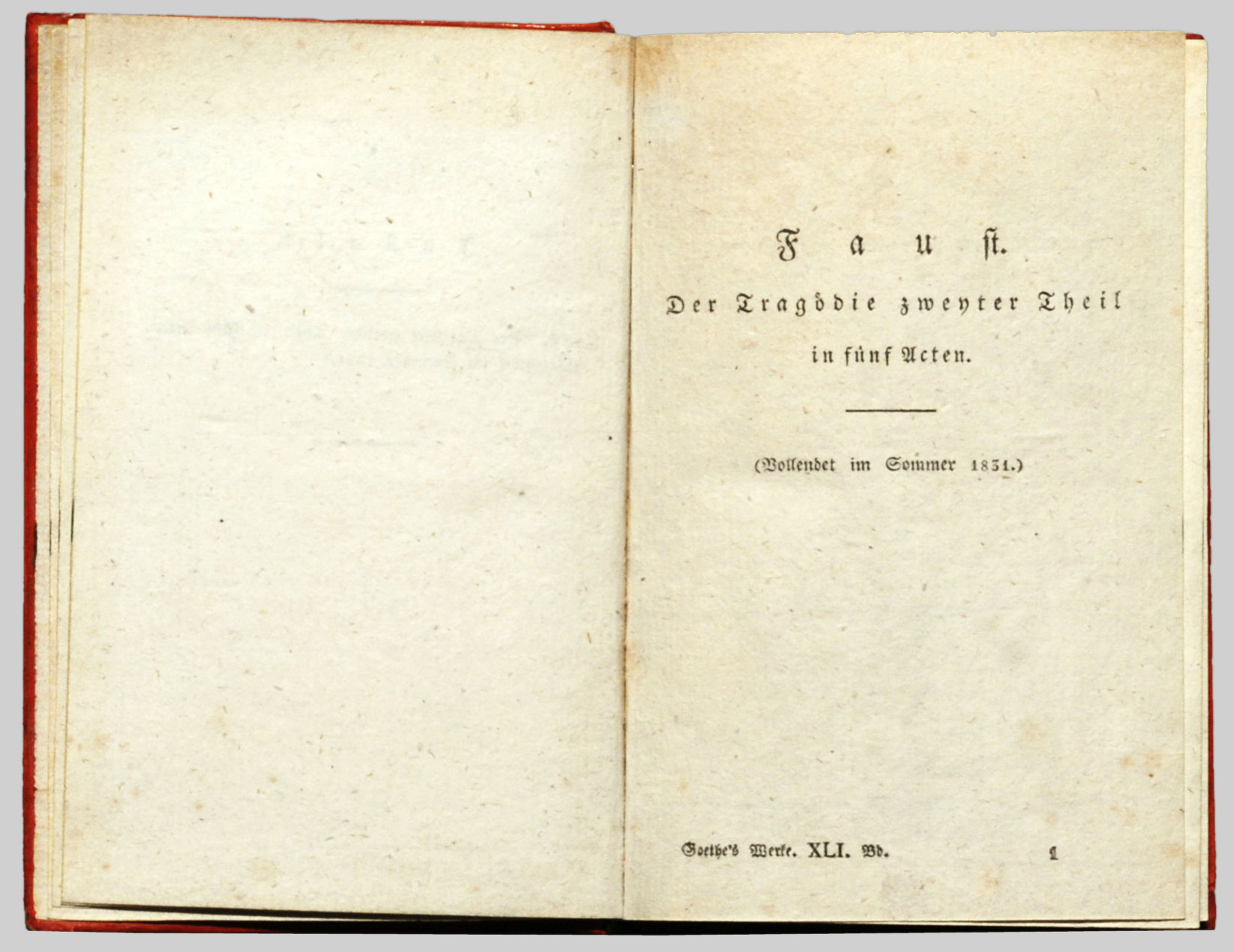
Faust: The Second Part of the Tragedy (German: Faust. Der Tragödie zweiter Teil in fünf Akten.) is the second part of the tragic play Faust by Johann Wolfgang von Goethe. It was published in 1832, the year of Goethe's death.
Only part of Faust I is directly related to the legend of Johann Faust, which dates to at latest the beginning of the 16th century (thus preceding Marlowe's play). The "Gretchen" subplot, although now the most widely known episode of the Faust legend, was of Goethe's own invention. In Faust II, the legend (at least in a version of the 18th century, which came to Goethe's attention) already contained Faust's marriage with Helen and an encounter with an Emperor. But certainly Goethe deals with the legendary material very freely in both parts.
Goethe had been working on Faust from before 1772 all the way up to his death in 1832 (he had worked on this play for more than 60 years), alternating between parts. In 1797, following Schiller's advice, he continued his work on the first part of the play, which he completed in 1805 (the same year of Schiller's death). The first part was published three years later, in 1808. In 1818, Goethe read Christopher Marlowe's play, Doctor Faustus, and he began working on the second part of the play in 1825. The first act of the tragedy's second part was written between 1826 and 1827, whilst the second act was written in a period spacing from 1828 to 1830. Goethe wrote the third act for the better half of 1827, and he continued working on the fifth act in 1828. The fourth act was written between February and July 1831, with Goethe sealing the manuscript (which was to be published after his death), but he sometimes took it out for private readings to his daughter-in-law, Ottilie von Goethe, and to his friend, Johann Peter Eckermann. Goethe died in March of 1832, and the tragedy was published a year later by Eckermann and Friedrich Wilhelm Riemer in the first volume of Nachgelassene Werke (Posthumous works).
The first act opens with an appeal by Ariel to forgive Faust and ease the cares of his suffering.
The first act sees Mephistopheles (playing the role of a fool) saving the imperial finances of the Emperor – and so the Holy Roman Empire – by money creation, introducing the use of paper money instead of gold to encourage spending (and economic recovery).
This is by far the most extensive section of the first act, describing the Florentine carnival from the perspective of Goethe, above all based on Antonio Francesco Grazzini's Tutti i trionfi (1559) – a collection of contemporary "songs and hard lifts". A parade of Florentine notables, including Dante and Gianni Schicchi, pass by.
The "Emperor of Thumb" (to use a devilish term of Mephistopheles) describes how much he enjoyed the recent celebrations, and wants more "dergleichen Scherze" (5988). The Emperor appears and blesses the newly introduced paper money from Mephisto, which is adorned with pictures of Simon Magus. The Emperor begins to understand its meaning and to squander it, as do his advisors. Goethe here satirizes the introduction of paper money during the French Revolution, with various advisors possibly representing Danton, Sieyès and other figures.
Faust enters the "realm of the mothers" – variously described as the depths of the psyche or the womb – in order to bring back the "ideal form" of beauty for the Emperor's delight. In this case, the ideal forms are Helen of Troy and her lover Paris. Faust summons their spirits from Hades, but the emperor and the male members of his court criticize Paris's appearance, while the women of the court criticize Helen's appearance. Faust falls in love with Helen. In a fit of jealously toward Paris, who is now abducting Helen, Faust destroys the illusion and the act ends in darkness and tumult.
Faust, Part Two
Faust: The Second Part of the Tragedy (German: Faust. Der Tragödie zweiter Teil in fünf Akten.) is the second part of the tragic play Faust by Johann Wolfgang von Goethe. It was published in 1832, the year of Goethe's death.
Only part of Faust I is directly related to the legend of Johann Faust, which dates to at latest the beginning of the 16th century (thus preceding Marlowe's play). The "Gretchen" subplot, although now the most widely known episode of the Faust legend, was of Goethe's own invention. In Faust II, the legend (at least in a version of the 18th century, which came to Goethe's attention) already contained Faust's marriage with Helen and an encounter with an Emperor. But certainly Goethe deals with the legendary material very freely in both parts.
Goethe had been working on Faust from before 1772 all the way up to his death in 1832 (he had worked on this play for more than 60 years), alternating between parts. In 1797, following Schiller's advice, he continued his work on the first part of the play, which he completed in 1805 (the same year of Schiller's death). The first part was published three years later, in 1808. In 1818, Goethe read Christopher Marlowe's play, Doctor Faustus, and he began working on the second part of the play in 1825. The first act of the tragedy's second part was written between 1826 and 1827, whilst the second act was written in a period spacing from 1828 to 1830. Goethe wrote the third act for the better half of 1827, and he continued working on the fifth act in 1828. The fourth act was written between February and July 1831, with Goethe sealing the manuscript (which was to be published after his death), but he sometimes took it out for private readings to his daughter-in-law, Ottilie von Goethe, and to his friend, Johann Peter Eckermann. Goethe died in March of 1832, and the tragedy was published a year later by Eckermann and Friedrich Wilhelm Riemer in the first volume of Nachgelassene Werke (Posthumous works).
The first act opens with an appeal by Ariel to forgive Faust and ease the cares of his suffering.
The first act sees Mephistopheles (playing the role of a fool) saving the imperial finances of the Emperor – and so the Holy Roman Empire – by money creation, introducing the use of paper money instead of gold to encourage spending (and economic recovery).
This is by far the most extensive section of the first act, describing the Florentine carnival from the perspective of Goethe, above all based on Antonio Francesco Grazzini's Tutti i trionfi (1559) – a collection of contemporary "songs and hard lifts". A parade of Florentine notables, including Dante and Gianni Schicchi, pass by.
The "Emperor of Thumb" (to use a devilish term of Mephistopheles) describes how much he enjoyed the recent celebrations, and wants more "dergleichen Scherze" (5988). The Emperor appears and blesses the newly introduced paper money from Mephisto, which is adorned with pictures of Simon Magus. The Emperor begins to understand its meaning and to squander it, as do his advisors. Goethe here satirizes the introduction of paper money during the French Revolution, with various advisors possibly representing Danton, Sieyès and other figures.
Faust enters the "realm of the mothers" – variously described as the depths of the psyche or the womb – in order to bring back the "ideal form" of beauty for the Emperor's delight. In this case, the ideal forms are Helen of Troy and her lover Paris. Faust summons their spirits from Hades, but the emperor and the male members of his court criticize Paris's appearance, while the women of the court criticize Helen's appearance. Faust falls in love with Helen. In a fit of jealously toward Paris, who is now abducting Helen, Faust destroys the illusion and the act ends in darkness and tumult.
Recent media
Recent media