
Recent from talks
Doctor Faustus (play)
Knowledge base stats:
Talk channels stats:
Members stats:
Doctor Faustus (play)
The Tragical History of the Life and Death of Doctor Faustus, commonly referred to simply as Doctor Faustus, is an Elizabethan tragedy by Christopher Marlowe, based on German stories about a scholar who sells his soul to the devil in exchange for magical power. Written in the late 16th century and first performed around 1594, the play follows Faustus’s rise as a magician through his pact with Lucifer—facilitated by the demon Mephistopheles—and his ultimate downfall as he fails to repent before his damnation.
The play survives in two major versions: the shorter 1604 "A" text and the expanded 1616 "B" text, which includes additional scenes and material of debated authorship. Though once considered less authoritative, the "B" text has gained renewed scholarly interest, especially regarding its comic elements and their thematic significance.
Doctor Faustus blends classical tragedy with Elizabethan drama, employing a five-act structure and a chorus. Thematically, it explores ambition, the limits of knowledge, Christian theology, and Renaissance humanism. Critics have long debated its stance on Calvinist predestination and its reflection of Reformation-era anxieties.
The play has had a lasting influence, inspiring adaptations across stage, film, and other media. Performances have been associated with supernatural legends since the 17th century, and the characters of Faustus and Mephistopheles remain iconic figures in Western literature.
The Admiral's Men performed the play 23 times between September 1594 and October 1597. On 22 November 1602, the diary of Philip Henslowe recorded a £4 payment to Samuel Rowley and William Bird for additions to the play, which suggests a revival soon after that date.
The powerful effect of the early productions is indicated by the legends that quickly accrued around them. In Histriomastix, his 1632 polemic against the drama, William Prynne records the tale that actual devils once appeared on the stage during a performance of Faustus, "to the great amazement of both the actors and spectators". Some people were allegedly driven mad, "distracted with that fearful sight." John Aubrey recorded a related legend, that Edward Alleyn, lead actor of The Admiral's Men, devoted his later years to charitable endeavours, like the founding of Alleyn's College, in direct response to this incident.
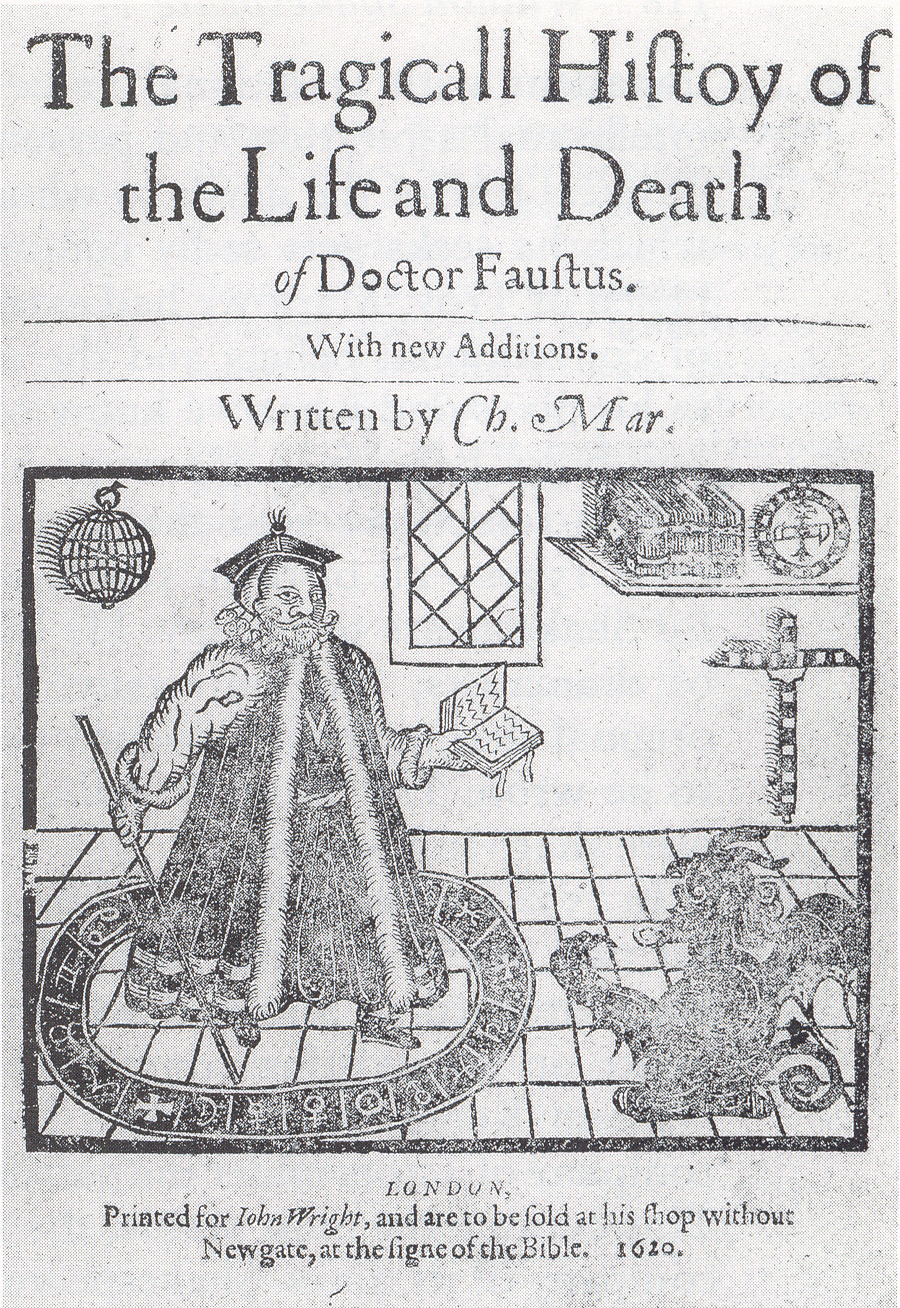
Given its source in the Historia von D. Johann Fausten, published as a chapbook in Germany in 1587, and the fact that the earliest known translation of the latter work into English was in 1592, the play was probably written in 1592 or 1593. It may have been entered into the Stationers' Register on 18 December 1592, though the records are confused and appear to indicate a conflict over the rights to the play. A subsequent Stationers' Register entry, dated 7 January 1601, assigns the play to the bookseller Thomas Bushell (variant written forms: Busshell or Bushnell), the publisher of the 1604 first edition. Bushell transferred his rights to the play to John Wright on 13 September 1610.
Two versions of the play exist:
Hub AI
Doctor Faustus (play) AI simulator
(@Doctor Faustus (play)_simulator)
Doctor Faustus (play)
The Tragical History of the Life and Death of Doctor Faustus, commonly referred to simply as Doctor Faustus, is an Elizabethan tragedy by Christopher Marlowe, based on German stories about a scholar who sells his soul to the devil in exchange for magical power. Written in the late 16th century and first performed around 1594, the play follows Faustus’s rise as a magician through his pact with Lucifer—facilitated by the demon Mephistopheles—and his ultimate downfall as he fails to repent before his damnation.
The play survives in two major versions: the shorter 1604 "A" text and the expanded 1616 "B" text, which includes additional scenes and material of debated authorship. Though once considered less authoritative, the "B" text has gained renewed scholarly interest, especially regarding its comic elements and their thematic significance.
Doctor Faustus blends classical tragedy with Elizabethan drama, employing a five-act structure and a chorus. Thematically, it explores ambition, the limits of knowledge, Christian theology, and Renaissance humanism. Critics have long debated its stance on Calvinist predestination and its reflection of Reformation-era anxieties.
The play has had a lasting influence, inspiring adaptations across stage, film, and other media. Performances have been associated with supernatural legends since the 17th century, and the characters of Faustus and Mephistopheles remain iconic figures in Western literature.
The Admiral's Men performed the play 23 times between September 1594 and October 1597. On 22 November 1602, the diary of Philip Henslowe recorded a £4 payment to Samuel Rowley and William Bird for additions to the play, which suggests a revival soon after that date.
The powerful effect of the early productions is indicated by the legends that quickly accrued around them. In Histriomastix, his 1632 polemic against the drama, William Prynne records the tale that actual devils once appeared on the stage during a performance of Faustus, "to the great amazement of both the actors and spectators". Some people were allegedly driven mad, "distracted with that fearful sight." John Aubrey recorded a related legend, that Edward Alleyn, lead actor of The Admiral's Men, devoted his later years to charitable endeavours, like the founding of Alleyn's College, in direct response to this incident.
Given its source in the Historia von D. Johann Fausten, published as a chapbook in Germany in 1587, and the fact that the earliest known translation of the latter work into English was in 1592, the play was probably written in 1592 or 1593. It may have been entered into the Stationers' Register on 18 December 1592, though the records are confused and appear to indicate a conflict over the rights to the play. A subsequent Stationers' Register entry, dated 7 January 1601, assigns the play to the bookseller Thomas Bushell (variant written forms: Busshell or Bushnell), the publisher of the 1604 first edition. Bushell transferred his rights to the play to John Wright on 13 September 1610.
Two versions of the play exist:
Recent media