
Recent from talks
Fayetteville Arsenal
Knowledge base stats:
Talk channels stats:
Members stats:
Fayetteville Arsenal
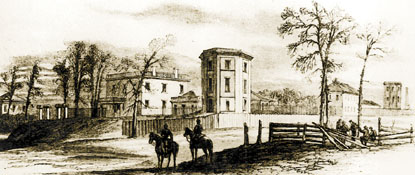
The Fayetteville Arsenal is a ruined Confederate States arsenal in Fayetteville, North Carolina. It housed numerous red brick and stone structures and octagonal corner guard towers. The principal armament manufactured at the arsenal was known as the "Fayetteville Rifle."
During the War of 1812 the United States government realized that the existing distribution of weapons and ammunition factories was not adequate for the defense of the country. A program was begun to provide more Federal arsenals which would be distributed so that no area of the country would be too far away from an arms depot. Bladen County Representative James McKay introduced House Resolution No. 374 for inclusion of an arsenal at Fayetteville.
The cornerstone for the Arsenal was laid April 9, 1838. It was constructed of brick and stone and at each of the four corners of its massive walls was an octagonal tower. Entry into the Arsenal was controlled by use of massive iron gates. Workshops, quarters and other buildings in the Arsenal were constructed of brick and wood.[citation needed] The hill upon which the arsenal was construction was known as Haymount.
Even before North Carolina formally seceded from the Union, Governor Ellis commissioned Warren Winslow to bring about the peaceful, if possible, surrender of the Arsenal at Fayetteville. General Walker Draughon, then in command of the North Carolina Militia, was given the order to take possession of the Arsenal, then occupied by a Federal garrison consisting of Battery D, 2nd U.S. Artillery.
He mobilized the Fayetteville Independent Light Infantry (FILI) (the oldest private military organization in the State, having been organized in 1793) under the command of Major Wright Huske, and the LaFayette Light Infantry, commanded by Capt. Joseph B. Starr. Other troops were used as well, and the total number of troops present on April 22, 1861 was approximately 500.
After the Confederate troops had been inspected by the representative of the Federal forces, Lieutenant Julius de Lagnel, he decided that resistance was fruitless and surrendered the arsenal without incident. It was vacated by Federal forces on April 27, 1861.[1] Major Wright Huske of the FILI "took up, in obedience to orders, its permanent quarters there for protection of important and valuable property."[citation needed] De Lagnel and the federal troops were permitted to leave with their small arms. De Lagnel subsequently sailed to New York, where he formally resigned his commission. The Confederates subsequently organized a battalion, known as the Armoury Guards, to garrison the arsenal.
After the fall of the Arsenal at Harpers Ferry to Confederate forces in April 1861, plans were made to relocate the rifle making machinery from that location to new workshops at the Fayetteville Arsenal. Arms-making machinery from Harpers Ferry was installed in October 1861, and the arsenal became a major supplier of small arms to the Confederate troops. The principal armament was known as the Fayetteville Rifle. At its peak, the arsenal produced 500 rifles per month and various numbers of other larger ordnance, cartridges, swords, and bayonets. Over one hundred workmen from the Harpers Ferry Arsenal had relocated with their families to Fayetteville. In the middle years of the war, young ladies of the area were employed in the making of cartridges and as clerks.
In 1865, as Union Major General William T. Sherman led his forces on the Carolinas campaign it became apparent to the Confederate commander, Colonel Childs, that Fayetteville was a major target. When Sherman reached Columbia, South Carolina, Col. Childs ordered the construction of earthworks for the defense of the Fayetteville area. Remnants of these earthworks can be seen on the grounds of the Veterans Administration Hospital on Ramsey Street.
Hub AI
Fayetteville Arsenal AI simulator
(@Fayetteville Arsenal_simulator)
Fayetteville Arsenal
The Fayetteville Arsenal is a ruined Confederate States arsenal in Fayetteville, North Carolina. It housed numerous red brick and stone structures and octagonal corner guard towers. The principal armament manufactured at the arsenal was known as the "Fayetteville Rifle."
During the War of 1812 the United States government realized that the existing distribution of weapons and ammunition factories was not adequate for the defense of the country. A program was begun to provide more Federal arsenals which would be distributed so that no area of the country would be too far away from an arms depot. Bladen County Representative James McKay introduced House Resolution No. 374 for inclusion of an arsenal at Fayetteville.
The cornerstone for the Arsenal was laid April 9, 1838. It was constructed of brick and stone and at each of the four corners of its massive walls was an octagonal tower. Entry into the Arsenal was controlled by use of massive iron gates. Workshops, quarters and other buildings in the Arsenal were constructed of brick and wood.[citation needed] The hill upon which the arsenal was construction was known as Haymount.
Even before North Carolina formally seceded from the Union, Governor Ellis commissioned Warren Winslow to bring about the peaceful, if possible, surrender of the Arsenal at Fayetteville. General Walker Draughon, then in command of the North Carolina Militia, was given the order to take possession of the Arsenal, then occupied by a Federal garrison consisting of Battery D, 2nd U.S. Artillery.
He mobilized the Fayetteville Independent Light Infantry (FILI) (the oldest private military organization in the State, having been organized in 1793) under the command of Major Wright Huske, and the LaFayette Light Infantry, commanded by Capt. Joseph B. Starr. Other troops were used as well, and the total number of troops present on April 22, 1861 was approximately 500.
After the Confederate troops had been inspected by the representative of the Federal forces, Lieutenant Julius de Lagnel, he decided that resistance was fruitless and surrendered the arsenal without incident. It was vacated by Federal forces on April 27, 1861.[1] Major Wright Huske of the FILI "took up, in obedience to orders, its permanent quarters there for protection of important and valuable property."[citation needed] De Lagnel and the federal troops were permitted to leave with their small arms. De Lagnel subsequently sailed to New York, where he formally resigned his commission. The Confederates subsequently organized a battalion, known as the Armoury Guards, to garrison the arsenal.
After the fall of the Arsenal at Harpers Ferry to Confederate forces in April 1861, plans were made to relocate the rifle making machinery from that location to new workshops at the Fayetteville Arsenal. Arms-making machinery from Harpers Ferry was installed in October 1861, and the arsenal became a major supplier of small arms to the Confederate troops. The principal armament was known as the Fayetteville Rifle. At its peak, the arsenal produced 500 rifles per month and various numbers of other larger ordnance, cartridges, swords, and bayonets. Over one hundred workmen from the Harpers Ferry Arsenal had relocated with their families to Fayetteville. In the middle years of the war, young ladies of the area were employed in the making of cartridges and as clerks.
In 1865, as Union Major General William T. Sherman led his forces on the Carolinas campaign it became apparent to the Confederate commander, Colonel Childs, that Fayetteville was a major target. When Sherman reached Columbia, South Carolina, Col. Childs ordered the construction of earthworks for the defense of the Fayetteville area. Remnants of these earthworks can be seen on the grounds of the Veterans Administration Hospital on Ramsey Street.
Recent media