
Recent from talks
Fender Precision Bass
Knowledge base stats:
Talk channels stats:
Members stats:
Fender Precision Bass
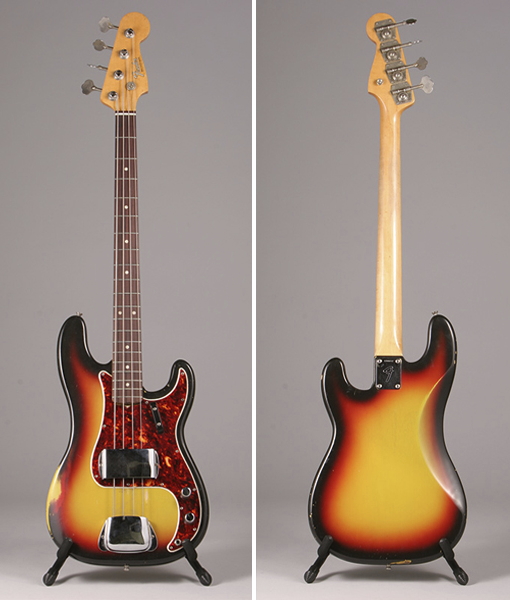
The Fender Precision Bass (or "P-Bass") is a model of electric bass guitar manufactured by Fender Musical Instruments Corporation. In its standard, post-1957 configuration, the Precision Bass is a solid body, four-stringed instrument usually equipped with a single split-coil humbucking pickup and a one-piece, 20-fret maple neck with rosewood or maple fingerboard.
Its prototype was designed by Leo Fender in 1950 and the Precision was brought to market in 1951. It was the first electric bass guitar to earn widespread attention and use, remaining among the best-selling and most-imitated electric bass guitars with considerable effect on the sound of popular music. Leo Fender designed the Precision bass for big band guitarists. Kansas City–based Roy Johnson of Lionel Hampton's big band was the first bassist to use the Precision in a concert setting. Music critic Leonard Feather wrote about this new development in Down Beat magazine, expressing surprise at hearing bass sounds from a guitar. Hampton soon replaced Johnson with bassist Monk Montgomery (Wes Montgomery's brother) who was depicted in a sketch next to the Precision bass models inside Fender's printed catalog in 1957–58. Montgomery helped to popularize the Precision during Hampton's European tour of 1953, despite some sour responses from veteran double bass players who were quoted in Melody Maker saying the new electric bass was just "a weak note amplified" or "an amplified plink-plonk."
The original Precision Bass of 1951 shared several of its design features with the Telecaster electric guitar, the main difference being its double cutaway body. The 1954 Stratocaster guitar with its contoured edges for comfort, was inspired by the Precision bass. In turn the Precision Bass then borrowed design elements from the Stratocaster guitar: The model season of 1954/55 saw the introduction of a body shape and comfort carve similar to the Stratocaster. The 1957 model had its headstock and pickguard redesigned to resemble the Stratocaster, and a rounder neck heel replacing the original square shape. A redesigned pickguard was made of a single layer of gold-anodized aluminium with 10 screw holes.
Most notably, in the 1957 model, the original single-coil pickup was replaced by the "split-coil" design with staggered pole pieces which is now known as the typical Precision pickup. Its two coils are typically connected in a hum-cancelling mode, a feature that was not emphasized by Fender at the time, as Seth Lover's patent on the humbucker pickup had not yet expired.
In 1959 a glued-on rosewood fingerboard featuring "clay"-style dot position markers replaced the one-piece maple neck and remained standard until 1966/67, when the now-CBS-owned Fender company began to offer a separate, laminated maple fingerboard capped on a maple neck. Rosewood fingerboards were then made of a veneered, round-laminated piece of wood and pearloid dot markers replaced the "clay"-style inlays introduced in 1959.
In 1960 the aluminum pickguard was replaced with a 13-screw celluloid design having three or four layers of black, white, white pearloid or with a brown "tortoise-shell" pattern). In the same year the newly designed Fender Jazz Bass was released.
The original Telecaster-derived design, with a few updates, was reintroduced in 1968 as the Fender Telecaster Bass. Within a few years, this evolved into a model distinctly different from the contemporary Precision Bass, alongside which it was marketed through 1979. Two artist-designed models use the Telecaster Bass body style; the Mike Dirnt Precision Bass, using today's standard single split-coil pick-up, and the Sting Precision Bass, using a single coil pick-up as did the earliest design.
Since 1969 the one-piece maple neck option was offered on many Fender basses, with the rosewood fretboard as an alternative. Some Precision Basses made in the 1970s were also available with an unlined fretless rosewood, ebony or (usually) maple fingerboard, popularized by Sting and Tony Franklin.
Hub AI
Fender Precision Bass AI simulator
(@Fender Precision Bass_simulator)
Fender Precision Bass
The Fender Precision Bass (or "P-Bass") is a model of electric bass guitar manufactured by Fender Musical Instruments Corporation. In its standard, post-1957 configuration, the Precision Bass is a solid body, four-stringed instrument usually equipped with a single split-coil humbucking pickup and a one-piece, 20-fret maple neck with rosewood or maple fingerboard.
Its prototype was designed by Leo Fender in 1950 and the Precision was brought to market in 1951. It was the first electric bass guitar to earn widespread attention and use, remaining among the best-selling and most-imitated electric bass guitars with considerable effect on the sound of popular music. Leo Fender designed the Precision bass for big band guitarists. Kansas City–based Roy Johnson of Lionel Hampton's big band was the first bassist to use the Precision in a concert setting. Music critic Leonard Feather wrote about this new development in Down Beat magazine, expressing surprise at hearing bass sounds from a guitar. Hampton soon replaced Johnson with bassist Monk Montgomery (Wes Montgomery's brother) who was depicted in a sketch next to the Precision bass models inside Fender's printed catalog in 1957–58. Montgomery helped to popularize the Precision during Hampton's European tour of 1953, despite some sour responses from veteran double bass players who were quoted in Melody Maker saying the new electric bass was just "a weak note amplified" or "an amplified plink-plonk."
The original Precision Bass of 1951 shared several of its design features with the Telecaster electric guitar, the main difference being its double cutaway body. The 1954 Stratocaster guitar with its contoured edges for comfort, was inspired by the Precision bass. In turn the Precision Bass then borrowed design elements from the Stratocaster guitar: The model season of 1954/55 saw the introduction of a body shape and comfort carve similar to the Stratocaster. The 1957 model had its headstock and pickguard redesigned to resemble the Stratocaster, and a rounder neck heel replacing the original square shape. A redesigned pickguard was made of a single layer of gold-anodized aluminium with 10 screw holes.
Most notably, in the 1957 model, the original single-coil pickup was replaced by the "split-coil" design with staggered pole pieces which is now known as the typical Precision pickup. Its two coils are typically connected in a hum-cancelling mode, a feature that was not emphasized by Fender at the time, as Seth Lover's patent on the humbucker pickup had not yet expired.
In 1959 a glued-on rosewood fingerboard featuring "clay"-style dot position markers replaced the one-piece maple neck and remained standard until 1966/67, when the now-CBS-owned Fender company began to offer a separate, laminated maple fingerboard capped on a maple neck. Rosewood fingerboards were then made of a veneered, round-laminated piece of wood and pearloid dot markers replaced the "clay"-style inlays introduced in 1959.
In 1960 the aluminum pickguard was replaced with a 13-screw celluloid design having three or four layers of black, white, white pearloid or with a brown "tortoise-shell" pattern). In the same year the newly designed Fender Jazz Bass was released.
The original Telecaster-derived design, with a few updates, was reintroduced in 1968 as the Fender Telecaster Bass. Within a few years, this evolved into a model distinctly different from the contemporary Precision Bass, alongside which it was marketed through 1979. Two artist-designed models use the Telecaster Bass body style; the Mike Dirnt Precision Bass, using today's standard single split-coil pick-up, and the Sting Precision Bass, using a single coil pick-up as did the earliest design.
Since 1969 the one-piece maple neck option was offered on many Fender basses, with the rosewood fretboard as an alternative. Some Precision Basses made in the 1970s were also available with an unlined fretless rosewood, ebony or (usually) maple fingerboard, popularized by Sting and Tony Franklin.
Recent media