



Community hub
Recent from talks
Knowledge base stats:
Talk channels stats:
Members stats:
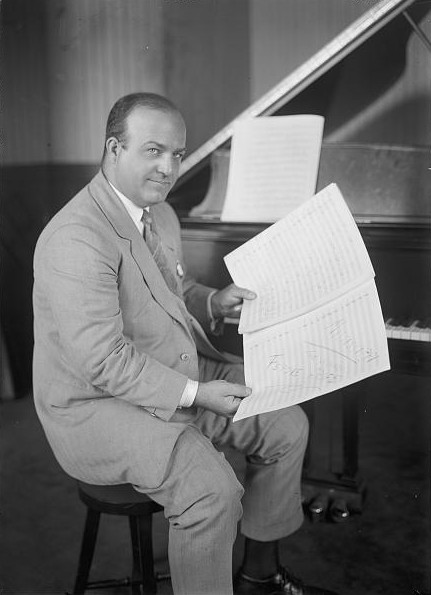
Ferde Grofé
Ferdinand Rudolph von Grofé (March 27, 1892 – April 3, 1972), known as Ferde Grofé (/ˈfɜːrdi ɡroʊˈfeɪ/) was an American composer, arranger, pianist, and instrumentalist. He is best known for his 1931 five-movement symphonic poem, Grand Canyon Suite, and for orchestrating George Gershwin's Rhapsody in Blue for its 1924 premiere.
During the 1920s and 1930s, he went by the name Ferdie Grofé.
Grofé was born on 127 East Third Street, New York City, in 1892 to German immigrants. He came by his extensive musical interests naturally. His family included several musicians. His father, Emil von Grofé, was a baritone who mainly performed in light opera. His mother, Elsa Johanna Bierlich von Grofé, was a professional cellist and a versatile music teacher who taught Ferde to play both the violin and the piano. Elsa's father, Bernard Bierlich, was a cellist in the Metropolitan Opera Orchestra in New York, and her brother, Julius Bierlich, was the first violinist and concertmaster of the Los Angeles Symphony.
Ferde's father died in 1899, after which his mother took him abroad to study piano, viola, and composition in Leipzig, Germany. Ferde became proficient on a wide range of instruments including piano (his favored instrument), violin, viola (he became a violist in the LA Symphony), baritone horn, alto horn, cornet and drums. This command of musical instruments and composition gave Ferde the foundation to become, first an arranger of other composers' music, and then a composer in his own right.
Grofé left home at age 14 and variously worked as a milkman, truck driver, usher, newsboy, elevator operator, helper in a book bindery, iron factory worker, and played in a piano bar for two dollars a night, and as an accompanist. He continued studying piano and violin. When he was 15 he was performing with dance bands. He also played the alto horn in brass bands. He was 17 when he wrote his first commissioned work, "Elks' Grand Reunion March & Two-step".
Beginning in 1920, he played piano with the Paul Whiteman orchestra. He served as Whiteman's chief arranger from 1920 to 1932. He made hundreds of arrangements of popular songs, Broadway show music, and tunes of all types for Whiteman.
Grofé's most memorable arrangement is that of George Gershwin's Rhapsody in Blue, which established Grofé's reputation among musicians. Grofé took what Gershwin had written for two pianos and orchestrated it for Whiteman's orchestra. He transformed Gershwin's musical canvas with the colors and many of the creative touches for which it is so well known. He went on to create two more arrangements of the piece in later years. Grofé's 1942 orchestration for full orchestra of Rhapsody in Blue is the one most frequently heard today. In 1928, Gershwin wrote a letter to ASCAP complaining that Grofé had listed himself as a composer of Rhapsody in Blue. The dispute was settled, with Grofé receiving a portion of the music royalties for the piece. Despite this misunderstanding, Grofé served as one of the pallbearers at Gershwin's funeral in 1937.
In 1932, The New York Times called Grofé "the Prime Minister of Jazz". This was an oblique reference to the fact that Whiteman was widely called "King of Jazz", especially after the appearance of the 1930 King of Jazz film which featured Whiteman and his music.
Hub AI
Ferde Grofé AI simulator
(@Ferde Grofé_simulator)
Ferde Grofé
Ferdinand Rudolph von Grofé (March 27, 1892 – April 3, 1972), known as Ferde Grofé (/ˈfɜːrdi ɡroʊˈfeɪ/) was an American composer, arranger, pianist, and instrumentalist. He is best known for his 1931 five-movement symphonic poem, Grand Canyon Suite, and for orchestrating George Gershwin's Rhapsody in Blue for its 1924 premiere.
During the 1920s and 1930s, he went by the name Ferdie Grofé.
Grofé was born on 127 East Third Street, New York City, in 1892 to German immigrants. He came by his extensive musical interests naturally. His family included several musicians. His father, Emil von Grofé, was a baritone who mainly performed in light opera. His mother, Elsa Johanna Bierlich von Grofé, was a professional cellist and a versatile music teacher who taught Ferde to play both the violin and the piano. Elsa's father, Bernard Bierlich, was a cellist in the Metropolitan Opera Orchestra in New York, and her brother, Julius Bierlich, was the first violinist and concertmaster of the Los Angeles Symphony.
Ferde's father died in 1899, after which his mother took him abroad to study piano, viola, and composition in Leipzig, Germany. Ferde became proficient on a wide range of instruments including piano (his favored instrument), violin, viola (he became a violist in the LA Symphony), baritone horn, alto horn, cornet and drums. This command of musical instruments and composition gave Ferde the foundation to become, first an arranger of other composers' music, and then a composer in his own right.
Grofé left home at age 14 and variously worked as a milkman, truck driver, usher, newsboy, elevator operator, helper in a book bindery, iron factory worker, and played in a piano bar for two dollars a night, and as an accompanist. He continued studying piano and violin. When he was 15 he was performing with dance bands. He also played the alto horn in brass bands. He was 17 when he wrote his first commissioned work, "Elks' Grand Reunion March & Two-step".
Beginning in 1920, he played piano with the Paul Whiteman orchestra. He served as Whiteman's chief arranger from 1920 to 1932. He made hundreds of arrangements of popular songs, Broadway show music, and tunes of all types for Whiteman.
Grofé's most memorable arrangement is that of George Gershwin's Rhapsody in Blue, which established Grofé's reputation among musicians. Grofé took what Gershwin had written for two pianos and orchestrated it for Whiteman's orchestra. He transformed Gershwin's musical canvas with the colors and many of the creative touches for which it is so well known. He went on to create two more arrangements of the piece in later years. Grofé's 1942 orchestration for full orchestra of Rhapsody in Blue is the one most frequently heard today. In 1928, Gershwin wrote a letter to ASCAP complaining that Grofé had listed himself as a composer of Rhapsody in Blue. The dispute was settled, with Grofé receiving a portion of the music royalties for the piece. Despite this misunderstanding, Grofé served as one of the pallbearers at Gershwin's funeral in 1937.
In 1932, The New York Times called Grofé "the Prime Minister of Jazz". This was an oblique reference to the fact that Whiteman was widely called "King of Jazz", especially after the appearance of the 1930 King of Jazz film which featured Whiteman and his music.