
.jpg/250px-Fernand_Gabriel_at_the_1914_French_Grand_Prix_(cropped).jpg)


.jpg/1550px-Fernand_Gabriel_at_the_1914_French_Grand_Prix_(cropped).jpg)
Community hub
Recent from talks
Contribute something
Nothing was collected or created yet.
Fernand Gabriel
View on WikipediaFernand Gabriel (30 April 1878 - 9 September 1943) was a French racing driver.
Key Information

.jpg)
Career
[edit]His first appearance in racing came in 1899, when he took part in the voiturette class in the Paris-Bordeaux race, on a Decauville; later in the year he took part (on the same car) in the first Tour de France Automobile.
In 1901, he moved to Darracq, and took part in the Paris-Berlin race, although he did not finish. His first achievement was coming 2nd in the Circuit des Ardennes on a Mors model Z - this time in the "big" car category[1] - and took his first victory kilometre sprints at Deauville and Château-Thierry (near Reims) the following year.[2]
His greatest achievement was winning the 1903 Paris-Madrid race, which was stopped at Bordeaux because of the number of fatalities on the primitive French roads. As was usual in town-to-town races, cars left one at a time at regular intervals, and the winner was the one with the lowest elapsed time. With starting number 168, Gabriel was not one of the first hundred starters,[3] yet he was the third to arrive at Bordeaux, and a clear leader when times were taken into account; the stopping of the race meant he was the winner by default.[4]
Probably as a result of this performance, he was chosen to represent France in the 1903 Gordon Bennett Cup at Athy in Ireland, and finished 4th, despite his Mors suffering a misfire and giving away a significant amount of power to the winning Mercedes.[5]
Gabriel was meant to have the honour of being the first starter at the first Grand Prix, the 1906 Grand Prix de l'ACF, being part of the de Diétrich team which had drawn start number 1, and being the leading driver; however the engine stalled at the start and he was the second car away. The problems with his car were such that he did not complete a lap.[6]
His best Grand Prix result came in 1911, in the Grand Prix de France. The race was not arranged by the Automobile Club de France, which had decided not to arrange a race that year, but by the AC de la Sarthe et de l’Ouest, and only attracted 14 starters; Gabriel came 3rd in a Rolland-Pilain.[7]
Gabriel concluded his career in 1928, with his fifth and final appearance at the 24 Hours of Le Mans, all for the Ariès concern.[8]
He died when the Renault factory, where he was working, was bombed by the Germans in the Second World War.[9]
Private life
[edit]Gabriel was married twice; firstly, to Berthe Cerisay in 1901 in Paris, and the second time to Huguette Detrez in Colombes in 1938.
Images
[edit]-
 1908 Grand Prix de l'ACF, on a Clément-Bayard;
 -
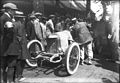 1911 Grand Prix de France, on a Rolland-Pilain;
 -
 1912 Grand Prix de l'ACF, on a Côte;
 -
 1913 Grand Prix de l'ACF, on a Th. Schneider;
 -
 1914 Grand Prix de l'ACF, on a Th. Schneider).

.jpg)
.jpg)
.jpg)

References
[edit]
- ^ Sheldon, Paul (1987). A Record of Grand Prix and Voiturette Racing Volume 1. pp. 19–21. ISBN 0951243306.
- ^ "Epreuves de montagne 1897–1914". La Berezina. Retrieved 14 January 2024.
- ^ A number of cars scheduled to start before Gabriel were withdrawn pre-race.
- ^ "The Paris-Madrid Automobile Race". Scientific American. 20 June 1903.
- ^ Lynch, Brendan. "Britain's first international motor race". Forix. Retrieved 14 January 2024.
- ^ Pomeroy, Laurence (1949). The Grand Prix Car. London: Motor Racing Publications. p. 21.
- ^ Venables, David (2009). Racing Colours - French Racing Blue. Surrey: Ian Allan. p. 29. ISBN 978-0-7110-3369-6.
- ^ "Fernand Gabriel (F)". 24h-en-piste. Retrieved 14 January 2024.
- ^ "Fernand Gabriel". Motorsport Memorial. Retrieved 14 January 2024.
Fernand Gabriel
View on GrokipediaEarly life
Birth and family background
Fernand Joseph Gabriel was born on 30 April 1878 in Paris, France. [1] [4] Little is known about his family background or early life, with no documented details on his parents, siblings, or childhood environment in available historical records. [1] He grew up in Paris. [5]Racing career
Entry into motorsport and early races
Fernand Gabriel entered motorsport in 1899, making his debut in the Paris–Bordeaux race on 24 May driving a Decauville voiturette, though he retired early from the event.[6][1] Later that year, he competed in the inaugural Tour de France Automobile over seven stages, securing a victory in the voiturette class with his Decauville and marking his first notable success in the emerging sport.[2][6] In 1901, now driving for Darracq, Gabriel won the voiturettes category in the Course d'Ostende-Voitures Légères held in Belgium.[6][7] Early the following year, he triumphed in the voiturette class at the inaugural La Turbie hill climb, a 16-kilometre uphill event near Nice.[6][1][7] Later in 1902, Gabriel switched to Automobiles Mors and began competing in heavier categories, achieving strong results that included a second-place finish in the Circuit des Ardennes—where he led until a breakdown on the final lap—and outright victories at the Deauville flying kilometre sprint and the Château-Thierry event.[2][6][1] These consistent performances with Decauville, Darracq, and Mors established Gabriel as one of Europe's finest drivers in the pioneering era of motor racing.[7]Victory in the 1903 Paris-Madrid race and Gordon Bennett Cup
The 1903 Paris–Madrid race, a grueling city-to-city contest spanning public roads from Versailles near Paris toward Madrid, began on May 24, 1903, but was halted at Bordeaux after the first leg of approximately 552 km due to catastrophic safety issues. Thick dust from the unpaved roads severely impaired visibility, while large crowds of spectators often failed to clear the course promptly, contributing to high-speed crashes on unprepared surfaces. The event claimed at least eight lives—including driver Marcel Renault and several spectators—and caused numerous injuries, earning it the grim nickname "The Race to Death" and prompting French authorities to ban future open-road city-to-city races.[8][1] French driver Fernand Gabriel, driving a 70 hp Mors numbered 168, dominated the truncated race and was declared the winner based on his performance to Bordeaux. He completed the 552 km distance in 5 hours 14 minutes 31 seconds, achieving an average speed of approximately 105 km/h (65.3 mph) and finishing more than 15 minutes ahead of the nearest competitor. This decisive margin under such hazardous conditions underscored his exceptional driving skill and control at a time when automobiles routinely reached speeds exceeding 100 km/h on public highways.[9][1] Later in 1903, Gabriel achieved another strong result by finishing fourth in the Gordon Bennett Cup.[1] [3] Gabriel's victory in the infamous 1903 Paris–Madrid race stands as a landmark accomplishment in pioneer motorsport, demonstrating mastery amid extreme peril and solidifying his reputation as a leading driver of the era.[2]Participation in Grand Prix racing
Fernand Gabriel participated in the inaugural French Grand Prix in 1906, driving a Lorraine-Dietrich. [10] He retired from the race due to a radius rod failure. Despite not finishing, his entry marked his transition from city-to-city races to the new Grand Prix format established by the Automobile Club de France. In 1907, he finished fourth in the French Grand Prix at Dieppe driving a Lorraine-Dietrich. [1] [3] Gabriel also competed in the 1908 French Grand Prix held at Dieppe, where he drove a Lorraine-Dietrich (also known as Clément-Bayard in some records). [2] [11] He did not finish the event. [1] In 1911, he drove a Rolland-Pilain in the Grand Prix des Vieux Tacots (an event for older vehicles sometimes referred to as a Grand Prix de France variant), achieving a strong third-place finish. [1] Gabriel returned for the 1914 French Grand Prix at Lyon, driving a Théophile-Schneider. [12] He retired from the race due to engine failure. This marked his final documented appearance in Grand Prix competition before the outbreak of World War I suspended the events. [13] No records indicate further participation in Grand Prix racing between 1914 and 1928.Later career and retirement
After World War I, Gabriel continued racing in smaller events and hill climbs before returning to major competition in the 1920s, driving for the Société des Automobiles Ariès. [1] He competed in the 24 Hours of Le Mans from 1924 to 1928. [14] His comeback began strongly in 1924, when he finished 11th overall and first in the 751-1100 cc class, covering 91 laps in an Ariès 8-10 CV CC4. [14] The 1925 effort ended in early retirement after just 11 laps with the same marque. [1] In 1926, he secured 13th overall, completing 102 laps in an Ariès 5-8 Super CV. [1] Both the 1927 and 1928 entries resulted in retirements. [14] Gabriel's 1928 Le Mans start, at age 50, proved to be his final competitive outing, marking his retirement from racing with no further documented events. [1] This concluded a career that had spanned from early city-to-city races to endurance competition in the post-war era. [14]Personal life
Marriages and family
Fernand Gabriel was married twice during his lifetime. His first marriage was to Berthe Cerisay in 1901. [1] [6] He later married Huguette Detrez (née Detrez) in Colombes in 1938, and she survived him. [1] [6] No further details about children or other family members are documented in historical records of his personal life.Death
Circumstances during World War II
Fernand Gabriel was killed on 9 September 1943 in La Garenne-Colombes, a suburb to the northwest of Paris, during an Allied bombing raid amid World War II. [1] [3] At the age of 65, he perished in one of the air raids targeting the Paris region as Allied forces intensified operations against German-occupied industry and infrastructure in France. [2] Sources provide conflicting details on the precise circumstances of his death within the raid. Several accounts state that Gabriel died when the Renault factory—where he was employed at the time—was struck by bombs. [3] [15] Other reports indicate that his house in the Parisian suburbs was destroyed during repeated bombings of the area between 1940 and 1943. [12] [16] The raid occurred against the backdrop of Allied efforts to disrupt German war production in the occupied Paris suburbs, though primary documentation confirming the exact target or Gabriel's location at the moment of impact remains limited in accessible secondary sources.Legacy
Historical significance in motorsport
Fernand Gabriel stands as one of Europe's finest drivers in the pioneering era of motorsport, a period when long-distance road races defined the sport's early development. [1] His victory in the 1903 Paris-Madrid race, achieved by covering the distance to Bordeaux more than 15 minutes faster than his nearest rivals despite starting near the back of the field, represented a high point in the city-to-city racing format that characterized the first decade of automobile competition. [2] This event, halted early due to fatal accidents, marked the beginning of the shift away from open-road races toward more controlled circuit-based formats. [1] Gabriel's involvement in foundational events further cemented his place among the first generation of motor racing drivers. [15] He competed in the 1903 Gordon Bennett Cup, securing fourth place for France, and was the first starter at the inaugural French Grand Prix in 1906, where he drove a Lorraine-Dietrich. [1] These participations helped bridge the era of hazardous point-to-point races with the emerging Grand Prix tradition, which emphasized specialized circuits and international competition under standardized rules. [1] His long career, spanning from 1899 to 1928 and encompassing early hillclimbs, Grand Prix starts, and later endurance races such as the 24 Hours of Le Mans, illustrates his sustained contribution to motorsport during its formative decades. [1]Recognition and memorials
Fernand Gabriel is commemorated in the Motorsport Memorial database, which includes him in its "Lest We Forget – World War I & World War II" section dedicated to motorsport-connected individuals who died as a result of the world wars.[1] This entry recognizes his status as a pioneer driver and describes him as "one of Europe's finest drivers in the pioneering era."[1] His profile in the database serves as a historical memorial, documenting his notable achievements such as the 1903 Paris-Madrid victory alongside biographical details.[1] No other formal posthumous honors, such as named trophies, plaques, or inductions into halls of fame, are recorded in available sources.[1]References
- https://www.wikidata.org/wiki/Q1406498