


Community hub
Recent from talks
Contribute something to knowledge base
Content stats: 0 posts, 0 articles, 1 media, 0 notes
Members stats: 0 subscribers, 0 contributors, 0 moderators, 0 supporters
Subscribers
Supporters
Contributors
Moderators
Ferrari SP
The Ferrari SP (also known as the Ferrari Dino SP) was a series of Italian sports prototype racing cars produced by Ferrari during the early 1960s. All featured a rear mid-engine layout, a first for a Ferrari sports car. Major racing accolades include the 1962 European Hill Climb Championship, two overall Targa Florio victories, in 1961 and 1962, and "1962 Coupe des Sports" title.
At first the SP-series used Vittorio Jano-designed, V6 Dino engines in both SOHC 60° and DOHC 65° forms. Later, Ferrari introduced a new SOHC 90° V8 engine designed by Carlo Chiti. All used dry sump lubrication and were mated to a 5-speed manual transmission.
In total only six chassis were produced with various engine configurations. Many times they were modified and converted into a different specification. The tubular steel chassis, tipo 561, featured all-round independent suspension and disc brakes. All shared the same wheelbase and open body style with some variations.
The rear mid-engine layout experience was soon carried over to the V12-powered Ferrari P-series of sports prototypes. They arrived in 1963. Later, by 1965, Ferrari introduced their first mid-engined Dino sports prototype, the 166 P, powered by a V6 engine. The Chiti V8 engine did not carry over to any successor.
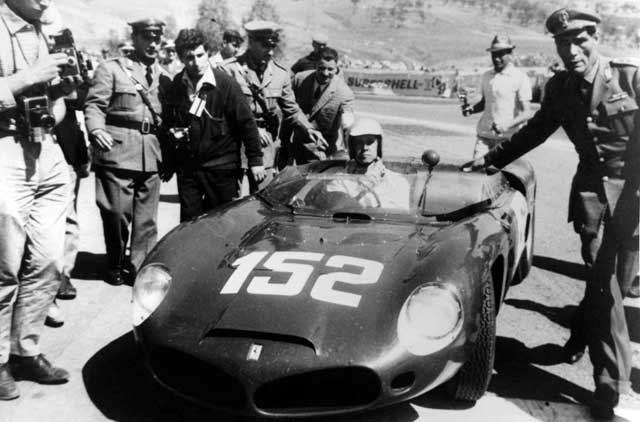
At the 1961 special press conference, Ferrari unveiled their first mid-engined sports car, the Ferrari 246 SP. Although the front-engined 250 Testa Rossa had many racing successes during the late 1950s, the emergence of rear engine competitors in Grand Prix and sports car racing indicated that Ferrari required new design to stay competitive. Enzo Ferrari publicly denied in January 1959 that a rear engine car was in the works, however during this same year he privately tasked Carlo Chiti with developing both a rear engine Formula One car and a rear engine sports car, to be introduced by the 1961 racing season. Chiti decided Jano's existing 2.4 litre 65° Dino V6 design was suitable for use in both of these designs, due to its light weight and compact size. Development work proceeded through 1960 and early 1961, with the 246 SP completed in time for the 13 February 1961 press conference where it was introduced to the public. The model proved its capabilities at the 1961 Targa Florio, which Wolfgang von Trips and Olivier Gendebien had won outright. With this the 246 SP scored one more point for the 1961 World Sportscar Championship for Ferrari. For the 1962 World Sportscar Championship in the Sportscar class cars under 3000 cc, the 246 SP won two out of three rounds, including the 1962 Targa Florio and "1962 Coupe des Sports" title for Ferrari. Only two cars were produced (chassis 0790 and 0796) and both were later converted into other types, with 0790 becoming a 196 SP in early 1963 and 0796 becoming a 250 P test mule before being destroyed in a crash.
The 246 SP's bodywork was a collaboration between Carlo Chiti and Medardo Fantuzzi, the owner of the Carrozzeria Fantuzzi. During the design process, solutions to reduce drag were tested in a wind tunnel. This resulted in the adoption of several new, innovative features, including a very low bonnet, high rear bodywork flush with the windscreen top and a vertical tail fin. A prominent detail were the two apertures, or air intakes in the front of the car. This solution was concurrently introduced on the 1961 Ferrari 156 Formula One car, dubbed the "sharknose," and on the 1961 250 TRI61. This front end styling had first appeared on a trio of Maserati 250Fs that Fantuzzi re-bodied in 1958 for racer Ross Jensen and team owner Temple Buell (son of the architect with the same name). Fantuzzi's suggestion that the twin intakes would improve air penetration was confirmed by Chiti's wind tunnel testing, leading to the adoption of this style throughout Ferrari's 1961 racing cars.
The bodywork was hand-shaped in Fantuzzi's workshop from 22 gauge aluminium sheet over wire forms. Major panels were designed to be detachable for easy maintenance access. Fantuzzi assigned one individual worker to oversee construction of each body shell. This division of labor, coupled with the use of traditional hand-built fabrication, resulted in slight differences between individual bodies.
During the course of early testing by Wolfgang von Trips and Ritchie Ginther, Ferrari engineers discovered that the aerodynamics of the body caused instability at high speeds. This aerodynamic instability was thought to be the cause of a dramatic rollover crash during testing at Modena Autodrome, which resulted in bruising for test driver von Trips and minor cosmetic damage to the vehicle. The issue was solved by the removal of the vertical fin seen at the car's introduction and the addition of a 5 inches (13 cm) tall rear spoiler, suggested by Ginther based on his wartime experience with aircraft.
Ferrari SP
The Ferrari SP (also known as the Ferrari Dino SP) was a series of Italian sports prototype racing cars produced by Ferrari during the early 1960s. All featured a rear mid-engine layout, a first for a Ferrari sports car. Major racing accolades include the 1962 European Hill Climb Championship, two overall Targa Florio victories, in 1961 and 1962, and "1962 Coupe des Sports" title.
At first the SP-series used Vittorio Jano-designed, V6 Dino engines in both SOHC 60° and DOHC 65° forms. Later, Ferrari introduced a new SOHC 90° V8 engine designed by Carlo Chiti. All used dry sump lubrication and were mated to a 5-speed manual transmission.
In total only six chassis were produced with various engine configurations. Many times they were modified and converted into a different specification. The tubular steel chassis, tipo 561, featured all-round independent suspension and disc brakes. All shared the same wheelbase and open body style with some variations.
The rear mid-engine layout experience was soon carried over to the V12-powered Ferrari P-series of sports prototypes. They arrived in 1963. Later, by 1965, Ferrari introduced their first mid-engined Dino sports prototype, the 166 P, powered by a V6 engine. The Chiti V8 engine did not carry over to any successor.
At the 1961 special press conference, Ferrari unveiled their first mid-engined sports car, the Ferrari 246 SP. Although the front-engined 250 Testa Rossa had many racing successes during the late 1950s, the emergence of rear engine competitors in Grand Prix and sports car racing indicated that Ferrari required new design to stay competitive. Enzo Ferrari publicly denied in January 1959 that a rear engine car was in the works, however during this same year he privately tasked Carlo Chiti with developing both a rear engine Formula One car and a rear engine sports car, to be introduced by the 1961 racing season. Chiti decided Jano's existing 2.4 litre 65° Dino V6 design was suitable for use in both of these designs, due to its light weight and compact size. Development work proceeded through 1960 and early 1961, with the 246 SP completed in time for the 13 February 1961 press conference where it was introduced to the public. The model proved its capabilities at the 1961 Targa Florio, which Wolfgang von Trips and Olivier Gendebien had won outright. With this the 246 SP scored one more point for the 1961 World Sportscar Championship for Ferrari. For the 1962 World Sportscar Championship in the Sportscar class cars under 3000 cc, the 246 SP won two out of three rounds, including the 1962 Targa Florio and "1962 Coupe des Sports" title for Ferrari. Only two cars were produced (chassis 0790 and 0796) and both were later converted into other types, with 0790 becoming a 196 SP in early 1963 and 0796 becoming a 250 P test mule before being destroyed in a crash.
The 246 SP's bodywork was a collaboration between Carlo Chiti and Medardo Fantuzzi, the owner of the Carrozzeria Fantuzzi. During the design process, solutions to reduce drag were tested in a wind tunnel. This resulted in the adoption of several new, innovative features, including a very low bonnet, high rear bodywork flush with the windscreen top and a vertical tail fin. A prominent detail were the two apertures, or air intakes in the front of the car. This solution was concurrently introduced on the 1961 Ferrari 156 Formula One car, dubbed the "sharknose," and on the 1961 250 TRI61. This front end styling had first appeared on a trio of Maserati 250Fs that Fantuzzi re-bodied in 1958 for racer Ross Jensen and team owner Temple Buell (son of the architect with the same name). Fantuzzi's suggestion that the twin intakes would improve air penetration was confirmed by Chiti's wind tunnel testing, leading to the adoption of this style throughout Ferrari's 1961 racing cars.
The bodywork was hand-shaped in Fantuzzi's workshop from 22 gauge aluminium sheet over wire forms. Major panels were designed to be detachable for easy maintenance access. Fantuzzi assigned one individual worker to oversee construction of each body shell. This division of labor, coupled with the use of traditional hand-built fabrication, resulted in slight differences between individual bodies.
During the course of early testing by Wolfgang von Trips and Ritchie Ginther, Ferrari engineers discovered that the aerodynamics of the body caused instability at high speeds. This aerodynamic instability was thought to be the cause of a dramatic rollover crash during testing at Modena Autodrome, which resulted in bruising for test driver von Trips and minor cosmetic damage to the vehicle. The issue was solved by the removal of the vertical fin seen at the car's introduction and the addition of a 5 inches (13 cm) tall rear spoiler, suggested by Ginther based on his wartime experience with aircraft.
Recent media
Recent media