


Community hub
Recent from talks
Contribute something
Nothing was collected or created yet.
Overhead camshaft engine
View on Wikipedia
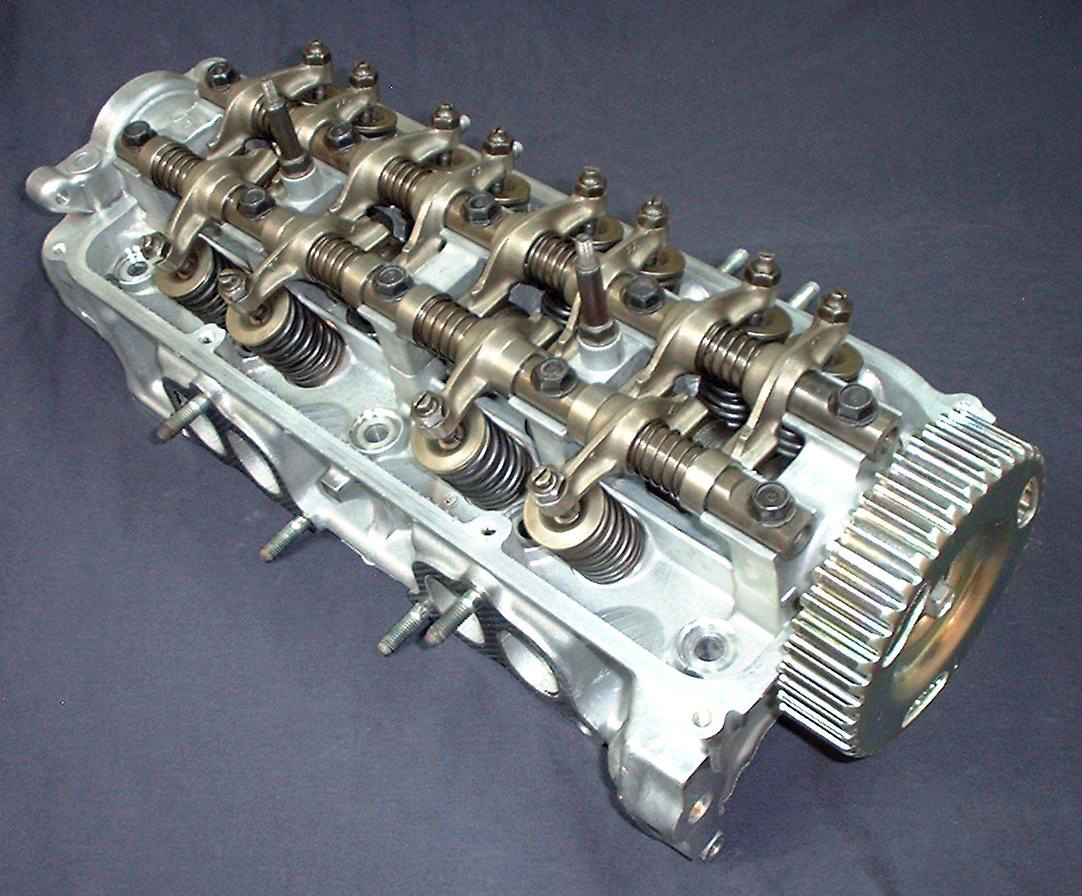
An overhead camshaft (OHC) engine is a piston engine in which the camshaft is located in the cylinder head above the combustion chamber.[1][2] This contrasts with earlier overhead valve engines (OHV), where the camshaft is located below the combustion chamber in the engine block.[3]
Single overhead camshaft (SOHC) engines have one camshaft per bank of cylinders. Dual overhead camshaft (DOHC, also known as "twin-cam"[4]) engines have two camshafts per bank. The first production car to use a DOHC engine was built in 1910. Use of DOHC engines slowly increased from the 1940s, leading to many automobiles by the early 2000s using DOHC engines.
Design
[edit]In an OHC engine, the camshaft is located at the top of the engine, above the combustion chamber. This contrasts the earlier overhead valve engine (OHV) and flathead engine configurations, where the camshaft is located down in the engine block. The valves in both OHC and OHV engines are located above the combustion chamber; however an OHV engine requires pushrods and rocker arms to transfer the motion from the camshaft up to the valves, whereas an OHC engine has the valves directly actuated by the camshaft.
Compared with OHV engines with the same number of valves, there are fewer reciprocating components and less valvetrain inertia in an OHC engine. This reduced inertia in OHC engines results in less valve float at higher engine speeds (RPM).[1] A downside is that the system used to drive the camshaft (usually a timing chain in modern engines) is more complex in an OHC engine, such as the 4-chain valvetrain of the Audi 3.2 or the 2 meter chain on Ford cammers. Another disadvantage of OHC engines is that during engine repairs where the removal of the cylinder head is required, the camshaft engine timing needs to be reset. In addition, an OHC engine has a large cylinder head to accommodate the camshaft or an extra set of valves to increase the volumetric efficiency, so that with the same displacement as an OHV engine, the OHC engine will end up being the physically larger of the two mostly due to the enlarged cylinder head.
The other main advantage of OHC engines is that there is greater flexibility to optimise the size, location and shape of the intake and exhaust ports, since there are no pushrods that need to be avoided.[1] This improves the gas flow through the engine, increasing power output and fuel efficiency.
Single overhead camshaft (SOHC)
[edit]
The oldest configuration of overhead camshaft engine is the single overhead camshaft (SOHC) design.[1] A SOHC engine has one camshaft per bank of cylinders, therefore a straight engine has a total of one camshaft and a V engine or flat engine has a total of two camshafts (one for each cylinder bank).
Most SOHC engines have 2 valves per cylinder (sometimes 3 or 4), 1 intake valve and one exhaust valve.[a] Motion of the camshaft is usually transferred to the valves either directly (using a tappet) or indirectly via a rocker arm.[1]
Dual overhead camshaft (DOHC)
[edit]
A dual overhead cam, double overhead cam, or twin-cam engine has two camshafts over each bank of the cylinder head,[1][2] one for the intake valves and another for the exhaust valves. Therefore there are two camshafts for a straight engine and a total of four camshafts for a V engine or a flat engine.
A V engine or flat engine requires four camshafts to function as a DOHC engine, since having two camshafts in total would result in only a single camshaft per cylinder bank for these engine layouts. Some V engines with four camshafts have been marketed as "quad-cam" engines,[9] however technically "quad-cam" would require four camshafts per cylinder bank (i.e. eight camshafts in total), therefore these engines are merely dual overhead camshaft engines.
Many DOHC engines have 4 valves per cylinder (sometimes 5, Audi or Volkswagen for instance).[b] The camshaft usually operates the valves directly via a bucket tappet. A DOHC design permits a wider angle between intake and exhaust valves than in SOHC engines, which improves the air-fuel mixture's flow through the engine. A further benefit is that the spark plug can be placed at the optimum location, which in turn improves combustion efficiency. Another newer benefit of DOHC engine design is the ability to independently change/phase the timing between each camshaft and the crankshaft. This affords better fuel economy by allowing a broader torque curve. Although each major manufacturer has their own trade name for their specific system of variable cam phasing systems, overall they are all classified as variable valve timing.
Components
[edit]Timing belt / timing chain
[edit]
The rotation of a camshaft is driven by a crankshaft. Many 21st century engines use a toothed timing belt made from rubber and kevlar to drive the camshaft.[1][10] Timing belts are inexpensive, produce minimal noise and have no need for lubrication.[11]: 93 A disadvantage of timing belts is the need for regular replacement of the belt;[11]: 94 recommended belt life typically varies between approximately 50,000–100,000 km (31,000–62,000 mi).[11]: 94–95 [12]: 250 If the timing belt is not replaced in time and fails and the engine is an interference engine, major engine damage is possible.
The first known automotive application of timing belts to drive overhead camshafts was the 1953 Devin-Panhard racing specials built for the SCCA H-modified racing series in the United States.[13]: 62 These engines were based on Panhard OHV flat-twin engines, which were converted to SOHC engines using components from Norton motorcycle engines.[13]: 62 The first production car to use a timing belt was the 1962 Glas 1004 compact coupe.[14]
Another camshaft drive method commonly used on modern engines is a timing chain, constructed from one or two rows of metal roller chains.[1][10] By the early 1960s most production automobile overhead camshaft designs used chains to drive the camshaft(s).[15]: 17 Timing chains do not usually require replacement at regular intervals, however the disadvantage is that they are noisier than timing belts.[12]: 253
Gear train
[edit]A gear train system between the crankshaft and the camshaft is commonly used in diesel overhead camshaft engines used in heavy trucks.[16] Gear trains are not commonly used in engines for light trucks or automobiles.[1]
Other camshaft drive systems
[edit]
Several OHC engines up until the 1950s used a shaft with bevel gears to drive the camshaft. Examples include the 1908–1911 Maudslay 25/30,[17][18] the Bentley 3 Litre,[19] the 1917-? Liberty L-12,[20] the 1929-1932 MG Midget, the 1925-1948 Velocette K series,[21] the 1931-1957 Norton International and the 1947-1962 Norton Manx.[22] In more recent times, the 1950-1974 Ducati Single,[23] 1973-1980 Ducati L-twin engine, 1999-2007 Kawasaki W650 and 2011-2016 Kawasaki W800 motorcycle engines have used bevel shafts.[24][25] The Crosley four cylinder was the last automotive engine to use the shaft tower design to drive the camshaft, from 1946 to 1952; the rights to the Crosley engine format were bought by a few different companies, including General Tire in 1952, followed by Fageol in 1955, Crofton in 1959, Homelite in 1961, and Fisher Pierce in 1966, after Crosley closed the automotive factory doors, and they continued to produce the same engine for several more years.
A camshaft drive using three sets of cranks and rods in parallel was used in the 1920–1923 Leyland Eight luxury car built in the United Kingdom.[26][27][28] A similar system was used in the 1926-1930 Bentley Speed Six and the 1930-1932 Bentley 8 Litre.[28][29] A two-rod system with counterweights at both ends was used by many models of the 1958-1973 NSU Prinz.[15]: 16-18
History
[edit]1900–1914
[edit]Among the first overhead camshaft engines were the 1902 Maudslay SOHC engine built in the United Kingdom[18]: 210 [15]: 906 [30] and the 1903 Marr Auto Car SOHC engine built in the United States.[31][32] The first DOHC engine was a Peugeot inline-four racing engine which powered the car that won the 1912 French Grand Prix. Another Peugeot with a DOHC engine won the 1913 French Grand Prix, followed by the Mercedes-Benz 18/100 GP with an SOHC engine winning the 1914 French Grand Prix.
The Isotta Fraschini Tipo KM— built in Italy from 1910–1914— was one of the first production cars to use an SOHC engine.[33]
World War I
[edit]
During World War I, both the Allied and Central Powers; specifically those of the German Empire's Luftstreitkräfte air forces, sought to quickly apply the overhead camshaft technology of motor racing engines to military aircraft engines. The SOHC engine from the Mercedes 18/100 GP car (which won the 1914 French Grand Prix) became the starting point for both Mercedes' and Rolls-Royce's aircraft engines. Mercedes created a series of six-cylinder engines which culminated in the Mercedes D.III. Rolls-Royce reversed-engineered the Mercedes cylinder head design based on a racing car left in England at the beginning of the war, leading to the Rolls-Royce Eagle V12 engine. Other SOHC designs included the Spanish Hispano-Suiza 8 V8 engine (with a fully enclosed-drivetrain), the American Liberty L-12 V12 engine, which closely followed the later Mercedes D.IIIa design's partly-exposed SOHC valvetrain design; and the Max Friz-designed; German BMW IIIa straight-six engine. The DOHC Napier Lion W12 engine was built in Great Britain beginning in 1918.
Most of these engines used a shaft to transfer drive from the crankshaft up to the camshaft at the top of the engine. Large aircraft engines— particularly air-cooled engines— experienced considerable thermal expansion, causing the height of the cylinder block to vary during operating conditions. This expansion caused difficulties for pushrod engines, so an overhead camshaft engine using a shaft drive with sliding spline was the easiest way to allow for this expansion. These bevel shafts were usually in an external tube outside the block, and were known as "tower shafts".[34]
-
 1914–1918 Hispano-Suiza 8A SOHC aircraft engine
 -
 1914–1918 Hispano-Suiza 8Be SOHC aircraft engine with "tower shafts" at the rear of each cylinder bank
 -
 Later production (1917-18) Mercedes D.III upper valvetrain details sketch, its design features copied by the BMW III and the Allied Liberty L-12 engines
 -
 Detail closeup of a Liberty L-12's upper valvetrain, showing the similarity to the later-production Mercedes design


1919–1944
[edit]
An early American overhead camshaft production engine was the SOHC straight-eight engine used in the 1921–1926 Duesenberg Model A luxury car.[35]
In 1926, the Sunbeam 3 litre Super Sports became the first production car to use a DOHC engine.[36][37]
In the United States, Duesenberg added DOHC engines (alongside their existing SOHC engines) with the 1928 release of the Duesenberg Model J, which was powered by a DOHC straight-eight engine. The 1931–1935 Stutz DV32 was another early American luxury car to use a DOHC engine. Also in the United States, the DOHC Offenhauser racing engine was introduced in 1933. This inline-four engine dominated North American open-wheel racing from 1934 until the 1970s.
Other early SOHC automotive engines were the 1920–1923 Wolseley Ten, the 1928-1931 MG 18/80, the 1926–1935 Singer Junior and the 1928–1929 Alfa Romeo 6C Sport. Early overhead camshaft motorcycles included the 1925–1949 Velocette K Series and the 1927–1939 Norton CS1.
1945–present
[edit]
The 1946–1948 Crosley CC Four was arguably the first American mass-produced car to use an SOHC engine.[38][39][40] This small mass-production engine powered the winner of the 1950 12 Hours of Sebring.[38]: 121
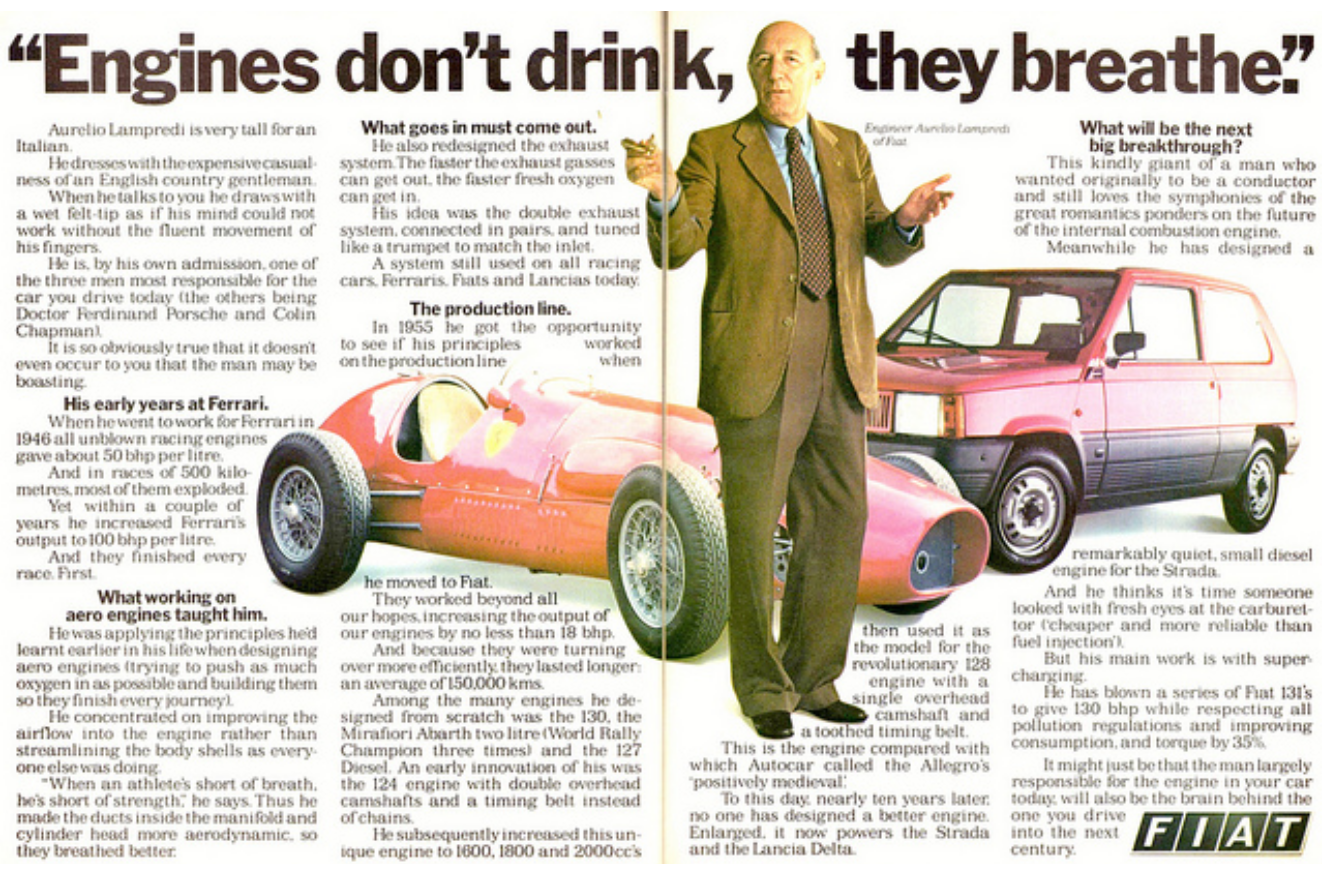
Use of a DOHC configuration gradually increased after World War II, beginning with sports cars. Iconic DOHC engines of this period include the 1948–1959 Lagonda straight-six engine, the 1949–1992 Jaguar XK straight-six engine and the 1954–1994 Alfa Romeo Twin Cam inline-four engine.[41][42] The 1966-2000 Fiat Twin Cam inline-four engine was one of the first DOHC engines to use a toothed timing belt instead of a timing chain.[43]
In the 1980s, the need for increased performance while reducing fuel consumption and exhaust emissions saw increasing use of DOHC engines in mainstream vehicles, beginning with Japanese manufacturers.[41] By the mid-2000s, most automotive engines used a DOHC layout.[citation needed]
See also
[edit]Footnotes
[edit]- ^ However a few engines, such as the 1973 Triumph Dolomite Sprint engine and Honda J Series V6 Engine were/are a SOHC configuration with four valves per cylinder. This was achieved by the camshaft being located in the center of the cylinder head, with equal length rocker arms actuating the intake and exhaust valves.[5] This arrangement was used to provide four valves per cylinder while minimising the valvetrain mass and minimising the overall engine size.[6][7][8]
- ^ However DOHC engines with two valves per cylinder include the Alfa Romeo Twin Cam engine, the Jaguar XK6 engine, the early Ford I4 DOHC engine, 10V Volvo Modular engine and the Lotus Ford Twin Cam engine.
References
[edit]- ^ a b c d e f g h i Hillier, V.A.W. (2012) [First published 1966]. "2". Fundamentals of Motor Vehicle Technology (Academic text-book). Vol. Book 1. In association with: (IMI) (6th ed.). Nelson Thornes Ltd. ISBN 9781408515181.
- ^ a b Stoakes, Graham; Sykes, Eric; Whittaker, Catherine (2011). "3". Principles of Light Vehicle maintenance & repair. Heinmann Work-Based Learning. Babcock International Group and Graham Stoakes. pp. 208–209. ISBN 9780435048167.
- ^ "OHV, OHC, SOHC and DOHC (twin cam) engine - Automotive illustrated glossary". www.samarins.com. Retrieved 2018-09-20.
- ^ Harley-Davidson Twin Cam engine, Fiat Twin Cam engine, Alfa Romeo Twin Cam engine, Quad 4 engine, Lotus-Ford Twin Cam
- ^ Heseltine, Richard (June 2010). Roebuck, Nigel (ed.). "Triumph Dolomite Sprint". Motor Sport. 86 (6). London, UK: 122. ISSN 0027-2019. Retrieved 29 March 2015.
- ^ Lewis, Jimmy (November 2001). Edwards, David (ed.). "New for '02: Honda CR250R CRF450R". Cycle World. 40 (11). Hachette-Filipacchi Magazines: 62. ISSN 0011-4286. Retrieved 2 January 2015.
- ^ "How It Works: Honda Unicam® Engines". www.honda.com. 23 January 2013. Archived from the original on 22 February 2014. Retrieved 2 January 2015.
- ^ "2010 Honda VFR1200A First Ride". www.moto123.com. 19 October 2009. Archived from the original on 2 January 2015. Retrieved 2 January 2015.
- ^ "Technically Interesting: Ford Indy DOHC V8". Bring a Trailer. 26 April 2018. Retrieved 6 September 2022.
- ^ a b "Dan's motorcycle 'Cam Drives'". www.dansmc.com. Retrieved 29 August 2012.
- ^ a b c Decker, John (June 1993). Oldham, Joe (ed.). "Saturday Mechanic: Replacing Your Timing Belt". Popular Mechanics. 170 (6). New York, NY US: Hearst. ISSN 0032-4558. Retrieved 1 March 2015.
- ^ a b Dorries, Elisabeth H. (2005). TechOne: Automotive Engine Repair. Clifton Park, NY US: Thompson Delmar Learning. ISBN 1-4018-5941-0. LCCN 2004057974. Retrieved 1 March 2015.
- ^ a b Pace, Harold W.; Brinker, Mark R. (2004). Vintage American Road Racing Cars 1950-1969. St. Paul MN US: MotorBooks International. p. 62. ISBN 0-7603-1783-6. Retrieved 27 February 2015.
- ^ Norbye, Jan P. (1984). "Expanding on Excellence: The 5-Series and 3-Series". BMW - Bavaria's Driving Machines. Skokie, IL: Publications International. p. 191. ISBN 0-517-42464-9.
- ^ a b c Boddy, William (January 1964). "Random Thoughts About O.H.C." Motor Sport. XL (1). London, UK: Teesdale Publishing.
- ^ Bennett, Sean (2014-01-01). Modern Diesel Technology: Diesel Engines. Stamford, CT US: Cengage Learning. pp. 88–89, 362. ISBN 978-1-285-44296-9. Retrieved 4 January 2015.
In most commercial diesels, OHCs are gear-driven.
- ^ Boddy, William (August 1972). Boddy, William (ed.). "An Edwardian Overhead-Camshaft 25/30 Maudslay". Motor Sport. XLVIII (8). London, UK: Teesdale Publishing: 909. Archived from the original on 6 February 2015. Retrieved 6 February 2015.
- ^ a b Culshaw, David; Horrobin, Peter (2013) [1974]. "Maudslay". The Complete Catalogue of British Cars 1895 - 1975 (e-book ed.). Poundbury, Dorchester, UK: Veloce Publishing. p. 210. ISBN 978-1-845845-83-4.
- ^ Norbye, Jan P. (1981). The complete handbook of automotive power trains. Tab Books. p. 318. ISBN 0-8306-2069-9. LCCN 79026958. Retrieved 7 January 2015.
- ^ Department, United States Bureau of Aircraft Production Airplane Engineering (March 4, 1918). "The Bulletin of the Airplane Engineering Department, U.S.A." War Department, Bureau of Aircraft Production, Airplane Engineering Department – via Google Books.
- ^ Cameron, Kevin (March 2004). "TDC: Little things". Cycle World. 43 (3): 14. ISSN 0011-4286. Retrieved 7 January 2015.
- ^ Wilson, Hugo (1995). "The A-Z of Motorcycles". The Encyclopedia of the Motorcycle. London, UK: Dorling Kindersley. p. 144. ISBN 0-7513-0206-6.
- ^ Walker, Mick (2003) [1991]. "4 Engine". Ducati Singles Restoration. St. Paul, MN US: Motorbooks International. p. 48. ISBN 0-7603-1734-8. Retrieved 4 January 2015.
- ^ "2015 W800". www.kawasaki.eu. Archived from the original on 10 November 2022. Retrieved 19 December 2019.
- ^ Ash, Kevin (26 October 2011). "Kawasaki W800 review". The Telegraph. Archived from the original on 21 June 2013.
- ^ A US patent 1495620 A, John Godfrey Parry Thomas, "Internal Combustion Engine", issued 1924-05-27
- ^ U.S. patent 1,495,620
- ^ a b Boddy, William (March 1974). Boddy, William (ed.). "How Did The Leyland Eight Rate?". Motor Sport. L (3): 230. Retrieved 3 January 2015.
- ^ Brooks, Philip C. (2009). Carpenter, Rhonda; Iwalani, Kahikina (eds.). "The Mighty Sixes". The International Club for Rolls-Royce & Bentley Owners Desk Diary 2010. Tampa, FL USA: Faircount: 27, 32.
- ^ Georgano, G. N. (1982) [1968]. "Maudslay". In Georgano, G. N. (ed.). The New Encyclopedia of Motorcars 1885 to the Present (Third ed.). New York: E. P. Dutton. p. 407. ISBN 0525932542. LCCN 81-71857.
- ^ "Marr Auto Car Company". www.marrautocar.com. Archived from the original on 11 April 2018.
- ^ Kimes, Beverly Rae (2007). Walter L Marr: Buick's Amazing Engineer. Racemaker Press. p. 40. ISBN 978-0976668343.
- ^ "1913 Isotta Fraschini 100-120 hp Tipo KM 4 Four-Seat Torpedo Tourer - Auction Lot". www.motorbase.com. Archived from the original on 9 October 2020. Retrieved 29 December 2019.
- ^ Thorpe, Leslie Aaron (1936). A text book on aviation: the new cadet system of ground school training. Vol. 3. Aviation Press. pp. 14–15. Retrieved 27 February 2015.
The overhead camshafts are driven by bevel gears and vertical shafts known as tower shafts.
- ^ Mueller, Mike (2006). "Chapter 6 - Chariot of the Gods Duesenberg Straight Eight". American Horsepower 100 Years of Great Car Engines. St. Paul, MN USA: Motorbooks. p. 51. ISBN 978-0-7603-2327-4. LCCN 2006017040. Retrieved 2015-02-02.
- ^ "Talking of sports cars: Sunbeam three-litre". Autocar. 147 (nbr 4221): 69–71. 1 October 1977.
- ^ Georgano, G.N. (1985). Cars: Early and Vintage, 1886-1930. London: Grange-Universal.
- ^ a b Simanaitis, Dennis (January 1994). Bryant, Thos L. (ed.). "Tech Tidbits". Road & Track. 45 (6). Newport Beach, CA US: Hachette Filipacchi Magazines: 121. ISSN 0035-7189.
- ^ "Crosley Engine Family Tree - Taylor Years". www.crosleyautoclub.com. Retrieved 19 December 2019.
- ^ "Crosley Engine Family Tree - CoBra Years". www.crosleyautoclub.com. Retrieved 19 December 2019.
- ^ a b "An Echo of the Past — the history and evolution of twin-cam engines". www.EuropeanCarWeb.com. European Car Magazine, Source Interlink Media. February 2009. Archived from the original on 3 March 2012. Retrieved 29 August 2012.
- ^ "Technical- Boxer History". www.alfisti.co.uk. Archived from the original on 29 March 2013.
- ^ "Old Fiat ad with Aurelio Lampredi". www.kinja-img.com. Retrieved 31 January 2015.
Overhead camshaft engine
View on GrokipediaFundamentals
Definition and basic operation
An overhead camshaft (OHC) engine is a type of internal combustion piston engine in which the camshaft is mounted in the cylinder head, positioned above the combustion chamber and the valves.[7][8] This configuration enables direct or near-direct actuation of the intake and exhaust valves through short linkages, such as rocker arms or cam followers, without the need for long pushrods extending from the engine block.[7][1] In basic operation, the camshaft is driven by the crankshaft through a timing mechanism, rotating at half the speed of the crankshaft in a four-stroke engine to synchronize with the engine cycle.[7][1] The camshaft features eccentric lobes—oval-shaped profiles aligned with each cylinder's valves—that push against valve followers or rocker arms as it rotates, forcing the valves to open at precise intervals for intake and exhaust, then allowing valve springs to close them.[7] This valvetrain path typically involves the cam lobe contacting a follower or tappet, which transmits motion via a short rocker arm to the valve stem, ensuring timed opening and closing relative to piston position for efficient air-fuel mixture intake, compression, combustion, and exhaust expulsion.[1] In a conceptual diagram, the camshaft would be illustrated horizontally in the cylinder head, with lobes protruding downward toward the valves seated in the head's roof, connected by minimal intermediate components to highlight the streamlined motion path. Key mechanical principles of OHC engines include reduced valvetrain inertia due to shorter valve stems and fewer moving parts compared to alternative designs, which allows for higher engine speeds and improved responsiveness.[7][8] These engines are commonly laid out in inline, V-type, or boxer configurations, with the camshaft(s) integrated into the cylinder head to optimize space and combustion chamber shape.[7] Historically, the term OHC distinguishes this design from earlier side-valve (flathead) engines, where the camshaft is in the block, and from overhead valve (OHV or pushrod) engines, which use the camshaft in the block but actuate valves via extended rods.[1] Variants include single overhead camshaft (SOHC) and dual overhead camshaft (DOHC) arrangements within the cylinder head.[7]Comparison to pushrod engines
Overhead camshaft (OHC) engines differ fundamentally from pushrod engines, also known as overhead valve (OHV) engines, in their valvetrain architecture. In an OHC design, the camshaft is mounted directly in the cylinder head above the valves, allowing for direct or minimally indirect actuation via short rocker arms or followers.[4] This placement reduces the number of moving parts in the valvetrain compared to OHV engines, where the camshaft resides in the engine block and transmits motion to the overhead valves through long pushrods and rocker arms.[4] The OHC configuration enables easier implementation of multiple valves per cylinder, such as four valves (two intake and two exhaust), by positioning the cam lobes closer to the valves without the need for elaborate linkages that would complicate an OHV setup.[4] Functionally, these structural variances lead to distinct performance characteristics. OHC engines exhibit lower valvetrain mass and inertia, permitting higher engine speeds and more precise valve timing due to the shorter, stiffer path from cam to valve.[4] In contrast, OHV engines are simpler in construction but face limitations from pushrod flex and higher inertia in the valvetrain components, which can cause valve float at elevated RPMs and restrict overall engine responsiveness.[4] While OHV designs offer a more compact overall engine height, benefiting vehicle packaging, the added complexity in the linkage system of pushrods and rockers can introduce parasitic losses and maintenance challenges over time.[9] For instance, Buick's 1904 Model B featured one of the first mass-produced OHV engines in the United States.[10] OHC designs, while offering superior breathing for high-performance needs, were more complex and expensive to produce initially, limiting them to prototypes and specialized vehicles; an early example is the 1905 Premier, which introduced an OHC hemispherical combustion chamber engine for enhanced power in racing contexts.[11] This contrast underscores how OHV layouts facilitated the growth of affordable mass-market automobiles, whereas OHC enabled advancements in engine efficiency for performance-oriented applications.[4]Design configurations
Single overhead camshaft (SOHC)
The single overhead camshaft (SOHC) configuration features one camshaft positioned in the cylinder head above the valves for each bank of cylinders, responsible for actuating both intake and exhaust valves through a series of lobes and intermediate components. This design typically employs two valves per cylinder—one intake and one exhaust—in a straightforward layout, though it can accommodate up to four valves by using additional rocker arms or bucket tappets to distribute the camshaft's motion. The camshaft is driven by the crankshaft at half the engine speed via a timing belt, chain, or gears, ensuring synchronized valve operation with the piston cycle.[12] In SOHC valve actuation mechanics, the camshaft's lobes are arranged in an offset pattern to handle both intake and exhaust functions sequentially, with each lobe profile pushing against followers, direct-acting tappets, or rocker arms to open the valves against spring pressure. For multi-valve setups, rocker arms pivot to transmit motion from a single lobe to two valves, enabling shared control but introducing slight timing compromises due to the mechanical linkage. This system relies on precise lobe geometry to achieve valve lift and duration, typically limiting maximum valve acceleration and high-RPM stability compared to independent cam arrangements, as the shared shaft constrains optimal phasing for intake and exhaust events.[13][12] SOHC engines find widespread applications in economy-oriented passenger cars and motorcycles, where cost-effective performance is prioritized, such as in the Honda Civic's 1.8-liter i-VTEC engine, which delivers around 143 horsepower while maintaining fuel efficiency through variable valve timing integrated into the single camshaft. They are also common in four-cylinder inline engines and some V6 designs for light-duty vehicles, balancing simplicity with adequate power output for everyday driving.[14][12] Engineering trade-offs in SOHC designs include a simpler cylinder head construction that reduces overall engine weight and height relative to dual-cam systems, lowering manufacturing costs by approximately $35–$40 per cylinder and simplifying maintenance. However, the shared camshaft limits independent control of intake and exhaust timing, potentially reducing high-speed airflow efficiency and power density, with fuel consumption benefits from variable valve lift capped at 1.5–3% in typical implementations. These compromises make SOHC suitable for mid-range performance but less ideal for high-revving applications requiring precise valve events.[12][15]Dual overhead camshaft (DOHC)
The dual overhead camshaft (DOHC) configuration employs two parallel camshafts mounted in the cylinder head per bank, with one camshaft dedicated to operating the intake valves and the other to the exhaust valves. This separation allows for independent cam lobe profiles tailored specifically to intake and exhaust timing requirements, optimizing valve events for enhanced volumetric efficiency and power output across a broader range of engine speeds.[16] Valve actuation in DOHC engines typically utilizes direct-acting or roller finger followers, which pivot on a fulcrum to transmit camshaft motion to the valve stems with reduced friction and valvetrain inertia compared to other systems. This design facilitates multi-valve arrangements, such as four valves per cylinder (two intake and two exhaust), which promote superior airflow through larger total valve area and more direct porting geometries.[17][18] DOHC setups integrate seamlessly with variable valve timing (VVT) systems, such as Toyota's VVT-i, where electro-hydraulic actuators adjust camshaft phasing relative to the crankshaft for continuous optimization of valve overlap and lift. While this arrangement increases cylinder head complexity due to the additional camshaft, bearings, and synchronization components, it enables advanced features in high-performance applications. For instance, the BMW S54 engine in the E46 M3 utilizes a DOHC 24-valve inline-six layout for precise high-revving operation, and the Toyota 2JZ-GTE, a DOHC 24-valve inline-six from the 1990s Supra and Aristo models, exemplifies its use in sports cars for improved breathing and tunability.[16][19][20] This evolution from single overhead camshaft designs primarily supports higher engine rev limits by allowing finer control over valve timing without mechanical compromises.[16]Drive systems
Timing belts and chains
In overhead camshaft (OHC) engines, timing belts and chains function as flexible drives that synchronize the camshaft's rotation with the crankshaft, ensuring valves open and close precisely in relation to piston movement during the four-stroke cycle. These systems are particularly adapted to the overhead placement of the camshaft, which positions it farther from the crankshaft than in pushrod designs, often requiring longer spans and additional guides for stability.[21] Timing belts consist of a reinforced rubber band embedded with fiberglass or Kevlar cords and molded teeth that engage pulleys on the crankshaft and camshaft, transmitting power without slippage under normal loads. Their lightweight construction and inherent damping reduce noise and vibration, making them ideal for compact OHC passenger car engines where efficiency and smoothness are prioritized. However, belts are not permanent; they degrade from heat, oil exposure, and flexing, necessitating replacement every 60,000 to 100,000 miles or 72 months, whichever occurs first, as recommended by major manufacturers like Gates. Failure to replace on schedule in interference OHC engines—where valve and piston paths overlap—can result in catastrophic damage, such as bent valves or punctured pistons, if the belt snaps or jumps teeth.[22] Timing chains, by contrast, are constructed from durable steel links forming a roller or silent chain that wraps around toothed sprockets, providing robust power transfer suited to high-torque OHC applications like truck engines. Oil-lubricated and bathed in the engine's crankcase flow, chains exhibit minimal stretch over time and are engineered to endure the engine's full service life without routine replacement, though they generate more noise and add weight due to their metallic structure. In dual overhead camshaft (DOHC) variants, the extended chain length from the cylinder head's elevation demands multiple idler sprockets and reinforced components for reliable operation.[21] For instance, the Ford 4.6L V8 DOHC engine employs a multi-link chain system lubricated by pressurized oil to handle heavy-duty loads.[23] Synchronization in both systems adheres to a 2:1 ratio, where the crankshaft rotates twice for each camshaft revolution, aligning valve events with the intake, compression, power, and exhaust strokes in four-stroke OHC cycles. This ratio is achieved through differing sprocket or pulley sizes, with the crankshaft component typically having half the teeth of the camshaft component to enforce precise timing. Hydraulic or spring-loaded tensioners automatically adjust for minor elongations, while fixed or pivoting guides route the belt or chain to avoid derailment, a critical feature in OHC layouts where misalignment could disrupt high-rpm performance.[24] Maintenance for timing belts focuses on interval-based inspections to detect cracking, glazing, or tooth wear, as gradual stretching can advance or retard valve timing by several degrees, leading to reduced power and increased emissions before outright failure. Chains, while more forgiving, rely on consistent engine oil quality and pressure; inadequate lubrication accelerates link wear, causing chain stretch, tensioner collapse, and audible rattling, particularly in DOHC OHC engines with extended runs. Failures often stem from neglected oil changes, resulting in guide wear or tensioner seizure, and require comprehensive replacement of the entire chain set during engine rebuilds to restore synchronization.[25] The overhead camshaft's position in OHC designs amplifies these risks by complicating access, underscoring the need for proactive service to avert costly repairs.[21]Gear trains and other mechanical drives
Gear trains for driving overhead camshafts (OHC) consist of a series of intermeshed spur or helical gears connecting the crankshaft to the camshaft, ensuring precise synchronization of valve timing through a rigid mechanical linkage.[26] These systems transmit rotational motion at a 2:1 ratio, with the crankshaft gear typically having half the teeth of the camshaft gear to achieve half-speed operation for the camshaft relative to the crankshaft.[27] While durable and capable of withstanding high loads without stretching, gear trains add significant rotational mass, which can limit engine responsiveness, and they generate noise from gear meshing unless helical designs or dampers are employed.[28] Such configurations have been employed in high-performance and vintage OHC engines, including early 20th-century Mercedes-Benz designs, such as the 1914 Mercedes 18/100 GP racing car, that featured single overhead camshafts. To accommodate longer distances between the crankshaft and overhead camshaft in inline or V-configured engines, idler gears or jackshafts serve as intermediate components in the gear train, bridging the span while maintaining alignment and reducing the required size of primary gears.[26] Idler gears, positioned between the driving crankshaft gear and driven camshaft gear, transfer motion without altering rotational direction and help distribute load across multiple contact points for smoother operation.[27] Backlash—the slight play between meshing teeth—is minimized through preloading techniques, such as spring-loaded adjusters or precision-ground helical gears, to prevent timing variations under thermal expansion or high-speed conditions.[26] Jackshafts, essentially extended idler assemblies, further enable compact packaging in multi-cylinder OHC setups by routing power through offset paths.[26] Beyond standard gear trains, alternative mechanical drives for OHC camshafts include vertical torsional shafts paired with bevel gears, which redirect rotational force at right angles from the crankshaft upward to the cylinder head.[29] These systems, introduced as early as 1909 in Deutz four-cylinder engines, use bevel gear pairs at the base and top of the shaft to achieve the necessary 90-degree transfer while preserving the 2:1 ratio.[29] However, torsional shafts are prone to wind-up—elastic twisting under load that can introduce timing inaccuracies—particularly in multi-cylinder configurations, limiting their use to singles or compact V-twins.[28] Rare experimental variants have incorporated hydraulic or pneumatic assists to dampen vibrations in prototype OHC setups, though these remain non-standard due to added complexity.[30] In OHC engines, gear trains and similar mechanical drives offer advantages for dual overhead camshaft (DOHC) arrangements by enabling direct, backlash-minimized power distribution to multiple camshafts without the elongation risks of flexible alternatives like belts or chains.[26] This precision supports high-rpm operation and consistent valve timing under extreme loads, as seen in 1950s Formula 1 racing engines such as the Porsche 804 flat-eight, which used gear-driven DOHC for reliable performance at over 8,000 rpm.[31] Belts and chains provide quieter alternatives in production applications but require periodic maintenance.[26]Advantages and challenges
Performance and efficiency benefits
Overhead camshaft (OHC) engines provide significant performance advantages through their shorter valvetrain, which reduces mass and inertia compared to pushrod (OHV) designs. This results in a higher natural frequency of the valvetrain, enabling improved dynamic response and the ability to sustain engine speeds exceeding 8,000 RPM without valve float.[32] The direct cam-to-valve actuation minimizes flex and energy loss, allowing for more aggressive cam profiles that enhance power delivery at high RPMs. Additionally, OHC configurations readily accommodate multi-valve setups (e.g., four or five valves per cylinder), which improve volumetric efficiency by optimizing airflow into and out of the combustion chamber, often yielding 10-25% higher power output relative to equivalent-displacement OHV engines with two valves per cylinder.[33] Efficiency benefits in OHC engines stem from enhanced airflow management, which lowers pumping losses during the intake and exhaust strokes. The reduced valvetrain friction and precise valve operation contribute to better overall thermal efficiency, with modern OHC designs integrating variable valve timing (VVT) to adjust lift and duration across operating loads for optimal combustion. Studies show that dual overhead cam (DOHC) systems with VVT can reduce fuel consumption by approximately 5% compared to baseline configurations, outperforming OHV engines with similar variable valve actuation (3.2% reduction).[34] Multi-valve OHC heads further boost efficiency by promoting more complete fuel-air mixing, leading to improved fuel economy in typical applications versus comparable OHV setups.[33] OHC engines also excel in emissions control and operational smoothness due to their precise valve timing, which supports leaner air-fuel mixtures and more efficient combustion. VVT-enabled OHC designs can reduce nitric oxide emissions by up to 24% at light loads by minimizing residual exhaust gases and optimizing overlap.[35] The lighter valvetrain reduces vibrations and noise, resulting in quieter and smoother operation than pushrod engines, where longer components amplify mechanical harshness.[32]Engineering complexities and drawbacks
Overhead camshaft (OHC) engines present several engineering challenges in manufacturing due to their design, which positions the camshaft in the cylinder head above the valves. This configuration results in taller cylinder heads compared to overhead valve (OHV) or pushrod engines, necessitating more material and larger castings for the head assembly. Precision machining is required for camshaft bearings and bores to ensure proper alignment and minimize edge loading on followers, as misalignment can lead to uneven wear and reduced valvetrain rigidity. These factors contribute to higher manufacturing costs for OHC designs, with production expenses typically exceeding those of equivalent OHV engines by a notable margin due to the added complexity in casting, machining, and assembly processes.[36] Reliability concerns in OHC engines often stem from the valvetrain's exposure to high operating temperatures and variable lubrication conditions, particularly in pivoted follower systems where oil supply can be limited, leading to accelerated wear on cams and followers. Head gasket failures can be more prevalent in engines with aluminum cylinder heads (common in both OHC and OHV designs) owing to differential thermal expansion rates between the head and block materials, which can compromise sealing under repeated heat cycles. In dual overhead camshaft (DOHC) variants, there is an elevated risk of valvetrain interference, where timing disruptions—such as from belt or chain failure—can cause valves to collide with pistons, resulting in bent valves or severe internal damage, a common issue in interference-type OHC configurations.[37][38][39] Maintenance of OHC engines is more labor-intensive, as accessing valvetrain components like the camshaft often requires removing the cylinder head, which involves disassembling intake and exhaust manifolds, timing drives, and associated hardware. Timing belt replacements, common in many OHC systems, add significant labor costs and downtime, as these belts must be changed at specified intervals to prevent catastrophic failure, unlike the more durable chains in some OHV designs.[40][41] Modern advancements, such as durable timing chains and advanced alloys, have mitigated some reliability and packaging issues in OHC designs as of 2025. Additional challenges include packaging constraints in compact engine bays, where the elevated camshaft position increases overall engine height and complicates integration with vehicle hood lines or ancillary components. Early OHC designs with direct actuation also suffered from higher noise and vibration levels due to direct cam-to-valve contact and insufficient damping, though modern refinements have mitigated these issues. Drive system vulnerabilities, such as timing belt tensioner wear, further exacerbate reliability risks in overhead configurations.[37][42]Historical development
Early innovations (1900–1919)
The development of overhead camshaft (OHC) engines in the early 20th century marked a significant shift toward improved valve actuation in internal combustion engines, driven primarily by racing and aviation demands. Italian manufacturer Isotta Fraschini advanced automotive OHC designs with engineer Giustino Cattaneo, introducing a single overhead camshaft (SOHC) in their Tipo KM luxury car around 1910, one of the earliest production vehicles to feature this configuration for enhanced breathing and power output, though limited to around 50 units.[43][44][45] This innovation built on prior experimental efforts, including a 1908 racing voiturette with a 1,327 cc OHC four-cylinder monobloc engine that achieved high revs up to 3,500 rpm, though production remained limited.[46] In the realm of motorsport, French automaker Peugeot advanced OHC technology with the revolutionary L76 Grand Prix racer of 1912, designed by Swiss engineer Ernest Henry in collaboration with drivers known as "Les Charlatans" (Georges Boillot, Jules Goux, and Paolo Zuccarelli). This car employed gear-driven dual overhead camshafts (DOHC) on a 7.6-liter inline-four engine with four valves per cylinder inclined at 45 degrees and pent-roof combustion chambers, producing approximately 140 bhp at 2,200 rpm and enabling victories at the 1912 French Grand Prix and the 1913 Indianapolis 500.[47][48] The design utilized L-shaped cam followers for valve operation and initially relied on wet sump lubrication, later evolving to dry sump systems by 1913 to address oil distribution in high-performance applications.[47] British efforts paralleled these advancements, with Sunbeam's racing team under Louis Hervé Coatalen developing a SOHC inline-four engine for their 1914 Grand Prix car, featuring chain-driven actuation on a 3.2-liter displacement that delivered 63 bhp at 2,600 rpm and demonstrated competitive reliability in pre-war events.[49] World War I accelerated OHC adoption in aviation, where the Mercedes D.III inline-six aircraft engine, introduced in 1917, incorporated a SOHC valvetrain for its 15.8-liter displacement and 170-180 hp output, powering fighters like the Albatros D.III and addressing the need for lightweight, high-revving power in aerial combat.[50][51] Early OHC implementations predominantly used gear or chain drives from the crankshaft to the overhead camshafts, which improved valve timing precision over side-valve designs but introduced engineering hurdles, particularly in lubrication for the elevated valvetrain components.[47] Many prototypes relied on total-loss oiling systems, where oil was pumped from a hand-pressurized tank and not recirculated, leading to frequent maintenance and inefficiency in overhead placements.[11] These technical milestones laid groundwork for future refinements, though high manufacturing costs and mechanical complexity—stemming from precision gearing and specialized materials—restricted adoption to luxury models and racing prototypes, preventing widespread mass production before 1920.[52]Interwar and wartime advancements (1920–1945)
During the interwar period, overhead camshaft (OHC) engines saw significant commercialization in both European and American production vehicles, transitioning from experimental designs to more reliable powerplants suitable for high-performance applications. In Europe, Alfa Romeo advanced DOHC technology with the introduction of the 6C 1750 Gran Sport in 1929, featuring a twin-cam inline-six engine that delivered 102 horsepower through improved valve control and breathing efficiency.[53] This model exemplified the growing adoption of OHC for sports cars, enabling higher revving and better power output compared to side-valve alternatives. In the United States, luxury marques like Duesenberg incorporated DOHC straight-eight engines in the Model J series starting in 1928, with a 6.9-liter displacement producing 265 horsepower via four valves per cylinder, emphasizing the technology's role in premium automobiles despite higher manufacturing costs.[54] Racing circuits heavily influenced OHC refinements, particularly in valve timing and drive systems, as constructors sought greater speeds under Grand Prix regulations. The Bugatti Type 35, introduced in 1924, utilized a single overhead camshaft (SOHC) straight-eight engine with three valves per cylinder, achieving over 90 horsepower and dominating races with more than 2,000 victories between 1924 and 1930 through optimized cam profiles that enhanced airflow at high RPMs.[55] By the 1930s, a shift toward chain drives gained prominence for OHC actuation, offering improved reliability and reduced noise over gear trains or vertical shafts, as seen in updated Alfa Romeo and Bugatti designs; chains allowed for simpler maintenance and better synchronization in demanding racing environments.[56] However, U.S. adoption remained limited, as overhead valve (OHV) pushrod engines dominated mass-market production due to their lower cost and sufficient performance for everyday vehicles, relegating OHC primarily to exotic or performance niches. World War II accelerated OHC advancements through military applications, particularly in aviation where high-output engines were critical. The Daimler-Benz DB 601, a SOHC inverted V-12 introduced in the late 1930s, powered iconic fighters like the Messerschmitt Bf 109, delivering up to 1,475 horsepower with supercharging and direct fuel injection for superior altitude performance.[57] Wartime demands also refined mass production techniques for OHC components, including precision machining of camshafts and lightweight alloys, which improved scalability and durability under extreme conditions. These innovations, while focused on aircraft, laid groundwork for postwar automotive adaptations, though OHC remained niche in non-military sectors until after 1945.Postwar evolution and modern applications (1946–present)
Following World War II, overhead camshaft (OHC) engines saw increased adoption in both economy-oriented production vehicles and high-performance racing applications, driven by demands for improved efficiency and power in the recovering automotive industry. Single overhead camshaft (SOHC) designs became prominent in compact economy cars, exemplified by the Fiat Twin Cam engine introduced in 1966, which powered models like the Fiat 124 and offered enhanced breathing for better fuel economy in everyday use. In parallel, double overhead camshaft (DOHC) configurations gained traction in motorsport, with Coventry Climax's lightweight aluminum DOHC engines dominating Formula 2 racing in the 1950s and influencing road car designs through their high-revving performance, producing up to 100 horsepower per liter reliably.[58] The 1970s and 1980s marked a pivotal shift as stringent emissions regulations worldwide propelled OHC architectures with multi-valve heads and variable valve timing (VVT) innovations. Honda's Compound Vortex Controlled Combustion (CVCC) engine, introduced in 1975, utilized a SOHC valvetrain to achieve low emissions without a catalytic converter, meeting U.S. standards ahead of competitors through its stratified charge design and auxiliary intake valve.[59] By 1987, Nissan pioneered production VVT with its NVCS system on the VG30DE DOHC engine, advancing camshaft phasing hydraulically to optimize torque across RPM ranges and improve efficiency by up to 10% in response to fuel crises and environmental mandates.[60] From the 2000s onward, OHC engines integrated advanced features like belt-in-oil timing systems and electric cam phasing to further enhance durability and precision in variable valve actuation. These oil-immersed belts, replacing traditional chains in many designs, reduced frictional losses by 30% while synchronizing camshafts more quietly, as seen in various European and Asian powertrains.[61] Toyota's Prius hybrid, debuting its second-generation 1.5L Atkinson-cycle DOHC engine in 2003, leveraged VVT-i for high thermal efficiency exceeding 40%, pairing seamlessly with electric motors for overall system economy.[62] In the 2020s, despite the rise of full electrification, OHC persists in high-efficiency gasoline and diesel engines, particularly in hybrids and downsized turbocharged setups amid tightening global emissions rules. Volkswagen's TSI engines, post-2020 Dieselgate reforms, incorporate DOHC with turbocharging and mild-hybrid integration for 48V-assisted boosting, achieving up to 15% better fuel economy through downsizing from larger naturally aspirated units.[63] Recent trends emphasize lightweight materials, such as aluminum alloys and composites for camshafts, reducing engine weight by 10-15% to support electrification transitions while maintaining performance in internal combustion applications.[64]References
- https://en.wikipedia.org/wiki/Variable_valve_timing