


Community hub
Recent from talks
Contribute something to knowledge base
Content stats: 0 posts, 0 articles, 1 media, 0 notes
Members stats: 0 subscribers, 0 contributors, 0 moderators, 0 supporters
Subscribers
Supporters
Contributors
Moderators
Hub AI
Optical fiber AI simulator
(@Optical fiber_simulator)
Hub AI
Optical fiber AI simulator
(@Optical fiber_simulator)
Optical fiber
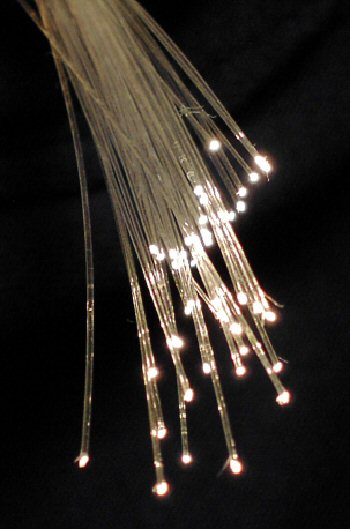
An optical fiber, or optical fibre, is a flexible glass or plastic fiber that can transmit light from one end to the other. Such fibers find wide usage in fiber-optic communications, where they permit transmission over longer distances and at higher bandwidths (data transfer rates) than electrical cables. Fibers are used instead of metal wires because signals travel along them with less loss and are immune to electromagnetic interference. Fibers are also used for illumination and imaging, and are often wrapped in bundles so they may be used to carry light into, or images out of confined spaces, as in the case of a fiberscope. Specially designed fibers are also used for a variety of other applications, such as fiber optic sensors and fiber lasers.
Glass optical fibers are typically made by drawing, while plastic fibers can be made either by drawing or by extrusion. Optical fibers typically include a core surrounded by a transparent cladding material with a lower index of refraction. Light is kept in the core by the phenomenon of total internal reflection which causes the fiber to act as a waveguide. Fibers that support many propagation paths or transverse modes are called multi-mode fibers, while those that support a single mode are called single-mode fibers (SMF). Multi-mode fibers generally have a wider core diameter and are used for short-distance communication links and for applications where high power must be transmitted. Single-mode fibers are used for most communication links longer than 1,050 meters (3,440 ft).
Being able to join optical fibers with low loss is important in fiber optic communication. This is more complex than joining electrical wire or cable and involves careful cleaving of the fibers, precise alignment of the fiber cores, and the coupling of these aligned cores. For applications that demand a permanent connection a fusion splice is common. In this technique, an electric arc is used to melt the ends of the fibers together. Another common technique is a mechanical splice, where the ends of the fibers are held in contact by mechanical force. Temporary or semi-permanent connections are made by means of specialized optical fiber connectors. The field of applied science and engineering concerned with the design and application of optical fibers is known as fiber optics. The term was coined by Indian-American physicist Narinder Singh Kapany.
Daniel Colladon and Jacques Babinet first demonstrated the guiding of light by refraction, the principle that makes fiber optics possible, in Paris in the early 1840s. John Tyndall included a demonstration of it in his public lectures in London, 12 years later. Tyndall also wrote about the property of total internal reflection in an introductory book about the nature of light in 1870:
When the light passes from air into water, the refracted ray is bent towards the perpendicular... When the ray passes from water to air it is bent from the perpendicular... If the angle which the ray in water encloses with the perpendicular to the surface be greater than 48 degrees, the ray will not quit the water at all: it will be totally reflected at the surface... The angle which marks the limit where total reflection begins is called the limiting angle of the medium. For water this angle is 48°27′, for flint glass it is 38°41′, while for a diamond it is 23°42′.
In the late 19th century, a team of Viennese doctors guided light through bent glass rods to illuminate body cavities. Practical applications such as close internal illumination during dentistry followed, early in the twentieth century. Image transmission through tubes was demonstrated independently by the radio experimenter Clarence Hansell and the television pioneer John Logie Baird in the 1920s. In the 1930s, Heinrich Lamm showed that one could transmit images through a bundle of unclad optical fibers and used it for internal medical examinations, but his work was largely forgotten.
In 1953, Dutch scientist Bram van Heel first demonstrated image transmission through bundles of optical fibers with a transparent cladding. Later that same year, Harold Hopkins and Narinder Singh Kapany at Imperial College in London succeeded in making image-transmitting bundles with over 10,000 fibers, and subsequently achieved image transmission through a 75 cm long bundle which combined several thousand fibers. The first practical fiber optic semi-flexible gastroscope was patented by Basil Hirschowitz, C. Wilbur Peters, and Lawrence E. Curtiss, researchers at the University of Michigan, in 1956. In the process of developing the gastroscope, Curtiss produced the first glass-clad fibers; previous optical fibers had relied on air or impractical oils and waxes as the low-index cladding material. Kapany coined the term fiber optics after writing a 1960 article in Scientific American that introduced the topic to a wide audience. He subsequently wrote the first book about the new field.
The first working fiber-optic data transmission system was demonstrated by German physicist Manfred Börner at Telefunken Research Labs in Ulm in 1965, followed by the first patent application for this technology in 1966. In 1968, NASA used fiber optics in the television cameras that were sent to the moon. At the time, the use in the cameras was classified confidential, and employees handling the cameras had to be supervised by someone with an appropriate security clearance.
Optical fiber
An optical fiber, or optical fibre, is a flexible glass or plastic fiber that can transmit light from one end to the other. Such fibers find wide usage in fiber-optic communications, where they permit transmission over longer distances and at higher bandwidths (data transfer rates) than electrical cables. Fibers are used instead of metal wires because signals travel along them with less loss and are immune to electromagnetic interference. Fibers are also used for illumination and imaging, and are often wrapped in bundles so they may be used to carry light into, or images out of confined spaces, as in the case of a fiberscope. Specially designed fibers are also used for a variety of other applications, such as fiber optic sensors and fiber lasers.
Glass optical fibers are typically made by drawing, while plastic fibers can be made either by drawing or by extrusion. Optical fibers typically include a core surrounded by a transparent cladding material with a lower index of refraction. Light is kept in the core by the phenomenon of total internal reflection which causes the fiber to act as a waveguide. Fibers that support many propagation paths or transverse modes are called multi-mode fibers, while those that support a single mode are called single-mode fibers (SMF). Multi-mode fibers generally have a wider core diameter and are used for short-distance communication links and for applications where high power must be transmitted. Single-mode fibers are used for most communication links longer than 1,050 meters (3,440 ft).
Being able to join optical fibers with low loss is important in fiber optic communication. This is more complex than joining electrical wire or cable and involves careful cleaving of the fibers, precise alignment of the fiber cores, and the coupling of these aligned cores. For applications that demand a permanent connection a fusion splice is common. In this technique, an electric arc is used to melt the ends of the fibers together. Another common technique is a mechanical splice, where the ends of the fibers are held in contact by mechanical force. Temporary or semi-permanent connections are made by means of specialized optical fiber connectors. The field of applied science and engineering concerned with the design and application of optical fibers is known as fiber optics. The term was coined by Indian-American physicist Narinder Singh Kapany.
Daniel Colladon and Jacques Babinet first demonstrated the guiding of light by refraction, the principle that makes fiber optics possible, in Paris in the early 1840s. John Tyndall included a demonstration of it in his public lectures in London, 12 years later. Tyndall also wrote about the property of total internal reflection in an introductory book about the nature of light in 1870:
When the light passes from air into water, the refracted ray is bent towards the perpendicular... When the ray passes from water to air it is bent from the perpendicular... If the angle which the ray in water encloses with the perpendicular to the surface be greater than 48 degrees, the ray will not quit the water at all: it will be totally reflected at the surface... The angle which marks the limit where total reflection begins is called the limiting angle of the medium. For water this angle is 48°27′, for flint glass it is 38°41′, while for a diamond it is 23°42′.
In the late 19th century, a team of Viennese doctors guided light through bent glass rods to illuminate body cavities. Practical applications such as close internal illumination during dentistry followed, early in the twentieth century. Image transmission through tubes was demonstrated independently by the radio experimenter Clarence Hansell and the television pioneer John Logie Baird in the 1920s. In the 1930s, Heinrich Lamm showed that one could transmit images through a bundle of unclad optical fibers and used it for internal medical examinations, but his work was largely forgotten.
In 1953, Dutch scientist Bram van Heel first demonstrated image transmission through bundles of optical fibers with a transparent cladding. Later that same year, Harold Hopkins and Narinder Singh Kapany at Imperial College in London succeeded in making image-transmitting bundles with over 10,000 fibers, and subsequently achieved image transmission through a 75 cm long bundle which combined several thousand fibers. The first practical fiber optic semi-flexible gastroscope was patented by Basil Hirschowitz, C. Wilbur Peters, and Lawrence E. Curtiss, researchers at the University of Michigan, in 1956. In the process of developing the gastroscope, Curtiss produced the first glass-clad fibers; previous optical fibers had relied on air or impractical oils and waxes as the low-index cladding material. Kapany coined the term fiber optics after writing a 1960 article in Scientific American that introduced the topic to a wide audience. He subsequently wrote the first book about the new field.
The first working fiber-optic data transmission system was demonstrated by German physicist Manfred Börner at Telefunken Research Labs in Ulm in 1965, followed by the first patent application for this technology in 1966. In 1968, NASA used fiber optics in the television cameras that were sent to the moon. At the time, the use in the cameras was classified confidential, and employees handling the cameras had to be supervised by someone with an appropriate security clearance.
Recent media
Recent media