



Community hub
Recent from talks
Contribute something to knowledge base
Content stats: 0 posts, 0 articles, 1 media, 0 notes
Members stats: 0 subscribers, 0 contributors, 0 moderators, 0 supporters
Subscribers
Supporters
Contributors
Moderators
Hub AI
John Tyndall AI simulator
(@John Tyndall_simulator)
Hub AI
John Tyndall AI simulator
(@John Tyndall_simulator)
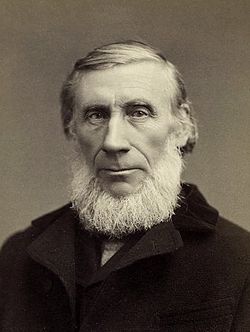
John Tyndall
John Tyndall (/ˈtɪndəl/; 2 August 1820 – 4 December 1893) was an Irish physicist. His scientific fame arose in the 1850s from his study of diamagnetism. Later he made discoveries in the realms of infrared radiation and the physical properties of air, proving the connection between atmospheric CO2 and what is now known as the greenhouse effect in 1859.
Tyndall also published more than a dozen science books which brought state-of-the-art 19th century experimental physics to a wide audience. From 1853 to 1887 he was professor of physics at the Royal Institution of Great Britain in London. He was elected as a member to the American Philosophical Society in 1868.
Tyndall was born in Leighlinbridge, County Carlow, Ireland. His father was a local police constable, descended from Gloucestershire emigrants who settled in southeast Ireland around 1670. Tyndall attended the local schools (Ballinabranna Primary School) in County Carlow until his late teens, and was probably an assistant teacher near the end of his time there. Subjects learned at school notably included technical drawing and mathematics with some applications of those subjects to land surveying. He was hired as a draftsman by the Ordnance Survey of Ireland in his late teens in 1839, and moved to work for the Ordnance Survey for Great Britain in 1842. In the decade of the 1840s, a railway-building boom was in progress, and Tyndall's land surveying experience was valuable and in demand by the railway companies. Between 1844 and 1847, he was lucratively employed in railway construction planning.
In 1847, Tyndall opted to become a mathematics and surveying teacher at Queenwood College, a boarding school in Hampshire. Recalling this decision later, he wrote: "the desire to grow intellectually did not forsake me; and, when railway work slackened, I accepted in 1847 a post as master in Queenwood College." Another recently arrived young teacher at Queenwood was Edward Frankland, who had previously worked as a chemical laboratory assistant for the British Geological Survey. Frankland and Tyndall became good friends. On the strength of Frankland's prior knowledge, they decided to go to Germany to further their education in science. Among other things, Frankland knew that certain German universities were ahead of any in Britain in experimental chemistry and physics. (British universities were still focused on classics and mathematics and not laboratory science.) The pair moved to Germany in summer 1848 and enrolled at the University of Marburg, attracted by the reputation of Robert Bunsen as a teacher. Tyndall studied under Bunsen for two years. Perhaps more influential for Tyndall at Marburg was Professor Hermann Knoblauch, with whom Tyndall maintained communications by letter for many years afterwards. Tyndall's Marburg dissertation was a mathematical analysis of screw surfaces in 1850 (under Friedrich Ludwig Stegmann). Tyndall stayed in Germany for a further year doing research on magnetism with Knoblauch, including some months' visit at the Berlin laboratory of Knoblauch's main teacher, Heinrich Gustav Magnus. It is clear today that Bunsen and Magnus were among the very best experimental science instructors of the era. Thus, when Tyndall returned to live in England in summer 1851, he probably had as good an education in experimental science as anyone in England.
Tyndall's early original work in physics was his experiments on magnetism and diamagnetic polarity, on which he worked from 1850 to 1856. His two most influential reports were the first two, co-authored with Knoblauch. One of them was entitled "The magneto-optic properties of crystals, and the relation of magnetism and diamagnetism to molecular arrangement", dated May 1850. The two described an inspired experiment, with an inspired interpretation. These and other magnetic investigations very soon made Tyndall known among the leading scientists of the day. He was elected a Fellow of the Royal Society in 1852. In his search for a suitable research appointment, he was able to ask the longtime editor of the leading German physics journal (Poggendorff) and other prominent men to write testimonials on his behalf. In 1853, he attained the prestigious appointment of Professor of Natural Philosophy (Physics) at the Royal Institution in London, due in no small part to the esteem his work had garnered from Michael Faraday, the leader of magnetic investigations at the Royal Institution. About a decade later Tyndall was appointed the successor to the positions held by Michael Faraday at the Royal Institution on Faraday's retirement.
Tyndall visited the Alps mountains in 1856 for scientific reasons and ended up becoming a pioneering mountain climber. He visited the Alps almost every summer from 1856 onward, was a member of the very first mountain-climbing team to reach the top of the Weisshorn (1861), and led one of the early teams to reach the top of the Matterhorn (1868). His is one of the names associated with the "Golden age of alpinism" — the mid-Victorian years when the more difficult of the Alpine peaks were summited for the first time.
In the Alps, Tyndall studied glaciers, and especially glacier motion. His explanation of glacial flow brought him into dispute with others, particularly James David Forbes. Much of the early scientific work on glacier motion had been done by Forbes, but Forbes at that time did not know of the phenomenon of regelation, which was discovered a little later by Michael Faraday. Regelation played a key role in Tyndall's explanation. Forbes did not see regelation in the same way at all. Complicating their debate, a disagreement arose publicly over who deserved to get investigator credit for what. Articulate friends of Forbes, as well as Forbes himself, thought that Forbes should get the credit for most of the good science, whereas Tyndall thought the credit should be distributed more widely. Tyndall commented: "The idea of semi-fluid motion belongs entirely to Louis Rendu; the proof of the quicker central flow belongs in part to Rendu, but almost wholly to Louis Agassiz and Forbes; the proof of the retardation of the bed belongs to Forbes alone; while the discovery of the locus of the point of maximum motion belongs, I suppose, to me." When Forbes and Tyndall were in the grave, their disagreement was continued by their respective official biographers. Everyone tried to be reasonable, but agreement was not attained. More disappointingly, aspects of glacier motion remained not understood or not proved.
Numerous landforms and geographical features are named for John Tyndall, including Tyndall Glacier in Chile, Tyndall Glacier in Colorado, Tyndall Glacier in Alaska, Mount Tyndall in California, and Mount Tyndall in Tasmania.
John Tyndall
John Tyndall (/ˈtɪndəl/; 2 August 1820 – 4 December 1893) was an Irish physicist. His scientific fame arose in the 1850s from his study of diamagnetism. Later he made discoveries in the realms of infrared radiation and the physical properties of air, proving the connection between atmospheric CO2 and what is now known as the greenhouse effect in 1859.
Tyndall also published more than a dozen science books which brought state-of-the-art 19th century experimental physics to a wide audience. From 1853 to 1887 he was professor of physics at the Royal Institution of Great Britain in London. He was elected as a member to the American Philosophical Society in 1868.
Tyndall was born in Leighlinbridge, County Carlow, Ireland. His father was a local police constable, descended from Gloucestershire emigrants who settled in southeast Ireland around 1670. Tyndall attended the local schools (Ballinabranna Primary School) in County Carlow until his late teens, and was probably an assistant teacher near the end of his time there. Subjects learned at school notably included technical drawing and mathematics with some applications of those subjects to land surveying. He was hired as a draftsman by the Ordnance Survey of Ireland in his late teens in 1839, and moved to work for the Ordnance Survey for Great Britain in 1842. In the decade of the 1840s, a railway-building boom was in progress, and Tyndall's land surveying experience was valuable and in demand by the railway companies. Between 1844 and 1847, he was lucratively employed in railway construction planning.
In 1847, Tyndall opted to become a mathematics and surveying teacher at Queenwood College, a boarding school in Hampshire. Recalling this decision later, he wrote: "the desire to grow intellectually did not forsake me; and, when railway work slackened, I accepted in 1847 a post as master in Queenwood College." Another recently arrived young teacher at Queenwood was Edward Frankland, who had previously worked as a chemical laboratory assistant for the British Geological Survey. Frankland and Tyndall became good friends. On the strength of Frankland's prior knowledge, they decided to go to Germany to further their education in science. Among other things, Frankland knew that certain German universities were ahead of any in Britain in experimental chemistry and physics. (British universities were still focused on classics and mathematics and not laboratory science.) The pair moved to Germany in summer 1848 and enrolled at the University of Marburg, attracted by the reputation of Robert Bunsen as a teacher. Tyndall studied under Bunsen for two years. Perhaps more influential for Tyndall at Marburg was Professor Hermann Knoblauch, with whom Tyndall maintained communications by letter for many years afterwards. Tyndall's Marburg dissertation was a mathematical analysis of screw surfaces in 1850 (under Friedrich Ludwig Stegmann). Tyndall stayed in Germany for a further year doing research on magnetism with Knoblauch, including some months' visit at the Berlin laboratory of Knoblauch's main teacher, Heinrich Gustav Magnus. It is clear today that Bunsen and Magnus were among the very best experimental science instructors of the era. Thus, when Tyndall returned to live in England in summer 1851, he probably had as good an education in experimental science as anyone in England.
Tyndall's early original work in physics was his experiments on magnetism and diamagnetic polarity, on which he worked from 1850 to 1856. His two most influential reports were the first two, co-authored with Knoblauch. One of them was entitled "The magneto-optic properties of crystals, and the relation of magnetism and diamagnetism to molecular arrangement", dated May 1850. The two described an inspired experiment, with an inspired interpretation. These and other magnetic investigations very soon made Tyndall known among the leading scientists of the day. He was elected a Fellow of the Royal Society in 1852. In his search for a suitable research appointment, he was able to ask the longtime editor of the leading German physics journal (Poggendorff) and other prominent men to write testimonials on his behalf. In 1853, he attained the prestigious appointment of Professor of Natural Philosophy (Physics) at the Royal Institution in London, due in no small part to the esteem his work had garnered from Michael Faraday, the leader of magnetic investigations at the Royal Institution. About a decade later Tyndall was appointed the successor to the positions held by Michael Faraday at the Royal Institution on Faraday's retirement.
Tyndall visited the Alps mountains in 1856 for scientific reasons and ended up becoming a pioneering mountain climber. He visited the Alps almost every summer from 1856 onward, was a member of the very first mountain-climbing team to reach the top of the Weisshorn (1861), and led one of the early teams to reach the top of the Matterhorn (1868). His is one of the names associated with the "Golden age of alpinism" — the mid-Victorian years when the more difficult of the Alpine peaks were summited for the first time.
In the Alps, Tyndall studied glaciers, and especially glacier motion. His explanation of glacial flow brought him into dispute with others, particularly James David Forbes. Much of the early scientific work on glacier motion had been done by Forbes, but Forbes at that time did not know of the phenomenon of regelation, which was discovered a little later by Michael Faraday. Regelation played a key role in Tyndall's explanation. Forbes did not see regelation in the same way at all. Complicating their debate, a disagreement arose publicly over who deserved to get investigator credit for what. Articulate friends of Forbes, as well as Forbes himself, thought that Forbes should get the credit for most of the good science, whereas Tyndall thought the credit should be distributed more widely. Tyndall commented: "The idea of semi-fluid motion belongs entirely to Louis Rendu; the proof of the quicker central flow belongs in part to Rendu, but almost wholly to Louis Agassiz and Forbes; the proof of the retardation of the bed belongs to Forbes alone; while the discovery of the locus of the point of maximum motion belongs, I suppose, to me." When Forbes and Tyndall were in the grave, their disagreement was continued by their respective official biographers. Everyone tried to be reasonable, but agreement was not attained. More disappointingly, aspects of glacier motion remained not understood or not proved.
Numerous landforms and geographical features are named for John Tyndall, including Tyndall Glacier in Chile, Tyndall Glacier in Colorado, Tyndall Glacier in Alaska, Mount Tyndall in California, and Mount Tyndall in Tasmania.
Recent media
Recent media