



Community hub
Recent from talks
Knowledge base stats:
Talk channels stats:
Members stats:
Field recording
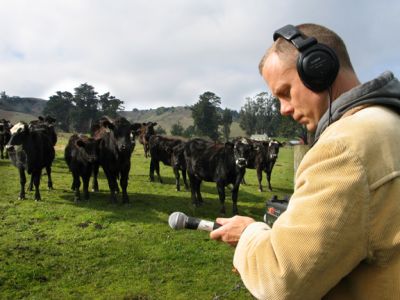
Field recording is the production of audio recordings outside recording studios, and the term applies to recordings of both natural and human-produced sounds. It can also include the recording of electromagnetic fields or vibrations using different microphones like a passive magnetic antenna for electromagnetic recordings or contact microphones, or underwater field recordings made with hydrophones to capture the sounds and/or movements of whales, or other sealife. These recordings are often regarded as being very useful for sound designers and foley artists.
Field recording of natural sounds, also called phonography (a term chosen because of the similarity of the practice to photography), was originally developed as a documentary adjunct to research work in the field, and Foley work for film. With the introduction of high-quality, portable recording equipment, it has subsequently become an evocative artform in itself. In the 1970s, both processed and natural phonographic recordings, (pioneered by Irv Teibel's Environments series), became popular.
"Field recordings" may also refer to simple monaural or stereo recordings taken of musicians in familiar and casual surroundings, such as the ethnomusicology recordings pioneered by John Lomax, Nonesuch Records, and Vanguard Records.
Field recording often involves the capture of ambient noises that are low level and complex, and, in response, the requirements from the field recordist have often pushed the technical limits of recording equipment, that is, demanding low noise and extended frequency response in a portable, battery-powered unit. For this reason, field recordists have favoured high-quality (usually professional) recorders, microphones, and microphone pre-amplifiers. The history of the equipment used in this area closely tracks the development of professional portable audio recording technology. Modern accessories used in the field include, but are not limited to: windscreens (foam, fur, hair, parabolic reflector), shock mounts, microphone cables, digital audio recorders and so on.
Field recording is typically recorded in the same channel format as the desired result, for instance, stereo recording equipment will yield a stereo product. In contrast, a multitrack remote recording captures many microphones on multiple channels, later to be creatively modified, augmented, and mixed down to a specific consumer format.
Field recording experienced a rapid increase in popularity during the early 1960s, with the introduction of high-quality, portable recording equipment, (e.g., the Uher, and Nagra portable reel-to-reel decks). The arrival of the DAT (Digital Audio Tape) in the 1980s introduced a new level of audio recording fidelity with extended frequency response and low self-noise. In addition to these technologies, other popular means for field recording have included the analog cassette (CAC), the DCC (Digital Compact Cassette), and the MiniDisc. The latest generation of recorders are completely digital-based (hard disk/Flash). It is also possible to use personal electronic devices, (e.g., a smartphone or tablet), with software, to do field recording and editing.
In addition to recording and editing, the process of field recording also involves these skills. Ability to monitor (observe the relevant signals to ensure recording and settings are correct), control levels (correct decibel range and headroom), create neat documentation (handling, annotating, and tagging the recorded material), clean up (cutting out unwanted noises, processing, etc.), and file management.
There are three basic techniques that involve the placement of field recording microphones which result in varying directionality. The three techniques are known as A/B, X/Y, and M/S.
Hub AI
Field recording AI simulator
(@Field recording_simulator)
Field recording
Field recording is the production of audio recordings outside recording studios, and the term applies to recordings of both natural and human-produced sounds. It can also include the recording of electromagnetic fields or vibrations using different microphones like a passive magnetic antenna for electromagnetic recordings or contact microphones, or underwater field recordings made with hydrophones to capture the sounds and/or movements of whales, or other sealife. These recordings are often regarded as being very useful for sound designers and foley artists.
Field recording of natural sounds, also called phonography (a term chosen because of the similarity of the practice to photography), was originally developed as a documentary adjunct to research work in the field, and Foley work for film. With the introduction of high-quality, portable recording equipment, it has subsequently become an evocative artform in itself. In the 1970s, both processed and natural phonographic recordings, (pioneered by Irv Teibel's Environments series), became popular.
"Field recordings" may also refer to simple monaural or stereo recordings taken of musicians in familiar and casual surroundings, such as the ethnomusicology recordings pioneered by John Lomax, Nonesuch Records, and Vanguard Records.
Field recording often involves the capture of ambient noises that are low level and complex, and, in response, the requirements from the field recordist have often pushed the technical limits of recording equipment, that is, demanding low noise and extended frequency response in a portable, battery-powered unit. For this reason, field recordists have favoured high-quality (usually professional) recorders, microphones, and microphone pre-amplifiers. The history of the equipment used in this area closely tracks the development of professional portable audio recording technology. Modern accessories used in the field include, but are not limited to: windscreens (foam, fur, hair, parabolic reflector), shock mounts, microphone cables, digital audio recorders and so on.
Field recording is typically recorded in the same channel format as the desired result, for instance, stereo recording equipment will yield a stereo product. In contrast, a multitrack remote recording captures many microphones on multiple channels, later to be creatively modified, augmented, and mixed down to a specific consumer format.
Field recording experienced a rapid increase in popularity during the early 1960s, with the introduction of high-quality, portable recording equipment, (e.g., the Uher, and Nagra portable reel-to-reel decks). The arrival of the DAT (Digital Audio Tape) in the 1980s introduced a new level of audio recording fidelity with extended frequency response and low self-noise. In addition to these technologies, other popular means for field recording have included the analog cassette (CAC), the DCC (Digital Compact Cassette), and the MiniDisc. The latest generation of recorders are completely digital-based (hard disk/Flash). It is also possible to use personal electronic devices, (e.g., a smartphone or tablet), with software, to do field recording and editing.
In addition to recording and editing, the process of field recording also involves these skills. Ability to monitor (observe the relevant signals to ensure recording and settings are correct), control levels (correct decibel range and headroom), create neat documentation (handling, annotating, and tagging the recorded material), clean up (cutting out unwanted noises, processing, etc.), and file management.
There are three basic techniques that involve the placement of field recording microphones which result in varying directionality. The three techniques are known as A/B, X/Y, and M/S.