



Community hub
Recent from talks
Contribute something to knowledge base
Content stats: 0 posts, 0 articles, 1 media, 0 notes
Members stats: 0 subscribers, 0 contributors, 0 moderators, 0 supporters
Subscribers
Supporters
Contributors
Moderators
Hub AI
Particulate matter AI simulator
(@Particulate matter_simulator)
Hub AI
Particulate matter AI simulator
(@Particulate matter_simulator)
Particulate matter
Particulate matter (PM) or particulates are microscopic particles of solid or liquid matter suspended in the air. An aerosol is a mixture of particulates and air, as opposed to the particulate matter alone, though it is sometimes defined as a subset of aerosol terminology. Sources of particulate matter can be natural or anthropogenic. Particulates have impacts on climate and precipitation that adversely affect human health.
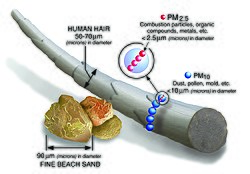
Types of atmospheric particles include suspended particulate matter; thoracic and respirable particles; inhalable coarse particles, designated PM10, which are coarse particles with a diameter of 10 micrometers (μm) or less; fine particles, designated PM2.5, with a diameter of 2.5 μm or less; ultrafine particles, with a diameter of 100 nm or less; and soot.
Airborne particulate matter is a Group 1 carcinogen. Particulates are the most harmful form of air pollution as they can penetrate deep into the lungs and brain from blood streams, causing health problems such as stroke, heart disease, lung disease, cancer and preterm birth. There is no safe level of particulates. Worldwide, exposure to PM2.5 contributed to 7.8 million deaths in 2021, and of which 4.7 million from outdoor air pollution and the remainder from household air pollution. Overall, ambient particulate matter is one of the leading risk factor for premature death globally.
Human activities generate significant amounts of particulates. For example:
Some types of dust, e.g., ashes, soot, paint, glass, plastic and dust from certain man-made fibres, which are brittle and break easily (can fragment and "proliferate"), can pose greater threats and irritations to humans. Those with sharp edges may be even more problematic. The number, shapes, stickiness, etc. of particulates may also be altered by different meteorological conditions.
Human-made (anthropogenic) aerosols account for about 10 percent of the total mass of aerosols in the atmosphere as estimated in 2010. The remaining 90 percent comes from natural sources such as volcanoes, dust storms, forest and grassland fires, living vegetation and sea spray, emitting particulates such as volcanic ash, desert dust, soot and sea salt.
In the United Kingdom domestic combustion is the largest single source of PM2.5 and PM10 annually, with domestic wood burning in both closed stoves and open fires responsible for 38% of PM2.5 in 2019. To tackle the problem some new laws were introduced since 2021. In some towns and cities in New South Wales wood smoke may be responsible for 60% of fine particle air pollution in the winter.
There are a few ways to reduce wood smoke, e.g., buying the right wood heater and maintaining it well, choosing the right firewood and burning it the right way. There are also regulations in some countries where people can report smoke pollution to the local council.
Particulate matter
Particulate matter (PM) or particulates are microscopic particles of solid or liquid matter suspended in the air. An aerosol is a mixture of particulates and air, as opposed to the particulate matter alone, though it is sometimes defined as a subset of aerosol terminology. Sources of particulate matter can be natural or anthropogenic. Particulates have impacts on climate and precipitation that adversely affect human health.
Types of atmospheric particles include suspended particulate matter; thoracic and respirable particles; inhalable coarse particles, designated PM10, which are coarse particles with a diameter of 10 micrometers (μm) or less; fine particles, designated PM2.5, with a diameter of 2.5 μm or less; ultrafine particles, with a diameter of 100 nm or less; and soot.
Airborne particulate matter is a Group 1 carcinogen. Particulates are the most harmful form of air pollution as they can penetrate deep into the lungs and brain from blood streams, causing health problems such as stroke, heart disease, lung disease, cancer and preterm birth. There is no safe level of particulates. Worldwide, exposure to PM2.5 contributed to 7.8 million deaths in 2021, and of which 4.7 million from outdoor air pollution and the remainder from household air pollution. Overall, ambient particulate matter is one of the leading risk factor for premature death globally.
Human activities generate significant amounts of particulates. For example:
Some types of dust, e.g., ashes, soot, paint, glass, plastic and dust from certain man-made fibres, which are brittle and break easily (can fragment and "proliferate"), can pose greater threats and irritations to humans. Those with sharp edges may be even more problematic. The number, shapes, stickiness, etc. of particulates may also be altered by different meteorological conditions.
Human-made (anthropogenic) aerosols account for about 10 percent of the total mass of aerosols in the atmosphere as estimated in 2010. The remaining 90 percent comes from natural sources such as volcanoes, dust storms, forest and grassland fires, living vegetation and sea spray, emitting particulates such as volcanic ash, desert dust, soot and sea salt.
In the United Kingdom domestic combustion is the largest single source of PM2.5 and PM10 annually, with domestic wood burning in both closed stoves and open fires responsible for 38% of PM2.5 in 2019. To tackle the problem some new laws were introduced since 2021. In some towns and cities in New South Wales wood smoke may be responsible for 60% of fine particle air pollution in the winter.
There are a few ways to reduce wood smoke, e.g., buying the right wood heater and maintaining it well, choosing the right firewood and burning it the right way. There are also regulations in some countries where people can report smoke pollution to the local council.
Recent media
Recent media