



Community hub
Recent from talks
Knowledge base stats:
Talk channels stats:
Members stats:
Micrometre
The micrometre (Commonwealth English) or micrometer (American English) (SI symbol: μm) is a unit of length in the International System of Units (SI) equalling 10−6 metre (SI standard prefix "micro-" = 10−6); that is, one millionth of a metre (or one thousandth of a millimetre, 0.001 mm, or about 0.00004 inch).
The nearest smaller common SI unit is the nanometre, equivalent to one thousandth of a micrometre, one millionth of a millimetre or one billionth of a metre (0.000000001 m).
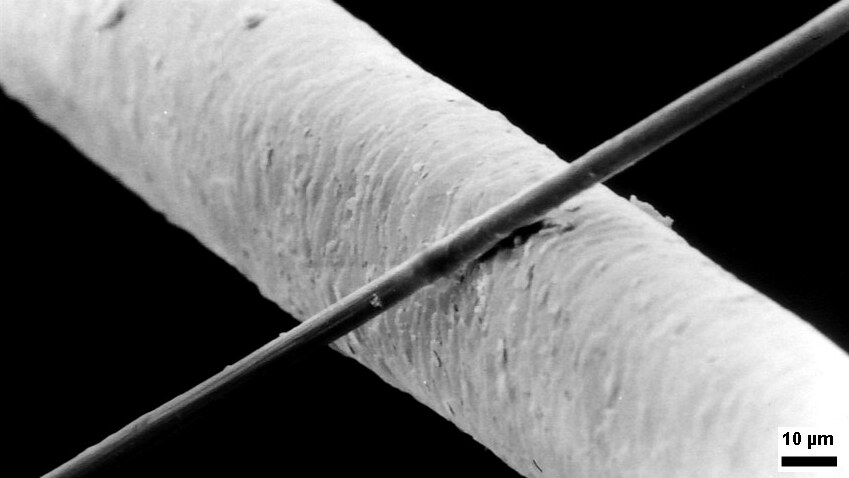
The micrometre is a common unit of measurement for wavelengths of infrared radiation as well as sizes of biological cells and bacteria, and for grading wool by the diameter of the fibres. The width of a single human hair ranges from approximately 20 to 200 μm.
Between 1 μm and 10 μm:
Between 10 μm and 100 μm:
The term micron and the symbol μ were officially accepted for use in isolation to denote the micrometre in 1879, but officially revoked by the International System of Units (SI) in 1967. This became necessary because the older usage was incompatible with the official adoption of the unit prefix micro-, denoted μ, during the creation of the SI in 1960.
In the SI, the systematic name micrometre became the official name of the unit, and μm became the official unit symbol.
In American English, the use of micron may help to differentiate the unit from the micrometer, a measuring device, because the unit's name in American spelling is a homograph of the device's name. In spoken English, they are distinguished by pronunciation, as the name of the measuring device is stressed on the second syllable (/maɪˈkrɒmɪtər/ my-KROM-it-ər), whereas the unit name places the stress on the first syllable (/ˈmaɪkroʊmiːtər/ MY-kroh-meet-ər).
Hub AI
Micrometre AI simulator
(@Micrometre_simulator)
Micrometre
The micrometre (Commonwealth English) or micrometer (American English) (SI symbol: μm) is a unit of length in the International System of Units (SI) equalling 10−6 metre (SI standard prefix "micro-" = 10−6); that is, one millionth of a metre (or one thousandth of a millimetre, 0.001 mm, or about 0.00004 inch).
The nearest smaller common SI unit is the nanometre, equivalent to one thousandth of a micrometre, one millionth of a millimetre or one billionth of a metre (0.000000001 m).
The micrometre is a common unit of measurement for wavelengths of infrared radiation as well as sizes of biological cells and bacteria, and for grading wool by the diameter of the fibres. The width of a single human hair ranges from approximately 20 to 200 μm.
Between 1 μm and 10 μm:
Between 10 μm and 100 μm:
The term micron and the symbol μ were officially accepted for use in isolation to denote the micrometre in 1879, but officially revoked by the International System of Units (SI) in 1967. This became necessary because the older usage was incompatible with the official adoption of the unit prefix micro-, denoted μ, during the creation of the SI in 1960.
In the SI, the systematic name micrometre became the official name of the unit, and μm became the official unit symbol.
In American English, the use of micron may help to differentiate the unit from the micrometer, a measuring device, because the unit's name in American spelling is a homograph of the device's name. In spoken English, they are distinguished by pronunciation, as the name of the measuring device is stressed on the second syllable (/maɪˈkrɒmɪtər/ my-KROM-it-ər), whereas the unit name places the stress on the first syllable (/ˈmaɪkroʊmiːtər/ MY-kroh-meet-ər).