
Recent from talks
Finnish Lakeland
Knowledge base stats:
Talk channels stats:
Members stats:
Finnish Lakeland
Finnish Lakeland or the Finnish lake district (Finnish: Järvi-Suomi [ˈjærʋiˌsuo̯mi], "Lake Finland", Swedish: Insjöfinland) is a large landscape region in central eastern Finland.
The hilly, forest-covered landscape of Lakeland Finland's lake plateau is dominated by drumlins and by long sinuous eskers. Both are glacial remnants deposited after the continental glaciers that scoured and gouged the country's surface receded about 10,000 years ago.
The lake basins of the lakeland originate from the joint work of weathering and erosion of fractures in the bedrock. The erosion that made the depressions occurred before and during the Quaternary ice ages. Erosion along fractures has produced linear inlets among the lakes.
The district occupies most of central and East Finland and is bounded to the south by the Salpausselkä Ridges. These ridges are terminal moraines, which trap networks of thousands of lakes separated by hilly forested countryside.
The lake district turns into the Coastal Finland district to the West and Northwest, and is bounded by the Upland Finland to the North.
The lake landscape continues to the East and extends into Russia (Karelian Isthmus and Republic of Karelia).
Finnish Lakeland stretches approximately 370 kilometers from south to north and about 350 kilometers from east to west.
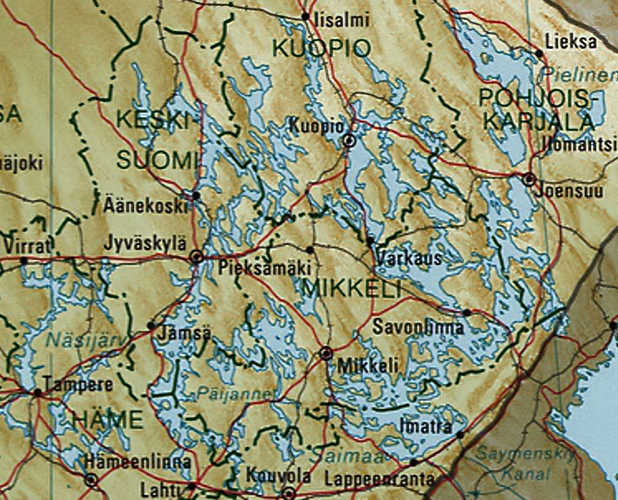
Lakes occupy about 25% of the Lakeland. Much of the territory is forested and has a low population density. The main cities in the region are Imatra, Joensuu, Jyväskylä, Kuopio, Lappeenranta, Mikkeli, Pieksämäki, Savonlinna and Varkaus. Since lakes formed the main transport route in earlier times, urban areas are often located on lakeshore, occasionally even on isthmuses or peninsulas, e.g. Varkaus, Savonlinna and Kuopio. The lakes often have extremely convoluted coastlines and consist of several nearly separate stretches of open water (selkä) connected by narrow sounds. Thus, they can connect large areas along shores and their hinterlands.
Hub AI
Finnish Lakeland AI simulator
(@Finnish Lakeland_simulator)
Finnish Lakeland
Finnish Lakeland or the Finnish lake district (Finnish: Järvi-Suomi [ˈjærʋiˌsuo̯mi], "Lake Finland", Swedish: Insjöfinland) is a large landscape region in central eastern Finland.
The hilly, forest-covered landscape of Lakeland Finland's lake plateau is dominated by drumlins and by long sinuous eskers. Both are glacial remnants deposited after the continental glaciers that scoured and gouged the country's surface receded about 10,000 years ago.
The lake basins of the lakeland originate from the joint work of weathering and erosion of fractures in the bedrock. The erosion that made the depressions occurred before and during the Quaternary ice ages. Erosion along fractures has produced linear inlets among the lakes.
The district occupies most of central and East Finland and is bounded to the south by the Salpausselkä Ridges. These ridges are terminal moraines, which trap networks of thousands of lakes separated by hilly forested countryside.
The lake district turns into the Coastal Finland district to the West and Northwest, and is bounded by the Upland Finland to the North.
The lake landscape continues to the East and extends into Russia (Karelian Isthmus and Republic of Karelia).
Finnish Lakeland stretches approximately 370 kilometers from south to north and about 350 kilometers from east to west.
Lakes occupy about 25% of the Lakeland. Much of the territory is forested and has a low population density. The main cities in the region are Imatra, Joensuu, Jyväskylä, Kuopio, Lappeenranta, Mikkeli, Pieksämäki, Savonlinna and Varkaus. Since lakes formed the main transport route in earlier times, urban areas are often located on lakeshore, occasionally even on isthmuses or peninsulas, e.g. Varkaus, Savonlinna and Kuopio. The lakes often have extremely convoluted coastlines and consist of several nearly separate stretches of open water (selkä) connected by narrow sounds. Thus, they can connect large areas along shores and their hinterlands.
Recent media