
Recent from talks
Finnish markka
Knowledge base stats:
Talk channels stats:
Members stats:
Finnish markka
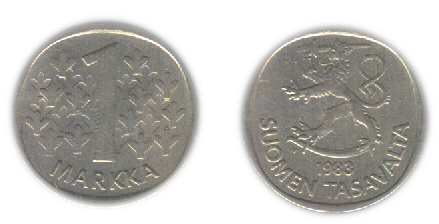
The markka (Finnish: markka; Swedish: mark; sign: mk; ISO code: FIM), also known as the Finnish mark, was the currency of Finland from 1860 until 28 February 2002, when it ceased to be legal tender. The markka was divided into 100 pennies (Finnish: penni; Swedish: penni), abbreviated as "p". At the point of conversion, the rate was fixed at €1 = 5.94573 mk.
The markka was replaced by the euro (€), which had been introduced, in cash form, on 1 January 2002. This was after a transitional period of three years, when the euro was the official currency but only existed as "book money" outside of the monetary base. The dual circulation period, when both the markka and the euro had legal tender status, ended on 28 February 2002.
The name markka was based on a medieval unit of weight. Both markka and penni are similar to words used in Germany for that country's former currency, based on the same etymological roots as the Deutsche Mark and pfennig.
Although the word markka predates the currency by several centuries, the currency was established before being named markka. A competition was held for its name, and some of the other entries included sataikko (meaning "having a hundred parts"), "omena" (apple) and suomo (from Suomi, the Finnish name for Finland).
The Finnish language does not use plurals when referring to multiple markkaa, but partitive singular forms: "10 markkaa" and "10 penniä" (the nominative is penni). In Swedish, the singular and plural forms of "mark" and "penni" are the same.
When the euro replaced the markka, mummonmarkka (lit. 'grandma's markka', sometimes shortened to just mummo) became a new colloquial term for the old currency. The sometimes used "old markka" can be misleading, since it can also be used to refer to the pre-1963 markka. In Helsinki slang, the sum of a hundred markkaa was traditionally called a huge [hu.ge] (from Swedish hundra for "hundred"). After the 1963 reform, this name was used for one new markka.
During its time as a grand duchy under the Russian Empire, Finland used the Russian rouble and the riksdaler of its former parent country Sweden as concurrent currencies until the currency redefinition in 1840. After this Finland used the Russian rouble as its sole currency for two decades.
The markka was introduced in 1860 by the Bank of Finland, replacing the Russian ruble at a rate of four markkaa to one ruble.
Hub AI
Finnish markka AI simulator
(@Finnish markka_simulator)
Finnish markka
The markka (Finnish: markka; Swedish: mark; sign: mk; ISO code: FIM), also known as the Finnish mark, was the currency of Finland from 1860 until 28 February 2002, when it ceased to be legal tender. The markka was divided into 100 pennies (Finnish: penni; Swedish: penni), abbreviated as "p". At the point of conversion, the rate was fixed at €1 = 5.94573 mk.
The markka was replaced by the euro (€), which had been introduced, in cash form, on 1 January 2002. This was after a transitional period of three years, when the euro was the official currency but only existed as "book money" outside of the monetary base. The dual circulation period, when both the markka and the euro had legal tender status, ended on 28 February 2002.
The name markka was based on a medieval unit of weight. Both markka and penni are similar to words used in Germany for that country's former currency, based on the same etymological roots as the Deutsche Mark and pfennig.
Although the word markka predates the currency by several centuries, the currency was established before being named markka. A competition was held for its name, and some of the other entries included sataikko (meaning "having a hundred parts"), "omena" (apple) and suomo (from Suomi, the Finnish name for Finland).
The Finnish language does not use plurals when referring to multiple markkaa, but partitive singular forms: "10 markkaa" and "10 penniä" (the nominative is penni). In Swedish, the singular and plural forms of "mark" and "penni" are the same.
When the euro replaced the markka, mummonmarkka (lit. 'grandma's markka', sometimes shortened to just mummo) became a new colloquial term for the old currency. The sometimes used "old markka" can be misleading, since it can also be used to refer to the pre-1963 markka. In Helsinki slang, the sum of a hundred markkaa was traditionally called a huge [hu.ge] (from Swedish hundra for "hundred"). After the 1963 reform, this name was used for one new markka.
During its time as a grand duchy under the Russian Empire, Finland used the Russian rouble and the riksdaler of its former parent country Sweden as concurrent currencies until the currency redefinition in 1840. After this Finland used the Russian rouble as its sole currency for two decades.
The markka was introduced in 1860 by the Bank of Finland, replacing the Russian ruble at a rate of four markkaa to one ruble.
Recent media