
Recent from talks
First Anglo-Burmese War
Knowledge base stats:
Talk channels stats:
Members stats:
First Anglo-Burmese War
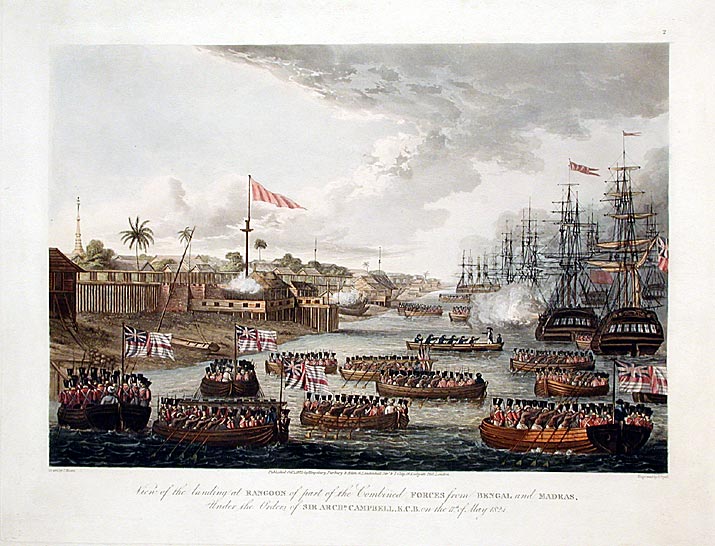
The First Anglo-Burmese War (Burmese: ပထမအင်္ဂလိပ်-မြန်မာစစ်; [pətʰəma̰ ɪ́ɰ̃ɡəleiʔ-mjəmà sɪʔ]; 5 March 1824 – 24 February 1826), also known as the First Burma War in English language accounts and First English Invasion War (Burmese: ပထမအင်္ဂလိပ်ကျူးကျော်စစ်) in Burmese language accounts, was the first of three wars fought between the British and Burmese empires in the 19th century. The war, which began primarily over the control of what is now Northeastern India, ended in a costly but decisive British victory, giving the British total control of Assam, Cachar, Manipur and Jaintia as well as Arakan Province and Tenasserim. The Burmese submitted to a British demand to pay an indemnity of one million pounds sterling, and signed a commercial treaty.
The war was one of the most expensive in British Indian history. 15,000 British soldiers died, together with an unknown number of Burmese military and civilian casualties. The high cost of the campaign to the British, 5–13 million pounds sterling (£500 million – £1.38 billion as of 2023) contributed to a severe economic crisis in British India which cost the East India Company its remaining privileges.
Although once strong enough to threaten the interests of the British East India Company (especially with respect to the eastern border regions of Assam, Manipur, and Arakan), the Burmese Empire now suffered "the beginning of the end" of its status as an independent nation. They would be economically burdened for years to come by the cost of the indemnity. The British, eventually waging the Second and Third Anglo-Burmese Wars against a much-weakened Burma, would assume control of the entire country by 1885.
By 1822, Burmese expansion into Manipur and Assam and its "forward policy" of probing into the hill states of Jaintia and Cachar, had put pressure on British Bengal. Calcutta unilaterally declared Cachar and Jaintia British protectorates and sent in troops.
Cross-border raids into these newly acquired territories from British territories and spheres of influence vexed the Burmese. Convinced that war was inevitable, Burmese commander-in-chief Maha Bandula became the main proponent of offensive policy against the British. Bandula was part of the war party at Bagyidaw's court, which also included Queen Me Nu and her brother, the Lord of Salin. Bandula believed that a decisive victory could allow Ava to consolidate its gains in its new western empire in Arakan, Manipur, Assam, Cachar, and Jaintia, as well as take over eastern Bengal.
In September 1823, the casus belli was British and Burmese forces clashing to claim Shalpuri Island near Chittagong. The Burmese considered the British sepoys raising their flag as a provocation which in turn led to Burmese troops attacking the sepoys and driving them out. The British considered the attack as unprovoked and Burmese occupation as war.
In January 1824, Burma sent one of their top generals, Thado Thiri Maha Uzana, into Cachar and Jaintia to disperse the rebels. The British sent in their own force to meet the Burmese in Cachar, resulting in the first clashes between the two. The war formally broke out on 5 March 1824, following border clashes in Arakan.
The British reason for the war was, in addition to expanding British Bengal's sphere of influence, the desire for new markets for British manufacturing. The British were also anxious to deny the French the use of Burmese harbours and concerned about French influence at the Court of Ava, as the kingdom was still known to them. British Ambassador Michael Symes's mission was equipped to gain as much knowledge as possible of the country for future British plans whereas previous envoys were concerned principally with trade concessions.[citation needed]
Hub AI
First Anglo-Burmese War AI simulator
(@First Anglo-Burmese War_simulator)
First Anglo-Burmese War
The First Anglo-Burmese War (Burmese: ပထမအင်္ဂလိပ်-မြန်မာစစ်; [pətʰəma̰ ɪ́ɰ̃ɡəleiʔ-mjəmà sɪʔ]; 5 March 1824 – 24 February 1826), also known as the First Burma War in English language accounts and First English Invasion War (Burmese: ပထမအင်္ဂလိပ်ကျူးကျော်စစ်) in Burmese language accounts, was the first of three wars fought between the British and Burmese empires in the 19th century. The war, which began primarily over the control of what is now Northeastern India, ended in a costly but decisive British victory, giving the British total control of Assam, Cachar, Manipur and Jaintia as well as Arakan Province and Tenasserim. The Burmese submitted to a British demand to pay an indemnity of one million pounds sterling, and signed a commercial treaty.
The war was one of the most expensive in British Indian history. 15,000 British soldiers died, together with an unknown number of Burmese military and civilian casualties. The high cost of the campaign to the British, 5–13 million pounds sterling (£500 million – £1.38 billion as of 2023) contributed to a severe economic crisis in British India which cost the East India Company its remaining privileges.
Although once strong enough to threaten the interests of the British East India Company (especially with respect to the eastern border regions of Assam, Manipur, and Arakan), the Burmese Empire now suffered "the beginning of the end" of its status as an independent nation. They would be economically burdened for years to come by the cost of the indemnity. The British, eventually waging the Second and Third Anglo-Burmese Wars against a much-weakened Burma, would assume control of the entire country by 1885.
By 1822, Burmese expansion into Manipur and Assam and its "forward policy" of probing into the hill states of Jaintia and Cachar, had put pressure on British Bengal. Calcutta unilaterally declared Cachar and Jaintia British protectorates and sent in troops.
Cross-border raids into these newly acquired territories from British territories and spheres of influence vexed the Burmese. Convinced that war was inevitable, Burmese commander-in-chief Maha Bandula became the main proponent of offensive policy against the British. Bandula was part of the war party at Bagyidaw's court, which also included Queen Me Nu and her brother, the Lord of Salin. Bandula believed that a decisive victory could allow Ava to consolidate its gains in its new western empire in Arakan, Manipur, Assam, Cachar, and Jaintia, as well as take over eastern Bengal.
In September 1823, the casus belli was British and Burmese forces clashing to claim Shalpuri Island near Chittagong. The Burmese considered the British sepoys raising their flag as a provocation which in turn led to Burmese troops attacking the sepoys and driving them out. The British considered the attack as unprovoked and Burmese occupation as war.
In January 1824, Burma sent one of their top generals, Thado Thiri Maha Uzana, into Cachar and Jaintia to disperse the rebels. The British sent in their own force to meet the Burmese in Cachar, resulting in the first clashes between the two. The war formally broke out on 5 March 1824, following border clashes in Arakan.
The British reason for the war was, in addition to expanding British Bengal's sphere of influence, the desire for new markets for British manufacturing. The British were also anxious to deny the French the use of Burmese harbours and concerned about French influence at the Court of Ava, as the kingdom was still known to them. British Ambassador Michael Symes's mission was equipped to gain as much knowledge as possible of the country for future British plans whereas previous envoys were concerned principally with trade concessions.[citation needed]
Recent media