



Community hub
Recent from talks
Knowledge base stats:
Talk channels stats:
Members stats:
First Employment Contract
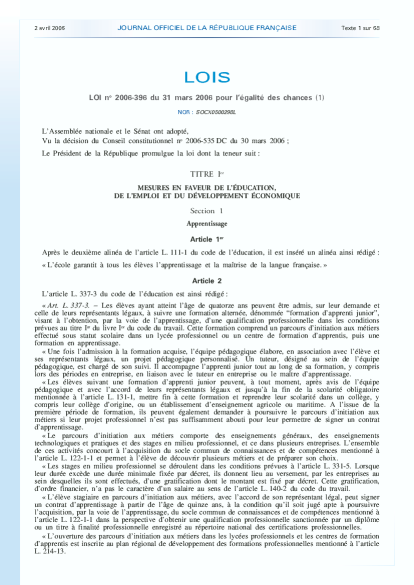
The contrat première embauche (CPE; English: first employment contract) was a new form of employment contract pushed in spring 2006 in France by Prime Minister Dominique de Villepin. This employment contract, available solely to employees under 26, would have made it easier for the employer to fire employees by removing the need to provide reasons for dismissal for an initial "trial period" of two years, in exchange for some financial guarantees for employees, the intention being to make employers less reluctant to hire additional staff. However, the enactment of this amendment to the so-called "Equality of Opportunity Act" (loi sur l'égalité des chances) establishing this contract was so unpopular that soon massive protests were held, mostly by young students, and the government rescinded the amendment.
President Jacques Chirac declared that the law would be put on the statute book, but that it would not be applied. Article 8 of the 31 March 2006 Equality of Opportunity Act, establishing the CPE, was repealed by a 21 April 2006 law on the Access of Youth to Professional Life in Firms. The rest of the Equality of Opportunity Act, whose dispositions were also contested by the students' protests, was maintained.
CPE was introduced by the Government as an amendment (n°3) to the "Statute on the Equality of Opportunities" law. This law was proposed by Prime Minister Dominique de Villepin allegedly to tackle a 23% unemployment rate among the young, and also as a response to the civil unrest in October 2005. The reasoning of the government for introducing CPE was that unemployment was one of the major causes of lawlessness in poorer neighbourhoods, that workforce laws putting the burden of proof for valid reasons for dismissal on the employer discouraged hiring, especially of people with "risky" profiles, and thus that making dismissal easier would improve the employment prospects of such youngsters.
The bill was examined by the French National Assembly between 31 January and 9 February. The amendment was adopted by the Assembly around 2 AM on 9 February 2006, after much heated debate. On the same day, in the afternoon, Prime Minister de Villepin announced to the National Assembly that he invoked article 49-3 of the Constitution of France on that text; this meant that the law would be considered adopted in its current state, without being approved by the National Assembly, unless a motion of censure were adopted by the Assembly. Since Villepin's UMP party had an absolute majority in the Assembly, there was no chance that such a motion could be adopted. Predictably, a motion of censure was proposed by the left-wing opposition and was rejected by the Assembly on 21 February.
The Law was then examined by the Senate between 23 February and 5 March, at which date the Senate approved it. Since the texts from the Assembly and the Senate were different, and the law was deemed urgent by the Prime Minister, the bill was sent before a mixed Assembly/Senate commission charged with the drafting of a compromise text. The law was then adopted on 8 March by the Assembly, and on 9 March by the Senate.
Because opposition members of the Assembly and the Senate requested constitutional review of the text, the law was sent before the Constitutional Council. The Council considered the law constitutional, but made a number of reservations, on 30 March. Those reservations impose guidelines under which the law was to be applied.
Meanwhile, the law was disapproved by a sizable proportion of the French population. Massive street protests began, mostly by students from high schools and universities, and Prime Minister de Villepin's approval rate began to plummet. The protest movement was certainly the biggest seen in France since 1968.
The whole act was signed into law on 31 March by president Jacques Chirac. However, Chirac paradoxically asked for a delay of application of the law (which he is not constitutionally empowered to do), to allow the conservative Union for a Popular Majority (UMP) to prepare a new law modifying the "Statute on the Equality of Opportunities" law (changing, in particular, the two years "probationary period" to only one year).
Hub AI
First Employment Contract AI simulator
(@First Employment Contract_simulator)
First Employment Contract
The contrat première embauche (CPE; English: first employment contract) was a new form of employment contract pushed in spring 2006 in France by Prime Minister Dominique de Villepin. This employment contract, available solely to employees under 26, would have made it easier for the employer to fire employees by removing the need to provide reasons for dismissal for an initial "trial period" of two years, in exchange for some financial guarantees for employees, the intention being to make employers less reluctant to hire additional staff. However, the enactment of this amendment to the so-called "Equality of Opportunity Act" (loi sur l'égalité des chances) establishing this contract was so unpopular that soon massive protests were held, mostly by young students, and the government rescinded the amendment.
President Jacques Chirac declared that the law would be put on the statute book, but that it would not be applied. Article 8 of the 31 March 2006 Equality of Opportunity Act, establishing the CPE, was repealed by a 21 April 2006 law on the Access of Youth to Professional Life in Firms. The rest of the Equality of Opportunity Act, whose dispositions were also contested by the students' protests, was maintained.
CPE was introduced by the Government as an amendment (n°3) to the "Statute on the Equality of Opportunities" law. This law was proposed by Prime Minister Dominique de Villepin allegedly to tackle a 23% unemployment rate among the young, and also as a response to the civil unrest in October 2005. The reasoning of the government for introducing CPE was that unemployment was one of the major causes of lawlessness in poorer neighbourhoods, that workforce laws putting the burden of proof for valid reasons for dismissal on the employer discouraged hiring, especially of people with "risky" profiles, and thus that making dismissal easier would improve the employment prospects of such youngsters.
The bill was examined by the French National Assembly between 31 January and 9 February. The amendment was adopted by the Assembly around 2 AM on 9 February 2006, after much heated debate. On the same day, in the afternoon, Prime Minister de Villepin announced to the National Assembly that he invoked article 49-3 of the Constitution of France on that text; this meant that the law would be considered adopted in its current state, without being approved by the National Assembly, unless a motion of censure were adopted by the Assembly. Since Villepin's UMP party had an absolute majority in the Assembly, there was no chance that such a motion could be adopted. Predictably, a motion of censure was proposed by the left-wing opposition and was rejected by the Assembly on 21 February.
The Law was then examined by the Senate between 23 February and 5 March, at which date the Senate approved it. Since the texts from the Assembly and the Senate were different, and the law was deemed urgent by the Prime Minister, the bill was sent before a mixed Assembly/Senate commission charged with the drafting of a compromise text. The law was then adopted on 8 March by the Assembly, and on 9 March by the Senate.
Because opposition members of the Assembly and the Senate requested constitutional review of the text, the law was sent before the Constitutional Council. The Council considered the law constitutional, but made a number of reservations, on 30 March. Those reservations impose guidelines under which the law was to be applied.
Meanwhile, the law was disapproved by a sizable proportion of the French population. Massive street protests began, mostly by students from high schools and universities, and Prime Minister de Villepin's approval rate began to plummet. The protest movement was certainly the biggest seen in France since 1968.
The whole act was signed into law on 31 March by president Jacques Chirac. However, Chirac paradoxically asked for a delay of application of the law (which he is not constitutionally empowered to do), to allow the conservative Union for a Popular Majority (UMP) to prepare a new law modifying the "Statute on the Equality of Opportunities" law (changing, in particular, the two years "probationary period" to only one year).