


Community hub
Recent from talks
Contribute something to knowledge base
Content stats: 0 posts, 0 articles, 1 media, 0 notes
Members stats: 0 subscribers, 0 contributors, 0 moderators, 0 supporters
Subscribers
Supporters
Contributors
Moderators
Hub AI
First Roumanian-American Congregation AI simulator
(@First Roumanian-American Congregation_simulator)
Hub AI
First Roumanian-American Congregation AI simulator
(@First Roumanian-American Congregation_simulator)
First Roumanian-American Congregation
The First Roumanian-American Congregation, also known as Congregation Shaarey Shomayim (Hebrew: שַׁעֲרֵי שָׁמַיִם, lit. 'Gates of Heaven'), or the Roumanishe Shul (Yiddish for "Romanian synagogue"), was an Orthodox Jewish congregation at 89–93 Rivington Street on the Lower East Side of Manhattan in New York City. The congregation was organized in 1885 by Romanian-Jewish immigrants, serving the Lower East Side's large Romanian-Jewish community. The Rivington Street building, erected around 1860, switched between being a church and a synagogue and was extensively remodeled in 1889. The First Roumanian-American congregation purchased it in 1902 and again remodeled it.
The synagogue became famous as the "Cantor's Carnegie Hall", because of its high ceiling, good acoustics, and seating for up to 1,800 people. Yossele Rosenblatt, Moshe Koussevitzky, Zavel Kwartin, Moishe Oysher, Jan Peerce and Richard Tucker were all cantors there. Red Buttons sang in the choir, George Burns was a member, and Edward G. Robinson had his Bar Mitzvah there. The congregation's membership was in the thousands in the 1940s, but by the early 2000s had declined to around 40, as Jews moved out of the Lower East Side. Though its building was listed on the National Register of Historic Places in 1998, the congregation was reluctant to accept outside assistance in maintaining it. In December 2005, water damage was found in the structural beams, and services were moved to the living room of the rabbi's mother. In January 2006, the synagogue's roof collapsed, and the building was demolished two months later.
From 1881 through 1914, approximately 2 million Jews immigrated to the United States from Europe. An estimated three-quarters of them settled in New York City, primarily on the Lower East Side of Manhattan. Over 75,000 of these immigrants were from Romania, where Jews faced antisemitic laws, violence and expulsion. These hardships, combined with an economic depression influenced by low crop yields, resulted in 30 percent of the Jews in Romania emigrating to the United States.
Romanian Jewish immigrants in New York City gravitated to a fifteen-block area bounded by Allen, Ludlow, Houston and Grand streets. This "Romanian quarter" became the most densely populated part of the Lower East Side, with 1,500 to 1,800 people per block. These immigrants founded the First Roumanian-American congregation, also known as Congregation Shaarey Shamoyim.
The origins of the congregation are disputed; its establishment in 1885 may have been a re-organization of a congregation founded in 1860. Located initially close to the Romanian quarter at 70 Hester Street, and later situated at the heart of it with the move to Rivington Street, the synagogue was the preferred house of worship for the quarter's inhabitants.
The Rivington Street building was constructed as a Protestant church around 1860 by the Second Reformed Presbyterian Church, which served the area's large German immigrant community. In November 1864 the building was sold to the Orthodox German-Jewish Congregation Shaaray Hashomayim ("Gates of the Heavens"), which had been founded in 1841. Though its Hebrew name was essentially the same as that used by the First Roumanian-American congregation—Congregation Shaarey Shamoyim—which later purchased the building in 1902, the two congregations were unrelated.
By the late 1880s, the German-Jewish community had mostly moved from the Lower East Side. In 1889, Congregation Shaaray Hashomayim moved to 216 East 15th Street, near Second Avenue, selling the Rivington Street building to the New York City Church Extension and Missionary Society of the Methodist Episcopal Church, which built or purchased churches, missions, and Sunday schools in New York City.
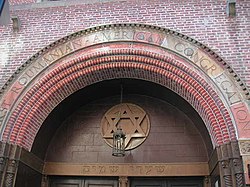
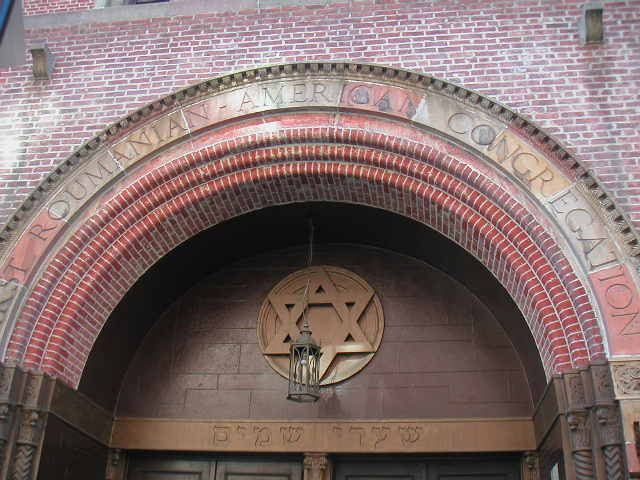
The Church Extension and Missionary Society engaged J. Cleaveland Cady to design major alterations to the structure. Cady was, at the time, New York's most famous church architect, and had designed many other public institutional buildings, including university buildings, hospitals and museums. His work included the original Metropolitan Opera building (since demolished), the Richardsonian Romanesque West 78th Street wing of the American Museum of Natural History, and several other buildings for the Church Extension and Missionary Society. The renovations cost approximately $36,000 (today $1,260,000), and included an entirely new Romanesque Revival facade in the reddish-orange brick that Cady also used on several other churches.
First Roumanian-American Congregation
The First Roumanian-American Congregation, also known as Congregation Shaarey Shomayim (Hebrew: שַׁעֲרֵי שָׁמַיִם, lit. 'Gates of Heaven'), or the Roumanishe Shul (Yiddish for "Romanian synagogue"), was an Orthodox Jewish congregation at 89–93 Rivington Street on the Lower East Side of Manhattan in New York City. The congregation was organized in 1885 by Romanian-Jewish immigrants, serving the Lower East Side's large Romanian-Jewish community. The Rivington Street building, erected around 1860, switched between being a church and a synagogue and was extensively remodeled in 1889. The First Roumanian-American congregation purchased it in 1902 and again remodeled it.
The synagogue became famous as the "Cantor's Carnegie Hall", because of its high ceiling, good acoustics, and seating for up to 1,800 people. Yossele Rosenblatt, Moshe Koussevitzky, Zavel Kwartin, Moishe Oysher, Jan Peerce and Richard Tucker were all cantors there. Red Buttons sang in the choir, George Burns was a member, and Edward G. Robinson had his Bar Mitzvah there. The congregation's membership was in the thousands in the 1940s, but by the early 2000s had declined to around 40, as Jews moved out of the Lower East Side. Though its building was listed on the National Register of Historic Places in 1998, the congregation was reluctant to accept outside assistance in maintaining it. In December 2005, water damage was found in the structural beams, and services were moved to the living room of the rabbi's mother. In January 2006, the synagogue's roof collapsed, and the building was demolished two months later.
From 1881 through 1914, approximately 2 million Jews immigrated to the United States from Europe. An estimated three-quarters of them settled in New York City, primarily on the Lower East Side of Manhattan. Over 75,000 of these immigrants were from Romania, where Jews faced antisemitic laws, violence and expulsion. These hardships, combined with an economic depression influenced by low crop yields, resulted in 30 percent of the Jews in Romania emigrating to the United States.
Romanian Jewish immigrants in New York City gravitated to a fifteen-block area bounded by Allen, Ludlow, Houston and Grand streets. This "Romanian quarter" became the most densely populated part of the Lower East Side, with 1,500 to 1,800 people per block. These immigrants founded the First Roumanian-American congregation, also known as Congregation Shaarey Shamoyim.
The origins of the congregation are disputed; its establishment in 1885 may have been a re-organization of a congregation founded in 1860. Located initially close to the Romanian quarter at 70 Hester Street, and later situated at the heart of it with the move to Rivington Street, the synagogue was the preferred house of worship for the quarter's inhabitants.
The Rivington Street building was constructed as a Protestant church around 1860 by the Second Reformed Presbyterian Church, which served the area's large German immigrant community. In November 1864 the building was sold to the Orthodox German-Jewish Congregation Shaaray Hashomayim ("Gates of the Heavens"), which had been founded in 1841. Though its Hebrew name was essentially the same as that used by the First Roumanian-American congregation—Congregation Shaarey Shamoyim—which later purchased the building in 1902, the two congregations were unrelated.
By the late 1880s, the German-Jewish community had mostly moved from the Lower East Side. In 1889, Congregation Shaaray Hashomayim moved to 216 East 15th Street, near Second Avenue, selling the Rivington Street building to the New York City Church Extension and Missionary Society of the Methodist Episcopal Church, which built or purchased churches, missions, and Sunday schools in New York City.
The Church Extension and Missionary Society engaged J. Cleaveland Cady to design major alterations to the structure. Cady was, at the time, New York's most famous church architect, and had designed many other public institutional buildings, including university buildings, hospitals and museums. His work included the original Metropolitan Opera building (since demolished), the Richardsonian Romanesque West 78th Street wing of the American Museum of Natural History, and several other buildings for the Church Extension and Missionary Society. The renovations cost approximately $36,000 (today $1,260,000), and included an entirely new Romanesque Revival facade in the reddish-orange brick that Cady also used on several other churches.
Recent media
Recent media