



Community hub
Recent from talks
Contribute something to knowledge base
Content stats: 0 posts, 0 articles, 1 media, 0 notes
Members stats: 0 subscribers, 0 contributors, 0 moderators, 0 supporters
Subscribers
Supporters
Contributors
Moderators
Hub AI
First State National Historical Park AI simulator
(@First State National Historical Park_simulator)
Hub AI
First State National Historical Park AI simulator
(@First State National Historical Park_simulator)
First State National Historical Park
First State National Historical Park is a National Park Service unit which lies primarily in the state of Delaware but which extends partly into Pennsylvania in Chadds Ford. Initially created as First State National Monument by President Barack Obama under the Antiquities Act on March 25, 2013, the park was later redesignated as First State National Historical Park by Congress.
The park covers the early colonial history of Delaware and the role Delaware played in the establishment of the nation, leading up to it being the first state to ratify the U.S. Constitution. It tells the unique story of the early settlement of the Delaware Valley by the Dutch, Swedes, Finns, and English and their relationship with Native Americans. It also seeks to preserve the cultural landscape of the Brandywine River Valley.
Russ Smith, the park's first superintendent, described its mission in part as, "I think it's... the recognition that it's not all about Jamestown and Plymouth Rock. There were 13 different traditions established in the 1600s that came together in 1776. The designation helps shine a light on that story. The way this place differs from other places is the diversity of the settlement. You had Dutch, Swedes, Finns, then the English, the Germans. The Netherlands were like the melting pot of Europe. So you had the Germans there, the French, the Belgians, and all these people were here in the Delaware Valley in the 1600s. You had that diversity and you also had a tradition of tolerance. As I tell people, while Virginia was jailing Baptists and New England was burning Quakers, there was freedom of religion on the Delaware River even before William Penn arrived. There is a common misconception that the English were the only ones who had any kind of representative government, and so that's where we got it. Well, the Netherlands were a Republic. The Swedes were not an absolute monarchy, so there was a tradition of self-determination as well."
The sites contained within the park are:
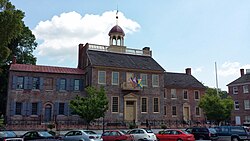
The New Castle Court House, which dates back to 1730, is one of the oldest courthouses in the country and played a role in a number of historic events that shaped the nation. The cupola of the Court House is the center of a 12 mile circle that forms the border between Delaware, Pennsylvania, and Maryland; the most famous attempt to survey these borders, incorporating the circle, was the Mason-Dixon line. The building was used as the meeting place for Delaware's colonial assembly, and was where the assembly voted in favor of independence from both Pennsylvania and England in 1776. The Declaration of Independence was read from the Court House's second floor balcony, and Delaware's first Constitution was drafted and adopted here. U.S. Supreme Court Justice Samuel Chase was impeached over his actions in the Court House during a trial in 1800. In 1848, U.S. Chief Justice Roger Taney presided over a series of trials in the Court House when prominent Quaker abolitionists and Underground Railroad conductors Thomas Garrett and John Hunn were accused of violating the Fugitive Slave Act. The Garrett trial was an inspiration to Harriet Beecher Stowe for certain scenes in Uncle Tom's Cabin.
The New Castle Green was first laid out as a town common in the 1650s by the Dutch colonists who founded New Castle. It is located a block away from the spot where William Penn first arrived in America in 1682, and is bounded by several historic structures, including the Court House, the 1809 federal Arsenal, and the 1703 Immanuel Episcopal Church on the Green where founder George Read is buried. The Sheriff's House, built in 1857, abuts the Court House and will eventually serve as First State National Historical Park's headquarters and Visitor's Center.
The Court House and the Green are owned by the state of Delaware, with the National Park Service owning a conservation easement on them. The Sheriff's House is owned by the National Park Service.
The Dover Green was first laid out as a public space in 1717 by William Penn's surveyors, and has been host to several historic events. The Declaration of Independence was read to the citizens of Dover from the Green in 1776, and it was the site of the mustering of a Continental Army regiment during the Revolution. When the proximity of the British navy threatened New Castle, the state changed its capital city to Dover in 1777, and a State House was built just off the Green in 1787. At a tavern which once stood on the Green, a convention ratified the Constitution on December 7, 1787, making Delaware the first state.
First State National Historical Park
First State National Historical Park is a National Park Service unit which lies primarily in the state of Delaware but which extends partly into Pennsylvania in Chadds Ford. Initially created as First State National Monument by President Barack Obama under the Antiquities Act on March 25, 2013, the park was later redesignated as First State National Historical Park by Congress.
The park covers the early colonial history of Delaware and the role Delaware played in the establishment of the nation, leading up to it being the first state to ratify the U.S. Constitution. It tells the unique story of the early settlement of the Delaware Valley by the Dutch, Swedes, Finns, and English and their relationship with Native Americans. It also seeks to preserve the cultural landscape of the Brandywine River Valley.
Russ Smith, the park's first superintendent, described its mission in part as, "I think it's... the recognition that it's not all about Jamestown and Plymouth Rock. There were 13 different traditions established in the 1600s that came together in 1776. The designation helps shine a light on that story. The way this place differs from other places is the diversity of the settlement. You had Dutch, Swedes, Finns, then the English, the Germans. The Netherlands were like the melting pot of Europe. So you had the Germans there, the French, the Belgians, and all these people were here in the Delaware Valley in the 1600s. You had that diversity and you also had a tradition of tolerance. As I tell people, while Virginia was jailing Baptists and New England was burning Quakers, there was freedom of religion on the Delaware River even before William Penn arrived. There is a common misconception that the English were the only ones who had any kind of representative government, and so that's where we got it. Well, the Netherlands were a Republic. The Swedes were not an absolute monarchy, so there was a tradition of self-determination as well."
The sites contained within the park are:
The New Castle Court House, which dates back to 1730, is one of the oldest courthouses in the country and played a role in a number of historic events that shaped the nation. The cupola of the Court House is the center of a 12 mile circle that forms the border between Delaware, Pennsylvania, and Maryland; the most famous attempt to survey these borders, incorporating the circle, was the Mason-Dixon line. The building was used as the meeting place for Delaware's colonial assembly, and was where the assembly voted in favor of independence from both Pennsylvania and England in 1776. The Declaration of Independence was read from the Court House's second floor balcony, and Delaware's first Constitution was drafted and adopted here. U.S. Supreme Court Justice Samuel Chase was impeached over his actions in the Court House during a trial in 1800. In 1848, U.S. Chief Justice Roger Taney presided over a series of trials in the Court House when prominent Quaker abolitionists and Underground Railroad conductors Thomas Garrett and John Hunn were accused of violating the Fugitive Slave Act. The Garrett trial was an inspiration to Harriet Beecher Stowe for certain scenes in Uncle Tom's Cabin.
The New Castle Green was first laid out as a town common in the 1650s by the Dutch colonists who founded New Castle. It is located a block away from the spot where William Penn first arrived in America in 1682, and is bounded by several historic structures, including the Court House, the 1809 federal Arsenal, and the 1703 Immanuel Episcopal Church on the Green where founder George Read is buried. The Sheriff's House, built in 1857, abuts the Court House and will eventually serve as First State National Historical Park's headquarters and Visitor's Center.
The Court House and the Green are owned by the state of Delaware, with the National Park Service owning a conservation easement on them. The Sheriff's House is owned by the National Park Service.
The Dover Green was first laid out as a public space in 1717 by William Penn's surveyors, and has been host to several historic events. The Declaration of Independence was read to the citizens of Dover from the Green in 1776, and it was the site of the mustering of a Continental Army regiment during the Revolution. When the proximity of the British navy threatened New Castle, the state changed its capital city to Dover in 1777, and a State House was built just off the Green in 1787. At a tavern which once stood on the Green, a convention ratified the Constitution on December 7, 1787, making Delaware the first state.
Recent media
Recent media