
Recent from talks
Fisheries acoustics
Knowledge base stats:
Talk channels stats:
Members stats:
Fisheries acoustics
Fisheries acoustics includes a range of research and practical application topics using acoustical devices as sensors in aquatic environments. Acoustical techniques can be applied to sensing aquatic animals, zooplankton, and physical and biological habitat characteristics.
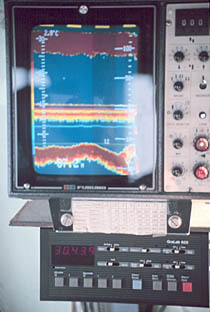
Biomass estimation is a method of detecting and quantifying fish and other marine organisms using sonar technology. An acoustic transducer emits a brief, focused pulse of sound into the water. If the sound encounters objects that are of different density than the surrounding medium, such as fish, they reflect some sound back toward the source. These echoes provide information on fish size, location, and abundance. The basic components of the scientific echo sounder hardware function is to transmit the sound, receive, filter and amplify, record, and analyze the echoes. While there are many manufacturers of commercially available "fish-finders," quantitative analysis requires that measurements be made with calibrated echo sounder equipment, having high signal-to-noise ratios.
An extremely wide variety of fish taxa produce sound. Sound production behavior provides an opportunity to study various aspects of fish biology, such as spawning behavior and habitat selection, in a noninvasive manner. Passive acoustic methods can be an attractive alternative or supplement to traditional fisheries assessment techniques because they are noninvasive, can be conducted at low cost, and can cover a large study area at high spatial and temporal resolution.
Following the First World War, when sonar was first used for the detection of submarines, echo sounders began to find uses outside the military. The French explorer Rallier du Baty reported unexpected midwater echoes, which he attributed to fish schools, in 1927. In 1929, the Japanese scientist Kimura reported disruptions in a continuous acoustic beam by sea bream swimming in an aquaculture pond.
In the early 1930s, two commercial fishermen, Ronald Balls, an Englishman, and Reinert Bokn, a Norwegian, began independently experimenting with echosounders as a means to locate fish. Acoustic traces of sprat schools recorded by Bokn in Frafjord, Norway was the first echogram of fish to be published. In 1935, Norwegian scientist Oscar Sund reported observations of cod schools from the research vessel Johan Hjort, marking the first use of echosounding for fisheries research.
Sonar technologies developed rapidly during the Second World War, and military surplus equipment was adopted by commercial fishers and scientists soon after the end of hostilities. This period saw the first development of instruments designed specifically to detect fish. Large uncertainties persisted in the interpretation of acoustic surveys, however: calibration of instruments was irregular and imprecise, and the sound-scattering properties of fish and other organisms was poorly understood. Beginning in the 1970s and 80s, a series of practical and theoretical investigations began to overcome these limitations. Technological advances such as split-beam echosounders, digital signal processing, and electronic displays also appeared in this period.
At present, acoustic surveys are used in the assessment and management of many fisheries worldwide. Calibrated, split-beam echosounders are the standard equipment. Several acoustic frequencies are often used simultaneously, allowing some discrimination of different types of animals. Technological development continues, including research into multibeam, broadband, and parametric sonars.
When individual targets are spaced far enough apart that they can be distinguished from one another, it is straightforward to estimate the number of fish by counting the number of targets. This type of analysis is called echo counting, and was historically the first to be used for biomass estimation.
Hub AI
Fisheries acoustics AI simulator
(@Fisheries acoustics_simulator)
Fisheries acoustics
Fisheries acoustics includes a range of research and practical application topics using acoustical devices as sensors in aquatic environments. Acoustical techniques can be applied to sensing aquatic animals, zooplankton, and physical and biological habitat characteristics.
Biomass estimation is a method of detecting and quantifying fish and other marine organisms using sonar technology. An acoustic transducer emits a brief, focused pulse of sound into the water. If the sound encounters objects that are of different density than the surrounding medium, such as fish, they reflect some sound back toward the source. These echoes provide information on fish size, location, and abundance. The basic components of the scientific echo sounder hardware function is to transmit the sound, receive, filter and amplify, record, and analyze the echoes. While there are many manufacturers of commercially available "fish-finders," quantitative analysis requires that measurements be made with calibrated echo sounder equipment, having high signal-to-noise ratios.
An extremely wide variety of fish taxa produce sound. Sound production behavior provides an opportunity to study various aspects of fish biology, such as spawning behavior and habitat selection, in a noninvasive manner. Passive acoustic methods can be an attractive alternative or supplement to traditional fisheries assessment techniques because they are noninvasive, can be conducted at low cost, and can cover a large study area at high spatial and temporal resolution.
Following the First World War, when sonar was first used for the detection of submarines, echo sounders began to find uses outside the military. The French explorer Rallier du Baty reported unexpected midwater echoes, which he attributed to fish schools, in 1927. In 1929, the Japanese scientist Kimura reported disruptions in a continuous acoustic beam by sea bream swimming in an aquaculture pond.
In the early 1930s, two commercial fishermen, Ronald Balls, an Englishman, and Reinert Bokn, a Norwegian, began independently experimenting with echosounders as a means to locate fish. Acoustic traces of sprat schools recorded by Bokn in Frafjord, Norway was the first echogram of fish to be published. In 1935, Norwegian scientist Oscar Sund reported observations of cod schools from the research vessel Johan Hjort, marking the first use of echosounding for fisheries research.
Sonar technologies developed rapidly during the Second World War, and military surplus equipment was adopted by commercial fishers and scientists soon after the end of hostilities. This period saw the first development of instruments designed specifically to detect fish. Large uncertainties persisted in the interpretation of acoustic surveys, however: calibration of instruments was irregular and imprecise, and the sound-scattering properties of fish and other organisms was poorly understood. Beginning in the 1970s and 80s, a series of practical and theoretical investigations began to overcome these limitations. Technological advances such as split-beam echosounders, digital signal processing, and electronic displays also appeared in this period.
At present, acoustic surveys are used in the assessment and management of many fisheries worldwide. Calibrated, split-beam echosounders are the standard equipment. Several acoustic frequencies are often used simultaneously, allowing some discrimination of different types of animals. Technological development continues, including research into multibeam, broadband, and parametric sonars.
When individual targets are spaced far enough apart that they can be distinguished from one another, it is straightforward to estimate the number of fish by counting the number of targets. This type of analysis is called echo counting, and was historically the first to be used for biomass estimation.
Recent media