



Community hub
Recent from talks
Knowledge base stats:
Talk channels stats:
Members stats:
Pagrus major
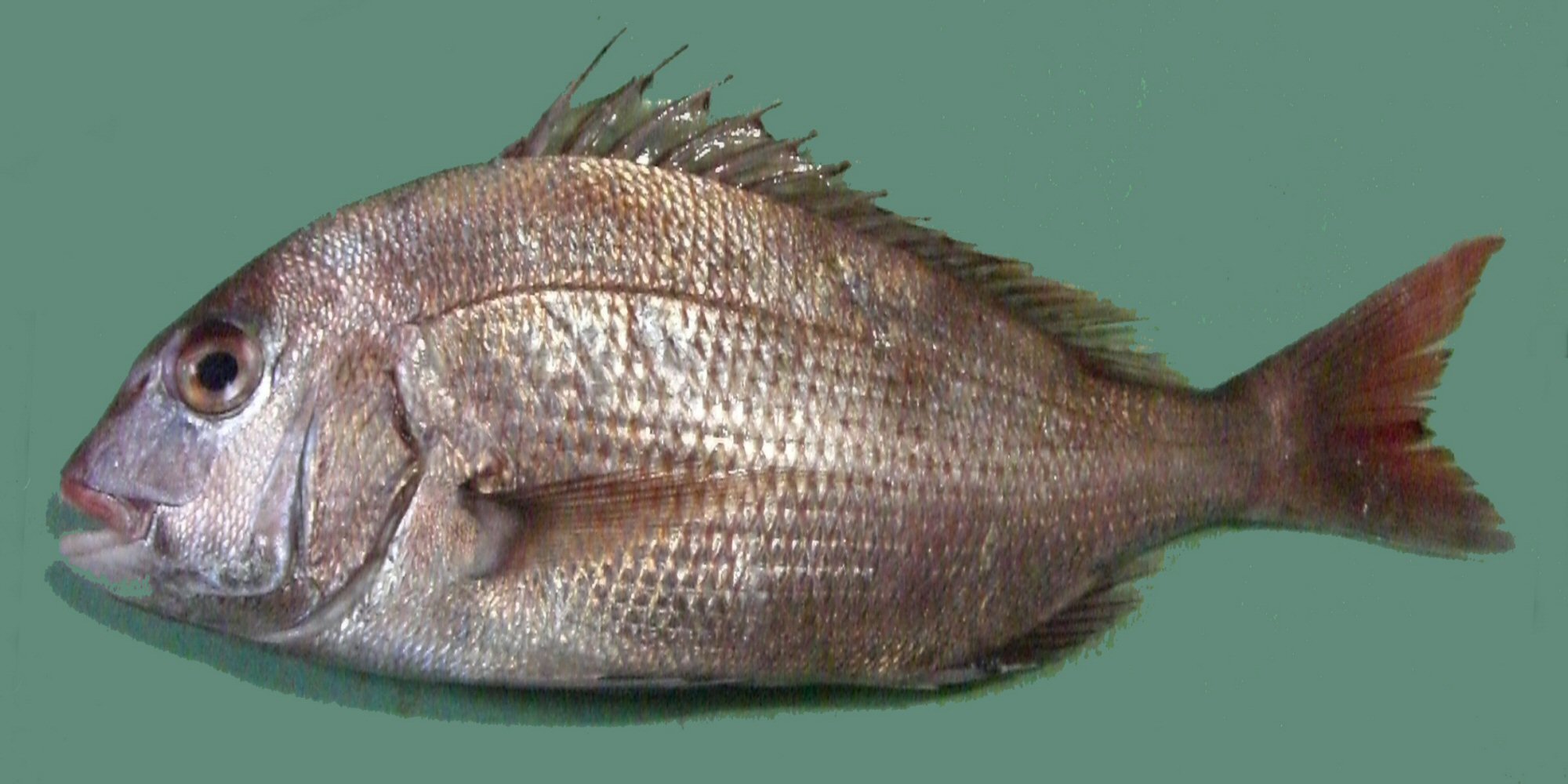
Pagrus major, the red seabream, red pargo, red porgy or silver seabream, is a species of marine ray-finned fish in the family Sparidae, which includes the seabreams and porgies. This species is found in the Western Pacific Ocean. The fish has high culinary and cultural importance in Japan, and is also frequently eaten in Korea and Taiwan.
Pagrus major was first formally described as Chrysophrys major in 1843 by the naturalists Coenraad Jacob Temminck and Hermann Schlegel with its type locality given as all the bays of Japan. The genus Pagrus is placed in the family Sparidae within the order Spariformes by the 5th edition of Fishes of the World. Some authorities classify this genus in the subfamily Sparinae, but the 5th edition of Fishes of the World does not recognise subfamilies within the Sparidae.
Pagrus major has the specific name major, meaning "great". Temminck and Schlegel described this species as the “most common of all the Japanese species of Chrysophrys and the largest in size”.
Red sea breams are relatively large fish, reaching up to 120 cm in length, although they are usually smaller. In countries where it’s eaten, larger specimens are preferred for fishing, but the most commonly consumed fish are between 30 and 70 cm in length. The body is oblong and laterally flattened, with the jaws protruding slightly forward. The pectoral fins are long and slender, reaching nearly half of the total length. The dorsal fin has 12 anterior spines and 10 posterior soft rays, and the anal fin has 3 spines and 8 soft rays. Caudal fins are large and bifid. The mouth has two pairs of sharp fangs on the upper jaw, and three pairs on the lower jaw. There are molars behind the fangs. The scales range from pinkish red to purplish brown, with blue spots across the body. Juveniles have five stripes that disappear upon maturity.
Red seabream is a marine subtropical oceanodromous demersal fish, found in the Northwest Pacific from the northeastern part of the South China Sea (Philippines excluded) northward to Japan. Adult fish live near the bottom of reefs at 30–200 meters deep, and are often solitary. Juveniles live in shallower waters.
Red seabream feeds on a wide variety of prey, which is influenced by individual life stage and seasonal changes. Juveniles will switch from a diet mainly consisting of small prey, such as Anomura and brittle stars, to feeding more on crabs, mantis shrimps, and cephalopods, which are larger and harder to capture. When they are fully grown, other fish will become their potential prey as well. In terms of food composition, cephalopods is the dominant part throughout the year, while crabs appearing mostly during summer and fall.
Red seabream spawns between February and August, when they swim from deeper waters to shallower areas. Eggs and juveniles float freely in the ocean, and are not protected by parents, which makes them easy prey for larger fish. Habitat preference is genetically coded in juveniles, which helps them to choose the optimal microhabitat in a fluctuating environment. Habitat preference is only observed in juvenile fish up to the age of 30 days, while adult fish do not show any habitat preference. Both adults and juveniles feed on small crustaceans, such as shrimp and crabs, as well as smaller fish and sea urchins.
The fish's average life span is between 20 and 40 years.
Hub AI
Pagrus major AI simulator
(@Pagrus major_simulator)
Pagrus major
Pagrus major, the red seabream, red pargo, red porgy or silver seabream, is a species of marine ray-finned fish in the family Sparidae, which includes the seabreams and porgies. This species is found in the Western Pacific Ocean. The fish has high culinary and cultural importance in Japan, and is also frequently eaten in Korea and Taiwan.
Pagrus major was first formally described as Chrysophrys major in 1843 by the naturalists Coenraad Jacob Temminck and Hermann Schlegel with its type locality given as all the bays of Japan. The genus Pagrus is placed in the family Sparidae within the order Spariformes by the 5th edition of Fishes of the World. Some authorities classify this genus in the subfamily Sparinae, but the 5th edition of Fishes of the World does not recognise subfamilies within the Sparidae.
Pagrus major has the specific name major, meaning "great". Temminck and Schlegel described this species as the “most common of all the Japanese species of Chrysophrys and the largest in size”.
Red sea breams are relatively large fish, reaching up to 120 cm in length, although they are usually smaller. In countries where it’s eaten, larger specimens are preferred for fishing, but the most commonly consumed fish are between 30 and 70 cm in length. The body is oblong and laterally flattened, with the jaws protruding slightly forward. The pectoral fins are long and slender, reaching nearly half of the total length. The dorsal fin has 12 anterior spines and 10 posterior soft rays, and the anal fin has 3 spines and 8 soft rays. Caudal fins are large and bifid. The mouth has two pairs of sharp fangs on the upper jaw, and three pairs on the lower jaw. There are molars behind the fangs. The scales range from pinkish red to purplish brown, with blue spots across the body. Juveniles have five stripes that disappear upon maturity.
Red seabream is a marine subtropical oceanodromous demersal fish, found in the Northwest Pacific from the northeastern part of the South China Sea (Philippines excluded) northward to Japan. Adult fish live near the bottom of reefs at 30–200 meters deep, and are often solitary. Juveniles live in shallower waters.
Red seabream feeds on a wide variety of prey, which is influenced by individual life stage and seasonal changes. Juveniles will switch from a diet mainly consisting of small prey, such as Anomura and brittle stars, to feeding more on crabs, mantis shrimps, and cephalopods, which are larger and harder to capture. When they are fully grown, other fish will become their potential prey as well. In terms of food composition, cephalopods is the dominant part throughout the year, while crabs appearing mostly during summer and fall.
Red seabream spawns between February and August, when they swim from deeper waters to shallower areas. Eggs and juveniles float freely in the ocean, and are not protected by parents, which makes them easy prey for larger fish. Habitat preference is genetically coded in juveniles, which helps them to choose the optimal microhabitat in a fluctuating environment. Habitat preference is only observed in juvenile fish up to the age of 30 days, while adult fish do not show any habitat preference. Both adults and juveniles feed on small crustaceans, such as shrimp and crabs, as well as smaller fish and sea urchins.
The fish's average life span is between 20 and 40 years.