



Community hub
Recent from talks
Contribute something to knowledge base
Content stats: 0 posts, 0 articles, 1 media, 0 notes
Members stats: 0 subscribers, 0 contributors, 0 moderators, 0 supporters
Subscribers
Supporters
Contributors
Moderators
Hub AI
Flag of Belarus AI simulator
(@Flag of Belarus_simulator)
Hub AI
Flag of Belarus AI simulator
(@Flag of Belarus_simulator)
Flag of Belarus
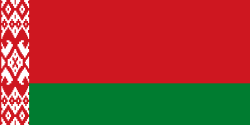
The national flag of Belarus is an unequal red-green bicolour with a red-on-white ornament pattern placed at the hoist (staff) end. The current design was introduced in 2012 by the State Committee for Standardisation of the Republic of Belarus, and is adapted from a design approved in a May 1995 referendum. It is a modification of the 1951 flag used while the country was a republic of the Soviet Union. Changes made to the Soviet-era flag were the removal of communist symbols – the hammer and sickle and the red star – as well as the reversal of the colours in the ornament pattern. Since the 1995 referendum, several flags used by Belarusian government officials and agencies have been modelled on this national flag.
Historically, the white-red-white flag was used by the Belarusian People's Republic in 1918 before Belarus became a Soviet Republic, then by several formations of the Belarusian national movement, including participants of the Slutsk Uprising and units commanded by Stanisław Bułak-Bałachowicz followed by use during the Nazi occupation of Belarus between 1943 and 1944, and again after it regained its independence in 1991 until the (disputed) 1995 referendum. Opposition groups have continued to use this flag. However, the Belarusian government has prohibited its use, claiming it is linked with Belarusian collaborators who adopted the flag during World War II. The white-red-white flag has been used in protests against the government, most recently the 2020–2021 Belarusian protests, and by the Belarusian diaspora.
The basic design of the national flag of Belarus was first described in Presidential Decree No. 214 of 7 June 1995. The flag is a rectangular cloth consisting of two horizontal stripes: a red upper stripe (which was inspired by the flag of the Soviet Union) covering two-thirds of the flag's height, and additional green lower stripe covering one-third. An additional vertical red-on-white traditional Belarusian decorative pattern, which occupies one-ninth of the flag's length, is placed against the flagstaff. The flag's ratio of width to length is 1:2. The flag does not differ significantly from the flag of the Byelorussian Soviet Socialist Republic (Byelorussian SSR), other than the removal of the hammer and sickle and the red star, as well as the reversal of red and white in the hoist pattern, from white-on-red to red-on-white. While there is no official interpretation for the colours of the flag, an explanation given by President Alexander Lukashenko is that red represents freedom and the sacrifice of the nation's forefathers, while green represents life.
In addition to the 1995 decree, "STB 911-2008: National Flag of the Republic of Belarus" was published by the State Committee for Standardisation of the Republic of Belarus in 2008. It gives the technical specifications of the national flag, such as the details of the colours and the ornament pattern. The red ornament design on the national flag was, until 2012, 1⁄12 the width of the flag, and 1⁄9 with the white margin. As of 2012, the red pattern has occupied the whole of the white margin (which stayed at 1⁄9).
The colours of the national flag are regulated in "STB 911-2008: National Flag of the Republic of Belarus" and are listed in the CIE Standard illuminant D65.
A decorative pattern, designed in 1917 by Matrona Markevich, is displayed on the hoist of the flag (as it was previously, on the 1951 flag). The pattern, derived from local plants and flowers, is a traditional type commonly used in Belarus. These patterns are sometimes used in woven garments, most importantly in the traditional ruchnik, a woven cloth used for ceremonial events such as religious services, weddings, and other more minor social functions, such as a host offering guests bread and salt served on a ručnik.
The husband of Matrona Markevich was arrested for anti-Soviet propaganda and executed during Soviet repression in Belarus in 1937, after which the family was dekulakised. The original ruchnik has not survived and was either confiscated by the NKVD in 1937 or destroyed during World War II. The brother of Matrona Markevich, Mikhail Katsar, head of the ethnography and folklore department at the Academy of Sciences of Belarus, was included into the commission that was ordered to create a new flag for the Belarusian SSR in 1951. A monument to Matrona Markevich was erected in Sianno in 2015.
Belarusian law requires that the flag be flown daily, weather permitting, from the following locations:
Flag of Belarus
The national flag of Belarus is an unequal red-green bicolour with a red-on-white ornament pattern placed at the hoist (staff) end. The current design was introduced in 2012 by the State Committee for Standardisation of the Republic of Belarus, and is adapted from a design approved in a May 1995 referendum. It is a modification of the 1951 flag used while the country was a republic of the Soviet Union. Changes made to the Soviet-era flag were the removal of communist symbols – the hammer and sickle and the red star – as well as the reversal of the colours in the ornament pattern. Since the 1995 referendum, several flags used by Belarusian government officials and agencies have been modelled on this national flag.
Historically, the white-red-white flag was used by the Belarusian People's Republic in 1918 before Belarus became a Soviet Republic, then by several formations of the Belarusian national movement, including participants of the Slutsk Uprising and units commanded by Stanisław Bułak-Bałachowicz followed by use during the Nazi occupation of Belarus between 1943 and 1944, and again after it regained its independence in 1991 until the (disputed) 1995 referendum. Opposition groups have continued to use this flag. However, the Belarusian government has prohibited its use, claiming it is linked with Belarusian collaborators who adopted the flag during World War II. The white-red-white flag has been used in protests against the government, most recently the 2020–2021 Belarusian protests, and by the Belarusian diaspora.
The basic design of the national flag of Belarus was first described in Presidential Decree No. 214 of 7 June 1995. The flag is a rectangular cloth consisting of two horizontal stripes: a red upper stripe (which was inspired by the flag of the Soviet Union) covering two-thirds of the flag's height, and additional green lower stripe covering one-third. An additional vertical red-on-white traditional Belarusian decorative pattern, which occupies one-ninth of the flag's length, is placed against the flagstaff. The flag's ratio of width to length is 1:2. The flag does not differ significantly from the flag of the Byelorussian Soviet Socialist Republic (Byelorussian SSR), other than the removal of the hammer and sickle and the red star, as well as the reversal of red and white in the hoist pattern, from white-on-red to red-on-white. While there is no official interpretation for the colours of the flag, an explanation given by President Alexander Lukashenko is that red represents freedom and the sacrifice of the nation's forefathers, while green represents life.
In addition to the 1995 decree, "STB 911-2008: National Flag of the Republic of Belarus" was published by the State Committee for Standardisation of the Republic of Belarus in 2008. It gives the technical specifications of the national flag, such as the details of the colours and the ornament pattern. The red ornament design on the national flag was, until 2012, 1⁄12 the width of the flag, and 1⁄9 with the white margin. As of 2012, the red pattern has occupied the whole of the white margin (which stayed at 1⁄9).
The colours of the national flag are regulated in "STB 911-2008: National Flag of the Republic of Belarus" and are listed in the CIE Standard illuminant D65.
A decorative pattern, designed in 1917 by Matrona Markevich, is displayed on the hoist of the flag (as it was previously, on the 1951 flag). The pattern, derived from local plants and flowers, is a traditional type commonly used in Belarus. These patterns are sometimes used in woven garments, most importantly in the traditional ruchnik, a woven cloth used for ceremonial events such as religious services, weddings, and other more minor social functions, such as a host offering guests bread and salt served on a ručnik.
The husband of Matrona Markevich was arrested for anti-Soviet propaganda and executed during Soviet repression in Belarus in 1937, after which the family was dekulakised. The original ruchnik has not survived and was either confiscated by the NKVD in 1937 or destroyed during World War II. The brother of Matrona Markevich, Mikhail Katsar, head of the ethnography and folklore department at the Academy of Sciences of Belarus, was included into the commission that was ordered to create a new flag for the Belarusian SSR in 1951. A monument to Matrona Markevich was erected in Sianno in 2015.
Belarusian law requires that the flag be flown daily, weather permitting, from the following locations:
Recent media
Recent media