
Recent from talks
Hammer and sickle
Knowledge base stats:
Talk channels stats:
Members stats:
Hammer and sickle
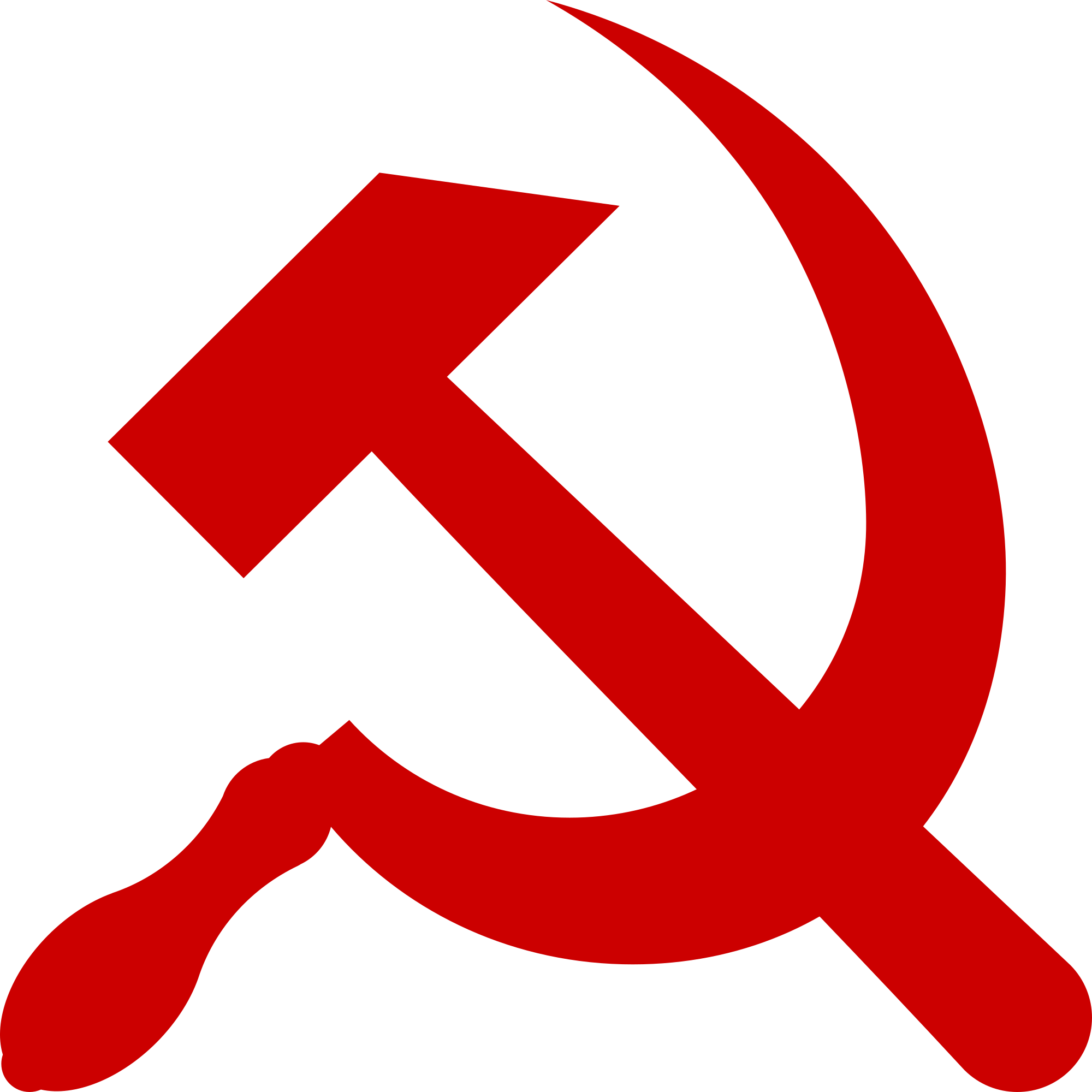
The hammer and sickle (Unicode: U+262D ☭ HAMMER AND SICKLE) is a communist symbol representing proletarian solidarity between industrial and agricultural workers. It was first adopted during the Russian Revolution at the end of World War I, the hammer representing workers and the sickle representing the peasants.
After World War I (from which Russia withdrew in 1917) and the Russian Civil War, the hammer and sickle became more widely used as a symbol for labor within the Soviet Union (USSR) and for international proletarian unity. It was taken up by many communist movements around the world, some with local variations. The hammer and sickle remains commonplace in self-declared socialist states, such as China, Cuba, Laos, North Korea, and Vietnam, but also some former Soviet republics following the dissolution of the Soviet Union, such as Belarus and Russia. Some countries have imposed bans on communist symbols, where the display of the hammer and sickle is prohibited.
One example of use prior to its political instrumentalization by the Soviet Union is found in Chilean currency circulating since 1894.
In 1918, Yevgeny Ivanovich Kamzolkin proposed a 'hammer and sickle' symbol as a decoration for the May Day celebrations in the Zamoskvorechye District of Moscow. It originally featured a sword, but Lenin strongly objected, disliking the militaristic connotations. On 6 July 1923, the 2nd session of the Central Executive Committee (CIK) adopted the emblem.[failed verification]
In 1919, the new Republic of Austria introduced a sickle and a hammer to its coat of arms, one in each talon of its supporting eagle, to represent the farming and industrial classes. They were removed in 1934 with the establishment of the Fascist Federal State of Austria and returned in 1945 after the defeat of Nazi Germany (which had absorbed Austria in 1938) in the Second World War.
In his work, Daily Life in a Crumbling Empire: The Absorption of Russia into the World Economy, sociologist David Lempert hypothesizes that the hammer and sickle was a secular replacement for the patriarchal cross.
At the time of creation, the hammer and sickle stood for worker-peasant alliance, with the hammer a traditional symbol of the industrial proletariat (who dominated the proletariat of Russia) and the sickle a traditional symbol for the peasantry, but the meaning has since broadened to a globally recognizable symbol for Marxism, communist parties, or socialist states.
Two federal subjects of the post-Soviet Russian Federation use the hammer and sickle in their symbols: the Vladimir Oblast has them on its flag and the Bryansk Oblast has them on its flag and coat of arms, which is also the central element of its flag. In addition, the Russian city of Oryol also uses the hammer and sickle on its flag.
Hub AI
Hammer and sickle AI simulator
(@Hammer and sickle_simulator)
Hammer and sickle
The hammer and sickle (Unicode: U+262D ☭ HAMMER AND SICKLE) is a communist symbol representing proletarian solidarity between industrial and agricultural workers. It was first adopted during the Russian Revolution at the end of World War I, the hammer representing workers and the sickle representing the peasants.
After World War I (from which Russia withdrew in 1917) and the Russian Civil War, the hammer and sickle became more widely used as a symbol for labor within the Soviet Union (USSR) and for international proletarian unity. It was taken up by many communist movements around the world, some with local variations. The hammer and sickle remains commonplace in self-declared socialist states, such as China, Cuba, Laos, North Korea, and Vietnam, but also some former Soviet republics following the dissolution of the Soviet Union, such as Belarus and Russia. Some countries have imposed bans on communist symbols, where the display of the hammer and sickle is prohibited.
One example of use prior to its political instrumentalization by the Soviet Union is found in Chilean currency circulating since 1894.
In 1918, Yevgeny Ivanovich Kamzolkin proposed a 'hammer and sickle' symbol as a decoration for the May Day celebrations in the Zamoskvorechye District of Moscow. It originally featured a sword, but Lenin strongly objected, disliking the militaristic connotations. On 6 July 1923, the 2nd session of the Central Executive Committee (CIK) adopted the emblem.[failed verification]
In 1919, the new Republic of Austria introduced a sickle and a hammer to its coat of arms, one in each talon of its supporting eagle, to represent the farming and industrial classes. They were removed in 1934 with the establishment of the Fascist Federal State of Austria and returned in 1945 after the defeat of Nazi Germany (which had absorbed Austria in 1938) in the Second World War.
In his work, Daily Life in a Crumbling Empire: The Absorption of Russia into the World Economy, sociologist David Lempert hypothesizes that the hammer and sickle was a secular replacement for the patriarchal cross.
At the time of creation, the hammer and sickle stood for worker-peasant alliance, with the hammer a traditional symbol of the industrial proletariat (who dominated the proletariat of Russia) and the sickle a traditional symbol for the peasantry, but the meaning has since broadened to a globally recognizable symbol for Marxism, communist parties, or socialist states.
Two federal subjects of the post-Soviet Russian Federation use the hammer and sickle in their symbols: the Vladimir Oblast has them on its flag and the Bryansk Oblast has them on its flag and coat of arms, which is also the central element of its flag. In addition, the Russian city of Oryol also uses the hammer and sickle on its flag.
Recent media