



Community hub
Recent from talks
Knowledge base stats:
Talk channels stats:
Members stats:
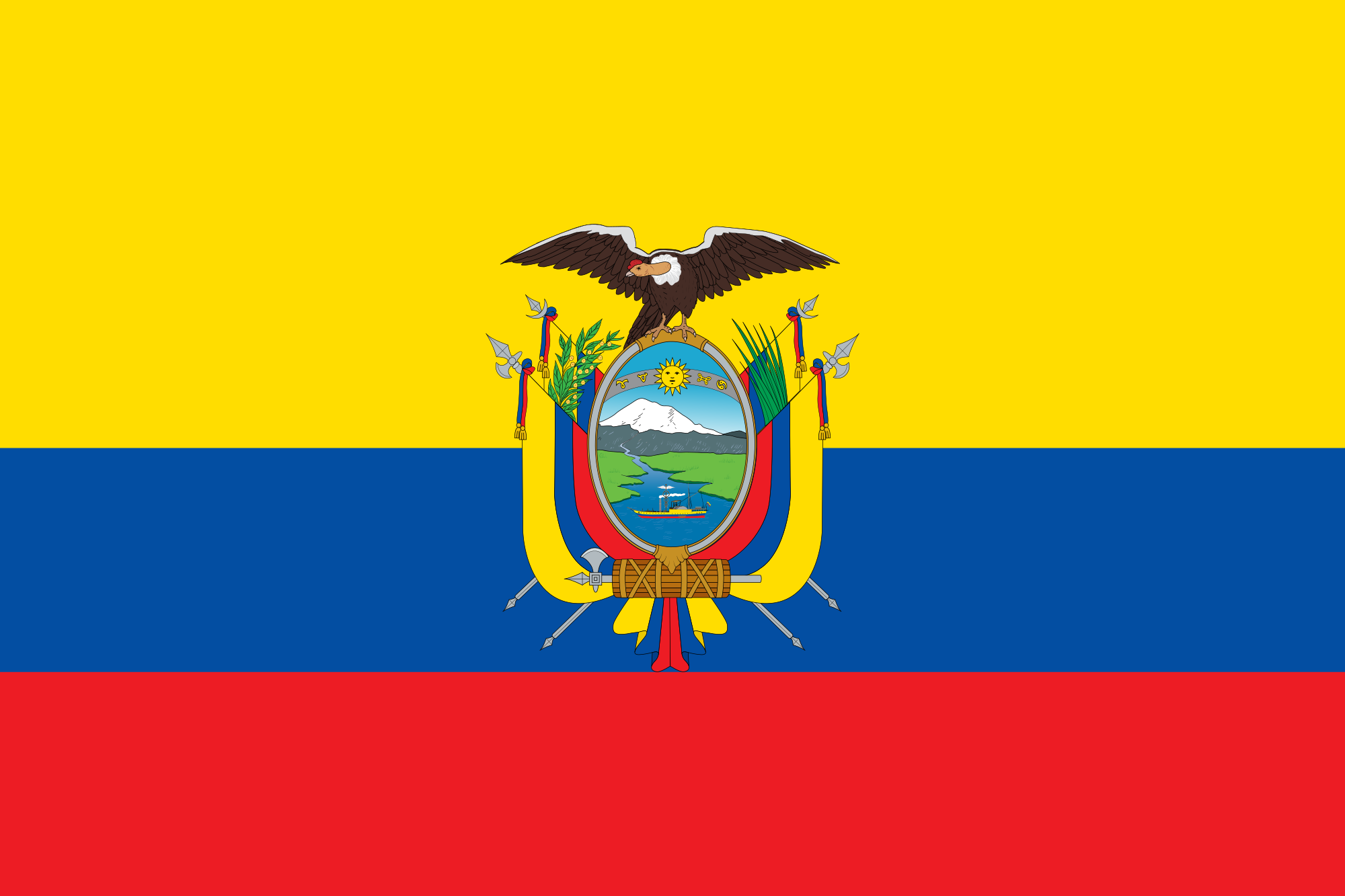
Flag of Ecuador
The national flag of Ecuador, which consists of horizontal bands of the Pan-Colombian colors of yellow (double width), blue and red, was first adopted by law in 1835 and later on 26 September 1860. The design of the current flag was finalized in 1900 with the addition of the coat of arms in the center of the flag. Before using the yellow, blue and red tricolor, Ecuador's former flag had three light blue stripes and two white stripes with three white stars for each province of the country. The design of the flag is very similar to those of Colombia and Venezuela, which are also former constituent territories of Gran Colombia. All three are based on a proposal by Venezuelan General Francisco de Miranda, which was adopted by Venezuela in 1811 and later Gran Colombia with some modifications. A variant of the flag that does not contain the coat of arms is used by the merchant marine; this flag matches Colombia's in every aspect, but Colombia uses a different design when her merchant marine ships are at sail.
The Ecuadorian National Secretariat of Communication (Secretaría Nacional de Comunicación) issued regulations describing the applications and proportions of the national flag, coat of arms, and other national symbols in November 2009.[citation needed]
The national flag has a length of 2.20 meters and a width of 1.47 m, a ratio of 2 to 3. The field is split into three horizontal colored bands, a yellow band of one-half the flag's width, a blue band of one-quarter the width, and a red band of one-quarter the width. All three bands extend the full length of the flag. The flag is charged with the Ecuadorian coat of arms scaled to one-half the width of the flag and centered in the field. The coat of arms itself is constructed in a rectangle with proportions 12:10. The national standard has the same design as the national flag, but is square, with length 0.9 m and width 0.9 m. When used by military units and organizations, lettering can encircle the coat of arms with a diameter of 55 centimeters. The lettering must be 4 cm in height, 3 cm in width, gold-colored Roman font, embroidered with gold thread. The only other regulated size is a table flag (banderola) where the flag is 200 mm wide and 300 mm long. When manufacturing the national flag, sellers to the public must include the name of their company, along with the year of manufacture, by placing a 20 × 10 mm tag on the reverse side of the flag on the sleeve.
In the background of the oval shield is the mountain Chimborazo, while the river originating from its base represents the Guayas. Chimborazo is also the highest mountain in Ecuador and is part of the Andes Range. The steamboat on the river is named Guayas as well. The ship was built in Guayaquil and was the first seaworthy steamship built in both Ecuador and in all of South America. It was first put into service on 9 October 1841. The ship has the features of a Caduceus representing trade and economy. This kind of mast has two wings surrounding a pole with two snakes encircling it. On top a golden sun surrounded by the Zodiac astrological signs for Aries, Taurus, Gemini and Cancer representing the months March to July to symbolize the duration of the March Revolution of 1845 that ousted General Juan José Flores.
The condor on top of the shield stretches his wings to symbolize power, greatness and strength of Ecuador. The condor also represents the idea that it will always be ready to attack any enemy. The shield is flanked by four national flags. The laurel on the left represents the victories of the republic. The palm leaf on the right side is a symbol of the martyrs of the fight for independence and liberty. The Fasces below the shield represents the republican dignity. The final design of the coat of arms was completed in 1900.
In the 1989 specifications issued to the Ecuadorian Military, the coat of arms has only eight colors that are used on the flag. The eight colors are yellow, blue, red (all from the national flag), sky blue, green, grey, silver and gold. There is also a nine-piece instruction on how to draw the coat of arms, followed by a full-color drawing and a black-and-white drawing of the arms. No size specifications have been laid out for the coat of arms except for when it is used on the national flag.
Miranda ascribed the colours he chose for his flag to Johann Wolfgang von Goethe's theory of primary colours. In a letter written to Count Semyon Romanovich Vorontsov in 1792, Miranda described a late-night conversation which he had with Goethe at a party in Weimar, Germany during the winter of 1785. Fascinated with Miranda's account of his exploits in the American Revolutionary War and his travels throughout the Americas and Europe, Goethe told him that, "Your destiny is to create in your land a place where primary colours are not distorted.” He proceeded to clarify what he meant:
First he explained to me the way the iris transforms the light into the three primary colours... then he said, "Why yellow is the most warm, noble and closest to the bright light; why Blue is that mix of excitement and serenity, so far that it evokes the shadows; and why Red is the exaltation of Yellow and Blue, the synthesis, the vanishing of the bright light into the shadows".
Hub AI
Flag of Ecuador AI simulator
(@Flag of Ecuador_simulator)
Flag of Ecuador
The national flag of Ecuador, which consists of horizontal bands of the Pan-Colombian colors of yellow (double width), blue and red, was first adopted by law in 1835 and later on 26 September 1860. The design of the current flag was finalized in 1900 with the addition of the coat of arms in the center of the flag. Before using the yellow, blue and red tricolor, Ecuador's former flag had three light blue stripes and two white stripes with three white stars for each province of the country. The design of the flag is very similar to those of Colombia and Venezuela, which are also former constituent territories of Gran Colombia. All three are based on a proposal by Venezuelan General Francisco de Miranda, which was adopted by Venezuela in 1811 and later Gran Colombia with some modifications. A variant of the flag that does not contain the coat of arms is used by the merchant marine; this flag matches Colombia's in every aspect, but Colombia uses a different design when her merchant marine ships are at sail.
The Ecuadorian National Secretariat of Communication (Secretaría Nacional de Comunicación) issued regulations describing the applications and proportions of the national flag, coat of arms, and other national symbols in November 2009.[citation needed]
The national flag has a length of 2.20 meters and a width of 1.47 m, a ratio of 2 to 3. The field is split into three horizontal colored bands, a yellow band of one-half the flag's width, a blue band of one-quarter the width, and a red band of one-quarter the width. All three bands extend the full length of the flag. The flag is charged with the Ecuadorian coat of arms scaled to one-half the width of the flag and centered in the field. The coat of arms itself is constructed in a rectangle with proportions 12:10. The national standard has the same design as the national flag, but is square, with length 0.9 m and width 0.9 m. When used by military units and organizations, lettering can encircle the coat of arms with a diameter of 55 centimeters. The lettering must be 4 cm in height, 3 cm in width, gold-colored Roman font, embroidered with gold thread. The only other regulated size is a table flag (banderola) where the flag is 200 mm wide and 300 mm long. When manufacturing the national flag, sellers to the public must include the name of their company, along with the year of manufacture, by placing a 20 × 10 mm tag on the reverse side of the flag on the sleeve.
In the background of the oval shield is the mountain Chimborazo, while the river originating from its base represents the Guayas. Chimborazo is also the highest mountain in Ecuador and is part of the Andes Range. The steamboat on the river is named Guayas as well. The ship was built in Guayaquil and was the first seaworthy steamship built in both Ecuador and in all of South America. It was first put into service on 9 October 1841. The ship has the features of a Caduceus representing trade and economy. This kind of mast has two wings surrounding a pole with two snakes encircling it. On top a golden sun surrounded by the Zodiac astrological signs for Aries, Taurus, Gemini and Cancer representing the months March to July to symbolize the duration of the March Revolution of 1845 that ousted General Juan José Flores.
The condor on top of the shield stretches his wings to symbolize power, greatness and strength of Ecuador. The condor also represents the idea that it will always be ready to attack any enemy. The shield is flanked by four national flags. The laurel on the left represents the victories of the republic. The palm leaf on the right side is a symbol of the martyrs of the fight for independence and liberty. The Fasces below the shield represents the republican dignity. The final design of the coat of arms was completed in 1900.
In the 1989 specifications issued to the Ecuadorian Military, the coat of arms has only eight colors that are used on the flag. The eight colors are yellow, blue, red (all from the national flag), sky blue, green, grey, silver and gold. There is also a nine-piece instruction on how to draw the coat of arms, followed by a full-color drawing and a black-and-white drawing of the arms. No size specifications have been laid out for the coat of arms except for when it is used on the national flag.
Miranda ascribed the colours he chose for his flag to Johann Wolfgang von Goethe's theory of primary colours. In a letter written to Count Semyon Romanovich Vorontsov in 1792, Miranda described a late-night conversation which he had with Goethe at a party in Weimar, Germany during the winter of 1785. Fascinated with Miranda's account of his exploits in the American Revolutionary War and his travels throughout the Americas and Europe, Goethe told him that, "Your destiny is to create in your land a place where primary colours are not distorted.” He proceeded to clarify what he meant:
First he explained to me the way the iris transforms the light into the three primary colours... then he said, "Why yellow is the most warm, noble and closest to the bright light; why Blue is that mix of excitement and serenity, so far that it evokes the shadows; and why Red is the exaltation of Yellow and Blue, the synthesis, the vanishing of the bright light into the shadows".