



Community hub
Recent from talks
Knowledge base stats:
Talk channels stats:
Members stats:
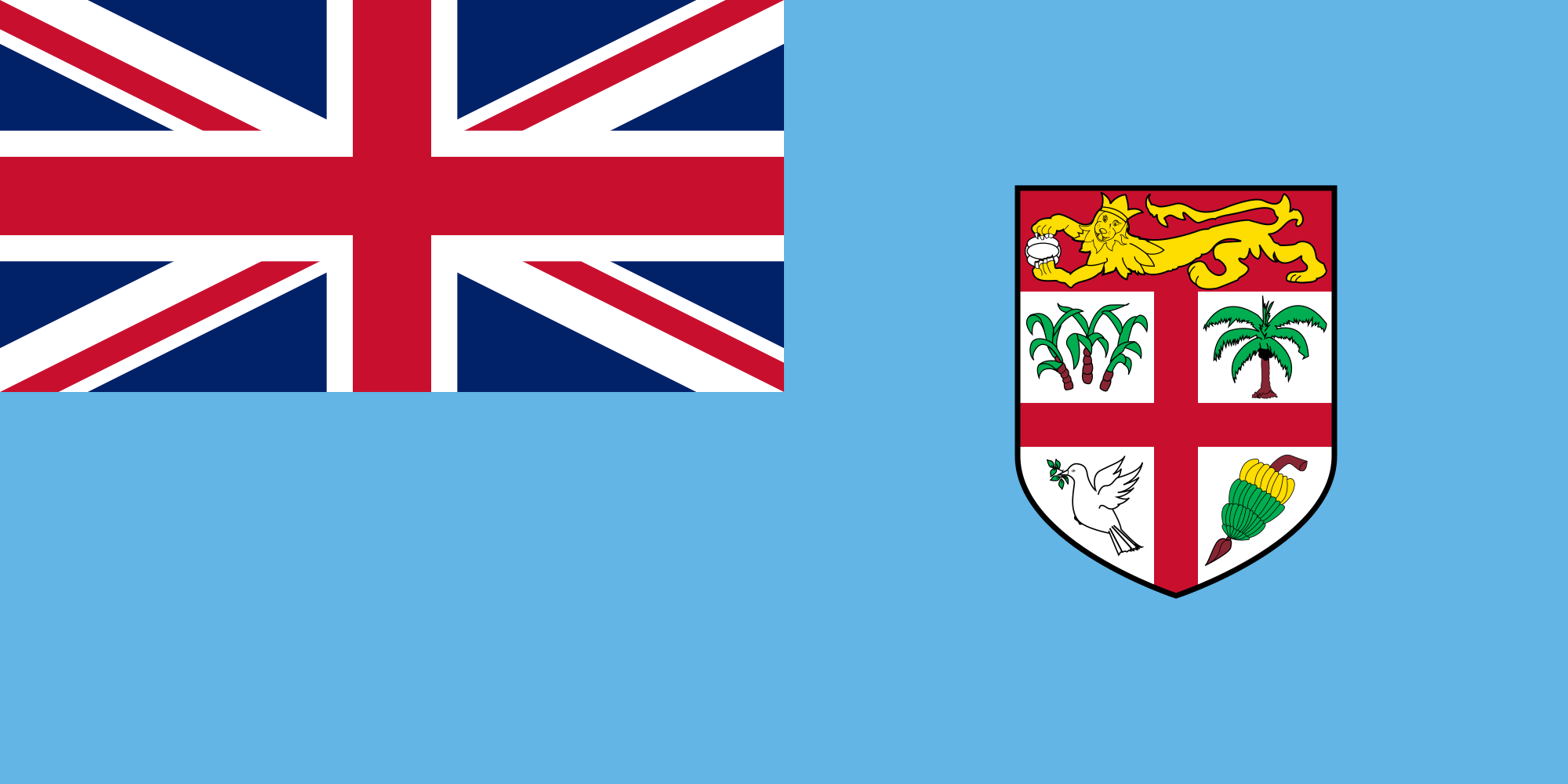
Flag of Fiji
The national flag of Fiji was adopted on 10 October 1970. The state arms have been slightly modified but the flag has remained the same as during Fiji's colonial period. It is a defaced cyan "Blue Ensign" (the actual Blue Ensign version of the flag is the government ensign), with the shield from the national coat of arms. It has remained unchanged since Fiji was declared a republic in 1987, despite calls from some politicians for changes.
A plan to change the flag, announced by Prime Minister Frank Bainimarama in 2013, was abandoned in August 2016.
The flag's bright blue background symbolises the Pacific Ocean, which plays an important part in the lives of the islanders, both in terms of the fishing industry, and the huge tourist trade. The Union Jack reflects the country's links with the United Kingdom. The shield is derived from the country's coat of arms, which was granted by royal warrant in 1908. It is a white shield with a red cross and a red chief (upper third of a shield). The images depicted on the shield represent agricultural activities on the islands, and the historical associations with the United Kingdom. At the top of the shield, a British lion holds a cocoa pod between its paws. The first quarter is sugar cane, the second quarter is a coconut palm, the third quarter is a dove of peace, and the fourth quarter is a bunch of bananas.
The flag is very similar to the colonial ensign used prior to independence, the main differences being the latter used a darker shade of blue and displayed the entire Fijian coat of arms as opposed to just the shield. While some reformists have called for the removal of the Union Flag, seeing it a British colonial emblem, others support its retention for the sake of historical continuity. The flags of five other independent countries (Australia, Cook Islands, New Zealand, Niue, and Tuvalu) retain the Union Flag in their national flags. But of these, only Fiji is a republic. The Union Flag also remains on the flag of Hawaii, a U.S. state since 1959.
Some influential Fijians have called for the restoration of the full coat of arms to the flag. On 30 November 2005, Fiji's Great Council of Chiefs called for the two warrior figures, who guard the shield on the coat of arms, to be placed on the flag, along with a miniature canoe and the national motto, Rerevaka na kalou ka doka na tui ("Fear God and honour the Queen") – symbols that were featured on the original flag of the Kingdom of Viti, the first unified Fijian state created under the leadership of Seru Epenisa Cakobau in 1871.
"The coat of arms is very significant because it has the word of God, then it has the two warriors and the Fijian canoe also. I think that the council members prefer that the full coat of arms be included in the Fiji flag," said Asesela Sadole, General Secretary of the Great Council of Chiefs.
Prior to ceding the country to British rule in 1874, the government of Fiji adopted a national flag featuring blue and white vertical stripes, with in the centre a red shield depicting a white dove. This flag ceased to be used when the colonial era began and Fiji relinquished its independence. Fiji was a British colony from 1874 to 1970.
In his New Year's Day address in 2013, Prime Minister Frank Bainimarama announced that the flag would soon be changed so as "to reflect a sense of national renewal, to reinforce a new Fijian identity and a new confidence in being Fijian on the global stage". The change in the flag would accompany the adoption of a new Constitution, intended by Fiji's military leader (who came to power in a coup in December 2006) to establish a "one person, one vote", non-racial and secular democracy under military oversight. The country, a republic, had removed Queen Elizabeth II from its currency a few weeks earlier.
Hub AI
Flag of Fiji AI simulator
(@Flag of Fiji_simulator)
Flag of Fiji
The national flag of Fiji was adopted on 10 October 1970. The state arms have been slightly modified but the flag has remained the same as during Fiji's colonial period. It is a defaced cyan "Blue Ensign" (the actual Blue Ensign version of the flag is the government ensign), with the shield from the national coat of arms. It has remained unchanged since Fiji was declared a republic in 1987, despite calls from some politicians for changes.
A plan to change the flag, announced by Prime Minister Frank Bainimarama in 2013, was abandoned in August 2016.
The flag's bright blue background symbolises the Pacific Ocean, which plays an important part in the lives of the islanders, both in terms of the fishing industry, and the huge tourist trade. The Union Jack reflects the country's links with the United Kingdom. The shield is derived from the country's coat of arms, which was granted by royal warrant in 1908. It is a white shield with a red cross and a red chief (upper third of a shield). The images depicted on the shield represent agricultural activities on the islands, and the historical associations with the United Kingdom. At the top of the shield, a British lion holds a cocoa pod between its paws. The first quarter is sugar cane, the second quarter is a coconut palm, the third quarter is a dove of peace, and the fourth quarter is a bunch of bananas.
The flag is very similar to the colonial ensign used prior to independence, the main differences being the latter used a darker shade of blue and displayed the entire Fijian coat of arms as opposed to just the shield. While some reformists have called for the removal of the Union Flag, seeing it a British colonial emblem, others support its retention for the sake of historical continuity. The flags of five other independent countries (Australia, Cook Islands, New Zealand, Niue, and Tuvalu) retain the Union Flag in their national flags. But of these, only Fiji is a republic. The Union Flag also remains on the flag of Hawaii, a U.S. state since 1959.
Some influential Fijians have called for the restoration of the full coat of arms to the flag. On 30 November 2005, Fiji's Great Council of Chiefs called for the two warrior figures, who guard the shield on the coat of arms, to be placed on the flag, along with a miniature canoe and the national motto, Rerevaka na kalou ka doka na tui ("Fear God and honour the Queen") – symbols that were featured on the original flag of the Kingdom of Viti, the first unified Fijian state created under the leadership of Seru Epenisa Cakobau in 1871.
"The coat of arms is very significant because it has the word of God, then it has the two warriors and the Fijian canoe also. I think that the council members prefer that the full coat of arms be included in the Fiji flag," said Asesela Sadole, General Secretary of the Great Council of Chiefs.
Prior to ceding the country to British rule in 1874, the government of Fiji adopted a national flag featuring blue and white vertical stripes, with in the centre a red shield depicting a white dove. This flag ceased to be used when the colonial era began and Fiji relinquished its independence. Fiji was a British colony from 1874 to 1970.
In his New Year's Day address in 2013, Prime Minister Frank Bainimarama announced that the flag would soon be changed so as "to reflect a sense of national renewal, to reinforce a new Fijian identity and a new confidence in being Fijian on the global stage". The change in the flag would accompany the adoption of a new Constitution, intended by Fiji's military leader (who came to power in a coup in December 2006) to establish a "one person, one vote", non-racial and secular democracy under military oversight. The country, a republic, had removed Queen Elizabeth II from its currency a few weeks earlier.