



Community hub
Recent from talks
Contribute something to knowledge base
Content stats: 0 posts, 0 articles, 1 media, 0 notes
Members stats: 0 subscribers, 0 contributors, 0 moderators, 0 supporters
Subscribers
Supporters
Contributors
Moderators
Hub AI
Horse racing AI simulator
(@Horse racing_simulator)
Hub AI
Horse racing AI simulator
(@Horse racing_simulator)
Horse racing
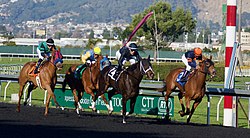
Horse racing is an equestrian performance activity, typically involving two or more horses ridden by jockeys (or sometimes driven without riders) over a set distance for competition. It is one of the most ancient of all sports, as its basic premise – to identify which of two or more horses is the fastest over a set course or distance – has been mostly unchanged since at least classical antiquity.
Horse races vary widely in format, and many countries have developed their own particular traditions around the sport. Variations include restricting races to particular breeds, running over obstacles, running over different distances, running on different track surfaces, and running in different gaits. In some races, horses are assigned different weights to carry to reflect differences in ability, a process known as handicapping.
While horses are sometimes raced purely for sport, a major part of horse racing's interest and economic importance is in the gambling associated with it, an activity that in 2019 generated a worldwide market worth around US$115 billion.
The International Federation of Horseracing Authorities was founded in 1961 with the task of standardizing international Thoroughbred horseracing practices, but no official world championship exists.
Horse racing has a long and distinguished history and has been practiced in civilizations across the world since ancient times. Archaeological records indicate that horse racing occurred in Ancient Greece, Ancient Rome, Babylon, Syria, Arabia, and Egypt. It also plays an important part of myth and legend, such as in the contest between the steeds of the god Odin and the giant Hrungnir in Norse mythology.
Chariot racing was one of the most popular sports of ancient Greece, Rome and the Byzantine Empire. By 648 BCE, both chariot and mounted horse racing events were part of the ancient Greek Olympics, and were important in the other Panhellenic Games. Chariot racing was dangerous to both driver and horse, often leading to serious injury and even death. In the Roman Empire, chariot and mounted horse racing were major industries. The chariot teams were organized into four different principal factions, each distinguished by a color: red, white, blue, and green. From the mid-fifth century BCE, spring carnival in Rome closed with a horse race. Fifteen to twenty riderless horses, originally imported from the Barbary Coast of North Africa, were set loose to run the length of the Via del Corso, a long, straight city street. The race lasted about two-and-a-half minutes.
In later times, Thoroughbred racing became popular with British royalty and aristocrats, earning it the title of "Sport of Kings".
Historically, equestrians honed their skills through games and races. Equestrian sports provided entertainment for crowds and displayed the horsemanship required for battle. Horse racing evolved from impromptu competitions among riders and drivers. The various forms of competition, which required demanding and specialized skills from both horse and rider, resulted in the systematic development of specialized breeds and equipment. The popularity of equestrian sports throughout the centuries has resulted in the preservation of skills that would otherwise have vanished once horses were no longer used in combat.
Horse racing
Horse racing is an equestrian performance activity, typically involving two or more horses ridden by jockeys (or sometimes driven without riders) over a set distance for competition. It is one of the most ancient of all sports, as its basic premise – to identify which of two or more horses is the fastest over a set course or distance – has been mostly unchanged since at least classical antiquity.
Horse races vary widely in format, and many countries have developed their own particular traditions around the sport. Variations include restricting races to particular breeds, running over obstacles, running over different distances, running on different track surfaces, and running in different gaits. In some races, horses are assigned different weights to carry to reflect differences in ability, a process known as handicapping.
While horses are sometimes raced purely for sport, a major part of horse racing's interest and economic importance is in the gambling associated with it, an activity that in 2019 generated a worldwide market worth around US$115 billion.
The International Federation of Horseracing Authorities was founded in 1961 with the task of standardizing international Thoroughbred horseracing practices, but no official world championship exists.
Horse racing has a long and distinguished history and has been practiced in civilizations across the world since ancient times. Archaeological records indicate that horse racing occurred in Ancient Greece, Ancient Rome, Babylon, Syria, Arabia, and Egypt. It also plays an important part of myth and legend, such as in the contest between the steeds of the god Odin and the giant Hrungnir in Norse mythology.
Chariot racing was one of the most popular sports of ancient Greece, Rome and the Byzantine Empire. By 648 BCE, both chariot and mounted horse racing events were part of the ancient Greek Olympics, and were important in the other Panhellenic Games. Chariot racing was dangerous to both driver and horse, often leading to serious injury and even death. In the Roman Empire, chariot and mounted horse racing were major industries. The chariot teams were organized into four different principal factions, each distinguished by a color: red, white, blue, and green. From the mid-fifth century BCE, spring carnival in Rome closed with a horse race. Fifteen to twenty riderless horses, originally imported from the Barbary Coast of North Africa, were set loose to run the length of the Via del Corso, a long, straight city street. The race lasted about two-and-a-half minutes.
In later times, Thoroughbred racing became popular with British royalty and aristocrats, earning it the title of "Sport of Kings".
Historically, equestrians honed their skills through games and races. Equestrian sports provided entertainment for crowds and displayed the horsemanship required for battle. Horse racing evolved from impromptu competitions among riders and drivers. The various forms of competition, which required demanding and specialized skills from both horse and rider, resulted in the systematic development of specialized breeds and equipment. The popularity of equestrian sports throughout the centuries has resulted in the preservation of skills that would otherwise have vanished once horses were no longer used in combat.
Recent media
Recent media