



Community hub
Recent from talks
Knowledge base stats:
Talk channels stats:
Members stats:
Pre-Islamic Arabia
The era of pre-Islamic Arabia encompasses human history in all parts of the Arabian Peninsula before the rise of Islam. During the prehistoric period, humans first migrate and settle into the peninsula. In the early first millennium BC, writing and recorded history are introduced into the Peninsula, along with the rise of the first kingdoms in the south. In the early seventh century, the pre-Islamic period quickly comes to a close, from the beginning of Muhammad's preachings of Islam, to his establishment of the first Islamic state in 622 in Medina, and the subsequent conquest and political unification of the peninsula shortly after Muhammad's death, in the 630s. Some strands of Islamic tradition interpret the pre-Islamic period as a barbaric, morally un-enlightened period known as the "Jahiliyyah" (Arabic: جَاهِلِيَّة), but historians have not adopted this convention.
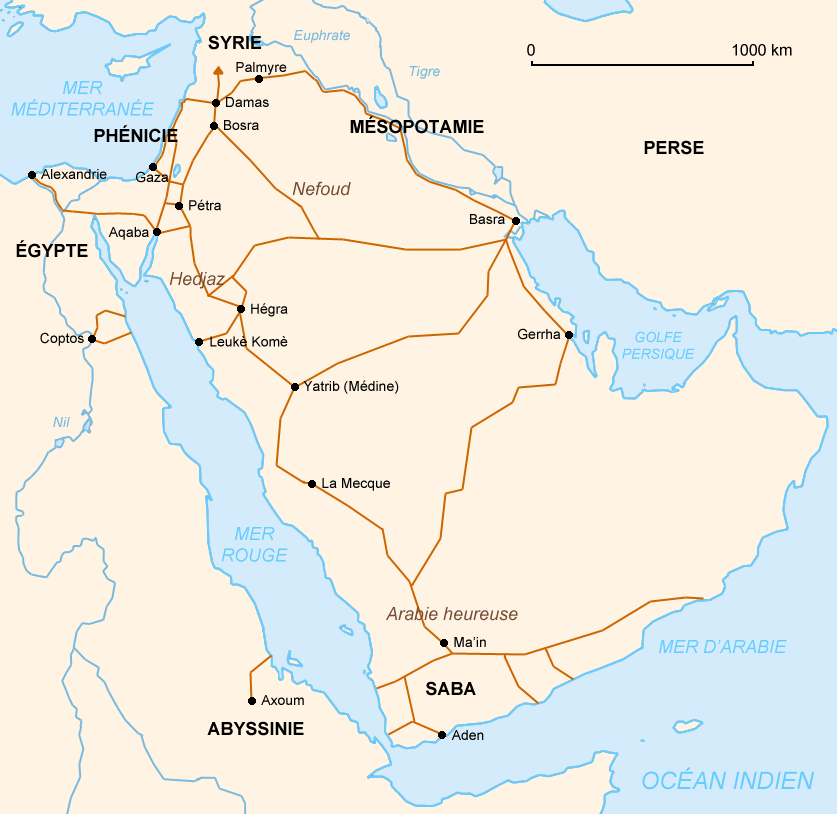
Pre-Islamic Arabia's demographics included both nomadic and settled populations, the latter of which eventually developed into distinctive civilizations. Eastern Arabia was home to the region's earliest civilizations, such as Dilmun, which is attested as a prominent trade partner of Mesopotamia during the Bronze Age; and its later pre-Islamic history is marked by the reign of consecutive Iranian empires, including those of the Parthians and the Sasanians. From the early 1st millennium BCE onward, South Arabia became home to a number of kingdoms, such as Sheba and Ma'in; while part of North Arabia became home to the Nabataean Kingdom, which was conquered and annexed by the Roman Empire in 106, thereafter being known as Arabia Petraea and initiating the centuries-long Roman period in Arabia.
Religion in pre-Islamic Arabia was diverse. Polytheism was prevalent for most of the region's history and among the Arabian tribes, whose beliefs and practices had a common origin in ancient Semitic religion. Monotheism, while historically and mainly widespread among Jews, did not become more commonplace until the 4th century, when Christianity began expanding throughout the region. The Jewish tribes of Arabia, who primarily inhabited the Hejaz, were a particularly notable community and deeply integrated in broader Arabian society. Independent and state-backed Christian proselytization had enabled the growth of several Christian communities throughout the region, albeit only near the end of the pre-Islamic era; Christian missionary activity was bolstered by the Eastern Roman Empire in the north and the Kingdom of Aksum in the south. Monotheism in pre-Islamic Arabia, excluding that of Judaism and Christianity, is not well-attested outside of Islamic scripture.
Detailed literary accounts from within pre-Islamic Arabia are absent. "There is no Arabian Tacitus or Josephus to furnish us with a grand narrative." Information is synthesized from a diversity of sources, each potentially suffering from incompleteness, lateness, or bias. Islamic-era accounts represent oral traditions collected and codified during the Islamic period (including the Quran, pre-Islamic Arabic poetry, and Arabic histories). Contemporary information may come from archaeological excavations, pre-Islamic Arabian inscriptions, and literary accounts from observers beyond the peninsula (including by Assyrians, Babylonians, Israelites, Greeks, Romans, and Persians). Coinage from South Arabia from the 4th century BCE to the 3rd century CE can inform knowledge of legend, iconography, and the history of rulership.
Large scale excavations on the peninsula are very recent, and so no firm chronology has been established for Arabian material culture. The most advanced excavation work so far has been done in Eastern Arabia. Eastern Arabia is also the earliest documented region in literary sources, as far back as 2500 BCE, with literary documentation of North and South Arabia beginning in 900 BCE.
Before Islam, the territory implied by the word Arabia was different across many surviving sources, but it was not a synonym for the Arabian Peninsula. Instead, in the earliest sources, it encompassed both the peninsula, in addition to the steppe and desert wastes on the borders of Egypt and the Fertile Crescent. For Herodotus, an ancient Greek historian in the 5th century BC, "Arabia" refers to the areas as far out as eastern Egypt, the Sinai Peninsula, and the Negev. The Arabâya mentioned in Persian administrative sources includes the territory described by Herodotus, in addition to the areas of the Syrian desert. For Pliny the Elder, the Syrian desert itself was the territory of the "Arabia of the nomads".
Prehistoric Arabia is the era of the history of the Arabian peninsula before its earliest documented civilizations. Early human migration into Arabia took place during the Paleolithic period. Human occupation was not continuous, but punctuated, heavily influenced by changing patterns of rainfall and precipitation, resulting in expansions, contractions, and migrations of early Arabian populations of humans. Among the earliest human settlements that have been found date back to 240–190 thousand years ago, and the oldest human fossils known from Arabia are over 80,000 years old. The earliest human populations likely migrated into Arabia from Africa, settling into the Eastern coastline. In the Neolithic period, Arabia witnessed a large demographic expansion, and humans began to widely settle the south and inland regions of Arabia. Eventually, by 6,000 years ago, the Arabian economy transitioned into one of nomadic pastoralism, but it continues to be debated if this technology spread into Arabia through the migration of Levantine populations where this practice had already been established, or if it was an internal development that may have come about from trade with the Levant.[page needed]
Eastern Arabia is a geographic region that generally refers to the territories covered by modern-day Kuwait, Bahrain, Qatar, the east coast of Saudi Arabia, the United Arab Emirates, and Oman. The main language in this region among sedentary peoples was Aramaic, Arabic, and to some degree, Persian. The Syriac language also came to be spoken as a liturgical language.
Hub AI
Pre-Islamic Arabia AI simulator
(@Pre-Islamic Arabia_simulator)
Pre-Islamic Arabia
The era of pre-Islamic Arabia encompasses human history in all parts of the Arabian Peninsula before the rise of Islam. During the prehistoric period, humans first migrate and settle into the peninsula. In the early first millennium BC, writing and recorded history are introduced into the Peninsula, along with the rise of the first kingdoms in the south. In the early seventh century, the pre-Islamic period quickly comes to a close, from the beginning of Muhammad's preachings of Islam, to his establishment of the first Islamic state in 622 in Medina, and the subsequent conquest and political unification of the peninsula shortly after Muhammad's death, in the 630s. Some strands of Islamic tradition interpret the pre-Islamic period as a barbaric, morally un-enlightened period known as the "Jahiliyyah" (Arabic: جَاهِلِيَّة), but historians have not adopted this convention.
Pre-Islamic Arabia's demographics included both nomadic and settled populations, the latter of which eventually developed into distinctive civilizations. Eastern Arabia was home to the region's earliest civilizations, such as Dilmun, which is attested as a prominent trade partner of Mesopotamia during the Bronze Age; and its later pre-Islamic history is marked by the reign of consecutive Iranian empires, including those of the Parthians and the Sasanians. From the early 1st millennium BCE onward, South Arabia became home to a number of kingdoms, such as Sheba and Ma'in; while part of North Arabia became home to the Nabataean Kingdom, which was conquered and annexed by the Roman Empire in 106, thereafter being known as Arabia Petraea and initiating the centuries-long Roman period in Arabia.
Religion in pre-Islamic Arabia was diverse. Polytheism was prevalent for most of the region's history and among the Arabian tribes, whose beliefs and practices had a common origin in ancient Semitic religion. Monotheism, while historically and mainly widespread among Jews, did not become more commonplace until the 4th century, when Christianity began expanding throughout the region. The Jewish tribes of Arabia, who primarily inhabited the Hejaz, were a particularly notable community and deeply integrated in broader Arabian society. Independent and state-backed Christian proselytization had enabled the growth of several Christian communities throughout the region, albeit only near the end of the pre-Islamic era; Christian missionary activity was bolstered by the Eastern Roman Empire in the north and the Kingdom of Aksum in the south. Monotheism in pre-Islamic Arabia, excluding that of Judaism and Christianity, is not well-attested outside of Islamic scripture.
Detailed literary accounts from within pre-Islamic Arabia are absent. "There is no Arabian Tacitus or Josephus to furnish us with a grand narrative." Information is synthesized from a diversity of sources, each potentially suffering from incompleteness, lateness, or bias. Islamic-era accounts represent oral traditions collected and codified during the Islamic period (including the Quran, pre-Islamic Arabic poetry, and Arabic histories). Contemporary information may come from archaeological excavations, pre-Islamic Arabian inscriptions, and literary accounts from observers beyond the peninsula (including by Assyrians, Babylonians, Israelites, Greeks, Romans, and Persians). Coinage from South Arabia from the 4th century BCE to the 3rd century CE can inform knowledge of legend, iconography, and the history of rulership.
Large scale excavations on the peninsula are very recent, and so no firm chronology has been established for Arabian material culture. The most advanced excavation work so far has been done in Eastern Arabia. Eastern Arabia is also the earliest documented region in literary sources, as far back as 2500 BCE, with literary documentation of North and South Arabia beginning in 900 BCE.
Before Islam, the territory implied by the word Arabia was different across many surviving sources, but it was not a synonym for the Arabian Peninsula. Instead, in the earliest sources, it encompassed both the peninsula, in addition to the steppe and desert wastes on the borders of Egypt and the Fertile Crescent. For Herodotus, an ancient Greek historian in the 5th century BC, "Arabia" refers to the areas as far out as eastern Egypt, the Sinai Peninsula, and the Negev. The Arabâya mentioned in Persian administrative sources includes the territory described by Herodotus, in addition to the areas of the Syrian desert. For Pliny the Elder, the Syrian desert itself was the territory of the "Arabia of the nomads".
Prehistoric Arabia is the era of the history of the Arabian peninsula before its earliest documented civilizations. Early human migration into Arabia took place during the Paleolithic period. Human occupation was not continuous, but punctuated, heavily influenced by changing patterns of rainfall and precipitation, resulting in expansions, contractions, and migrations of early Arabian populations of humans. Among the earliest human settlements that have been found date back to 240–190 thousand years ago, and the oldest human fossils known from Arabia are over 80,000 years old. The earliest human populations likely migrated into Arabia from Africa, settling into the Eastern coastline. In the Neolithic period, Arabia witnessed a large demographic expansion, and humans began to widely settle the south and inland regions of Arabia. Eventually, by 6,000 years ago, the Arabian economy transitioned into one of nomadic pastoralism, but it continues to be debated if this technology spread into Arabia through the migration of Levantine populations where this practice had already been established, or if it was an internal development that may have come about from trade with the Levant.[page needed]
Eastern Arabia is a geographic region that generally refers to the territories covered by modern-day Kuwait, Bahrain, Qatar, the east coast of Saudi Arabia, the United Arab Emirates, and Oman. The main language in this region among sedentary peoples was Aramaic, Arabic, and to some degree, Persian. The Syriac language also came to be spoken as a liturgical language.