
Recent from talks
Flea beetle
Knowledge base stats:
Talk channels stats:
Members stats:
Flea beetle
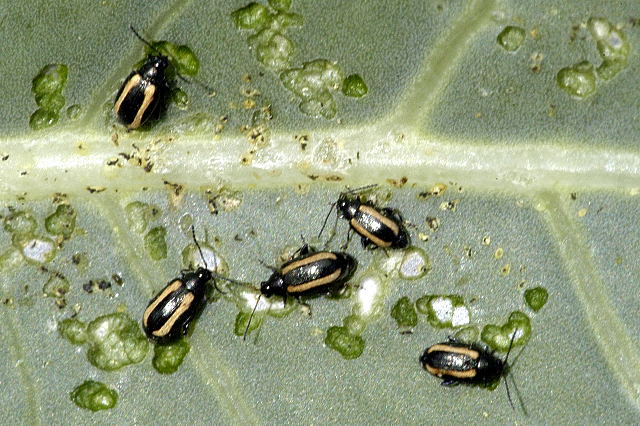
The flea beetle is any small, jumping beetle of the leaf beetle family (Chrysomelidae) that is part of the tribe Alticini, which is part of the subfamily Galerucinae. Historically the flea beetles were classified as their own subfamily.
Traditionally, the Alticini were separated from other Galerucinae by the presence of jumping hind legs, characterised by enlarged femora containing a spring structure allowing the flea beetles to jump. Recent phylogenetic studies suggest that jumping hind legs evolved multiple times in the Galerucinae, rather than once, and that several genera should be transferred between Alticini and Galerucinae sensu stricto (or Galerucini in some classifications).
The adults are very small to moderately sized Chrysomelidae (i.e. among beetles in general they are on the smallish side). They are similar to other leaf beetles, but characteristically have the hindleg femora greatly enlarged. These enlarged femora allow for the springing action of these insects when disturbed. The jumping mechanism of flea beetles has been studied extensively. One study looked at several species of flea beetles, including the Altica cirsicola species, and described the jumping mechanism of these beetles to be very efficient. This study even applied the knowledge gained from the flea beetles to create a preliminary design for a bionic leg that can jump. Flea beetles can also walk normally and fly. Many flea beetles are attractively colored; dark, shiny and often metallic colors predominate.
Adult flea beetles feed externally on plants, eating the surface of the leaves, stems and petals. Under heavy feeding the small round holes caused by an individual flea beetle's feeding may coalesce into larger areas of damage. Some flea beetle larvae (e.g. of Phyllotreta species) are root feeders.
In adverse weather conditions (rain, for example) some flea beetles seek shelter in the soil. Some species, such as Phyllotreta cruciferae and P. striolata, prefer to leave their hideouts only during warm and dry weather. The German name Erdflöhe (literally "earth fleas") refers to their jumping ability and this behavior of hiding in the soil.
Flea beetles may be beneficial or may be pests, depending on the species.
Many major agricultural crops are attacked by flea beetles, including various cruciferous plants such as mustard and rapeseed. Numerous garden plants are also subject to flea beetle feeding, such as flowers of Gardenia and Rothmannia by Altica species.
Flea beetles execute their most severe attacks during dry weather and are most active on sunny days. The larvae are known to chew roots.
Hub AI
Flea beetle AI simulator
(@Flea beetle_simulator)
Flea beetle
The flea beetle is any small, jumping beetle of the leaf beetle family (Chrysomelidae) that is part of the tribe Alticini, which is part of the subfamily Galerucinae. Historically the flea beetles were classified as their own subfamily.
Traditionally, the Alticini were separated from other Galerucinae by the presence of jumping hind legs, characterised by enlarged femora containing a spring structure allowing the flea beetles to jump. Recent phylogenetic studies suggest that jumping hind legs evolved multiple times in the Galerucinae, rather than once, and that several genera should be transferred between Alticini and Galerucinae sensu stricto (or Galerucini in some classifications).
The adults are very small to moderately sized Chrysomelidae (i.e. among beetles in general they are on the smallish side). They are similar to other leaf beetles, but characteristically have the hindleg femora greatly enlarged. These enlarged femora allow for the springing action of these insects when disturbed. The jumping mechanism of flea beetles has been studied extensively. One study looked at several species of flea beetles, including the Altica cirsicola species, and described the jumping mechanism of these beetles to be very efficient. This study even applied the knowledge gained from the flea beetles to create a preliminary design for a bionic leg that can jump. Flea beetles can also walk normally and fly. Many flea beetles are attractively colored; dark, shiny and often metallic colors predominate.
Adult flea beetles feed externally on plants, eating the surface of the leaves, stems and petals. Under heavy feeding the small round holes caused by an individual flea beetle's feeding may coalesce into larger areas of damage. Some flea beetle larvae (e.g. of Phyllotreta species) are root feeders.
In adverse weather conditions (rain, for example) some flea beetles seek shelter in the soil. Some species, such as Phyllotreta cruciferae and P. striolata, prefer to leave their hideouts only during warm and dry weather. The German name Erdflöhe (literally "earth fleas") refers to their jumping ability and this behavior of hiding in the soil.
Flea beetles may be beneficial or may be pests, depending on the species.
Many major agricultural crops are attacked by flea beetles, including various cruciferous plants such as mustard and rapeseed. Numerous garden plants are also subject to flea beetle feeding, such as flowers of Gardenia and Rothmannia by Altica species.
Flea beetles execute their most severe attacks during dry weather and are most active on sunny days. The larvae are known to chew roots.
Recent media