
Recent from talks
Beetle
Knowledge base stats:
Talk channels stats:
Members stats:
Beetle
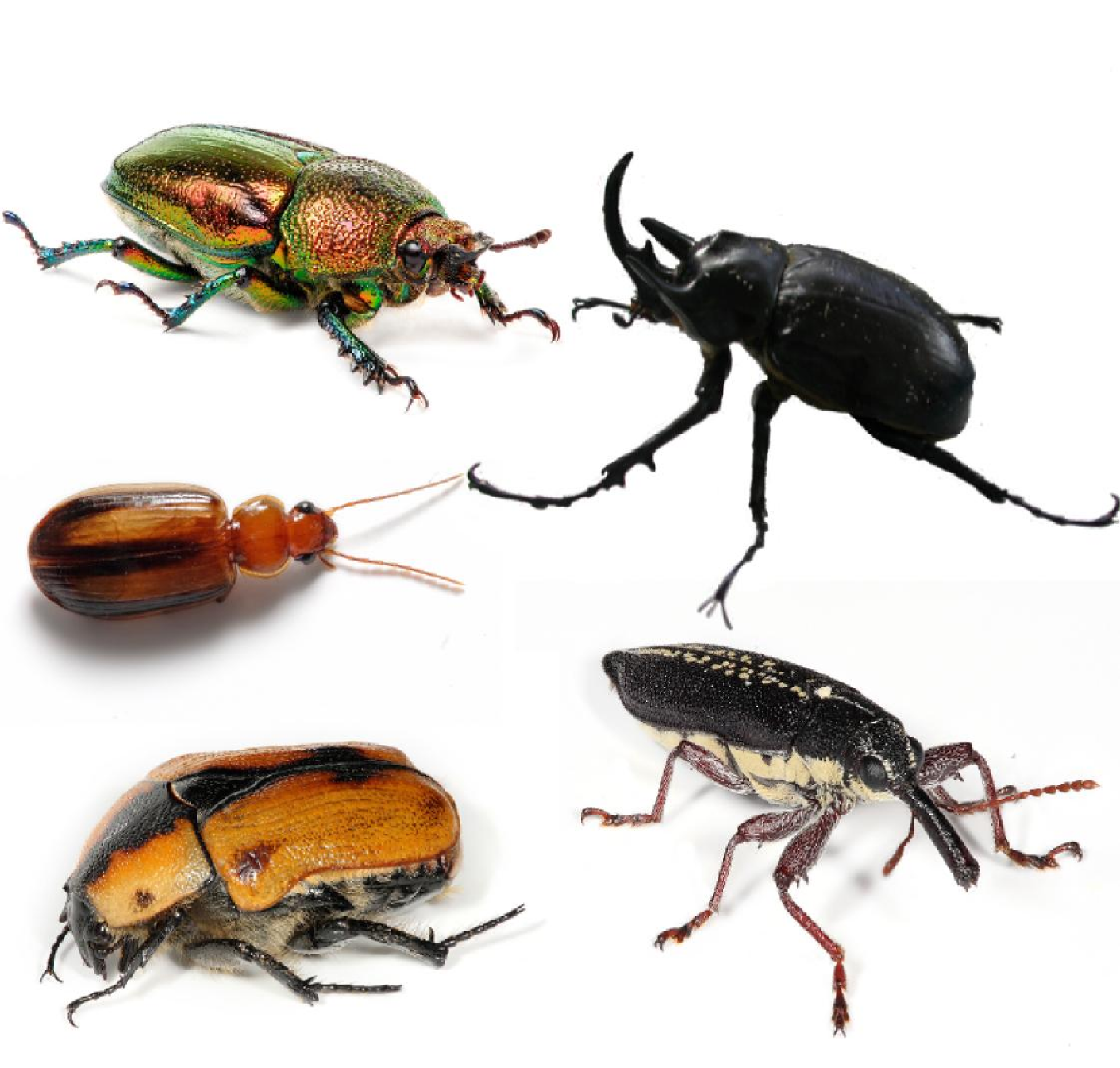
Beetles are insects that form the order Coleoptera (/koʊliːˈɒptɛrə/), in the superorder Holometabola. Their front pair of wings are hardened into wing-cases, elytra, distinguishing them from most other insects. The Coleoptera, with about 400,000 described species, is the largest of all orders, constituting almost 40% of described arthropods and 25% of all known animal species; new species are discovered frequently, with estimates suggesting that there are between 0.9 and 2.1 million total species. Other similarly diverse orders are dipterans (flies) and hymenopterans (wasps).
Found in almost every habitat except the sea and the polar regions, they interact with their ecosystems in several ways: beetles often feed on plants and fungi, break down animal and plant debris, and eat other invertebrates. Some species are serious agricultural pests, such as the Colorado potato beetle, while others such as Coccinellidae (ladybirds or ladybugs) eat aphids, scale insects, thrips, and other plant-sucking insects that damage crops. Some others also have unusual characteristics, such as fireflies, which use a light-emitting organ for mating and communication purposes.
Beetles typically have a particularly hard exoskeleton including the elytra, though some such as the rove beetles have very short elytra while blister beetles have softer elytra. The general anatomy of a beetle is quite uniform and typical of insects, although there are several examples of novelty, such as adaptations in water beetles which trap air bubbles under the elytra for use while diving. Beetles are holometabolans, which means that they undergo complete metamorphosis, with a series of conspicuous and relatively abrupt changes in body structure between hatching and becoming adult after a relatively immobile pupal stage. Some, such as stag beetles, have a marked sexual dimorphism, the males possessing enormously enlarged mandibles which they use to fight other males. Many beetles are aposematic, with bright colors and patterns warning of their toxicity, while others are harmless Batesian mimics of such insects. Many beetles, including those that live in sandy places, have effective camouflage.
Beetles are prominent in human culture, from the sacred scarabs of ancient Egypt to beetlewing art and use as pets or fighting insects for entertainment and gambling. Many beetle groups are brightly and attractively colored making them objects of collection and decorative displays. Over 300 species are used as food, mostly as larvae; species widely consumed include mealworms and rhinoceros beetle larvae. However, the major impact of beetles on human life is as agricultural, forestry, and horticultural pests. Serious pest species include the boll weevil of cotton, the Colorado potato beetle, the coconut hispine beetle, the mountain pine beetle, and many others. Most beetles, however, do not cause economic damage and some, such as numerous species of lady beetles, are beneficial by helping to control insect pests. The scientific study of beetles is known as coleopterology.
The name of the taxonomic order, Coleoptera, comes from the Greek koleopteros (κολεόπτερος), given to the group by Aristotle for their elytra, hardened shield-like forewings, from koleos, sheath, and pteron, wing. The English name beetle comes from the Old English word bitela, little biter, related to bītan (to bite), leading to Middle English betylle. Another Old English name for beetle is ċeafor, chafer, used in names such as cockchafer, from the Proto-Germanic *kebrô ("beetle"; compare German Käfer, Dutch kever, Afrikaans kewer).
Beetles are by far the largest order of insects: the roughly 400,000 species make up about 40% of all arthropod species so far described, and about 25% of all animal species. A 2015 study provided four independent estimates of the total number of beetle species, giving a mean estimate of some 1.5 million with a "surprisingly narrow range" spanning all four estimates from a minimum of 0.9 to a maximum of 2.1 million beetle species. The four estimates made use of host-specificity relationships (1.5 to 1.9 million), ratios with other taxa (0.9 to 1.2 million), plant:beetle ratios (1.2 to 1.3), and extrapolations based on body size by year of description (1.7 to 2.1 million).
This immense diversity led the evolutionary biologist J. B. S. Haldane to quip, when some theologians asked him what could be inferred about the mind of the Christian God from the works of His Creation, "An inordinate fondness for beetles".
However, the ranking of beetles as most diverse has been challenged. Multiple studies posit that Diptera (flies) and/or Hymenoptera (sawflies, wasps, ants and bees) may have more species.
Hub AI
Beetle AI simulator
(@Beetle_simulator)
Beetle
Beetles are insects that form the order Coleoptera (/koʊliːˈɒptɛrə/), in the superorder Holometabola. Their front pair of wings are hardened into wing-cases, elytra, distinguishing them from most other insects. The Coleoptera, with about 400,000 described species, is the largest of all orders, constituting almost 40% of described arthropods and 25% of all known animal species; new species are discovered frequently, with estimates suggesting that there are between 0.9 and 2.1 million total species. Other similarly diverse orders are dipterans (flies) and hymenopterans (wasps).
Found in almost every habitat except the sea and the polar regions, they interact with their ecosystems in several ways: beetles often feed on plants and fungi, break down animal and plant debris, and eat other invertebrates. Some species are serious agricultural pests, such as the Colorado potato beetle, while others such as Coccinellidae (ladybirds or ladybugs) eat aphids, scale insects, thrips, and other plant-sucking insects that damage crops. Some others also have unusual characteristics, such as fireflies, which use a light-emitting organ for mating and communication purposes.
Beetles typically have a particularly hard exoskeleton including the elytra, though some such as the rove beetles have very short elytra while blister beetles have softer elytra. The general anatomy of a beetle is quite uniform and typical of insects, although there are several examples of novelty, such as adaptations in water beetles which trap air bubbles under the elytra for use while diving. Beetles are holometabolans, which means that they undergo complete metamorphosis, with a series of conspicuous and relatively abrupt changes in body structure between hatching and becoming adult after a relatively immobile pupal stage. Some, such as stag beetles, have a marked sexual dimorphism, the males possessing enormously enlarged mandibles which they use to fight other males. Many beetles are aposematic, with bright colors and patterns warning of their toxicity, while others are harmless Batesian mimics of such insects. Many beetles, including those that live in sandy places, have effective camouflage.
Beetles are prominent in human culture, from the sacred scarabs of ancient Egypt to beetlewing art and use as pets or fighting insects for entertainment and gambling. Many beetle groups are brightly and attractively colored making them objects of collection and decorative displays. Over 300 species are used as food, mostly as larvae; species widely consumed include mealworms and rhinoceros beetle larvae. However, the major impact of beetles on human life is as agricultural, forestry, and horticultural pests. Serious pest species include the boll weevil of cotton, the Colorado potato beetle, the coconut hispine beetle, the mountain pine beetle, and many others. Most beetles, however, do not cause economic damage and some, such as numerous species of lady beetles, are beneficial by helping to control insect pests. The scientific study of beetles is known as coleopterology.
The name of the taxonomic order, Coleoptera, comes from the Greek koleopteros (κολεόπτερος), given to the group by Aristotle for their elytra, hardened shield-like forewings, from koleos, sheath, and pteron, wing. The English name beetle comes from the Old English word bitela, little biter, related to bītan (to bite), leading to Middle English betylle. Another Old English name for beetle is ċeafor, chafer, used in names such as cockchafer, from the Proto-Germanic *kebrô ("beetle"; compare German Käfer, Dutch kever, Afrikaans kewer).
Beetles are by far the largest order of insects: the roughly 400,000 species make up about 40% of all arthropod species so far described, and about 25% of all animal species. A 2015 study provided four independent estimates of the total number of beetle species, giving a mean estimate of some 1.5 million with a "surprisingly narrow range" spanning all four estimates from a minimum of 0.9 to a maximum of 2.1 million beetle species. The four estimates made use of host-specificity relationships (1.5 to 1.9 million), ratios with other taxa (0.9 to 1.2 million), plant:beetle ratios (1.2 to 1.3), and extrapolations based on body size by year of description (1.7 to 2.1 million).
This immense diversity led the evolutionary biologist J. B. S. Haldane to quip, when some theologians asked him what could be inferred about the mind of the Christian God from the works of His Creation, "An inordinate fondness for beetles".
However, the ranking of beetles as most diverse has been challenged. Multiple studies posit that Diptera (flies) and/or Hymenoptera (sawflies, wasps, ants and bees) may have more species.
Recent media