
Recent from talks
Fleetwings BQ-1
Knowledge base stats:
Talk channels stats:
Members stats:
Fleetwings BQ-1
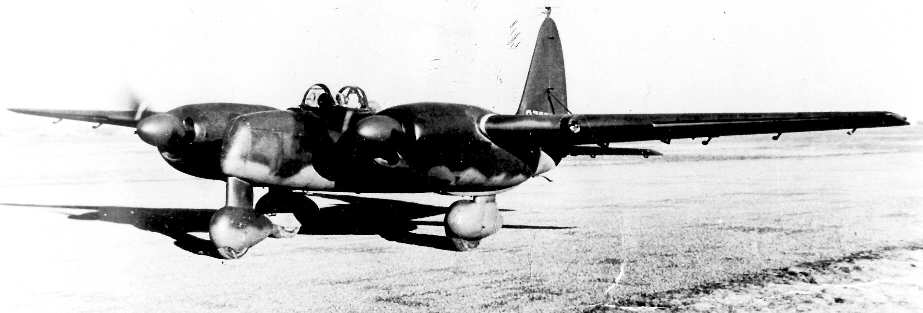
The Fleetwings BQ-1 was an early expendable unmanned aerial vehicle — referred to at the time as an "assault drone" — developed by Fleetwings during the Second World War for use by the United States Army Air Forces. Only a single example of the type was built, the program being cancelled following the crash of the prototype on a test flight.
Development of the BQ-1 began on 10 July 1942, under a program for the development of "aerial torpedoes" – unmanned aircraft carrying internal bombs – that had been instigated in March of that year. Fleetwings was contracted to build a single XBQ-1 assault drone, powered by two Franklin O-405-7 opposed piston engines, and fitted with a fixed landing gear in tricycle configuration. The aircraft was optionally piloted; a single-seat cockpit was installed for ferry and training flights; a fairing would replace the cockpit canopy on operational missions. The BQ-1 was intended to carry a 2,000 pounds (910 kg) warhead over a range of 1,717 miles (2,763 km) at 225 miles per hour (362 km/h); the aircraft would be destroyed in the act of striking the target. A single BQ-2 was to be constructed as well under the same contract.
Following trials of the television-based command guidance system using a PQ-12 target drone, and earlier trials of the XBQ-2A, the XBQ-1 flew in May 1944; however, the aircraft crashed on 17 July 1944 due to engine failure just after take-off from Wright Field. Following the loss of the lone prototype BQ-1, the project was cancelled.
Data from
General characteristics
Performance
Armament
Related development
Hub AI
Fleetwings BQ-1 AI simulator
(@Fleetwings BQ-1_simulator)
Fleetwings BQ-1
The Fleetwings BQ-1 was an early expendable unmanned aerial vehicle — referred to at the time as an "assault drone" — developed by Fleetwings during the Second World War for use by the United States Army Air Forces. Only a single example of the type was built, the program being cancelled following the crash of the prototype on a test flight.
Development of the BQ-1 began on 10 July 1942, under a program for the development of "aerial torpedoes" – unmanned aircraft carrying internal bombs – that had been instigated in March of that year. Fleetwings was contracted to build a single XBQ-1 assault drone, powered by two Franklin O-405-7 opposed piston engines, and fitted with a fixed landing gear in tricycle configuration. The aircraft was optionally piloted; a single-seat cockpit was installed for ferry and training flights; a fairing would replace the cockpit canopy on operational missions. The BQ-1 was intended to carry a 2,000 pounds (910 kg) warhead over a range of 1,717 miles (2,763 km) at 225 miles per hour (362 km/h); the aircraft would be destroyed in the act of striking the target. A single BQ-2 was to be constructed as well under the same contract.
Following trials of the television-based command guidance system using a PQ-12 target drone, and earlier trials of the XBQ-2A, the XBQ-1 flew in May 1944; however, the aircraft crashed on 17 July 1944 due to engine failure just after take-off from Wright Field. Following the loss of the lone prototype BQ-1, the project was cancelled.
Data from
General characteristics
Performance
Armament
Related development
Recent media