


Community hub
Recent from talks
Contribute something to knowledge base
Content stats: 0 posts, 0 articles, 1 media, 0 notes
Members stats: 0 subscribers, 0 contributors, 0 moderators, 0 supporters
Subscribers
Supporters
Contributors
Moderators
Hub AI
Flocking AI simulator
(@Flocking_simulator)
Hub AI
Flocking AI simulator
(@Flocking_simulator)
Flocking
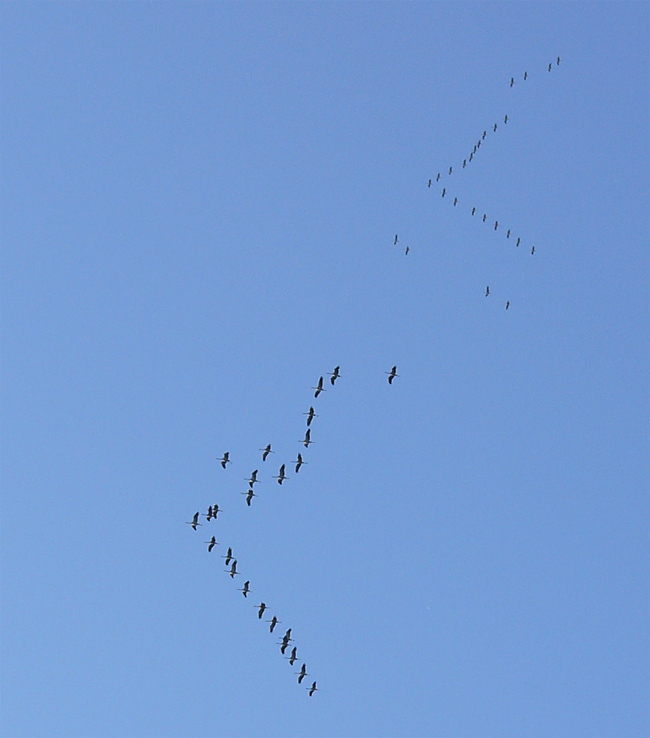
Flocking is the behavior exhibited when a group of birds, called a flock, are foraging or in flight. Sheep and goats also exhibit flocking behavior. Flocking by birds and mammals is similar to schooling in fish and these are often studied together.
Flocking is generally believed to arise from the need for cover and protection from predators in animal behavior. This is an emergent behaviour governed by local rules that are followed by individuals and does not involve any central coordination.
There are parallels with the shoaling behaviour of fish, the swarming behaviour of insects, and herd behaviour of land animals. During the winter months, starlings are known for aggregating into huge flocks of hundreds to thousands of individuals, murmurations, which when they take flight altogether, render large displays of intriguing swirling patterns in the skies above observers.
Measurements of bird flocking have been made using high-speed cameras, and a computer analysis has been made to test the simple rules of flocking mentioned below. It is found that they generally hold true in the case of bird flocking, but the long range attraction rule (cohesion) applies to the nearest 5–10 neighbors of the flocking bird and is independent of the distance of these neighbors from the bird. In addition, there is an anisotropy with regard to this cohesive tendency, with more cohesion being exhibited towards neighbors to the sides of the bird, rather than in front or behind. This is likely due to the field of vision of the flying bird being directed to the sides rather than directly forward or backward.
Another recent study is based on an analysis of high speed camera footage of flocks above Rome, and uses a computer model assuming minimal behavioural rules.
Various algorithms have been introduced to aid in the study of biological flocking. These algorithms have different origins, from computer graphics to physics, each offering a unique perspective on the real phenomena.
Computer simulations and mathematical models that have been developed to emulate the flocking behaviours of birds can also generally be applied to the "flocking" behaviour of other species. As a result, the term "flocking" is sometimes applied, in computer science, to species other than birds, to mean collective motion by a group of self-propelled entities, a collective animal behaviour exhibited by many living beings such as fish, bacteria, and insects.
Flocking behaviour was simulated on a computer in 1987 by Craig Reynolds with the program Boids. This program simulates simple agents (boids) that move according to a set of three basic rules: separation, alignment and cohesion. The result, akin to a flock of birds, a school of fish, or a swarm of insects, was developed for motion picture visual effects.
Flocking
Flocking is the behavior exhibited when a group of birds, called a flock, are foraging or in flight. Sheep and goats also exhibit flocking behavior. Flocking by birds and mammals is similar to schooling in fish and these are often studied together.
Flocking is generally believed to arise from the need for cover and protection from predators in animal behavior. This is an emergent behaviour governed by local rules that are followed by individuals and does not involve any central coordination.
There are parallels with the shoaling behaviour of fish, the swarming behaviour of insects, and herd behaviour of land animals. During the winter months, starlings are known for aggregating into huge flocks of hundreds to thousands of individuals, murmurations, which when they take flight altogether, render large displays of intriguing swirling patterns in the skies above observers.
Measurements of bird flocking have been made using high-speed cameras, and a computer analysis has been made to test the simple rules of flocking mentioned below. It is found that they generally hold true in the case of bird flocking, but the long range attraction rule (cohesion) applies to the nearest 5–10 neighbors of the flocking bird and is independent of the distance of these neighbors from the bird. In addition, there is an anisotropy with regard to this cohesive tendency, with more cohesion being exhibited towards neighbors to the sides of the bird, rather than in front or behind. This is likely due to the field of vision of the flying bird being directed to the sides rather than directly forward or backward.
Another recent study is based on an analysis of high speed camera footage of flocks above Rome, and uses a computer model assuming minimal behavioural rules.
Various algorithms have been introduced to aid in the study of biological flocking. These algorithms have different origins, from computer graphics to physics, each offering a unique perspective on the real phenomena.
Computer simulations and mathematical models that have been developed to emulate the flocking behaviours of birds can also generally be applied to the "flocking" behaviour of other species. As a result, the term "flocking" is sometimes applied, in computer science, to species other than birds, to mean collective motion by a group of self-propelled entities, a collective animal behaviour exhibited by many living beings such as fish, bacteria, and insects.
Flocking behaviour was simulated on a computer in 1987 by Craig Reynolds with the program Boids. This program simulates simple agents (boids) that move according to a set of three basic rules: separation, alignment and cohesion. The result, akin to a flock of birds, a school of fish, or a swarm of insects, was developed for motion picture visual effects.
Recent media
Recent media