



Community hub
Recent from talks
Knowledge base stats:
Talk channels stats:
Members stats:
Florida High-Speed Corridor
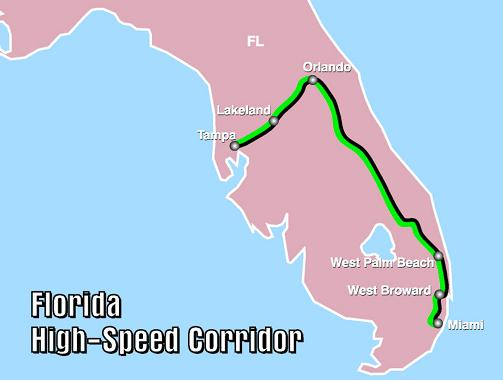
The Florida High-Speed Corridor is a canceled once-publicly funded high-speed rail project in the U.S. state of Florida reestablished as private enterprise. Initial service would have run between the cities of Tampa and Orlando, with plans to then extend service to South Florida, terminating in Miami. Trains with a top speed of 168 mph (270 km/h) to 186 mph (300 km/h) would run on dedicated rail lines alongside the state's existing highway network.
Construction of the line was slated to begin in 2011, with the initial Tampa-Orlando phase completed by 2014. On February 16, 2011, Florida Governor Rick Scott formally announced that he would be rejecting federal funds to construct the high-speed railway, thereby killing the Florida High-Speed Rail project. Governor Scott said the project would be "far too costly to taxpayers" and that "the risk[s] far outweigh the benefits".
In the wake of the project's cancellation, a private sector express passenger service running across much of the proposed route has been proposed by All Aboard Florida, now known as Brightline. This service began operations in 2018 and now runs passenger trains between Orlando and Miami. Its extension from Orlando to Tampa is in the early planning stages and has yet to be fully funded.
After the original federal proposal in the 1960s, U.S. federal and state governments revisited the idea of fast trains occasionally. The Passenger Railroad Rebuilding Act of 1980 led to the funding of high-speed corridor studies in 1984. Private-sector consortia intending to build high-speed lines were created in Florida, Ohio, Texas, California, and Nevada. Maglev trains became a new field of interest. They were officially added to the definition of "railroad" in 1988 and were studied repeatedly. Five high-speed corridors were officially endorsed in October 1992 following the passage of the Intermodal Surface Transportation Efficiency Act of 1991. TEA-21 and other legislation continued to be passed with mentions of high-speed rail, but lacking funding or real direction.
In November 2000, Florida voters approved an amendment to Florida's constitution mandating the state establish a system of high-speed trains exceeding 120 mph (190 km/h) to link its five largest urban areas, with construction commencing by November 1, 2003. The Florida Legislature enacted the Florida High-Speed Rail Authority Act in March 2001, creating the Florida High-Speed Rail Authority (HSRA). The HSRA established a Vision Plan for the system which proposed construction in several phases. Preliminary assessments and environmental studies were begun to develop an initial phase of the system between Orlando and Tampa.
The first phase, planned for completion in 2009 under the original referendum, would have connected Orlando to Tampa (Phase 1, Part 1), with a later extension to St. Petersburg (Phase 1, Part 2). Later phases might have extended the network to Miami, Fort Myers, Jacksonville, Tallahassee and Pensacola.
The Florida HSRA issued a Request for Proposal to Design, Build, Operate, Maintain and Finance (DBOM&F) the Orlando to Tampa Phase In October 2002. Two of the four received in February 2003 were reviewed further, one from a consortium of Fluor Corp. and Bombardier Transportation and one from Global Rail Consortium. The proposals showed the cost of the Orlando-Tampa route to be approximately $2.4 billion. Both proposals offered private equity contributions to support operations of the system and show the willingness of the private sector to share the risk associated with projected ridership revenues. In June 2003, Florida Governor Jeb Bush vetoed funding for the project that the Florida Legislature approved. The HSRA continued moving forward with the project, using funds already authorized by the federal government, and in October 2003 ranked the Fluor Bombardier proposal first.
In early 2004, Governor Jeb Bush endorsed an effort to repeal the 2000 amendment that mandated the construction of the High-Speed Rail System. On October 27, 2004, the authority voted to prefer the consortium of Fluor Corp. and Bombardier Transportation to build and operate the system, using Bombardier's JetTrain technology. However, a month later in November, Florida voters repealed the 2000 amendment, removing the constitutional mandate for the system. Although the amendment was repealed, no action was taken by the state legislature in regard to the Florida High-Speed Rail Authority Act. With the law still in effect, Florida's HSRA continued to meet, and completed the environmental impact statement for the Tampa-Orlando segment in 2005. With the constitutional mandate gone, funding for the project stopped, and very little action was taken over the next several years.
Hub AI
Florida High-Speed Corridor AI simulator
(@Florida High-Speed Corridor_simulator)
Florida High-Speed Corridor
The Florida High-Speed Corridor is a canceled once-publicly funded high-speed rail project in the U.S. state of Florida reestablished as private enterprise. Initial service would have run between the cities of Tampa and Orlando, with plans to then extend service to South Florida, terminating in Miami. Trains with a top speed of 168 mph (270 km/h) to 186 mph (300 km/h) would run on dedicated rail lines alongside the state's existing highway network.
Construction of the line was slated to begin in 2011, with the initial Tampa-Orlando phase completed by 2014. On February 16, 2011, Florida Governor Rick Scott formally announced that he would be rejecting federal funds to construct the high-speed railway, thereby killing the Florida High-Speed Rail project. Governor Scott said the project would be "far too costly to taxpayers" and that "the risk[s] far outweigh the benefits".
In the wake of the project's cancellation, a private sector express passenger service running across much of the proposed route has been proposed by All Aboard Florida, now known as Brightline. This service began operations in 2018 and now runs passenger trains between Orlando and Miami. Its extension from Orlando to Tampa is in the early planning stages and has yet to be fully funded.
After the original federal proposal in the 1960s, U.S. federal and state governments revisited the idea of fast trains occasionally. The Passenger Railroad Rebuilding Act of 1980 led to the funding of high-speed corridor studies in 1984. Private-sector consortia intending to build high-speed lines were created in Florida, Ohio, Texas, California, and Nevada. Maglev trains became a new field of interest. They were officially added to the definition of "railroad" in 1988 and were studied repeatedly. Five high-speed corridors were officially endorsed in October 1992 following the passage of the Intermodal Surface Transportation Efficiency Act of 1991. TEA-21 and other legislation continued to be passed with mentions of high-speed rail, but lacking funding or real direction.
In November 2000, Florida voters approved an amendment to Florida's constitution mandating the state establish a system of high-speed trains exceeding 120 mph (190 km/h) to link its five largest urban areas, with construction commencing by November 1, 2003. The Florida Legislature enacted the Florida High-Speed Rail Authority Act in March 2001, creating the Florida High-Speed Rail Authority (HSRA). The HSRA established a Vision Plan for the system which proposed construction in several phases. Preliminary assessments and environmental studies were begun to develop an initial phase of the system between Orlando and Tampa.
The first phase, planned for completion in 2009 under the original referendum, would have connected Orlando to Tampa (Phase 1, Part 1), with a later extension to St. Petersburg (Phase 1, Part 2). Later phases might have extended the network to Miami, Fort Myers, Jacksonville, Tallahassee and Pensacola.
The Florida HSRA issued a Request for Proposal to Design, Build, Operate, Maintain and Finance (DBOM&F) the Orlando to Tampa Phase In October 2002. Two of the four received in February 2003 were reviewed further, one from a consortium of Fluor Corp. and Bombardier Transportation and one from Global Rail Consortium. The proposals showed the cost of the Orlando-Tampa route to be approximately $2.4 billion. Both proposals offered private equity contributions to support operations of the system and show the willingness of the private sector to share the risk associated with projected ridership revenues. In June 2003, Florida Governor Jeb Bush vetoed funding for the project that the Florida Legislature approved. The HSRA continued moving forward with the project, using funds already authorized by the federal government, and in October 2003 ranked the Fluor Bombardier proposal first.
In early 2004, Governor Jeb Bush endorsed an effort to repeal the 2000 amendment that mandated the construction of the High-Speed Rail System. On October 27, 2004, the authority voted to prefer the consortium of Fluor Corp. and Bombardier Transportation to build and operate the system, using Bombardier's JetTrain technology. However, a month later in November, Florida voters repealed the 2000 amendment, removing the constitutional mandate for the system. Although the amendment was repealed, no action was taken by the state legislature in regard to the Florida High-Speed Rail Authority Act. With the law still in effect, Florida's HSRA continued to meet, and completed the environmental impact statement for the Tampa-Orlando segment in 2005. With the constitutional mandate gone, funding for the project stopped, and very little action was taken over the next several years.