Hubbry Logo
MiamiMiamiMain
Open search
Miami
Community hub
Miami
logo
8 pages, 0 posts
0 subscribers
Be the first to start a discussion here.
Miami
Miami
from Wikipedia

Miami[b] is a coastal city in the U.S. state of Florida. It is the second-most populous city proper in Florida, with a population of 442,241 at the 2020 census.[6] The Miami metropolitan area in South Florida has an estimated 6.46 million residents, ranking as the third-largest metropolitan area in the Southeast and sixth-largest metropolitan area in the United States.[9] Miami has the third-largest skyline in the U.S. with over 300 high-rises,[11] 70 of which exceed 491 ft (150 m).[12] It is the county seat of Miami-Dade County.

Key Information

Miami is a major center and leader in finance, commerce, culture, arts, and international trade.[13][14] Miami's metropolitan area is by far the largest urban economy in Florida, with a 2017 gross domestic product of $344.9 billion.[15] In a 2018 UBS study of 77 world cities, Miami was the third-richest city in the U.S. and the third-richest globally in purchasing power.[16] Miami is a majority-minority city, with 70.2 percent of the city's population identifying as Hispanic and Latino as of 2020.[17]

Downtown Miami has among the largest concentrations of international banks in the U.S. and is home to several large national and international companies.[18][19] The Health District is home to several major University of Miami-affiliated hospital and health facilities, including Jackson Memorial Hospital, the nation's largest hospital with 1,547 beds,[20] and the Miller School of Medicine, the University of Miami's academic medical center and teaching hospital, and others engaged in health-related care and research. PortMiami, the city's seaport, is the busiest cruise port in the world in both passenger traffic and cruise lines.[21]

The Miami metropolitan area is the second-most visited city or metropolitan statistical area in the U.S. after New York City, with over four million visitors in 2022.[22] Due to its strong commercial and cultural ties to Latin America and majority-Hispanic population (at 70%), Miami has been called the "Gateway to Latin America" or even the "Capital of Latin America."[23][24][25]

Toponymy

[edit]

Miami was named after the Miami River, derived from Mayaimi, the historic name of Lake Okeechobee and the Native Americans who lived around it.[26] Miami is sometimes colloquially referred to as The 305, Magic City, Gateway to the Americas, Gateway to Latin America, Capital of Latin America,[1] and Vice City.

History

[edit]
In 1896, approximately 400 men gathered in the building pictured on the left and voted to incorporate Miami.
The mouth of Miami River at Brickell Key in February 2010

The Tequesta tribe occupied the Miami area for around 2,000 years before contact with Europeans. A village of hundreds of people, dating to 500–600 BCE, was located at the mouth of the Miami River. It is believed that the entire tribe migrated to Cuba by the mid-1700s.[27] In 1566, admiral Pedro Menéndez de Avilés, Florida's first governor, claimed the area for Spain. A Spanish mission was constructed one year later. Florida was ruled by Spain for centuries—aside from a brief British interlude (1763–1783) that ended with Britain losing the territory back to Spain—until Spain ceded it to the United States in 1821, in exchange for U.S. recognition of Spanish sovereignty in Texas and the resolution of the border dispute along the Sabine River. In 1836, the U.S. built Fort Dallas on the banks of the Miami River as part of their development of the Florida Territory and their attempt to suppress and remove the Seminoles. As a result, the Miami area became a site of fighting in the Second Seminole War.

Miami is noted as the only major city in the United States founded by a woman. Julia Tuttle, a local citrus grower and a wealthy Cleveland native, was the original owner of the land upon which Miami was built.[28] In the late 19th century, the area was known as "Biscayne Bay Country", and reports described it as a promising wilderness and "one of the finest building sites in Florida".[29][30] The Great Freeze of 1894–1895 hastened Miami's growth, as the crops there were the only ones in Florida that survived. Julia Tuttle subsequently convinced railroad tycoon Henry Flagler to extend his Florida East Coast Railway to the region, for which she became known as "the mother of Miami".[31][32] Miami was officially incorporated as a city on July 28, 1896, with a population of just over 300.[33]

During the early 20th century, migrants from the Bahamas and African-Americans constituted 40 percent of the city's population.[34]: 25  When landlords began to rent homes to African-Americans around Avenue J, what would later become NW Fifth Avenue, a gang of white men with torches marched through the neighborhood and warned the residents to move or be bombed.[34]: 33  Miami’s economy was heavily based on seasonal tourism and construction work, which created a volatile job market of low-wage, temporary employment and contributed to pronounced income inequality even as the city promoted itself as a booming leisure destination.”Bennett, Evan P. (2024) “Working in the Magic City: Moral Economy in Early Twentieth-Century Miami,” Labour / Le Travail, 21(1): 123-152.

Despite the city’s image of resort-style prosperity, workers and activists during the interwar period organized around unemployment and labor exclusion, helping to lay early foundations for labor mobilization in South Florida.[citation needed]

Miami prospered during the 1920s with an increase in population and development in infrastructure as northerners moved to the city. The legacy of Jim Crow was embedded in these developments. Miami's chief of police at the time, H. Leslie Quigg, did not hide the fact that he, like many other white Miami police officers, was a member of the Ku Klux Klan. Unsurprisingly, these officers enforced social codes far beyond the written law. Quigg, for example, "personally and publicly beat a colored bellboy to death for speaking directly to a white woman".[34]: 53 [35] The collapse of the Florida land boom of the 1920s, the 1926 Miami Hurricane, and the Great Depression in the 1930s slowed development. When World War II began, Miami became a base for U.S. defense against German submarines due to its prime location on the southern coast of Florida. This brought an increase in Miami's population; 172,172 people lived in the city by 1940. The city's nickname, The Magic City, came from its rapid growth, which was noticed by winter visitors who remarked that the city grew so much from one year to the next that it was like magic.[36]

After Fidel Castro rose to power in Cuba following the Revolution in 1959, many wealthy Cubans sought refuge in Miami, further increasing the city's population. Miami's national profile expanded dramatically in the 1970s, particularly in 1972.[37] The region hosted both the Democratic and Republican National Conventions in the 1972 Presidential election. The Miami Dolphins also made history with their undefeated "perfect" season. The area's educational and cultural institutions also developed significantly in this period, positioning the city to service a larger and increasingly international population.[37]

Miami developed new businesses and cultural amenities as part of the New South in the 1980s and 1990s. At the same time, South Florida weathered social problems related to drug wars, immigration from Haiti and Latin America, and the widespread destruction of Hurricane Andrew.[38][36] Racial and cultural tensions sometimes sparked, but Miami developed in the latter half of the 20th century as a major international, financial, and cultural center. It is the second-largest U.S. city with a Spanish-speaking majority (after El Paso, Texas), and the largest city with a Cuban-American plurality.[39][40]

Geography

[edit]

Miami and its suburbs are located on a broad plain between the Everglades to the west and Biscayne Bay to the east, which extends from Lake Okeechobee southward to Florida Bay. The elevation of the area averages at around 6 ft (1.8 m)[41] above sea level in most neighborhoods, especially near the coast. The highest points are found along the Miami Rock Ridge, which lies under most of the eastern Miami metro. The main portion of Miami is on the shores of Biscayne Bay, which contains several hundred natural and artificial barrier islands, the largest of which contains Miami Beach and South Beach. The Gulf Stream, a warm ocean current, runs northward just 15 miles (24 km) off the coast, allowing Miami's climate to stay warm and mild all year.

Geology

[edit]

The surface bedrock under the Miami area is called Miami oolite or Miami limestone. This bedrock is covered by a thin layer of soil, and is no more than 50 feet (15 m) thick. Miami limestone formed as the result of the drastic changes in sea level associated with recent glacial periods, or ice ages. Beginning some 130,000 years ago, the Sangamonian Stage raised sea levels to approximately 25 feet (8 m) above the current level. All of southern Florida was covered by a shallow sea. Several parallel lines of reef formed along the edge of the submerged Florida plateau, stretching from the present Miami area to what is now the Dry Tortugas.[42]

The area behind this reef line was a large lagoon. Miami limestone formed throughout the area from the deposition of oolites and the shells of bryozoans. Starting about 100,000 years ago, the Wisconsin glaciation began lowering sea levels, exposing the floor of the lagoon. By 15,000 years ago, the sea level had dropped 300 to 350 feet (90 to 110 m) below the current level. The sea level rose quickly after that, stabilizing at the current level about 4,000 years ago, leaving the mainland of South Florida just above sea level.[42]

Beneath the plain lies the Biscayne Aquifer, a natural underground source of fresh water that extends from southern Palm Beach County to Florida Bay. It comes closest to the surface around the cities of Miami Springs and Hialeah.[43] Most of the Miami metropolitan area obtains its drinking water from the Biscayne Aquifer. As a result of the aquifer, it is not possible to dig more than 15 to 20 ft (5 to 6 m) beneath the city without hitting water, which impedes underground construction, though some underground parking garages exist. For this reason, the mass transit systems in and around Miami are elevated or at-grade.[42]

Most of the western fringes of Miami border the Everglades, a tropical marshland covering most of the southern portion of Florida. Alligators that live in the marshes have ventured into Miami communities and onto major highways.[42]

Cityscape

[edit]
Downtown Miami as seen from PortMiami in April 2025

Neighborhoods

[edit]
Map of Miami neighborhoods
A view from one of the higher points in Miami, west of Downtown Miami. The highest natural point in Miami is in Coconut Grove, near Biscayne Bay along the Miami Rock Ridge at 24 feet (7.3 m) above sea level.[44]
The historic district of Downtown Miami is one of the city's oldest with buildings constructed as far back as 1896.

Miami is split roughly into north, south, west, and Downtown areas. The heart of the city is Downtown Miami, which is on the eastern side and includes the neighborhoods of Brickell, Virginia Key, Watson Island, and PortMiami. Downtown Miami is Florida's largest and most influential central business district, with many major banks, courthouses, financial headquarters, cultural and tourist attractions, schools, parks, and a large residential population. Brickell Avenue has the largest concentration of international banks in the United States. Just northwest of Downtown is the Health District, which is Miami's center for hospitals, research institutes and biotechnology, with hospitals such as Jackson Memorial Hospital, Bascom Palmer Eye Institute, and the University of Miami's Miller School of Medicine.[45]

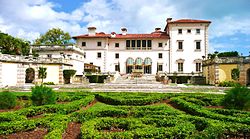
The southern side of Miami includes the neighborhoods of Coral Way, The Roads, and Coconut Grove. Coral Way is a historic residential neighborhood built in 1922 between Downtown and Coral Gables, and is home to many old homes and tree-lined streets. Coconut Grove, settled in 1825, and annexed into Miami in 1925, is a historic neighborhood with narrow, winding roads and a heavy tree canopy.[45][46] It is the location of Miami's City Hall at Dinner Key, the former Coconut Grove Playhouse, CocoWalk, and the Coconut Grove Convention Center. It is home to many nightclubs, bars, restaurants, and bohemian shops, which makes it very popular with local college students. Coconut Grove is known for its many parks and gardens, such as Vizcaya Museum, The Kampong, The Barnacle Historic State Park, and numerous other historic homes and estates.[45]

The western side of Miami includes the neighborhoods of Little Havana, West Flagler, and Flagami. Although at one time a mostly Jewish neighborhood, today western Miami is home to immigrants from mostly Central America and Cuba. The west central neighborhood of Allapattah is a multicultural community of many ethnicities.[45]

The northern side of Miami includes Midtown, a district with a great mix of diversity ranging from Caribbeans to Central Americans, South Americans and Europeans. The Edgewater neighborhood of Midtown is mostly composed of high-rise residential towers and is home to the Adrienne Arsht Center for the Performing Arts. Wynwood is an art district with ten galleries in former warehouses, as well as a large outdoor mural project. The wealthier residents of Miami usually live in the Design District and the Upper Eastside, which has many 1920s homes as well as examples of Miami Modern architecture in the MiMo Historic District.[47] The northern side of Miami also has notable African-American and Caribbean immigrant communities, including Little Haiti, Overtown (home of the Lyric Theater), and Liberty City.[45]

Climate

[edit]
A summer afternoon thunderstorm rolling into Miami from the Everglades, July 2006

Miami has a tropical monsoon climate (Köppen climate classification Am)[48][49] with hot and wet summers and warm and dry winters.

Miami's sea-level elevation, coastal location, position just above the Tropic of Cancer, and proximity to the Gulf Stream shape its climate. Average winter high temperatures, from December to March, range from 76.4–80.3 °F (24.7–26.8 °C). January is the coolest month with an average daily temperature of 68.2 °F (20.1 °C). Low temperatures fall below 50 °F (10 °C) about 3 to 4 nights during the winter season,[citation needed] after the passage of cold fronts that produce what little rainfall that falls in the winter.

There are two basic seasons in Miami, a hot and wet season from May to October, and a warm and dry season from November to April. During the hot and wet season, daily thundershowers occur in the humid unstable air masses. The wet season in Miami is defined as the period during which the average daily dew point temperature is above 70 °F (21 °C). The rainy season typically begins on the first day that occurs, or within a few days later.[50]

Daily rainfall in Miami decreases sharply when the average daily dew point falls to 70 °F (21 °C) or below. In some years, a stalled front to the south of the Florida peninsula may cause rains to continue for a few more days. From 1956 to 1997, the date summer began ranged from April 16 to June 3, with a median date of May 21. In those same years, the date summer ended ranged from September 24 to November 1, with a median date of October 17.[50]

During summer, temperatures range from the mid-80s to low 90s °F (29–35 °C) and are accompanied by high humidity. The heat is often relieved in the afternoon by thunderstorms or a sea breeze that develops off the Atlantic Ocean. Much of the year's 61.9 inches (1,572 mm) of rainfall occurs during this period. Dew points in the warm months range from 71.9 °F (22.2 °C) in June to 73.7 °F (23.2 °C) in August.[51]

Historical temperature extremes range from 27 °F (−2.8 °C) on February 3, 1917, to 100 °F (38 °C) on July 21, 1942.[52] While Miami has never recorded snowfall at any official weather station since records have been kept, snow flurries fell in some parts of Miami on January 19, 1977.[53][54][55] The coldest daytime maximum temperature on record is 45 °F (7 °C) in December 1989 during the December 1989 United States cold wave. The warmest overnight low measured is 84 °F (29 °C) on several occasions.[51]

Hurricane season officially runs from June 1 to November 30, although hurricanes can develop beyond those dates. The most likely time for Miami to be hit is during the peak of the Cape Verde season, which is mid-August to the end of September.[56] Although tornadoes are uncommon in the area, one struck in 1925 and another in 1997.[57][58] Around 40% of homes in Miami are built upon floodplains and are considered as flood-risk zones.[59]

Miami falls within the Department of Agriculture's 10b/11a plant hardiness zone.[60]

Miami is one of the major coastal cities and major cities in the United States that will be most affected by climate change.[61][62] Globally, it is one of the most at-risk cities, according to a 2020 report by Resources for the Future.[63][64] Global sea level rise, which in Miami is projected to be 21 inches (53 cm) to 40 inches (100 cm) by 2070, will lead to an increase in storm damage, more intense flooding, and will threaten Miami's water supply.[65][66][67] Other potential impacts of climate change include higher hurricane wind speeds and severe thunderstorms, which can bring about hail or tornadoes.[64] Some protective efforts are in place, including nourishing beaches and adding protective barriers, raising buildings and roads that are vulnerable, and restoring natural habitats such as wetlands.[64] Miami Beach has invested $500 million to protect roads, buildings, and water systems.[64] Real estate prices in Miami already reflect the increase in prices for real estate at a higher elevation within the city compared to real estate at a lower elevation.[68]

Month Jan Feb Mar Apr May Jun Jul Aug Sep Oct Nov Dec Year
Record high °F (°C) 88
(31)
89
(32)
93
(34)
97
(36)
98
(37)
98
(37)
100
(38)
98
(37)
97
(36)
95
(35)
91
(33)
89
(32)
100
(38)
Mean maximum °F (°C) 84.4
(29.1)
85.8
(29.9)
89.0
(31.7)
90.7
(32.6)
92.8
(33.8)
94.2
(34.6)
94.7
(34.8)
94.5
(34.7)
93.2
(34.0)
90.9
(32.7)
87.0
(30.6)
84.9
(29.4)
95.8
(35.4)
Mean daily maximum °F (°C) 76.2
(24.6)
78.2
(25.7)
80.6
(27.0)
83.6
(28.7)
86.7
(30.4)
89.3
(31.8)
90.6
(32.6)
90.7
(32.6)
89.0
(31.7)
85.9
(29.9)
81.3
(27.4)
78.2
(25.7)
84.2
(29.0)
Daily mean °F (°C) 68.6
(20.3)
70.7
(21.5)
73.1
(22.8)
76.7
(24.8)
80.1
(26.7)
82.8
(28.2)
84.1
(28.9)
84.2
(29.0)
83.0
(28.3)
80.1
(26.7)
74.8
(23.8)
71.2
(21.8)
77.4
(25.2)
Mean daily minimum °F (°C) 61.0
(16.1)
63.2
(17.3)
65.6
(18.7)
69.8
(21.0)
73.4
(23.0)
76.3
(24.6)
77.5
(25.3)
77.7
(25.4)
76.9
(24.9)
74.2
(23.4)
68.3
(20.2)
64.3
(17.9)
70.7
(21.5)
Mean minimum °F (°C) 45.1
(7.3)
48.5
(9.2)
52.3
(11.3)
59.6
(15.3)
66.7
(19.3)
71.5
(21.9)
72.5
(22.5)
72.8
(22.7)
72.7
(22.6)
65.0
(18.3)
55.7
(13.2)
49.7
(9.8)
42.5
(5.8)
Record low °F (°C) 28
(−2)
27
(−3)
32
(0)
39
(4)
50
(10)
60
(16)
66
(19)
67
(19)
62
(17)
45
(7)
36
(2)
30
(−1)
27
(−3)
Average precipitation inches (mm) 1.83
(46)
2.15
(55)
2.46
(62)
3.36
(85)
6.32
(161)
10.51
(267)
7.36
(187)
9.58
(243)
10.22
(260)
7.65
(194)
3.53
(90)
2.44
(62)
67.41
(1,712)
Average precipitation days (≥ 0.01 in) 7.7 6.5 6.3 6.9 10.8 17.6 17.3 19.4 18.1 13.8 8.6 8.0 141.0
Average relative humidity (%) 72.7 70.9 69.5 67.3 71.6 76.2 74.8 76.2 77.8 74.9 73.8 72.5 73.2
Average dew point °F (°C) 57.6
(14.2)
57.6
(14.2)
60.4
(15.8)
62.6
(17.0)
67.6
(19.8)
72.0
(22.2)
73.0
(22.8)
73.8
(23.2)
73.2
(22.9)
68.7
(20.4)
63.9
(17.7)
59.2
(15.1)
65.8
(18.8)
Mean monthly sunshine hours 219.8 216.9 277.2 293.8 301.3 288.7 308.7 288.3 262.2 260.2 220.8 216.1 3,154
Percentage possible sunshine 66 69 75 77 72 70 73 71 71 73 68 66 71
Average ultraviolet index 5.1 6.7 8.6 10.2 10.5 10.7 10.8 10.5 9.3 7.1 5.3 4.5 8.2
Source 1: NOAA (relative humidity, dew point and sun 1961–1990),[51][69][70] The Weather Channel[71]
Source 2: UV Index Today (1995 to 2022),[72] Thunderstorm days (1961 to 1990)[73]


Demographics

[edit]
Historical population
CensusPop.Note
19001,681
19105,471225.5%
192029,571440.5%
1930110,637274.1%
1940172,17255.6%
1950249,27644.8%
1960291,68817.0%
1970334,85914.8%
1980346,8653.6%
1990358,6483.4%
2000362,4701.1%
2010399,45710.2%
2020442,24110.7%
2024 (est.)487,01410.1%
U.S. Decennial Census[74]
1900–1970[75] 1980[76] 1990[77]
2000[78] 2010[79] 2020[6] 2024[7]

Miami is the largest city in South Florida, the second-largest city in Florida, and is the anchor of the largest metropolitan area in Florida: the Miami metropolitan area, which has over 6 million residents. Despite Miami being home to less than a fourteenth (1/14) of the population of the metro area, it is an outlier compared to its neighbors, being nearly twice the size of the next-largest city in the metro: Hialeah. Miami has approximately a sixth of the population of its own county, Miami-Dade, which is the state's largest.

Miami had rapid growth in the first half of the twentieth century. Its population grew from 1,681 in the 1900 census to 249,276 in the 1950 census. This made it Florida's largest city, a title it retained until the Jacksonville Consolidation, when the city of Jacksonville absorbed most of Duval County, nearly tripling its population. Since then, Miami has retained its spot as Florida's second-largest city.

Throughout the latter half of the twentieth century, Miami experienced a certain amount of stagnation in its population, with expansion slowing during the 1950s and 1960s before nearly halting in the next three decades as suburbanization occurred. Miami grew by 34.3% in the 1950s and 1960s as its population reached 334,859 at the 1970 census. In the next three decades, it only grew 8.2%. By the time of the 2000 census, Miami's population stood at 362,470.

In the 2000s and 2010s, spurred by high-rise construction in Downtown Miami, Edgewater, and Brickell, Miami's population began to grow quickly once more.[80] An estimate by the American Community Survey found that the downtown population, from Brickell north to Midtown Miami, grew nearly 40% between 2010 and 2018.[81] From 2000 to 2010, Miami's population grew by 10.2% and reached 399,457 in 2010. In the early 2010s, Miami's population crossed a milestone of 400,000 people. In the 2020 census, it had grown by a further 10.7%, up to a population of 442,241.

Historical racial composition 2020[6] 2010[79] 2000[78] 1990[77] 1980[76]
White (Non-Hispanic) 14.0% 11.9% 11.8% 12.2% 19.4%
Hispanic or Latino (any race) 70.2% 70.0% 65.8% 62.5% 55.9%
Black or African American (Non-Hispanic) 11.9% 16.3% 19.9% 24.6% 23.7%
Asian (Non-Hispanic) 1.3% 0.9% 0.6% 0.5% 1.0%
Native American (Non-Hispanic) 0.1% 0.1% 0.1% 0.1%
Some other race (Non-Hispanic) 0.6% 0.2% 0.1% 0.1%
Two or more races (Non-Hispanic) 2.0% 0.7% 1.7% N/A N/A
Population 442,241 399,457 362,470 358,548 346,865

In 1970, the Census Bureau reported Miami's population as 45.3% Hispanic, 32.9% non-Hispanic White, and 22.7% Black.[83] Miami's explosive population growth has been driven by internal migration from other parts of the country, up until the 1960s. From 1970 to 2000, population growth in Miami was stagnant, as non-Hispanic White Miamians left and significant immigration from Latin America, particularly Cuba, made up the balance.[84][85] Miami's Hispanic majority solidified itself in this period of time, and in 1985, Miami elected its first Cuban-born mayor, Xavier Suarez.

The non-Hispanic Black population of the city of Miami peaked in 1990 at almost 90,000, making up nearly a quarter of the population of Miami. Since then, Miami's non-Hispanic Black population has experienced a precipitous and steady decline. In the 2020 census, it was 52,447, only 11.7% of the population. Reasons for this include high costs in areas such as Liberty City and Little Haiti, compounded with gentrification.[86][87]

The non-Hispanic White population began to rebound in the twenty-first century, as the monolithically Hispanic areas in the Western and Central parts of Miami experienced population stagnation. This caused them to begin to be outweighed by migration into the Downtown region, from Latin America and the rest of the United States. This caused the non-Hispanic White population to rise from a nadir of 11.8% at the time of the 2000 census to 11.9% at the time of the 2010 census. After this, the non-Hispanic White population grew significantly faster than Miami as a whole did during the 2010s. In the 2020 census, non-Hispanic Whites were 14.0% of the population of Miami and numbered 61,829, the highest number since the 1980s. The non-Hispanic White population of Miami surpassed the non-Hispanic Black population of Miami in the 2010s.

Demographic characteristics 2020[88][89][90] 2010[91][92][93] 2000[94][95][96] 1990[77] 1980[76]
Households 212,146 183,994 148,388 130,252 134,046
Persons per household 2.08 2.17 2.44 2.69 2.59
Sex Ratio 97.8 99.2 98.9 93.5 88.0
Ages 0–17 16.5% 18.4% 21.7% 23.0% 21.4%
Ages 18–64 69.0% 65.6% 61.3% 60.4% 61.6%
Ages 65 + 14.5% 16.0% 17.0% 16.6% 17.0%
Median age 39.7 38.8 37.7 35.9 38.2
Population 442,241 399,457 362,470 358,548 346,865
Economic indicators
2017–21 American Community Survey Miami Miami-Dade County Florida
Median income[97] $31,472 $32,513 $34,367
Median household income[98] $47,860 $57,815 $61,777
Poverty Rate[99] 20.9% 15.7% 13.1%
High school diploma[100] 79.2% 82.5% 89.0%
Bachelor's degree[100] 33.1% 31.7% 31.5%
Advanced degree[100] 13.2% 11.9% 11.7%
Language spoken at home[e] 2015[f] 2010[g] 2000[103] 1990[104] 1980[105]
English 23.0% 22.6% 24.7% 26.7% 36.0%
Spanish or Spanish Creole 70.0% 69.9% 66.6% 64.0% 57.5%
French or Haitian Creole 4.5% 4.9% 6.0% 7.7% 2.6%
Other Languages 2.5% 2.6% 2.7% 1.6% 3.9%
Nativity 2015[h] 2010[i] 2000[110][111] 1990[112][104] 1980[105]
% population native-born 42.0% 41.9% 40.5% 40.3% 46.3%
... born in the United States 39.3% 39.3% 37.9% 37.3% 43.4%
... born in Puerto Rico or Island Areas 1.8% 1.7% 1.9% 2.2% 2.9%
... born to American parents abroad 0.9% 0.9% 0.6% 0.7%
% population foreign-born[j] 58.0% 58.1% 59.5% 59.7% 53.7%
... born in Cuba 27.6% 27.5% 30.3% 32.1% 35.9%
... born in Nicaragua 5.4% 5.7% 7.2% 7.3% N/A[k]
... born in Honduras 5.0% 5.4% 4.5% 1.9% N/A[k]
... born in Haiti 2.8% 3.2% 3.9% 5.0% N/A[k]
... born in Colombia 2.8% 2.4% 1.9% 1.2% N/A[k]
... born in Venezuela 1.8% 1.4% 0.6% 0.4% N/A[k]
... born in the Dominican Republic 1.7% 1.9% 2.0% 1.2% 0.6%
... born in Peru 1.1% 1.0% 0.9% 0.6% N/A[k]
... born in Argentina 1.0% 1.1% 0.6% 0.2% N/A[k]
... born in Mexico 0.9% 1.1% 0.6% 0.4% 0.1%
... born in other countries 7.9% 7.4% 7.0% 9.4% 17.1%

In 2010, 34.4% of city residents were of Cuban origin, 15.8% had a Central American background (7.2% Nicaraguan, 5.8% Honduran, 1.2% Salvadoran, and 1.0% Guatemalan), 8.7% were of South American descent (3.2% Colombian, 1.4% Venezuelan, 1.2% Peruvian, 1.2% Argentine, 1.0% Chilean and 0.7% Ecuadorian), 4.0% had other Hispanic or Latino origins (0.5% Spaniard), 3.2% descended from Puerto Ricans, 2.4% were Dominican, and 1.5% had Mexican ancestry.

In 2010, 5.6% of city residents were West Indian or Afro-Caribbean American origin (4.4% Haitian, 0.4% Jamaican, 0.4% Bahamian, 0.1% British West Indian, and 0.1% Trinidadian and Tobagonian, 0.1% Other or Unspecified West Indian),[113] 3.0% were Black Hispanics,[114] and 0.4% were Subsaharan African origin.[115][116]

In 2010, those of (non-Hispanic white) European ancestry were 11.9% of Miami's population. Of the city's total population, 1.7% were German, 1.6% Italian, 1.4% Irish, 1.0% English, 0.8% French, 0.6% Russian, and 0.5% were Polish.[115][116]

In 2010, those of Asian ancestry were 1.0% of Miami's population. Of the city's total population, 0.3% were Indian/Indo-Caribbean (1,206 people), 0.3% Chinese/Chinese Caribbean (1,804 people), 0.2% Filipino (647 people), 0.1% were other Asian (433 people), 0.1% Japanese (245 people), 0.1% Korean (213 people), and 0.0% were Vietnamese (125 people).[115]

In 2010, 1.9% of the population considered themselves to be of only American ancestry (regardless of race or ethnicity),[115][116] while 0.5% were of Arab ancestry, in 2010.[115]

Religion in the Miami Metro Area (2014)[117]
  1. Protestantism (39.0%)
  2. Catholicism (27.0%)
  3. Mormonism (0.50%)
  4. Eastern Orthodoxy (0.50%)
  5. Jehovah's Witnesses (1.00%)
  6. Other Christian (1.00%)
  7. No religion (21.0%)
  8. Judaism (9.00%)
  9. Other religion (1.00%)
Cathedral of Saint Mary, the seat of the archbishop of the Roman Catholic Archdiocese of Miami.

In a 2014 Pew Research Center study, Christianity was the most-practiced religion in Miami (68%), with 39% professing attendance at a variety of churches that could be considered Protestant, and 27% professing Catholicism.[118][119] Followed by Judaism (9%); Islam, Buddhism, Hinduism, and a variety of other religions have smaller followings; atheism or no self-identifying organized religious affiliation was practiced by 21%.

There has been a Norwegian Seamen's church in Miami since the early 1980s. In November 2011, Crown Princess of Norway Mette-Marit opened a new building for the church. The church was built as a center for the 10,000 Scandinavians that live in Florida. Around 4,000 of them are Norwegian. The church is also an important place for the 150 Norwegians that work at Walt Disney World in Central Florida.[120]

In a 2022 Point-In-Time Homeless Count, there were 3,440 homeless people in Miami-Dade County,[121] 970 of which were on the streets. In the city limits of Miami, there were 591 unsheltered homeless people on the streets, up from 555 in 2021.[122]

According to National Immigration Forum, the top countries of origin for Miami's immigrants are Latin America (86%): Cuba (741,666), Haiti (213,000), Colombia (166,338), Jamaica (144,445); Europe (6.1%): United Kingdom (23,334), Germany (15,611), Italy (14,240) and Asia (5.2%): India (23,602), China (21,580) and the Philippines (15,078).[123]

Economy

[edit]
Brickell Avenue has the largest concentration of international banks in the nation.
Downtown Miami's Brickell Financial District serves as an example of the city's recent waves of "Manhattanization".

Miami is a major center of commerce and finance and has a strong international business community. According to the 2020 ranking of world cities undertaken by the Globalization and World Cities Research Network (GaWC) based on the level of presence of global corporate service organizations, Miami is considered a Beta + level world city, along with Atlanta, Dallas, and Houston. However, according to the U.S. census between 2015 and 2019, Miami lacks in terms of owner-occupied housing, computer and internet usage, education of bachelor's degree or higher, median household income, per capita income, while having a higher percentage of persons in poverty.[124][125] In 2013, Miami had a Gross Metropolitan Product of $257 billion, ranking 11th in the United States and 20th worldwide in GMP.[126][127]

Several large companies are headquartered in Miami, including but not limited to Akerman LLP,[128] Alienware,[129] Arquitectonica,[130] Brightstar Corporation, Celebrity Cruises,[131] Carnival Corporation,[132] Duany Plater-Zyberk,[133] Greenberg Traurig, Inktel Direct, Lennar Corporation, Norwegian Cruise Line, Oceania Cruises, OPKO Health, Parkjockey, RCTV International,[134] Royal Caribbean International, Sitel, Southern Wine & Spirits,[135] Telemundo, Vector Group, Watsco and World Fuel Services. In 2022, hedge fund Citadel LLC and market maker Citadel Securities relocated their headquarters from Chicago to Miami.[136][137][138] Over 1,400 multinational firms are located in Miami, with many major global organizations headquartering their Latin American operations (or regional offices) in the city including Walmart.[139] Companies based in nearby cities or unincorporated areas of Miami-Dade County include, Benihana, Burger King, Carnival Cruise Line, Navarro Discount Pharmacies, Perry Ellis International, Ryder, Sedano's, UniMás, and U.S. Century Bank.[140][141][142][143][144][145][146]

Miami is a major television production center, and the most important city in the United States for Spanish-language media. Telemundo and UniMás have their headquarters in the Miami area. Univisión Studios and Telemundo Global Studios produce much of the original programming for their respective parent networks, such as telenovelas, news, sports, and talk shows. In 2011, 85% of Telemundo's original programming was filmed in Miami.[147] Miami is a significant music recording center, with the Sony Music Latin headquarters in the city,[148] along with many other smaller record labels. Miami also attracts many artists for music video and film shoots.

During the mid-2000s, Miami witnessed its largest real estate boom since the Florida land boom of the 1920s, and the city had well over a hundred approved high-rise construction projects. However, only 50 were actually built.[149] A rapid wave of Manhattanization, or high-rise construction, led to fast population growth in Miami's inner neighborhoods, with Downtown, Brickell and Edgewater becoming the fastest-growing areas of Miami. Miami currently has the seven tallest, as well as fifteen of top twenty, skyscrapers in the state of Florida, with the tallest being the 868-foot (265 m) Panorama Tower.[150]

The housing market crash of 2007 caused a foreclosure crisis in the area.[151] Like other metro areas in the United States, crime in Miami is localized to specific neighborhoods.[152]

Miami International Airport (IATA: MIA) and PortMiami are among the nation's busiest ports of entry, especially for cargo from South America and the Caribbean. PortMiami is the world's busiest cruise port. Miami International Airport is the busiest airport in Florida and the largest gateway between the United States and Latin America.[153] Due to its strength in international business, finance and trade, Miami has among the largest concentration of international banks in the country, primarily along Brickell Avenue in Brickell, Miami's financial district. Miami was the host city of the 2003 Free Trade Area of the Americas negotiations.

Miami is the home to the National Hurricane Center and the headquarters of the United States Southern Command, responsible for military operations in Central and South America. Miami is also an industrial center, especially for stone quarrying and warehousing. These industries are centered largely on the western fringes of Miami near Doral and Hialeah.[154]

In the 2012 census, Miami had the fourth highest percentage of family incomes below the federal poverty line out of all large cities in the United States, behind Detroit, Cleveland, and Cincinnati, respectively. Miami is also one of the very few cities in the U.S. where the local government has gone bankrupt, in 2001.[155]

The Little Fire Ant, Wasmannia auropunctata, is an invasive agricultural pest in parts of Miami.[156]

PortMiami

[edit]
PortMiami, the world's largest cruise ship port and headquarters for many of the world's largest cruise companies, seen from the docked MSC Magnifica cruise ship in March 2024.

PortMiami in Miami is the largest cruise ship port in the world.[157] It has retained its status as the number one cruise and passenger port in the world for well over a decade, accommodating the largest cruise ships and the major cruise lines. In 2017, the port served 5,340,559 cruise passengers.[158] The port is one of the nation's busiest cargo ports, importing 9,162,340 tons of cargo in 2017.[158]

Among North American ports, it ranks second to New Orleans' Port of South Louisiana in cargo tonnage imported from Latin America. The port sits on 518 acres (2 km2) and has seven passenger terminals. China is the port's number one import country and number one export country. Miami has the world's largest amount of cruise line headquarters, home to Carnival Cruise Line, Celebrity Cruises, Norwegian Cruise Line, Oceania Cruises, and Royal Caribbean International. In 2014, the Port of Miami Tunnel opened, connecting the MacArthur Causeway to PortMiami.[159]

Tourism and conventions

[edit]
The Royal Caribbean International headquarters at PortMiami

Tourism is one of the Miami's largest private-sector industries, accounting for more than 144,800 jobs in Miami-Dade County.[160] Miami's frequent portrayal in music, film, and popular culture has made Miami and its landmarks recognizable worldwide. In 2016, it attracted the second-highest number of foreign tourists of any city in the United States, after New York City, and is among the top 20 cities worldwide by international visitor spending. More than 15.9 million visitors arrived in Miami in 2017, adding $26.1 billion to the economy.[161] With a large hotel infrastructure and the newly renovated Miami Beach Convention Center, Miami is a popular destination for annual conventions and conferences.[162]

Some of the most popular tourist destinations in Miami include South Beach, Lincoln Road, Bayside Marketplace, Downtown Miami, and Brickell City Centre. The Art Deco District in Miami Beach is reputed as one of the most glamorous in the world for its nightclubs, beaches, historical buildings, and shopping. Annual events such as the Miami Open, Art Basel, the Winter Music Conference, the South Beach Wine and Food Festival, and Mercedes-Benz Fashion Week Miami attract millions to the metropolis every year.

Culture

[edit]

Miami enjoys a vibrant culture that is influenced by a diverse population from all around the world. Miami is known as the "Magic City" for seemingly popping up overnight due to its young age and massive growth. Miami is infamous for its drug war in the early 1980s and its outrun aesthetics.[163][164][165] It is nicknamed the "Capital of Latin America" because of its high population of Spanish speakers.[166][167][168][169]

Miami has been the setting of numerous films and television shows, including Bad Boys, Miami Vice, Cocaine Cowboys, CSI: Miami, Burn Notice, Jane the Virgin, Scarface, The Birdcage, Ballers, South Beach Tow, Ace Ventura: Pet Detective, Ride Along 2, Love & Hip Hop: Miami, Kourtney & Kim Take Miami, Family Karma, The Golden Girls, 2 Fast 2 Furious, Austin & Ally, The Real CSI: Miami, and Dexter.[170][171][172][173][174][175][176] Several video games, including Hotline Miami, the Gameloft racing game Asphalt Overdrive, Scarface: The World Is Yours, and the fictional Vice City in several video games across the Grand Theft Auto series, most notably Grand Theft Auto: Vice City and the upcoming Grand Theft Auto VI, is based on Miami.[177][178]

Entertainment

[edit]
The Adrienne Arsht Center for the Performing Arts, the second-largest performing arts center in the United States

Venues

[edit]

Miami is home to many entertainment venues, theaters, museums, parks, and performing arts centers. The Adrienne Arsht Center for the Performing Arts is the home of the Florida Grand Opera and the second-largest performing arts center in the United States after Lincoln Center in New York City.[179] The center attracts many large-scale operas, ballets, concerts, and musicals from around the world.

Other performing arts venues in Miami include the Olympia Theater, Wertheim Performing Arts Center, the Fair Expo Center, the Tower Theater, and the Bayfront Park Amphitheater.[180]

Miami's first boat-in movie theater opened in 2020.[181]

Events

[edit]

Miami is home to a number of annual festivals, such as the Calle Ocho Festival, the largest Latin music festival in the country, which has run since 1978.[182][183]

Another celebrated event is the Miami International Film Festival, taking place every year for 10 days around the first week of March, during which independent international and American films are screened across Miami. Miami has over a half dozen independent film theaters.[184]

The Miami Jewish Film Festival (MJFF) was established in 1996.[185] It is an annual event held in January that screens a variety of films relating to Jewish history and culture. As of 2025, the festival awards a number of film awards: Critics Jury Prize, Next Wave Jury Prize, Kadima Jury Prize, Torchbearer Award, Emerging Filmmaker Award, and the Audience Awards for Best Narrative Film, Documentary Film, and Short Film. The Miami Jewish Film Club holds special screenings throughout the year.[186]

Miami is a major fashion center, home to models and some of the top modeling agencies in the world. Miami hosts many fashion shows and events, including the annual Miami Fashion Week and the Mercedes-Benz Fashion Week Miami, held in the Wynwood Art District.[187][188][189]

Music and performing arts

[edit]

Miami attracts a large number of musicians, singers, actors, dancers, and orchestral players. The city has numerous orchestras, symphonies, and performing art conservatories. These include the Florida Grand Opera, FIU School of Music, Frost School of Music, and the New World School of the Arts.[190][191][192][193]

Museums and visual arts

[edit]
The Lowe Art Museum on the campus of the University of Miami

Some of the museums in Miami include the Frost Art Museum, Frost Museum of Science, HistoryMiami, Institute of Contemporary Art, Miami Children's Museum, Pérez Art Museum, Lowe Art Museum, and the Vizcaya Museum and Gardens, a National Historic Landmark set on a 28-acre early 20th century estate in Coconut Grove.[194]

Cuisine

[edit]

The cuisine of Miami is a reflection of its diverse population, with a heavy influence from Latin American, Caribbean, Soul, and Jewish cuisine. By combining them with mainstream American cuisine, it has spawned a unique South Florida style of cooking known as Floribbean cuisine. It is widely available throughout Miami and South Florida and can be found in restaurant chains such as Pollo Tropical.

Cuban immigrants in the 1960s originated the Cuban sandwich and brought medianoche, Cuban espresso, Bistec de palomilla, and croquetas, all of which have grown in popularity among all Miamians and have become symbols of the city's varied cuisine. Today, these are part of the local culture and can be found throughout the city at window cafés, particularly outside of supermarkets and restaurants.[195][196] Some of these locations, such as the Versailles restaurant in Little Havana, are landmark eateries of Miami. Located on the Atlantic Ocean, and with a long history as a seaport, Miami is also known for its seafood, with many seafood restaurants located along the Miami River and in and around Biscayne Bay.[197] The city is also the headquarters of restaurant chains such as Burger King and Benihana.

Dialect

[edit]

The Miami area has a unique dialect of American English, commonly called the "Miami accent", that is widely spoken. The accent developed among second- or third-generation Hispanics, including Cuban Americans, whose first language was English. Some non-Hispanic white, black and other races who were born and raised in the Miami area have tended to adopt it as well.[198]

It is based on a fairly standard American accent but with some changes, very similar to dialects in the Mid-Atlantic, especially those in the New York area and Northern New Jersey, including New York Latino English. Unlike Virginia Piedmont, Coastal Southern American, Northeast American dialects and Florida Cracker dialect, "Miami accent" is rhotic. It incorporates a rhythm and pronunciation heavily influenced by Spanish, where rhythm is syllable-timed.[199]

This is a native dialect of English, not learner English or interlanguage. It is possible to differentiate this variety from an interlanguage spoken by second-language speakers, in that the "Miami accent" does not generally display the following features: there is no addition of /ɛ/ before initial consonant clusters with /s/, speakers do not confuse /dʒ/ with /j/, (e.g., Yale with jail), and /r/ and /rr/ are pronounced as alveolar approximant [ɹ] instead of alveolar tap [ɾ] or alveolar trill [r] in Spanish.[200][201][202][203]

Sports

[edit]

Miami's main five sports teams are Inter Miami of Major League Soccer (MLS),[204] the Miami Marlins of Major League Baseball (MLB),[205] the Florida Panthers of the National Hockey League (NHL),[206] the Miami Heat of the National Basketball Association (NBA)[207] and the Miami Dolphins of the National Football League (NFL).[208] The Miami Open, an annual tennis tournament, was previously held in Key Biscayne before moving to Hard Rock Stadium after the tournament was purchased by Miami Dolphins owner Stephen Ross in 2019.

Miami is home to numerous marinas, jai alai venues, and golf courses. The city streets have hosted professional auto races in the past, most notably the open-wheel Grand Prix of Miami, the sports car Grand Prix of Miami, and Miami Grand Prix of Formula One.[209] In 2015, Miami hosted a one-off Formula E race. The Homestead–Miami Speedway oval hosts NASCAR races.[210]

The Heat and the Marlins play within Miami's city limits, at the Kaseya Center in Downtown and LoanDepot Park in Little Havana, respectively. Marlins Park is built on the site of the old Miami Orange Bowl stadium.[211]

The Miami Dolphins play at Hard Rock Stadium in suburban Miami Gardens, while the Florida Panthers play in nearby Sunrise at Amerant Bank Arena. Inter Miami CF plays at Chase Stadium in nearby Fort Lauderdale, temporarily until a stadium is built at Miami Freedom Park. Miami FC is another professional soccer club that plays in the USL Championship second tier of the United States soccer league system. The Club plays its home matches at the FIU Stadium on the campus of Florida International University (FIU) in Miami.

The Orange Bowl, one of the major bowl games in the College Football Playoff of the NCAA, is played at Hard Rock Stadium every winter. The stadium has also hosted the Super Bowl. The Miami metro area has hosted the game ten times, five times at the current Hard Rock Stadium and five at the Miami Orange Bowl, tying New Orleans for the most games.[212]

Miami is also the home of many college sports teams. The two largest are the University of Miami Hurricanes, whose football team plays at Hard Rock Stadium and Florida International University Panthers, whose football team plays at FIU Stadium. The Hurricanes compete in the Atlantic Coast Conference (ACC), while the Panthers compete in the Conference USA of the National Collegiate Athletic Association.[213][214]

Miami is home to Paso Fino horses. Competitions are held at Tropical Park Equestrian Center.[215]

Miami hosted the 2024 Copa América final in July 2024.[216]

Miami will serve as one of eleven U.S. host cities for the 2026 FIFA World Cup.[217]

The following are the major professional sports teams in the Miami metropolitan area:

Miami major league professional sports teams
Club Sport Miami Area since League Venue League Championships
Miami Dolphins American football 1965[218] National Football League Hard Rock Stadium 1972 (VII), 1973 (VIII)[219][220]
Florida Panthers Ice hockey 1993 National Hockey League Amerant Bank Arena 2024, 2025
Miami Heat Basketball 1988[221] National Basketball Association Kaseya Center 2006,[222] 2012,[223] 2013[224]
Miami Marlins Baseball 1993[225] Major League Baseball LoanDepot Park 1997, 2003[226][227]
Inter Miami CF Soccer 2018 Major League Soccer Chase Stadium

Beaches and parks

[edit]
Bayfront Park on Biscayne Bay, February 2017

The City of Miami has various lands operated by the National Park Service, the Florida Division of Recreation and Parks, and the City of Miami Department of Parks and Recreation.

Miami's tropical weather allows for year-round outdoor activities.[228] Miami has numerous marinas, rivers, bays, canals, and the Atlantic Ocean, which make boating, canoeing, sailing, and fishing popular outdoor activities. Biscayne Bay has numerous coral reefs that make snorkeling and scuba diving popular. There are over 80 parks and gardens in the city.[229] The largest and most popular parks are Bayfront Park and Museum Park (located in the heart of Downtown and the location of the Miami-Dade Arena and Bayside Marketplace), Tropical Park, Peacock Park, Virginia Key, and Watson Island.[230][231][232][233][234]

Other popular cultural destinations in or near Miami include Zoo Miami,[235] Jungle Island,[236] the Miami Seaquarium,[237] Monkey Jungle,[238] Coral Castle,[239] Charles Deering Estate,[240] Fairchild Tropical Botanic Garden, and Key Biscayne.[241][242]

In its 2020 ParkScore ranking, The Trust for Public Land reported that the park system in the City of Miami was the 64th best park system among the 100 most populous U.S. cities,[243] down slightly from 48th place in the 2017 ranking.[244] The City of Miami was analyzed to have a median park size of 2.6 acres, park land as percent of city area of 6.5%, 87% of residents living within a 10-minute walk of a park, $48.39 spending per capita of park services, and 1.3 playgrounds per 10,000 residents.[245]

Law and government

[edit]
Miami City Hall, located at Dinner Key in Coconut Grove, is home to Miami's primary administrative offices.
Miami's new logo

The government of the City of Miami uses the mayor-commissioner type of system. The city commission consists of five commissioners that are elected from single member districts. The city commission constitutes the governing body with powers to pass ordinances, adopt regulations, and exercise all powers conferred upon the city in the city charter. The mayor is elected at large and appoints a city manager. The City of Miami is governed by Mayor Francis Suarez and 5 city commissioners that oversee the five districts in the city.[246]

The commission's regular meetings are held at Miami City Hall, which is located at 3500 Pan American Drive on Dinner Key in the neighborhood of Coconut Grove. In the United States House of Representatives, Miami is represented by Republicans Maria Elvira Salazar and Mario Diaz-Balart, along with Democrat Frederica Wilson.

City Commission

[edit]
  1. Francis Suarez – Mayor of the City of Miami
  • Miguel Angel Gabela – Miami Commissioner, District 1
Allapattah and Grapeland Heights
  • Damian Pardo – Miami Commissioner, District 2
Arts & Entertainment District, Brickell, Coconut Grove, Coral Way, Downtown Miami, Edgewater, Midtown Miami, Park West and the South part Upper Eastside
Coral Way, Little Havana and The Roads
  • Manolo Reyes – Miami Commissioner, District 4
Coral Way, Flagami and West Flagler
  • Christine King – Miami Commissioner, District 5
Buena Vista, Design District, Liberty City, Little Haiti, Little River, Lummus Park, Overtown, Spring Garden and Wynwood and northern part of the Upper Eastside
  • Arthur Noriega – City Manager
  • Victoria Méndez – City Attorney
  • Todd B. Hannon – City Clerk

Politics

[edit]

For much of the 20th century, Miami and its surrounding area, Miami-Dade County, were solidly Democratic, reflecting the city's diverse population and liberal political leanings. However, in recent election cycles, a notable shift has occurred. The 2020 presidential election marked a turning point, with Trump making substantial gains among Hispanic voters, especially within the Cuban-American community. This shift was reflected in Miami-Dade County, where Trump only lost the county by seven points and lost the city by 19 points, a 21-point shift to the right from 2016.[247] Then in the 2022 Florida gubernatorial election, Ron DeSantis won the county for the first time for a Republican candidate since 2002 and only lost the city of Miami by one-and-a-half points.[248] That trend continued in the 2024 presidential election in Florida, with Trump winning the county by eleven points, a rare occurrence for a Republican presidential candidate. This was the first time a Republican candidate had won Miami-Dade County since 1988, a major political transformation in what had traditionally been a Democratic stronghold.[249]

Education

[edit]

Colleges and universities

[edit]
Florida International University, with its main campus in nearby University Park, is the largest university in South Florida and the fourth largest university by enrollment in the U.S. It is also one of Florida's primary research universities.
Founded in 1925, the University of Miami in nearby Coral Gables is Florida's top ranked private institution of higher education.

Miami-Dade County has over 200,000 students enrolled in local colleges and universities, placing it seventh in the nation in per capita university enrollment. In 2010, the city's four largest colleges and universities, Miami Dade College, Florida International University, University of Miami, and Barry University, graduated 28,000 students.[250]

Miami is also home to both for-profit and nonprofit organizations that offer a range of professional training and other, related educational programs. Per Scholas, for example is a nonprofit organization that offers free professional certification training directed towards successfully passing CompTIA A+ and Network+ certification exams as a route to securing jobs and building careers.[251] [252][253]

Colleges and universities in and around Miami:

Primary and secondary schools

[edit]
Miami Senior High School, founded in 1903, was Miami's first high school.

Public schools in Miami are governed by Miami-Dade County Public Schools, which is the largest school district in Florida and the fourth-largest in the United States. In September 2008 it had a student enrollment of 385,655 and over 392 schools and centers. The district is the largest minority public school system in the country, with 60% of its students being of Hispanic origin, 28% Black or West Indian American, 10% White (non-Hispanic) and 2% non-white of other minorities.[269]

The Miami city limits is home to several key high schools: Design and Architecture High School, ranked seventh highest on the "Gold Medal" by list US News and World Report,[270] MAST Academy, Coral Reef High School, and the New World School of the Arts.[citation needed] M-DCPS is also one of a few public school districts in the United States to offer optional bilingual education in Spanish, French, German, Haitian Creole, and Mandarin Chinese.

Miami is home to several well-known Roman Catholic, Jewish and non-denominational private schools. The Archdiocese of Miami operates the area's Catholic private schools, which include Immaculata-Lasalle High School (in the Miami city limits), St. Theresa School (Coral Gables), Monsignor Edward Pace High School (Miami Gardens), and St. Brendan High School (in Westchester), among numerous other Catholic elementary and high schools.[271][272][273] Archbishop Curley-Notre Dame High School was in the Miami city limits until its closure in 2016.[274]

Catholic preparatory schools operated by religious orders in the area are Belen Jesuit Preparatory School (Tamiami) and Christopher Columbus High School (Westchester) for boys and Carrollton School of the Sacred Heart (Miami city limits) and Our Lady of Lourdes Academy (Ponce-Davis) for girls.[275][276][277][278]

Non-denominational private schools in Miami are Ransom Everglades, Gulliver Preparatory School, The Cushman School, and Miami Country Day School. Other schools in the area include Samuel Scheck Hillel Community Day School, Dade Christian School, Dawere International High School,[279][280] Palmer Trinity School, Westminster Christian School, and Riviera Schools.[281][282][283][284][285][286]

Supplementary education

[edit]

The Miami Hoshuko, is a part-time Japanese school for Japanese citizens and ethnic Japanese people in the area. Previously it was located on Virginia Key, at the Rosenstiel School of Marine and Atmospheric Science.[287] Currently the school holds classes in Westchester and has offices in Doral.[288]

Media

[edit]
The former headquarters of The Miami Herald on Biscayne Bay

Miami has one of the largest television markets in the nation and the second largest in the state of Florida after Tampa Bay.[289] Miami has several major newspapers, the main and largest newspaper being The Miami Herald. El Nuevo Herald is the major and largest Spanish-language newspaper. The Miami Herald and El Nuevo Herald are Miami's and South Florida's main, major and largest newspapers. The papers left their longtime home in Downtown Miami in 2013. The newspapers are now headquartered at the former home of U.S. Southern Command in Doral.[290]

Other major newspapers include Miami Today, headquartered in Brickell, Miami New Times, headquartered in Midtown, Miami SunPost, South Florida Business Journal, and The Miami Times. An additional Spanish-language newspaper, Diario Las Americas also serves Miami. Student newspapers from the local universities include the University of Miami's The Miami Hurricane, Florida International University's The Beacon, Miami-Dade College's The Metropolis, and Barry University's The Buccaneer. Many neighborhoods and neighboring areas have their own local newspapers, such as the Aventura News, Coral Gables Tribune, Biscayne Bay Tribune, Biscayne Times, and the Palmetto Bay News.

A number of magazines circulate throughout the greater Miami area, including Miami Monthly, Southeast Florida's only city/regional, and Ocean Drive, a hot-spot social scene glossy.

Miami is the headquarters and main production city of many of the world's largest television networks, record label companies, broadcasting companies and production facilities, such as Telemundo, Univision, Univision Communications, Mega TV, Universal Music Latin Entertainment, RCTV International and Sunbeam Television. In 2009, Univision announced plans to build a new production studio in Miami, dubbed Univision Studios. Univision Studios is headquartered in Miami, and will produce programming for all of Univision Communications' television networks.[291]

Miami is the twelfth largest radio market and the seventeenth largest television market in the United States.[292][293] Television stations serving the Miami area include WFOR 4 (CBS O&O), WTVJ 6 (NBC O&O), WSVN 7 (Fox, with ABC on DT2 via WDFL-LD 18), WLTV 23 (Univision O&O), WBFS 33 (The CW), WPXM 35 (Ion O&O), WHFT 45 (TBN (O&O), WSCV 51 (Telemundo) and WAMI 69 (UniMás O&O). Independent stations include WPLG 10 and WSFL 39, while WPBT 2 and WLRN 17 are member stations of PBS.

Transportation

[edit]

In the 2016 American Community Survey, 72.3% of working city of Miami residents commuted by driving alone, 8.7% carpooled, 9% used public transportation, and 3.7% walked. About 1.8% used all other forms of transportation, including taxicab, motorcycle, and bicycle. About 4.5% of working city of Miami residents worked at home.[294] In 2015, 19.9% of city of Miami households were without a car, which decreased to 18.6% in 2016. The national average was 8.7 percent in 2016. Miami averaged 1.24 cars per household in 2016, compared to a national average of 1.8 per household.[295]

Expressways and roads

[edit]
State Road 886, also known as Port Boulevard, connects Downtown Miami and PortMiami over Biscayne Bay.

Miami's road system is based along the numerical Miami grid where Flagler Street forms the east–west baseline and Miami Avenue forms the north–south meridian. The corner of Flagler Street and Miami Avenue is in the middle of Downtown in front of the Downtown Macy's (formerly the Burdine's headquarters). The Miami grid is primarily numerical so that, for example, all street addresses north of Flagler Street and west of Miami Avenue have "NW" in their address. Because its point of origin is in Downtown, which is close to the coast, the "NW" and "SW" quadrants are much larger than the "SE" and "NE" quadrants. Many roads, especially major ones, are also named (e.g., Tamiami Trail/SW 8th St), although, with exceptions, the number is in more common usage among locals.

With few exceptions, within this grid north–south roads are designated as Courts, Roads, Avenues or Places (often remembered by their acronym), while east–west roads are streets, Terraces, Drives or occasionally Ways. Major roads in each direction are located at one mile intervals. There are 16 blocks to each mile on north–south avenues, and 10 blocks to each mile on east–west streets. Major north–south avenues generally end in "7" – e.g., 17th, 27th, 37th/Douglas Aves., 57th/Red Rd., 67th/Ludlam, 87th/Galloway, etc., all the way west beyond 177th/Krome Avenue. One prominent exception is 42nd Avenue, LeJeune Road, located at the half-mile point instead.

Major east–west streets to the south of Downtown are multiples of 16, though the beginning point of this system is at SW 8th St, one half-mile south of Flagler ("zeroth") Street. Thus, major streets are at 8th St., 24th St./Coral Way, 40th St./Bird, 56th/Miller, 72nd/ Sunset, 88th/N. Kendall, 104th (originally S. Kendall), 120th/Montgomery, 136th/Howard, 152nd/Coral Reef, 168th/Richmond, 184th/Eureka, 200th/Quail Roost, 216th/Hainlin Mill, 232nd/Silver Palm, 248th/Coconut Palm, etc., well into the 300s. Within the grid, odd-numbered addresses are generally on the north or east side, and even-numbered addresses are on the south or west side.

All streets and avenues in Miami-Dade County follow the Miami grid, with a few exceptions, most notably in Coral Gables, Hialeah, Coconut Grove and Miami Beach. One neighborhood, The Roads, is named as such because its streets run off the Miami grid at a 45-degree angle, and therefore are all named roads.

Miami-Dade County is served by four Interstate Highways (I-75, I-95, I-195, I-395) and several U.S. Highways including U.S. Route 1, U.S. Route 27, U.S. Route 41, and U.S. Route 441.

Some of the major Florida State Roads (and their common names) serving Miami are:

Miami has six major causeways that span over Biscayne Bay connecting the western mainland, with the eastern barrier islands along the Atlantic Ocean. The Rickenbacker Causeway is the southernmost causeway and connects Brickell to Virginia Key and Key Biscayne. The Venetian Causeway and MacArthur Causeway connect Downtown with South Beach. The Julia Tuttle Causeway connects Midtown and Miami Beach. The 79th Street Causeway connects the Upper East Side with North Beach. The northernmost causeway, the Broad Causeway, is the smallest of Miami's six causeways and connects North Miami to Bay Harbor Islands and Bal Harbour.

In 2007, Miami was identified as having the rudest drivers in the United States, the second year in a row to have been cited, in a poll commissioned by automobile club AutoVantage.[296] Miami is also consistently ranked as one of the most dangerous cities in the United States for pedestrians.[297]

Public transportation

[edit]
Miami's Metrorail is the city's rapid transit system and connects Miami with its outlying suburbs.
Tri-Rail is Miami's commuter rail that runs north–south from Miami's suburbs in West Palm Beach to Miami International Airport.

Public transportation in Miami is operated by Miami-Dade Transit and SFRTA, and includes commuter rail (Tri-Rail), heavy-rail rapid transit (Metrorail), an elevated people mover (Metromover), and buses (Metrobus). Miami has Florida's highest transit ridership as about 17% of Miamians use transit on a daily basis.[298] The average Miami public transit commute on weekdays is 90 minutes, while 39% of public transit riders commute for more than 2 hours a day. The average wait time at a public transit stop or station is 18 minutes, while 37% of riders wait for more than 20 minutes on average every day. The average single trip distance with public transit is 7.46 mi (12 km), while 38% travel more than 8.08 mi (13 km) in each direction.[299]

Miami's heavy-rail rapid transit system, Metrorail, is an elevated system comprising two lines and 23 stations on a 24.4-mile (39.3 km)-long line. Metrorail connects the urban western suburbs of Hialeah, Medley, and inner-city Miami with suburban The Roads, Coconut Grove, Coral Gables, South Miami, and urban Kendall via the central business districts of Miami International Airport, the Health District, and Downtown. A free, elevated people mover, Metromover, operates 21 stations on three different lines in greater Downtown Miami, with a station at roughly every two blocks of Downtown and Brickell. Several expansion projects are being funded by a transit development sales tax surcharge throughout Miami-Dade County.[300]

Tri-Rail, a commuter rail system operated by the South Florida Regional Transportation Authority (SFRTA), runs from Miami International Airport northward to West Palm Beach, making eighteen stops throughout Miami-Dade, Broward, and Palm Beach counties.[301]

The Miami Intermodal Center is a massive transportation hub servicing Metrorail, Amtrak, Tri-Rail, Brightline, Metrobus, Greyhound Lines, taxis, rental cars, MIA Mover, private automobiles, bicycles and pedestrians adjacent to Miami International Airport. Miami Intermodal Center was completed in 2010, and is serving about 150,000 commuters and travelers in the Miami area. Phase I of MiamiCentral Station was completed in 2012, and the Tri-Rail part of Phase II was completed in 2015, but the construction of the Amtrak part remains delayed.

Two new light rail systems, Baylink and the Miami Streetcar, have been proposed and are currently in the planning stage. BayLink would connect Downtown with South Beach, and the Miami Streetcar would connect Downtown with Midtown.

Miami is the southern terminus of Amtrak's Atlantic Coast services, running two lines, the Silver Meteor and the Silver Star, both terminating in New York City. The Miami Amtrak Station is located in the suburb of Hialeah near the Tri-Rail/Metrorail Station on NW 79 St and NW 38 Ave. Current construction of the Miami Central Station will move all Amtrak operations from its current out-of-the-way location to a centralized location with Metrorail, MIA Mover, Tri-Rail, Miami International Airport, and the Miami Intermodal Center all within the same station closer to Downtown. The station was expected to be completed by 2012,[302] but experienced several delays and was later expected to be completed in late 2014,[303] again pushed back to early 2015.[304]

Airports

[edit]
Miami International Airport, the nation's 10th-largest airport

Miami International Airport serves as the primary international airport of the Greater Miami Area. One of the busiest international airports in the world because of its centric location, Miami International Airport caters to over 45 million passengers a year. The airport is a major hub and the largest international gateway for American Airlines.[305]

Miami International is the second busiest airport by passenger traffic in Florida, the United States' third-largest international port of entry for foreign air passengers, behind New York's John F. Kennedy International Airport and Los Angeles International Airport. The airport's extensive international route network includes non-stop flights to over seventy international cities in North and South America, Europe, Africa, Asia, and the Middle East.[305]

Nearby Fort Lauderdale–Hollywood International Airport and Palm Beach International Airport also serve commercial traffic in the Miami area.[306] Miami-Opa Locka Executive Airport in Opa-locka and Miami Executive Airport in an unincorporated area southwest of Miami serve general aviation traffic in the Miami area.

Cycling and walking

[edit]

The city government under former mayor Manny Diaz took an ambitious stance in support of bicycling in Miami for both recreation and commuting.[307] In 2010, Miami was ranked as the 44th-most bike-friendly city in the U.S., according to Bicycling Magazine.[308]

A 2011 study by Walk Score ranked Miami the eighth-most walkable of the 50 largest cities in the U.S.[309]

Public safety

[edit]

International relations

[edit]

Sister cities

[edit]

Cooperation agreements

[edit]

Notable people

[edit]

Notes

[edit]

See also

[edit]

References

[edit]

Further reading

[edit]
[edit]
Revisions and contributorsEdit on WikipediaRead on Wikipedia
from Grokipedia

Miami is a coastal city and major seaport in southeastern , , situated on at the mouth of the Miami River. Incorporated on July 28, 1896, with an initial population of 444, the city serves as the of Miami-Dade County and the economic core of the Miami-Fort Lauderdale-West Palm Beach , home to approximately 6.18 million residents as of 2023. Dubbed the "Magic City" due to its explosive growth spurred by the arrival of Henry Flagler's in the late , Miami boasts a subtropical climate that supports its beaches, vibrant nightlife, and status as a year-round tourist destination. As a global hub for international commerce, the city hosts , the world's busiest cruise passenger port and a key container facility, while its economy thrives on finance, real estate, and trade with Latin America and the Caribbean. Miami's cultural identity reflects waves of , particularly from and other Latin American countries, evident in neighborhoods like —a hub of community activities—and the architecture of the neighboring city of Miami Beach, which draws millions for its preserved 1920s-1930s designs.

Etymology

Name Origin and Historical Usage

The name "Miami" applied to the city originates from the adjacent Miami River, which derives from Mayaimi, the designation used by Native American tribes for the region around what is now Lake Okeechobee. This indigenous term, linked to the Mayaimi tribe that inhabited the lake's vicinity until displaced in the 17th or 18th century, was extended to the river by later European cartographers and explorers mapping South Florida's waterways. Spanish expeditions documented early presence along the river starting in the 1560s, with missions established on its north bank between 1567 and 1570, though primary accounts from these periods refer to local Tequesta inhabitants rather than explicitly using "Miami" for the waterway. By the 19th century, U.S. surveys and maps consistently labeled the river as "Miami," reflecting settler adoption of the indigenous-derived name without alteration. During the late 19th-century push for settlement, figures such as , who owned extensive land north of the river, advocated for development at the site's mouth, aligning with the existing river nomenclature rather than proposing alternatives. The formal application to the urban settlement culminated in the city's incorporation on July 28, 1896, under the designating it "The City of ," with an initial of 444 residents voting in approval. This , ratified by Florida's , marked the first official municipal use of the name, tying it directly to the river's longstanding identifier amid railroad extension and land grants that facilitated growth. Subsequent historical maps from the early , such as those depicting the original boundaries with annexations, reinforced the name's continuity for the expanding urban core, distinguishing it from nearby features like while prioritizing the river as the geographic anchor. No verified primary documents indicate shifts or competing proposals overriding the river's name in the incorporation process, underscoring its empirical persistence from indigenous linguistics through colonial records to modern civic identity.

History

Indigenous Peoples and Early European Contact

The Tequesta people inhabited the region around and the mouth of the River for millennia prior to European arrival, establishing villages supported by fishing, hunting, and gathering in a coastal environment characterized by mangroves, wetlands, and marine resources. Archaeological evidence, including shell middens and artifacts from sites like the —a 2,000-year-old structure at the river's confluence with the bay—indicates semi-permanent settlements focused on subsistence economies, with tools for processing fish, sharks, and marine mammals reflecting adaptation to local ecology rather than intensive . The Tequesta extended across southeast , with their principal village near modern serving as a hub for trade and ceremonies, though population densities remained low due to the nutrient-poor soils and seasonal flooding that constrained large-scale farming or dense aggregation. To the southwest, the exerted influence over adjacent , including parts of through alliances or raids, but their core domain centered around Charlotte Harbor and the Gulf Coast, where they built complex shell mound societies without or cultivation, relying instead on and canoe-based . Intertribal dynamics involved competition for resources, but the 's remained distinct, with of shared artistic motifs on bone tools suggesting cultural exchange rather than dominance. Pre-Columbian populations in were sparse overall, estimated in the low thousands for the Tequesta, limited by the region's hydrological barriers and reliance on estuarine productivity, which supported bands rather than hierarchical urban centers seen elsewhere in the . European contact began with Juan Ponce de León's 1513 expedition, when he sailed along Florida's east coast, claiming the peninsula for after landing near present-day St. Augustine, though his route likely skirted the Miami area without direct disembarkation there. Subsequent Spanish probes yielded limited interaction with the , as explorers prioritized northern and for gold or conversion, leaving south Florida's indigenous groups initially isolated from sustained settlement. By the mid-16th century, indirect exposure to pathogens via trade routes and shipwrecks initiated catastrophic depopulation, with epidemics of , , and ravaging immunologically naive populations. The Tequesta and Calusa suffered mortality rates exceeding 90% from these diseases between the 1500s and 1700s, compounded by Spanish military raids and enslavement attempts, leading to societal collapse by the early 18th century; surviving remnants sought refuge in Spanish missions, such as the short-lived one established on Biscayne Bay in 1743, but even these failed amid ongoing attrition. Florida's transfer to British control in 1763 found the Miami River basin effectively depopulated, with abandoned villages and overgrown middens signaling the end of indigenous dominance, paving the way for uninhabited lands available for later European claims without resistance. This rapid demographic vacuum resulted from the interplay of introduced diseases and the fragility of low-density, non-immune societies in isolated ecosystems, rather than solely conquest.

19th-Century Settlement and Incorporation

In the 1870s, private homesteaders began claiming land in the Miami area, transforming sparsely inhabited swampland through individual initiative. William Brickell, arriving from Cleveland in 1871, established a trading post and homesteaded on the south bank of the Miami River, engaging in commerce with Native Americans and early settlers. By the 1890s, Julia Tuttle, a widow from Cleveland who relocated in 1891, acquired significant acreage including the site of the former Fort Dallas, envisioning agricultural and urban potential in the subtropical climate. These entrepreneurs bore the risks of isolation and environmental challenges without substantial government support, laying the groundwork for settlement. The pivotal catalyst came during the of 1894-1895, which devastated citrus crops northward while sparing Miami's vegetation. Tuttle sent Flagler samples of unaffected orange blossoms and , demonstrating the region's viability for year-round . In response, railroad magnate agreed to extend his southward, contingent on land donations from Tuttle and Brickell, who offered half their holdings for the rail terminus and associated infrastructure. Flagler's private investment, including the construction of the Royal Palm Hotel and basic streets upon the line's arrival in April 1896, unlocked accessibility and spurred economic activity from near-vacant territory. Miami was incorporated as a on July 28, 1896, with an initial population of 444 residents, formalized through a vote largely driven by the railroad's presence. This entrepreneurial alignment rapidly attracted settlers, growing the population to approximately 1,700 by the 1900 census, as Flagler's developments created value through improved transport and amenities, drawing migrants seeking opportunity in the nascent urban center.

20th-Century Expansion and Turbulence

In the 1920s, Miami experienced a speculative land boom fueled by railroad expansion and promotional campaigns, driving the city's population from 29,549 in 1920 to estimates exceeding 75,000 by 1925 through influxes of investors and tourists seeking subtropical real estate. The frenzy culminated in inflated property values, with transactions often involving multiple resales in a single day, but collapsed following the Great Miami Hurricane of September 1926, which destroyed over 13,000 homes, killed at least 115 in the Miami area, and inflicted $100 million in damages, exacerbating an already overleveraged market and triggering widespread bankruptcies and abandonment. This bust reversed much of the gains, with thousands of speculators fleeing and construction halting, though official 1930 census figures showed recovery to 110,637 residents amid the Great Depression's onset. World War II revived Miami's economy through the establishment of naval bases and training facilities, including Richmond Naval Air Station, which attracted military personnel and supported shipbuilding and aviation activities. The wartime influx swelled the resident population from 173,000 to over 325,000 during peak winter months, generating employment in defense-related industries and laying groundwork for postwar infrastructure like expanded ports and airports. This dependency on federal military spending cushioned the city from broader postwar adjustments but fostered vulnerabilities to cuts after 1945. From the late 1950s through the 1970s, waves of Cuban exiles fleeing Fidel Castro's regime—over 600,000 arriving in the U.S. by 1973, with the majority settling in Miami—spurred entrepreneurial growth in sectors like , retail, and , elevating the city's GDP through formation and remittances. However, the rapid influx strained public services, overwhelming schools, housing, and welfare systems in neighborhoods like , where surged and lagged behind demand. Miami's total rose steadily from 249,998 in 1950 to 334,859 in 1970, reflecting this demographic pressure amid economic diversification but highlighting fiscal dependencies on state and federal aid. Tensions escalated in 1980 with the McDuffie riots, sparked by the acquittal of four white Dade County police officers in the fatal 1979 beating of Black motorcyclist Arthur McDuffie, leading to four days of unrest in Liberty City that killed 18 people (10 Black, eight white), injured over 400, and caused $100 million in through and . The same year, the brought 125,000 Cuban migrants to Miami between April and October, including up to 20,000 with criminal records or issues whom Castro deliberately released from prisons and asylums to inflate the exodus's undesirability. U.S. policies permitting unchecked entry overwhelmed detention and vetting capacities, contributing to a surge in as unassimilated elements from the boatlift integrated into illicit networks. The early 1980s crack cocaine epidemic amplified this volatility, with Miami's homicides peaking at 621 in 1981—a more than doubling from 243 in 1978—driven by turf wars over drug importation routes through the port and . The convergence of Mariel-linked offenders, lax initial screening, and booming narcotics trade—facilitated by corruptible local institutions—fueled systemic violence, as evidenced by findings on disproportionate criminality taxing justice resources. This period underscored Miami's economic reliance on transient booms, from speculation to migration and vice, often precipitating social fractures without robust policy safeguards.

Post-1980s Revival and Modern Developments

struck on August 24, 1992, as a Category 5 storm, causing 23 direct deaths in the United States—primarily in Dade County—and inflicting $27 billion in damages, the costliest in U.S. history at the time. The storm demolished over 63,500 homes and damaged more than 124,000 others in the Miami area, particularly in southern suburbs like Homestead. Rebuilding accelerated through payouts exceeding $15.5 billion and private capital inflows, though the event exposed underprepared insurers, leading to 16 company insolvencies and subsequent market-driven reforms like stricter building codes and expansions rather than heavy subsidies. The mid-2000s housing boom in , fueled by speculative investment, ended with the 2008 bubble burst, slashing home values by approximately 40-50% and triggering widespread foreclosures. Recovery gained momentum in the , supported by resurgence—with visitor numbers climbing from 13.5 million in 2010 to over 26 million by 2019—as international appeal and infrastructure upgrades drew Latin American and European travelers. In the 2020s, solidified as a and tech hub under Mayor , who promoted and tax advantages to attract firms; relocated its headquarters from in 2022, followed by other hedge funds and crypto entities. trends post-2020 amplified inflows, with the city proper's population rising from 442,241 in 2020 to an estimated 487,014 by 2024—a 10.1% increase—driven by domestic migrants seeking Florida's no-income-tax environment over high-tax states. Miami-Dade County's GDP grew 3.5% in 2023, surpassing the national 2.9% rate, reflecting private-sector-led expansion in services and trade amid policy stability.

Geography

Physical Setting and Geology

Miami occupies a low-lying in southeastern , with elevations ranging from to a maximum of approximately 40 feet (12 ) above across the city, though the average elevation in most neighborhoods is about 6 feet (1.8 ). The terrain is predominantly flat, consisting of a narrow strip of land between to the east and the wetlands to the west, which imposes constraints on urban expansion by limiting available high ground and exposing the area to inundation from both marine and inland sources. This subdued topography, shaped by Pleistocene marine deposition, offers opportunities for waterfront development but necessitates elevated structures and drainage systems to mitigate risks in localized hotspots, such as along coastlines. Geologically, Miami lies atop the Biscayne Aquifer, a shallow, unconfined system primarily composed of the , a Pleistocene-age oolitic characterized by high and permeability. The oolitic of this , formed in shallow marine environments, forms the surficial and facilitates rapid , serving as the region's primary freshwater source with values among the highest in the aquifer's upper flow unit. However, the aquifer's connectivity to exposes it to , particularly during overpumping or sea-level fluctuations, which constrains groundwater extraction for development and requires management to prevent contamination of potable supplies. The porous nature of the oolitic enables quick of , allowing several centimeters of rainfall to drain through the in under an hour, which aids post-storm recovery by reducing prolonged saturation but contributes to initial rapid flooding on the flat during intense events. Barrier islands, such as Miami Beach, are linked to the mainland via causeways spanning , leveraging the shallow, substrate for while highlighting geological opportunities for island chaining that expand habitable land in an otherwise constrained coastal setting. These subsurface features thus balance water resource abundance with vulnerabilities that shape strategies, favoring permeable over impermeable surfaces to harness natural drainage.

Urban Layout and Neighborhoods

Miami's urban layout radiates from , with forming the central core characterized by high-rise concentrations along the waterfront and grid-patterned streets extending inland. Development patterns emerged from early 20th-century private land subdivisions rather than comprehensive public planning, fostering a mosaic of over 80 distinct neighborhoods shaped by market incentives and evolving ordinances. The city's Miami 21 code, adopted in 2009 as a form-based system, prioritizes building form and over strict use separations, enabling private developers to adapt districts through contextual height limits and zones that transition from dense urban cores to suburban edges. Downtown functions as the primary business nucleus, hosting , , and residential towers within its 10,613-acre expanse, while adjacent transitioned from a derelict zone in the early to an arts-oriented district via private investments in street murals and of industrial structures. , solidified as a enclave post-1959 , occupies a compact area west of Downtown with row-house densities reflecting mid-20th-century immigrant settlement patterns driven by proximity to centers. In contrast, upscale Coral Gables exemplifies early private-led planning, founded in 1925 by developer George Merrick as a Mediterranean Revival suburb spanning themed villages with enforced architectural standards and banyan-lined avenues, distinguishing it from the organic growth of core districts. Higher-density legacy neighborhoods like Overtown, originally "Colored Town" under Jim Crow restrictions, concentrated Black residents at up to 150 people per residential acre by the mid-20th century, exacerbating strain and later displacement from Interstate 95 construction in the 1960s that razed thousands of units. Contemporary in areas such as Edgewater features vertically oriented private developments, including approved 47-story towers with mixed market-rate and , leveraging incentives for bayfront sites to achieve densities exceeding 100 units per acre amid rising demand for urban living. These patterns underscore how private initiative, rather than top-down mandates, has iteratively redefined Miami's spatial fabric, though high-density zones often correlate with elevated rates compared to low-rise suburbs, as evidenced by historical legacies.

Climate Patterns and Natural Hazards

Miami experiences a (Köppen classification Am), with consistently warm temperatures, high humidity, and a distinct from May to . Average daily high temperatures range from 77°F (25°C) in to 89°F (32°C) in July and August, while lows rarely drop below 60°F (16°C), averaging 68°F (20°C) in winter months.
MonthAvg Max Temp (°F/°C)Avg Mean Temp (°F/°C)Avg Min Temp (°F/°C)Avg Precip (in/mm)
January77/2569/2162/172.0/51
February78/2670/2163/172.0/51
March80/2772/2266/192.8/71
April82/2875/2470/213.1/79
May86/3078/2674/235.9/150
June88/3181/2777/259.0/229
July89/3283/2878/267.2/183
August89/3283/2878/268.9/226
September88/3182/2877/259.0/229
October86/3079/2674/237.1/180
November82/2875/2469/213.0/76
December79/2671/2264/182.3/58
Annual totals approximately 62 inches (1,575 mm), concentrated in the , with the receiving about 248 days of sunshine per year. These patterns result from Miami's position at 25.76°N latitude, influenced by and the , yielding minimal seasonal variation compared to temperate zones. Hurricanes pose the primary natural hazard, with the Atlantic season (June 1 to November 30) bringing risks of high winds, , and heavy rain. Since 1851, has recorded over 130 instances of hurricane or tropical storm conditions affecting the Miami area, but direct landfalls of major hurricanes (Category 3 or higher on the Saffir-Simpson scale) on the city itself remain infrequent. Notable direct major impacts include the 1926 Great Miami Hurricane (Category 4, with winds up to 131 mph), which devastated early settlements, and in 1992 (Category 5 at landfall nearby, causing $27 billion in damage primarily southward but prompting region-wide reforms). Post-1926, only Andrew inflicted a major direct hit on core Miami-Dade infrastructure, with events like (2017, Category 4 track but weakened to Category 1 at nearest approach) and Wilma (2005, Category 3 offshore) causing indirect damage through surges and winds rather than eye-wall passage. Tidal flooding, often termed "sunny-day" flooding, occurs during —perigean spring tides amplified by the moon's closest orbital approach to , typically in , , and —exacerbating vulnerabilities in low-lying areas below 4 feet (1.2 m) . Such events flooded streets in Miami Beach and downtown Miami on October 8-10, 2025, with water levels reaching 2-3 feet in isolated spots, but without unprecedented submersion compared to prior decades when adjusted for changes. Causal factors include astronomical tidal cycles, gradual mean (measured at 3.3 mm/year locally since 1930 by NOAA tide gauges), and non-climatic contributors like land from (estimated 1-2 mm/year in filled coastal zones) and aging systems overwhelmed by impervious surfaces. Empirical tide records show no acceleration beyond linear trends attributable solely to or ice melt, with and maintenance deficits explaining much of the increase in flood frequency over CO2-driven narratives emphasized in some academic and media sources prone to . Engineering adaptations have enhanced resilience, particularly following Andrew's exposure of code weaknesses. Florida's 1992 building code overhaul mandated wind-resistant designs, elevating structures on pilings in flood zones and requiring breakaway walls for ground levels. Miami Beach deployed over 80 stormwater pumps by 2020, capable of handling 4,000 gallons per minute each, reducing king tide inundation durations from hours to minutes in treated areas. New developments incorporate raised roadways and permeable pavements, with 2025 data indicating effective mitigation during recent events, as no widespread structural failures or evacuations beyond routine precautions occurred. These measures, grounded in empirical post-disaster analysis rather than predictive models, have sustained urban functionality amid recurrent hazards.

Demographics

Population Dynamics and Growth

Miami's population stood at 1,681 residents according to the 1900 U.S. Census, marking the city's incorporation as a municipality. By the 2020 Census, this had expanded to 442,241, reflecting periods of rapid expansion interspersed with stagnation and decline, particularly during the mid-20th century economic challenges and the 1980s urban unrest. The city's land area of approximately 35.9 square miles yields a 2020 population density of about 12,300 persons per square mile, among the highest in the United States, concentrated in dense urban core neighborhoods. Post-2020, Miami's population grew to an estimated 464,655 by 2025, representing a roughly 5% increase from the 2020 baseline, driven predominantly by net migration rather than natural increase. This uptick followed an initial post-COVID surge in domestic inflows, as enabled relocations from high-tax jurisdictions like New York and , drawn by Florida's absence of and lower overall tax burden on high earners. Such migration patterns align with causal factors including fiscal incentives and preferences over welfare entitlements, countering narratives of dependency-driven growth. However, by 2023-2024, net domestic migration turned negative for the area, with over 100,000 more residents departing for other U.S. locales than arriving, amid rising living costs and infrastructure strains. This has contributed to a suburban exodus, with dwellers relocating to lower-density exurbs in Miami-Dade County and beyond, easing central density pressures but sustaining metro-area expansion through and local retention. Overall growth persists at a modest annual rate of under 1%, tempered by these outflows.

Ethnic and Cultural Composition

Miami's ethnic composition reflects successive waves of immigration, with Hispanics of Latin American origin comprising 70% of the city's population according to the 2020 United States Census. Non-Hispanic Blacks constitute approximately 12% of residents, non-Hispanic Whites about 11%, and Asians around 1%, with the remainder including smaller groups and multiracial individuals. Among Hispanics, those of Cuban descent dominate, accounting for roughly half of the city's total population through early exile cohorts following Fidel Castro's 1959 revolution, which instilled an anti-communist orientation and emphasis on self-reliance that propelled entrepreneurial ventures. Cuban exiles established key businesses and cultural institutions, notably in Little Havana, contributing to Miami's emergence as a commercial hub via networks that facilitated trade and investment. Subsequent Hispanic inflows include Nicaraguans and Venezuelans, who began arriving in larger numbers from the onward amid Sandinista rule and later Chávez-Maduro policies, respectively, often sharing the Cuban exiles' aversion to and replicating patterns of rapid formation despite initial barriers. These groups have formed enclaves that preserve Spanish-language dominance, sometimes hindering broader linguistic assimilation and creating service delivery challenges in monolingual environments. Cuban and other successes contrast with persistent segregation in Black neighborhoods like Liberty City, where the population derives from early 20th-century Southern U.S. migrants and arrivals such as , resulting in concentrated communities facing integration hurdles. Liberty City's over 40% poverty rate as of 2017 underscores debates over causal factors, with some attributing stagnation to welfare dependencies eroding work incentives and others to cultural adaptations from rural origins ill-suited to urban economies. Unassimilated enclaves across groups foster tensions, as ethnic concentrations can elevate localized crime through insular networks while impeding cross-cultural ties; empirical studies indicate immigrant barrios sometimes correlate with higher drug-related violence due to segmented assimilation paths that limit mainstream incorporation. Cuban-origin achievements, including disproportionate business ownership, highlight how ideological flight from collectivism aids integration, whereas other enclaves' insularity raises barriers to English acquisition and intergroup cooperation essential for civic cohesion.

Socioeconomic Indicators

In 2023, the median household income in Miami was $59,390, significantly lower than the U.S. national median of $78,538 and reflecting a concentration of lower-wage service and employment alongside high-end sectors. The city's poverty rate stood at 17.9%, affecting over 80,000 residents and exceeding the national rate of 11.1%, with disparities pronounced in immigrant-heavy neighborhoods where informal economies and remittances play key roles in household resilience. Income inequality in the greater Miami area remains among the highest in the U.S., with a of 0.51 in recent assessments, surpassing the national average of 0.48 and driven by a polarized distribution between affluent professionals in and and low-skill laborers in . This metric, derived from data, underscores structural factors like seasonal volatility and limited upward mobility in entry-level jobs, rather than uniform opportunity gaps. Homeownership rates in proper were notably low at 30.7% in 2023, constrained by soaring property values—median home prices exceeded $475,000—and a rental-dominated urban core favoring condominiums over single-family dwellings. Educational attainment lags behind national benchmarks, with 82.4% of adults aged 25 and older holding a or equivalent, compared to 89.9% nationwide, while only about 30% possess a or higher versus 38.2% nationally. Public school systems face empirical critiques for underperformance, with proficiency rates in reading and math often below 50% in assessments, attributable to high student mobility from transient populations and resource strains rather than inherent demographic deficits. Empirical studies highlight pathways out of , particularly among residents, where family-based networks and entrepreneurial ventures—such as small businesses in and retail—facilitate intergenerational mobility at rates exceeding those in native-born cohorts reliant on public assistance programs.

Economy

Major Sectors and Trade

PortMiami serves as a primary hub for containerized cargo and cruise operations, handling approximately 1.2 million twenty-foot equivalent units (TEUs) in 2024, primarily facilitating trade with Latin America and the Caribbean. The port's Foreign Trade Zone 281 allows for duty-free storage, manipulation, and re-export of goods, reducing costs for importers and exporters and supporting annual trade volumes exceeding $75 billion as of recent fiscal years. In fiscal year 2024, achieved a record 8.23 million cruise passengers, maintaining its position as the busiest cruise port in the United States. This volume underscores Miami's role in the global cruise industry, with operations benefiting from the city's strategic location and year-round subtropical climate that minimizes seasonal disruptions compared to northern ports. Post-2020 supply chain disruptions, including labor issues and congestion at West Coast gateways like and Long Beach, have driven cargo shifts to East Coast ports, including Miami, as importers seek more reliable routes amid ongoing global bottlenecks. The and sectors dominate Miami's , supporting 209,000 jobs—roughly 10% of county employment—and generating $31 billion in total economic impact in 2024, equivalent to 9% of Miami-Dade's GDP. Conventions and meetings, hosted primarily at the , contribute substantially to this figure through high-value events that leverage the city's infrastructure and appeal, though the industry faces challenges from seasonal visitor dips in summer months despite overall year-round draw. Logistics and trade-related services complement these sectors, capitalizing on Miami International Airport's proximity and the port's connectivity to enhance multimodal freight movement.

Financial and Tech Emergence

In the 2020s, has emerged as a secondary financial hub dubbed "Wall Street South," driven by relocations of major institutions seeking Florida's business-friendly environment. shifted its headquarters from to in 2022, prompting follow-on moves by competitors like and Balyasny, though some have expressed disappointment over limited local tech talent pools. International Holdings launched the city's first dedicated options trading floor in September 2025, expanding its footprint in equities and derivatives trading. These developments reflect a pivot from traditional trade dependencies toward white-collar sectors, with planning to hire 60 salespeople in global markets from its base as of 2025. The tech and sectors have accelerated this shift, with Miami's valued at approximately $95 billion in 2024 and ranking 16th globally, up from 23rd the prior year. inflows reached $2 billion in the first half of 2025 alone, disproportionately targeting AI-powered and ventures, including firms like ONE Amazon, which secured $105 million in early 2025 funding. Crypto and events, such as the Futurist scheduled for November 2025 and the Crypto Gathering, continue to draw developers and investors, building on prior Conferences hosted in Miami. As of early 2026, Miami/South Florida, recognized as a crypto hub, hosts entry-level positions such as junior developers, analysts, community managers, interns, and support roles at Web3 and crypto firms, with over 15 such listings available. Salaries range from $15,000–$90,000 for internships and non-technical entry roles, $70,000–$110,000+ for junior technical positions, and approximately $97,000 for entry-level blockchain developers with 1–3 years of experience. Miami-Dade County's GDP expanded by 3.5% in 2023, outpacing the national rate of 2.9%, with finance and tech contributing to sustained post-pandemic momentum into 2025. This growth stems primarily from structural factors rather than transient hype: Florida's lack of , reinforced by Ron DeSantis's 2025 tax relief measures including $1.6 billion in cuts and elimination of commercial lease taxes, has incentivized relocations of high earners and firms. The post-2020 surge enabled executives and talent to migrate without disrupting operations, amplified by DeSantis administration reforms prioritizing and fiscal restraint. However, rapid talent poaching has exposed strains from influxes exceeding 3.5% growth projected for 2025, including overburdened transportation and utilities. Critics warn of bubble risks if speculative fervor outpaces organic productivity gains, as evidenced by funds' challenges in sourcing skilled engineers locally despite aggressive hiring. Miami's market in the 2020s has been characterized by a significant surge, particularly in luxury condominiums and waterfront developments, driven by population influx and investor interest. Projects like Aria Reserve in Edgewater, featuring twin 62-story towers with residences starting at $1.1 million and the South Tower completing in summer 2025, exemplify this boom. Similarly, Nexo Residences in North Miami Beach, a 16-story complex designed for short-term rentals with units from the low $500,000s and slated for 2026 completion, highlights the shift toward flexible ownership models. By October 2025, housing inventory stood at 6,378 listings, contributing to a buyer's market in some segments, though median sale prices hovered around $605,000, down 6.9% year-over-year amid delistings by stubborn sellers. In premium areas like , median prices reached $1.65 million in July 2025, up 4.4% from the prior year, with Northeast Coconut Grove seeing a 15.4% increase to $1.7 million. These trends reflect sustained demand in high-end locales despite broader softening. Risks have emerged from potential overbuilding and heightened bubble vulnerability, with ranking as the world's riskiest housing market in 2025 due to price-to-income imbalances and construction volume. Post-2024 hurricanes, rates surged 34% statewide to an average of $3,023, exacerbating affordability pressures and prompting carrier withdrawals. Market corrections, evidenced by price declines and increased inventory in non-luxury segments, demonstrate self-regulating dynamics preferable to interventions like rent controls, which empirical evidence from other markets shows distort supply without addressing root causes.

Government and Politics

Municipal Structure and Administration

Miami employs a -commissioner form of government, consisting of an elected serving as chief executive and a five-member city commission, with each commissioner elected from one of five geographic districts to represent localized interests. The commission functions as the legislative authority, holding powers to enact ordinances, approve amendments, adopt the annual budget, and oversee key municipal functions including policing through the . The executes commission policies, appoints department directors and board members subject to commission confirmation, and directs administrative operations such as and emergency services. This structure decentralizes authority by tying commissioners to specific , facilitating responsiveness to neighborhood-level concerns in areas like and , in contrast to more centralized models that concentrate power at higher governmental tiers. For instance, the commission administers via the Miami 21 , which regulates development , building heights, and land-use compatibility to manage urban growth empirically tied to local economic and infrastructural capacities. Policing authority resides locally, with the commission budgeting and policy-directing the city's independent police force responsible for and response within municipal boundaries. Fiscal oversight centers on the commission's annual process, culminating in adoption of a comprehensive plan covering operating and capital outlays; the 2025 totals over $3.4 billion, including approximately $1.8 billion in operating funds and $1.7 billion for capital projects. However, Blaise Ingoglia critiqued the 2025 on October 23, 2025, flagging over $94 million in excessive spending deemed wasteful, as it reportedly exceeded benchmarks adjusted for and influx by $15,320 per new resident. Ingoglia's analysis, based on comparative fiscal metrics, highlighted the general fund's growth from $763 million in to over $1 billion by , urging reductions to align expenditures with verifiable municipal needs rather than expansionary trends.

Electoral Politics and Voter Shifts

Miami-Dade County, encompassing the city of Miami, long served as a for Democratic presidential candidates, with the last Republican victory occurring in 1988 when defeated . In 2020, secured the county by 7.3 percentage points over . However, by 2024, Trump flipped the county, winning by 11 points against , marking the first Republican presidential win there in 36 years and reflecting a broader ideological realignment driven by voter dissatisfaction with Democratic policies. This shift extended to voter registration, with Republicans achieving a narrow edge in Miami-Dade by May 2025, registering 464,370 voters (34%) compared to 440,790 Democrats (32.3%), surpassing Democrats for the first time in decades. The change was particularly pronounced among voters, who comprise over 60% of the county's electorate and increasingly prioritized economic stability, entrepreneurship, and opposition to over identity-based appeals. , a dominant subgroup, cited Republican stances on foreign policy—especially criticism of leftist regimes in —as key factors, viewing Democratic leniency toward as reminiscent of the Castro era that prompted their exodus. This conservatism among Hispanics, including and fleeing similar ideologies, accelerated the realignment, with Trump gaining majority support in Hispanic-majority precincts. Local electoral dynamics underscored these trends in the 2025 Miami mayoral race, where term-limited incumbent Francis Suarez's exit opened contests focused on corruption allegations and housing shortages. Candidates debated accountability for scandals involving figures like Commissioner Joe Carollo, convicted of corruption in 2023, alongside proposals to ease zoning for affordable units amid rising costs. The race drew controversy when the city commission voted 3-2 in June 2025 to postpone elections from November to 2026, citing administrative efficiencies, but a circuit court ruled the move unconstitutional in July, followed by an appellate affirmation, ensuring the vote proceeded on November 4. Mayoral contender Emilio Gonzalez, who sued to block the delay, framed it as an "outrageous abuse of power," highlighting voter frustration with entrenched interests amid the city's Republican-leaning shifts.

Policy Debates and Governance Challenges

In the November 4, 2025 municipal election, voters weighed four amendments addressing governance structures and . Referendum 2 proposed authorizing the city commission to sell or lease non-waterfront public properties after soliciting at least three bids, with exemptions for fewer proposals or urgent needs, aiming to monetize underutilized assets amid fiscal pressures. Proponents, including business advocates, contended that such disposals could generate revenue for and reduce maintenance burdens on taxpayers, potentially accelerating development in a city facing rapid . Opponents, often preservationists and community groups, warned of risks including erosion of public green spaces, potential undervaluation of properties, and favoritism toward connected developers, echoing broader tensions between urban expansion and asset retention. Another key measure sought to establish an independent redistricting committee to redraw commission districts every decade following the U.S. , with members appointed by diverse stakeholders to curb alleged political manipulation in prior maps. Supporters argued this would enhance electoral fairness and representation in a diversifying city, while skeptics highlighted enforcement challenges and the panel's vulnerability to partisan appointments despite safeguards. Related proposals included mandating a review commission every decade for public input on reforms and extending term limits to lifetime caps after three terms, reflecting debates over institutional stagnation versus experienced leadership. Governance challenges intensified in 2025 with state-level scrutiny revealing spending inefficiencies, as Florida Chief Financial Officer Blaise Ingoglia's review under the Department of Government Efficiency (DOGE) calculated the city's annual expenditures exceeding benchmarks by $94 million, attributing excesses to administrative bloat and non-essential outlays. Ingoglia likened the operations to a business on the brink of insolvency, urging cuts in redundant staffing and procurement reforms to align with revenue realities strained by post-pandemic recovery and infrastructure demands. DOGE analyses, leveraging data tools, recommended exploring private-sector partnerships for services like waste management and permitting to bypass public sector delays, which local developers have quantified as adding 20-30% to project timelines through layered approvals. Bureaucratic hurdles, including protracted reviews and environmental clearances, have constrained construction booms, with 2025 reports noting permitting backlogs contributing to stalled office and residential projects despite demand from influxes of remote workers and investors. officials defended processes as necessary for resilience against sea-level rise and controls, but audits favored pilots, citing evidence from peer cities where streamlined codes boosted GDP contributions from by 15% without compromising safety. These debates underscore a push for empirical metrics in policy, prioritizing verifiable cost-benefit analyses over entrenched practices.

Public Safety

Historical Crime Patterns

Miami's crime rates remained relatively low through the mid-20th century, with Dade recording fewer than 100 homicides annually in the and early , reflecting a stable urban environment prior to the influx of international trafficking. This period contrasted sharply with the dramatic escalation beginning in the late , as Miami emerged as a primary entry point for shipments from , fueling turf wars among smugglers and distributors that drove upward. By 1978, Dade murders reached 243, rising to 320 in 1979 and 515 in 1980, with the homicide rate surpassing national averages amid brazen public executions linked to the . The 1980 Mariel boatlift exacerbated this surge, as Cuba's government released an estimated 2,700 criminals and mentally ill individuals among the 125,000 arrivals, contributing to a temporary spike in violent offenses and a sustained rise in property crimes in relative to comparable metropolitan areas. Of the 574 homicides in in 1980, 38 were attributed to Mariel entrants, correlating with the boatlift's disproportionate impact on local incarceration rates for and . Empirical analyses indicate this event increased 's crime burden beyond typical patterns, as the selected cohort included hardened offenders, challenging narratives attributing rises solely to socioeconomic disadvantage rather than direct causal inputs of criminal actors. Crime patterns in the 1980s further aligned with the crack cocaine epidemic's spread, which amplified gang-related homicides and robberies tied to distribution networks, rather than endogenous factors like alone, as evidenced by the concentration of in drug corridors such as Liberty City and Overtown. Homicide peaks in 1981, with over 600 in Dade County, subsided gradually into the early 1990s as federal interdiction efforts disrupted supply lines and local policing shifted toward community-oriented models emphasizing beat patrols and problem-solving, which correlated with initial drops in reported incidents. These declines underscored causal links to disrupted illicit economies over structural excuses, with data showing rates falling amid stabilized structures in immigrant enclaves post-boatlift, though broader single-parent household increases in affected neighborhoods paralleled residual property offenses.

Policing Strategies and Recent Declines

The (MPD) has implemented data-driven policing strategies, including and targeted patrols based on crime hotspots identified through CompStat-like systems, to enhance deterrence and . These approaches, evolving from national post-2014 reforms emphasizing evidence-based stops to mitigate bias claims while maintaining proactive enforcement, prioritize high-impact interventions such as increased presence in areas with elevated and risks. MPD's 2024 strategic plan further integrated these tactics, contributing to an 8% reduction in that year through focused reductions in homicides, shootings, and robberies. In June 2025, the Miami City Commission approved participation in the federal 287(g) program, delegating immigration enforcement authority to local officers to identify and detain removable aliens with criminal histories during routine policing. This has facilitated joint operations with ICE, resulting in over 400 arrests of criminal noncitizens in the Miami area by September 2025, targeting offenses including lewd conduct and outstanding warrants. Proponents argue this swift removal disrupts recidivism cycles among deportable offenders, as rapid deportation post-arrest limits reoffending opportunities compared to prolonged detention or release, aligning with deterrence principles where certain and prompt consequences reduce crime incentives. These strategies correlate with marked crime declines in 2025. For the first half of the year, MPD reported a 20% drop in homicides, alongside decreases in robberies (17%), aggravated assaults (19%), and auto thefts. Citywide property crimes, including burglaries, fell by approximately 37% through mid-2025, with broader metrics showing residential burglaries down 13-19% in comparable jurisdictions. Thefts and larcenies exhibited similar trends, with reductions around 12% in preliminary data, attributed to heightened deterrence from data-informed stops and . Critics, including advocates, contend that 287(g) expansions erode community trust, potentially deterring reporting among immigrant populations and diverting resources from non-immigration offenses, though empirical data on net impacts remains debated with emphasizing arrests of convicted criminals over general deterrence critiques. Despite such concerns, the observed declines suggest efficacy in prioritizing high-risk actors, as sustained proactive measures have yielded safer outcomes without corresponding rises in unreported indicators.

Public Health and Emergency Response

Miami's infrastructure integrates with its system, overseen by the City of Miami Fire Rescue's Division of , which coordinates disaster planning, response, and recovery for events including hurricanes and public health crises. The framework emphasizes early warning systems, mandatory evacuations, and stringent s developed after Hurricane Andrew's landfall on August 24, 1992, which destroyed over 25,000 homes in due to inadequate enforcement of prior standards. Post-Andrew reforms included the adoption of 's statewide in 2002 and Miami-Dade County's High-Velocity Hurricane Zone provisions, requiring structures to withstand winds up to 146-175 mph, significantly reducing structural failures in subsequent storms. These measures, combined with improved forecasting providing lead times for evacuations, have minimized fatalities; for instance, during in September 2017, evacuated 6.8 million residents with only 123 total deaths statewide, and Miami-Dade reported limited structural damage thanks to code compliance. Individual preparedness plays a central role in Miami's hurricane response, with residents urged to maintain emergency kits stocked with three days' supplies of , non-perishable , medications, and evacuation plans, as outlined in county and state guides. in September 2022, while primarily devastating Florida's Gulf Coast with 150 deaths from , had negligible direct impact on due to timely evacuations and resilient infrastructure, underscoring the efficacy of personal actions like heeding warnings and relocating from low-lying areas. efforts extend to control during outbreaks, with vector surveillance for mosquito-borne illnesses like Zika integrated into protocols, though the focus remains on rapid mobilization of resources for post-storm sanitation and medical aid. Florida's approach to the , including in Miami, prioritized mandates, with Governor issuing Executive Order 21-102 on April 29, 2021, suspending remaining local restrictions and enabling a swift economic rebound without prolonged closures. This strategy correlated with faster recovery in sectors like and compared to states with extended lockdowns, as businesses resumed operations by mid-2021. In addressing the opioid crisis, Miami-Dade has seen declines tied to enhanced port interdictions at facilities like , a major entry point for precursors; statewide, opioid-related deaths dropped 32% in 2024, with cases down 35%, reflecting U.S. Customs and Border Protection's seizures exceeding prior years. These efforts, including community distribution, complement individual responsibility in recognizing overdose risks and seeking timely intervention.

Culture

Arts and Entertainment

Miami's arts and entertainment sector thrives on its multicultural influences, particularly Latin American and Caribbean elements, fostering a dynamic scene that attracts global attention. The city's visual arts, music, film, and performing arts contribute significantly to cultural exports and local economy, with events drawing millions of visitors annually. However, rapid commercialization has sparked debates over accessibility and displacement. The Walls, an outdoor museum established in 2009, exemplifies Miami's graffiti and mural culture, featuring works by over 90 international artists across 85,000 square feet and attracting more than 3 million visitors per year. This transformation of a former industrial warehouse district into an arts hub has boosted , with Wynwood seeing visitor numbers rise from 600,000 in 2013 to 15 million by 2023, generating substantial tax revenue. Miami Beach, held annually since 2002, further elevates the scene, drawing over 75,000 attendees in 2024 and producing a record $547 million in economic impact, up 9.4% from prior years, through sales, hospitality, and related spending. In performing arts, the Adrienne Arsht Center for the Performing Arts, opened in 2006, serves as a premier venue with multiple halls hosting over 300 events yearly, including Broadway tours, jazz, and classical concerts. It has engaged more than 5 million people since inception, with peak annual attendance reaching 416,000 patrons in 2008. Miami's music industry has produced global stars like Gloria Estefan, whose Miami Sound Machine blended Cuban rhythms with pop in the 1980s, achieving hits that popularized Latin crossover sounds worldwide. Pitbull, a Miami native, has exported hip-hop and dance tracks internationally, embodying the city's energetic club scene. The area functions as a Latin music business hub, with recordings and productions reflecting Cuban and Puerto Rican influences. The film sector gained notoriety through Scarface (1983), directed by and starring as a Cuban immigrant , largely filmed in Miami despite local Cuban community opposition to its violent portrayal of refugees, prompting some relocation to . This production cemented Miami's image as a cinematic backdrop for crime dramas, influencing subsequent works and tied to its locations. Critics highlight gentrification's downsides in arts districts like , where rising rents—driven by galleries and developers—have displaced longtime artists and working-class residents, including Puerto Rican garment workers who shaped the area pre-2000s. Local creators struggle with workspace affordability amid the shift from gritty authenticity to commercialized appeal.

Culinary Traditions and Influences

Miami's culinary foundations trace to the indigenous , whose diet centered on fish, , and native like coontie starch, supplemented by hunting manatees and seabirds. Spanish colonization from the onward introduced , beans, , and , which fused with local traditions, while 19th-century Bahamian immigrants added preparations such as fritters and chowder, reflecting adaptive responses to subtropical abundance. The post-1959 Cuban exodus profoundly shaped modern Miami cuisine, with over 500,000 immigrants by the 1980s establishing staples like the Cuban sandwich—roast pork, ham, Swiss cheese, pickles, and mustard on —as a ubiquitous lunch item, alongside croquetas, plantain tostones, and strong cafecito. Cuban entrepreneurs, leveraging exile-driven resilience, dominated the restaurant sector, founding ventures like the iconic in 1921, which popularized the city's namesake delicacy: claws harvested seasonally from to under strict quotas to sustain populations, served cracked with mustard sauce. Subsequent Haitian arrivals from the 1970s integrated (fried pork) and diri ak djon djon (black mushroom rice), while Nicaraguan and other Latin influences added vigorón and , fostering a market where immigrant-owned eateries—often family-run—prioritized authentic, labor-intensive preparations over national chain dilutions, evidenced by the proliferation of ventanitas (walk-up windows) serving fresh empanadas and tamales. By the 21st century, these roots evolved into fusion adaptations, with chefs blending Latin techniques and seafood into innovative plates, as seen in Brickell's 2025 Michelin-starred Elcielo Miami, where Colombian influences meet theatrical presentations using local ingredients. This progression underscores causal dynamics of : waves of entrepreneurs filling demand for culturally resonant foods, yielding a scene resilient to , with empirical dominance of independent operations over franchised uniformity.

Language, Dialect, and Media

Miami's linguistic environment is characterized by extensive bilingualism, with Spanish serving as a primary language alongside English due to the city's large population. According to demographic data, approximately 66.5% of residents in the Miami area speak Spanish as their primary language at home, reflecting the influence of , Venezuelan, and other Latin American immigrants. This prevalence fosters , where speakers fluidly alternate between English and Spanish within sentences or conversations, a practice deeply embedded in daily interactions among bilingual residents. The local variety of English, influenced by this bilingual context, features distinct phonetic traits often described in sociolinguistic studies as part of "Miami English." Notable characteristics include fronting of the GOAT vowel (as in "goat" or "boat"), where the sound shifts forward in the mouth, alongside other vowel modifications attributable to Spanish phonetic interference from non-native speakers. extends to lexical borrowing, with Spanish terms integrated into English speech, contributing to a hybrid that deviates from English but facilitates communication in a multilingual setting. While this adaptability enhances social cohesion, some linguists note it can obscure traditional English norms, though empirical evidence shows second-generation bilinguals often shift toward English dominance in formal contexts. Media in Miami mirrors this duality, with robust Spanish-language outlets catering to the majority-Hispanic audience. El Nuevo Herald, a daily newspaper published by the Miami Herald Media Company, provides comprehensive coverage of local Miami-Dade events, U.S. politics, and Latin American affairs, reaching over three million readers weekly through print and digital platforms. Other Spanish broadcasters, such as and affiliates, dominate local television ratings, prioritizing content in Spanish to align with viewer preferences. Critics, including some educators and policy analysts, argue that the ubiquity of Spanish media and home usage contributes to uneven English proficiency, potentially hindering integration and academic performance, though studies counter that bilingual exposure correlates with cognitive advantages and eventual English preference among youth.

Education

Higher Education Institutions

The , a private research institution founded in 1925 and located in Coral Gables, enrolls approximately 13,250 undergraduates and maintains a total student body of around 19,593 as of fall 2024. It emphasizes interdisciplinary research, particularly through its Miller School of Medicine, established in 1952 as Florida's oldest , which advances work in , cancer, and . The university's research expenditures support innovations that contribute to Miami's biomedical sector, fostering collaborations with local hospitals and attracting federal funding exceeding $400 million annually in recent years. Florida International University (FIU), the largest public university in the area and fourth-largest in Florida, serves over 44,900 undergraduates and a total enrollment surpassing 56,000 students as of fall 2024. As a Hispanic-serving institution with rapid research growth, FIU has expanded its STEM programs, ranking among the top 50 nationally in several fields and producing graduates for high-demand sectors like engineering and computing. Its Modesto A. Maidique and campuses drive applied research in areas such as tied to the and , leveraging 's trade hub status. These institutions form a key talent pipeline for Miami's economy, particularly in , , and healthcare, where holders earn nearly double the lifetime of high school graduates, injecting billions into regional GDP through retention and spillovers. UM and FIU draw international students—comprising about 6-10% of enrollment—enhancing Miami's global connectivity and supporting industries like and with multilingual, skilled workers. Their combined research outputs, including patents and startups, bolster economic multipliers estimated at $4-11 per dollar invested in , though challenges like uneven funding allocation persist amid Florida's public-private divides.

K-12 System and Challenges

The (MDCPS) district, the fourth-largest in the United States, enrolled 313,220 students in the 2025 school year, a decline of over 13,000 from the prior year's 326,279, driven by falling birth rates, families relocating from due to high living costs, and a sharp drop in immigrant student arrivals (down 5,346 from 2024 and over 18,000 from 2023). This enrollment contraction threatens budget stability, as state funding ties directly to student counts, potentially forcing school closures or consolidations despite per-pupil expenditures exceeding national medians in recent years. MDCPS grapples with acute teacher shortages, described as a nationwide manifesting locally through chronic vacancies, overreliance on uncertified substitutes, and elevated class sizes that strain instructional quality. Administrative challenges compound these issues, including past scandals like the 2006 case where 32 s faced dismissal or resignation for falsifying professional credits to secure pay raises, exposing lapses in oversight and accountability mechanisms. Such incidents, alongside resistance to performance-based dismissals—as critiqued in a 2012 analysis showing fewer than 10 ineffective teachers removed annually from over 20,000—underscore how bureaucratic inertia hinders talent retention and discipline enforcement over funding inadequacies. National Assessment of Educational Progress (NAEP) results reveal performance gaps, with MDCPS fourth-grade math scores at 246 in 2024 (above the large-city average of 231 but below the national benchmark) and eighth-grade reading at 262 (above large-city 255), yet proficiency levels lag due to demographic factors like 90% low-income enrollment in underperforming schools and high concentrations of English learners. These gaps persist despite district-wide "A" ratings from state metrics, as socioeconomic disadvantage and cultural-linguistic diversity foster classroom disruptions and lower readiness, effects not fully mitigated by increased spending but better addressed in flexible models. Charter schools in Miami-Dade and statewide outperform traditional publics, with Florida data indicating charter students surpass district peers in math, reading, and science proficiency rates, even after controlling for entry lags, pointing to superior administrative autonomy and parental choice as key drivers over resource allocation. In MDCPS, district-managed charters exemplify this, achieving higher school grades amid similar demographics, while traditional schools' centralized policies limit adaptations to behavioral challenges rooted in poverty and mobility, perpetuating cycles of underachievement.

Supplementary and Vocational Programs

Miami's supplementary education programs primarily address language barriers for its large immigrant population, with English as a Second Language (ESOL) courses offered through institutions like , which prepare non-native speakers for employment, skill enhancement, and U.S. citizenship. These programs, available at multiple centers across Miami-Dade County, emphasize practical communication for workforce integration, serving thousands of adult learners annually in a city where over 70% of residents speak a language other than English at home. Similar offerings at and focus on intensive ESL tracks to bridge academic and professional gaps for beginners and intermediates. Vocational training fills critical skill shortages in Miami's service-oriented , with programs at Miami-Dade Technical Colleges providing technical (CTE) in fields like , , healthcare, and , enabling entry-level workforce participation within one year. Miami Dade College's REVEST initiative delivers free, high-demand vocational courses to eligible adults, targeting sectors such as commercial arts, , and health occupations to align with local job markets. At Miami Lakes Educational Center & Technical College, hands-on training in , transportation, and personal services equips participants with employable skills, contributing to reduced unemployment in blue-collar industries. Programs like UpSkill Miami, supported by , have trained cohorts in , aviation, and emerging tech roles, fostering direct pathways to in Miami's and hubs. Tech bootcamps represent a growing supplementary avenue for digital upskilling, with providers like 4Geeks Academy in Brickell offering full-stack web development courses that produce job-ready graduates for Miami's expanding tech sector. Ironhack and BrainStation (formerly Wyncode) deliver immersive programs in UX/UI design, data analytics, and coding, often lasting 9-24 weeks, to meet demands from fintech and e-commerce firms attracted to the city's innovation ecosystem. The University of Miami's part-time coding bootcamp, spanning 24 weeks, integrates project-based learning to prepare adults for software engineering roles, emphasizing practical outcomes over traditional degrees. These initiatives provide economic advantages by delivering targeted, accelerated training that aligns with Miami's low unemployment rate of 2.6% as of January 2025 and growth in high-value industries like technology and logistics.

Transportation and Infrastructure

Roadways and Expressways

Miami's roadway infrastructure centers on a network of interstate highways, state-designated expressways, and local arterials that support the city's role as a major economic hub. Interstate 95 (I-95), the primary north-south corridor, traverses the metropolitan area, carrying over 250,000 vehicles daily in peak sections and connecting Miami to northern and beyond. Complementary routes include Interstate 195 (I-195), linking the city to Miami Beach across , and U.S. Highway 1 (US 1), which parallels I-95 through urban zones. These highways form the backbone of regional mobility, handling freight from and commuter traffic amid rapid . Limited-access expressways, managed by the Greater Miami Expressway Agency (GMX), provide tolled alternatives to alleviate surface street congestion. The Dolphin Expressway (State Road 836 or SR 836), an east-west facility spanning approximately 15 miles from Florida's Turnpike to I-95 near downtown, operates as an all-electronic toll road with revenues reinvested into county-wide mobility enhancements, including lane additions and technology upgrades. Tolls collected on the Dolphin and four other expressways—Airport Expressway (SR 112), Don Shula Expressway (SR 874), Snapper Creek Expressway (SR 878), and Gratigny Parkway (SR 924)—totaled over $200 million annually in recent fiscal years, funding maintenance and expansions totaling more than $1.5 billion since the agency's inception. These five facilities encompass 34 centerline miles and 221 lane miles, emphasizing managed lanes and interchanges to prioritize high-occupancy and transit vehicles where feasible. Traffic congestion remains a persistent challenge, exacerbated by vehicle miles traveled growing faster than population or road capacity expansions. In 2024, Miami ranked among the top U.S. cities for delays, with drivers losing an average of 60 hours annually to , reflecting a 33% congestion level during peak periods. This marked an uptick from prior years, aligning with national trends of a roughly 9% increase in congestion metrics from 2023, driven by post-pandemic return-to-office patterns and sustained exceeding buildout rates. Causal factors include Miami-Dade's vehicle fleet expansion outpacing new lane miles, with projects lagging behind a 10-15% rise in daily vehicle miles since 2014, compounded by limited alternative routes in a geographically constrained urban core. Ongoing initiatives, such as the Kendall Parkway corridor with express bus lanes, aim to address these imbalances, though critics note that added capacity often induces further demand without curbing underlying growth pressures.

Air, Sea, and Public Transit

(MIA), the primary international gateway for the region, handled nearly 56 million passengers in 2024, marking a 7% increase from the previous year and establishing a record for the facility. The airport also processed over 3 million tons of cargo in the same year, another all-time high, with volumes rising 9% year-over-year and including a substantial share of U.S. imports of fresh-cut flowers primarily from . MIA serves as a key hub for over 80 airlines connecting to approximately 150 destinations, predominantly in , reinforcing its role in regional trade and travel. The Port of Miami, situated at the mouth of the Miami River on , dominates global cruise operations as the world's busiest passenger port, accommodating 8,233,056 cruise passengers in 2024—a 12.79% rise from 7.3 million in 2023 and a new national record. This volume underscores partnerships with 23 cruise lines across 518 acres of facilities, handling record daily ship calls and supporting ancillary in . The port also facilitates throughput, with ongoing dredge and projects enhancing capacity for containerized freight, though cruise activity accounts for the majority of its passenger metrics. Public transit in Miami is managed by , encompassing , , and bus services, with overall system ridership surpassing pre-COVID levels by more than 110% recovery as of 2024. , the county's heavy rail line spanning 25 miles with 23 stations, recorded 14.5 million boardings in the most recent , reflecting a 5.4% increase from 2023 and the highest annual figure since 2019, though still below the 18.5 million peak of fiscal 2019. , a free automated , operates an elevated 2-mile loop serving downtown Miami's central business district and Omni area with eight stations, seeing ridership gains such as 720,753 passengers in April 2025—up significantly from April 2024—facilitating short-haul connectivity without fares. These systems integrate with MIA via rail links, supporting commuter and visitor mobility amid .

Sustainability and Future Projects

Miami-Dade County has implemented resilient infrastructure projects following major flooding events, such as the 2017 and subsequent heavy rains, prioritizing elevated roadways and improved drainage to maintain functionality during storms. For instance, the Miami Forever Bond program allocated $192 million specifically for mitigation and flood prevention, funding projects like stormwater pump stations and raised roads in vulnerable areas. In Miami Beach, the Resilient305 Strategy includes elevating over 50 miles of roads by up to 3 feet since 2018, with completion targeted for ongoing phases through 2026, though these efforts have faced lawsuits alleging they exacerbate flooding in adjacent low-lying neighborhoods by redirecting water flows. Similarly, approved $75 million in October 2024 for the Greater Island Resilience Project, with construction slated to begin in late 2025 or early 2026 to fortify roads and utilities against recurrent inundation. Future transportation initiatives in the Miami area emphasize high-speed alternatives amid ongoing debates over investment efficacy. Proposals for a hyperloop system connecting Miami to Orlando, advanced by Hyperloop One in 2017 as a global challenge finalist, envision travel times reduced to 26 minutes over 257 miles via vacuum-tube pods reaching speeds above 600 mph, with elevated tubes routed through rural corridors to minimize land impacts. Extending southward, a 2020 Florida legislative study allocated $1 million to explore a Tampa-Naples-Miami hyperloop following the Tamiami Trail, potentially integrating with existing high-speed rail like Brightline for intercity connectivity. However, these remain conceptual, with no construction timelines as of 2025, reflecting challenges in scaling vacuum-tube technology beyond prototypes. Empirical analyses underscore cost-benefit realism in prioritizing roadway enhancements over expansive transit expansions, given Miami's low-density sprawl and transit ridership trends. A return-on-investment study found that investments in roads and highways yielded ROIs exceeding 1.0 across multiple time horizons, while public transit programs returned less than 1.0, though positive, due to factors like declining ridership—Florida's bus and rail usage dropped over twice the national average from 2014 to 2018. This aligns with causal factors such as high rates and elastic demand sensitivities in Miami-Dade, where fare hikes or service expansions yield limited uptake on low-density routes, suggesting greater long-term value in resilient road networks for emergency evacuations and daily mobility over subsidized transit with marginal utilization.

Recreation and Attractions

Beaches, Parks, and Outdoor Spaces

Miami's beaches, spanning approximately 10 miles along the barrier island of Miami Beach, feature prominently in the city's outdoor offerings, with South Beach serving as the iconic stretch renowned for its white sands and turquoise waters. The South Beach area includes about 2.5 miles of public beachfront, drawing millions of visitors annually as part of Greater Miami's record 28.2 million tourists in 2024, many of whom prioritize coastal access—historically, around 77% of visitors engage with the region's beaches. Adjacent to these shores lies the Art Deco Historic District, the world's largest concentration of Art Deco architecture, encompassing over 800 structures from the 1920s and 1930s characterized by geometric motifs, vibrant colors, and streamlined designs along Ocean Drive and Collins Avenue. The city's park system, managed by Miami-Dade County, comprises over 250 facilities totaling more than 12,000 acres, providing urban green spaces amid dense development. Notable examples include , a 32-acre waterfront expanse in downtown Miami offering promenades and amphitheaters, and Oleta River State Park, Florida's largest at 1,043 acres, popular for , biking, and with annual usage exceeding hundreds of thousands of visitors. These areas support recreational activities that promote physical health, such as walking and water sports, while studies link proximity to such green and blue spaces in Miami-Dade County to reduced incidence of among older adults and lower symptoms of depression, anxiety, and stress through mechanisms like mental restoration and improved air quality. Miami's outdoor assets extend to natural preserves, with accessible within a 40- to 50-mile drive west or south from the city center, positioning Miami as a gateway for involving tours and wildlife observation in the subtropical . However, these coastal and park spaces face challenges from and storm damage, exacerbated by hurricanes; Miami-Dade County's beaches undergo periodic renourishment, with a full-template restoration project contracted in December 2024 for completion in 2025 to combat ongoing sediment loss, supported by state allocations of $256.4 million for beach projects through fiscal year 2026-27. Maintenance demands significant public investment, averaging $133 annually for , reflecting the causal trade-offs of preserving barrier islands against natural forces like wave action and sea-level rise.

Sports Franchises and Events

Miami hosts several professional sports franchises across major leagues, contributing significantly to the local economy through ticket sales, tourism, and related spending. The of the (NBA) compete at the , a multi-purpose arena in downtown Miami that opened in 1999 and hosts over 200 events annually, including concerts and other sports. In the 2024-25 NBA season, the Heat drew an attendance of 808,337 fans, ranking fifth among NBA teams. The franchise has achieved three NBA championships (2006, 2012, 2013) and maintains a competitive presence under . The Miami Dolphins of the National Football League (NFL) play home games at Hard Rock Stadium in Miami Gardens, a suburb north of Miami, with a capacity exceeding 65,000. The team, owned by Stephen M. Ross, has a history dating to 1965 and remains one of the NFL's older franchises, though recent seasons have featured inconsistent performance amid high-profile quarterback transitions. Attendance averages around 65,000 per game, bolstered by the stadium's role in hosting major events like the Miami Open tennis tournament. In (MLB), the play at , a retractable-roof stadium in that opened in 2012 with a capacity of 37,442. The , established in 1993, secured titles in and but have struggled with attendance and payroll in recent years, averaging under 15,000 fans per game despite the venue's modern amenities like climate-controlled seating. Major League Soccer's (MLS) Inter Miami CF, founded in 2018 and playing at Chase Stadium in Fort Lauderdale, experienced explosive growth following Lionel Messi's arrival in July 2023 on a $150 million contract. Messi scored 10 goals and provided one assist in seven Leagues Cup appearances that year, leading the team to its first trophy. The influx elevated MLS viewership by nearly 30% across platforms in subsequent seasons and doubled the club's valuation to $1.2 billion by 2025. Home matches have drawn sellout crowds exceeding 20,000, with Messi's playoff brace in October 2025 underscoring sustained attendance gains. These franchises drive economic multipliers, with events at venues like generating $47.7 million from a single UFC bout in 2023 through visitor spending on hotels, dining, and transport. Overall, Miami's scene amplifies regional tourism, though suburban stadium locations like temper direct impacts.

Tourism Impacts and Conventions

In 2024, Miami-Dade County recorded a peak of 28.2 million visitors, including 20.1 million overnight stays and 8.1 million day trips, marking a 3.9% increase from 2023 and surpassing prior records. This surge generated $22 billion in direct visitor spending, contributing to a total economic impact of $31.1 billion—equivalent to 9% of the county's GDP—and sustaining 209,000 jobs across hospitality, retail, and related sectors. While bolsters employment and tax revenues—yielding $2.2 billion in local taxes sufficient to fund salaries for over 32,000 police officers—the influx exacerbates pressures by favoring short-term rentals, which diminish long-term stock amid already elevated demand. Increased visitor volumes also strain through and public space overuse, while nightlife districts experience elevated activities, including trafficking and related , correlated with tourism-driven crowds. Miami's rate, 86% above the state average, intersects with these dynamics in zones, though causal attribution requires distinguishing tourist behavior from baseline urban factors. The , following a $640 million renovation, amplifies these effects by hosting major conventions and tradeshows, drawing 344,490 attendees across 52 events in the first half of 2025 alone and setting a 2024 record with preparations for 64 confirmed events in 2025. These gatherings, including national conferences like Supercon, inject additional revenue into hotels and services but intensify short-term peaks in congestion and resource demands, prompting local debates on capacity limits.

Controversies and Criticisms

Corruption and Political Scandals

In September 2023, former Miami City Commissioner Alex Díaz de la Portilla was arrested on federal charges of bribery, money laundering, and conspiracy, accused of accepting over $100,000 from a private school developer in exchange for official actions favoring the project. The case stemmed from an FBI probe into City Hall corruption, prompted by whistleblower allegations from Commissioner Manolo Reyes. Charges were dropped in November 2024 after prosecutors determined insufficient evidence, though the investigation highlighted systemic vulnerabilities in local permitting processes. Separately, in 2023–2024, Miami-Dade County Commissioner Joe faced charges for accepting bribes to influence and development decisions, culminating in a guilty verdict and a sentence of nearly three years in prison on September 15, 2025. , a long-serving Democrat, solicited payments disguised as campaign contributions, illustrating how entrenched incumbency in Miami-Dade's historically one-party Democratic commission—dominated since the with minimal Republican representation until recent elections—fostered reduced oversight and normalized arrangements. This pattern of uncompetitive elections, where incumbents won over 80% of races from 2000–2020, enabled personal networks to override , per analyses of local electoral data. Miami Mayor Francis Suárez, a Republican, drew scrutiny in 2023–2024 for financial ties to developer Rishi Kapoor, whose firm paid Suárez $86,000 for "consulting" while Suárez advocated for Kapoor's projects, including rezoning approvals. The SEC sued Kapoor in January 2024 for securities fraud involving $100 million in investor losses, subpoenaing Suárez as a witness amid probes into potential unregistered brokerage activities. No charges were filed against Suárez, but critics, including anti-corruption advocates, alleged conflicts of interest exacerbated by lax ethics enforcement, contrasting with heavier scrutiny of Democratic figures like Martinez. Mainstream outlets like the Miami Herald emphasized Suárez's payments without equivalent historical coverage of Democratic developers' influence in county contracts, reflecting selective framing in a media landscape skewed toward critiquing non-left-leaning officials. These scandals parallel chronic corruption in nearby Opa-Locka, a small Miami-Dade city where, from 2016 onward, federal probes uncovered a $1.7 million kickback scheme involving city managers, commissioners, and contractors who rigged bids for public works projects. Key convictions included former City Manager David Chivukani's 38-month sentence in November 2016 for bribery and former Commissioner Terence Pinder's involvement before his 2016 death amid charges. Opa-Locka's one-party Democratic control, with mayors and councils rarely facing opposition, mirrored Miami-Dade dynamics, leading to seven convictions by 2018 and ongoing financial distress from misappropriated funds. Recurring scandals have eroded , with surveys post-2023 arrests showing over 60% of Miami-Dade residents doubting officials' , compared to national averages. Economically, bribe-inflated contracts raised infrastructure costs by an estimated 10–20% in affected projects, diverting taxpayer funds and deterring ethical developers. Causal factors include prolonged one-party rule minimizing electoral , as evidenced by pre-2022 commission races where Democrats held supermajorities without competitive primaries, enabling networks until voter shifts toward Republicans post-2020 reduced such dominance. Reforms like enhanced FBI oversight have yielded arrests but highlight the need for structural competition to curb entrenched corruption.

Housing Affordability and Urban Sprawl

Miami's housing market has experienced rapid rent escalation, with median one-bedroom apartment rents reaching $2,600 by October 2025, reflecting a 6% year-over-year increase amid ongoing affordability pressures. Since 2020, rents have risen approximately 20%, contributing to a crisis where six in ten metro area residents allocate at least 30% of income to and three in ten spend half or more. Home prices have similarly outpaced income growth, with the affordability gap between renting and buying projected to widen further in 2025 due to persistent high rates and limited supply responsiveness. Housing inventory has rebounded sharply, reaching 19,319 active listings in -Dade County by mid-2025, a five-year high that signals increased seller activity and a potential moderation in prices. However, this uptick carries risks, as analysts ranked the world's most vulnerable housing market for a bubble in 2025, citing price growth detached from fundamentals like and . Such overvaluation stems from supply constraints and speculative inflows, potentially leading to corrections if demand softens amid elevated insurance costs and interest rates. Urban sprawl in Miami extends into surrounding wetlands and farmland, driven by demand for low-density housing and commercial space, as evidenced by the 2022 Miami-Dade County decision to shift the Urban Development Boundary for a 380-acre warehouse project on former agricultural land adjacent to mangroves. This expansion offers residents greater locational choice and eases immediate density pressures in the core city but imposes costs, including heightened infrastructure demands for roads and utilities, increased traffic congestion, and threats to ecological buffers like the Everglades that mitigate flooding in a low-elevation region prone to sea-level rise. Sprawl's environmental toll is amplified by wetland conversion, which reduces natural stormwater absorption and exacerbates strain on aging sewer systems, necessitating green infrastructure adaptations that have yet to fully offset impacts. Policy debates center on supply-side reforms versus mandates, with evidence indicating that easing zoning restrictions to permit denser development more effectively boosts housing availability than inclusionary zoning requirements, which often deter new construction and elevate market-wide prices. Miami-Dade has pursued limited inclusionary measures, such as in the Omni redevelopment area, mandating affordable units in exchange for density bonuses, yet broader analyses suggest these fail to materially increase net supply due to developer avoidance. Proponents of deregulation argue that reforming single-family zoning and height limits in urban corridors would channel growth inward, preserving peripheral wetlands while addressing shortages through market-driven production rather than subsidized or coerced inclusions that distort incentives.

Immigration Enforcement and Social Tensions

In June 2025, the Miami City Commission voted 3-2 to approve a 287(g) agreement with U.S. Immigration and Customs Enforcement (ICE), enabling local police to identify and process undocumented immigrants for deportation during routine arrests. This measure, part of broader Florida efforts including Florida Department of Law Enforcement certification in July 2025, aimed to enhance federal-local cooperation amid rising unauthorized entries. Proponents argued it addressed public safety by targeting criminal non-citizens, while opponents, including immigrant advocacy groups, contended it eroded community trust and profiled residents. Parallel tensions arose from maritime migrant arrivals, particularly from , with U.S. interdictions repatriating hundreds in fiscal year 2025. For instance, on February 11, 2025, crews intercepted a vessel carrying 132 Haitians south of the , returning them to ; by September 2025, over 600 such repatriations occurred. A smaller group landed on near Miami on February 3, 2025, prompting local custody and highlighting enforcement strains on coastal resources. These incidents fueled debates over border security, as uncontrolled sea arrivals bypassed formal processes and pressured local capacities without equivalent vetting seen in historical waves. Crime linked to recent Venezuelan migrants has intensified social frictions, exemplified by activities of the (TdA) gang, which expanded into . In March 2025, Miami's U.S. Attorney charged a TdA-suspected member with illegal possession tied to operations. Earlier cases included a Venezuelan migrant's alleged role in a retired officer's 2023 killing and a 2023 Doral home invasion by TdA affiliates, both facing capital charges. Local Venezuelan-American communities have voiced concerns that unvetted new arrivals import criminal elements, contrasting with integrated groups and straining law enforcement. Historically, exiles arriving post-1959 demonstrated strong in , fostering enclave economies through and high labor participation, with pre-1980 waves achieving above-average outcomes via family networks and . Later cohorts, like the 1980 , showed mixed results with elevated initial crime but eventual stabilization, yet overall contributions transformed into a hub without proportional welfare reliance. In contrast, empirical patterns from recent non- waves reveal higher incidences of involvement and service burdens, as selection mechanisms—political refugees versus economic opportunists—yield differing assimilation trajectories and public costs. Critiques of policies underscore these disparities, arguing that legalizations incentivize mass unauthorized migration, overwhelming Miami's and diluting incentives for observed in successes. Advocates for cite humanitarian needs, but detractors, including local stakeholders, highlight causal links to fiscal strains and spikes, as unaddressed gaps perpetuate cycles of tension without resolving root integration failures. Such views reflect broader realism that policy outcomes hinge on migrant selectivity and rigor, rather than blanket pathways bypassing .

Environmental Vulnerabilities and Resilience

Miami's environmental vulnerabilities stem from its low elevation, porous , and exposure to tidal flooding, compounded by approximately 9 inches of local since the 1930s. This rise, measured at tide gauges in Miami Beach, has increased the frequency of "sunny day" flooding during king tides, where interacts with elevated levels to inundate streets and basements in areas as low as 2-3 feet above mean . However, relative water levels are also influenced by localized rates of up to 3-5 mm per year in coastal zones, driven by compaction under heavy urban development and high-rise construction loads rather than uniform global trends. The Biscayne , a shallow system supplying much of the region's , faces from over-pumping for urban and agricultural use, with intrusion advancing inland due to reduced freshwater gradients from excessive extraction exceeding natural recharge rates. These risks are mitigated through engineered adaptations, including Miami Beach's deployment of 48 stormwater pump stations since 2016, which have reduced chronic flooding in treated areas by pumping excess water into Biscayne Bay during high tides and storms. Updated Florida Building Codes, enforced locally, require new structures to elevate first floors above base flood elevations—often 10-17 inches higher than 2000 levels—and incorporate flood vents and impermeable barriers, proving effective in withstanding Category 5 hurricanes like Irma in 2017 without widespread structural failure. Geological causal factors, such as the dissolution of underlying limestone creating voids exacerbated by development-induced loading, underscore that vulnerabilities arise from site-specific land use patterns more than isolated climatic forcing. As of October 2025, no supports from due to these vulnerabilities; net domestic outflows of around 67,000 from Miami-Dade County between 2023 and 2024 reflect economic pressures like costs rather than environmental displacement, offset by international inflows sustaining . Alarmist projections of uninhabitability have not materialized, as empirical data shows sustained residency and investment, though critics contend that overemphasis on distracts from pressing issues like overexploitation, where pumping volumes have induced cone-of-depression effects lowering water tables by several feet in urban cores. Prioritizing causal realism—integrating , , and —over singular climatic narratives enables targeted resilience, as demonstrated by ongoing monitoring via satellite revealing hotspots tied to construction rather than broad sinking.

International Relations

Sister Cities and Diplomatic Ties

Miami's international relations include partnerships primarily coordinated through Miami-Dade County, which encompasses the city and manages a program established in to advance , cultural understanding, trade, and commerce. These relationships involve over 30 cities across , , the , , , and , focusing on reciprocal exchanges in education, business delegations, cultural festivals, and student programs rather than substantial financial commitments. The initiatives emphasize low-cost activities, such as hosting delegations and joint events, to build networks that support Miami's role as a gateway for Latin American and global trade without imposing significant taxpayer burdens. Notable partnerships include Miami-Dade County's agreement with Taipei, Taiwan, established in 1989, which has facilitated business missions, trade discussions, and cultural exchanges to strengthen economic ties in technology and logistics sectors. Similarly, the City of Miami maintains a sister city relationship with Madrid, Spain, aimed at enhancing bilateral trade, tourism promotion, and cultural collaborations, including events highlighting shared Hispanic heritage and urban development strategies. An emeritus status agreement exists with Murcia, Spain, preserving historical links for occasional exchanges in agriculture and education. Recent additions, such as the 2022 sister city pact with Curitiba, Brazil, prioritize improving trade relations in agribusiness and sustainable urban planning through targeted delegations and protocol agreements. These ties contribute to Miami's diplomatic profile by hosting international visitors and fostering goodwill, though benefits are largely intangible and centered on networking opportunities for local businesses and institutions. Exchanges often involve minimal direct costs, funded through private sponsorships or in-kind contributions, prioritizing practical outcomes like over symbolic gestures.

Trade Agreements and Global Cooperation

The Port of Miami functions as a primary conduit for U.S. trade under bilateral free trade agreements (FTAs) with Latin American countries, handling significant cargo volumes from partners like , , the , , and . These FTAs, such as the U.S.- Trade Promotion Agreement effective since May 15, 2012, eliminate tariffs on most goods, facilitating increased exports and imports routed through the port's facilities. In 2024, represented 46% of PortMiami's total trade, encompassing 346,382 twenty-foot equivalent units (TEUs) valued at $26.7 billion. Supply chain diversification away from has amplified Miami's strategic importance in hemispheric trade by 2025, with import volumes from rising amid nearshoring trends driven by geopolitical tensions and cost pressures. U.S. firms have increasingly sourced from regional alternatives, boosting container throughput at as a gateway to the . Global cooperation extends to combating illicit activities intertwined with legitimate trade, including historical U.S.- partnerships against drug trafficking that secure maritime routes. However, by October 2025, these efforts faced disruption following U.S. decertification of for insufficient counternarcotics cooperation—the first such action since 1997—prompting threats of tariffs on Colombian exports and cuts to aid, which could elevate costs for port-handled goods. Such measures underscore tensions between trade facilitation and enforcement priorities, potentially redirecting flows through alternative U.S. ports.

Notable Residents

Business and Political Figures

Francis X. Suarez has served as of since November 15, 2017, following his election with 86% voter support after eight years as a city . As the first Miami-born , Suarez has prioritized infrastructure and public safety initiatives, including the deployment of gunshot detection technology during his tenure. His administration has emphasized pro-business policies to foster , drawing on his prior experience in and to attract and development. These efforts have contributed to policy shifts promoting as a hub for innovation and residency for high-net-worth individuals and firms. Jorge Mas serves as chairman and co-founder of , Inc., a Miami-headquartered company specializing in network construction and engineering. Under his leadership as CEO from onward, MasTec's annual revenue expanded from $930 million to an anticipated $12.4 billion in 2024, driven by expansions in , , and utilities sectors. Mas, whose family founded the firm in the after immigrating from , has also advocated for and Cuban independence, influencing local philanthropy and business networks that support wealth creation through projects. The Mas family's recognition with the 2025 Jay Malina Leadership Award by the Beacon Council underscores their role in Miami's economic landscape. Marco Rubio, born in Miami to Cuban immigrants, rose from local politics to become a U.S. Senator for in 2011 and later in 2025, shaping governance through policies on trade, security, and Latin American relations that bolster Miami's international commerce ties. His career has amplified Miami's influence in national Republican politics, facilitating federal support for port expansions and anti-communist stances aligned with the city's Cuban-American community.

Cultural and Sports Icons

, as lead vocalist of the , pioneered the fusion of Latin rhythms with , creating the "Miami sound" that achieved global popularity starting in the mid-1980s. The band's 1985 single "Conga" marked a breakthrough, reaching number 10 on the and exemplifying their crossover appeal. Estefan has sold over 100 million records worldwide, earning three and establishing as a hub for Latin-influenced music export. Pitbull, born Armando Christian Pérez in , has amplified the city's cultural footprint through hip-hop and tracks, branding himself "Mr. 305" after Miami's area code. His music, blending and pop, has sold over 70 million singles worldwide, with hits promoting Spanish phrases like "dale" to international audiences. This global reach underscores Miami's influence on urban and genres. In sports, stands as the Miami Heat's defining figure, leading the franchise to its first NBA championship in and earning Finals MVP honors with averages of 34.7 points per game in the series. He contributed to two more titles in 2012 and 2013 alongside , accumulating 13 selections over his 16-year career primarily with the Heat. Wade's legacy includes a statue outside the and a street renaming, symbolizing his embodiment of Miami's competitive spirit.

References

Add your contribution
Related Hubs
User Avatar
No comments yet.