



Community hub
Recent from talks
Knowledge base stats:
Talk channels stats:
Members stats:
Fluid inclusion
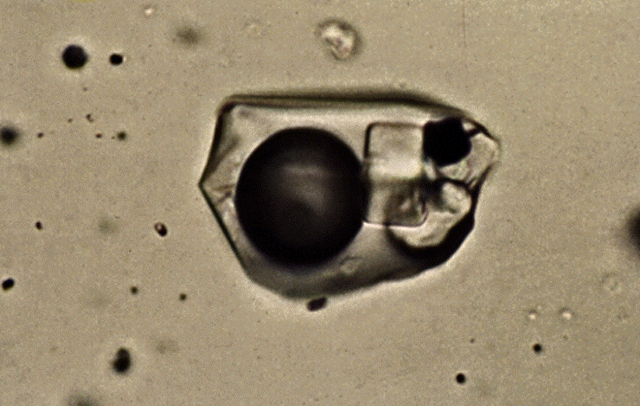
A fluid inclusion is a bubble of liquid and/or gas that is trapped within a crystal. As minerals often form from a liquid or aqueous medium, tiny bubbles of that liquid can become trapped within the crystal, or along healed crystal fractures. These inclusions usually range in size from 0.01 mm to 1 mm and are only visible in detail by microscopic study, however specimens of fenster or skeletal quartz may include thin sheet-like inclusions that are many millimetres in length and breadth within their lamellar voids.
These inclusions occur in a wide variety of environments. For example, they are found within cementing minerals of sedimentary rocks, in gangue minerals such as quartz or calcite in hydrothermal circulation deposits, in fossil amber, and in deep ice cores from the Greenland and Antarctic ice caps. The inclusions can provide information about the conditions existing during the formation of the enclosing mineral. Fourier transform infrared spectroscopy and Raman spectroscopy can be used to determine the composition of fluid inclusions.
Hydrothermal ore minerals, which typically form from high temperature aqueous solutions, trap tiny bubbles of liquids or gases when cooling and forming solid rock. The trapped fluid in an inclusion preserves a record of the composition, temperature and pressure of the mineralizing environment. An inclusion often contains two or more phases. If a vapor bubble is present in the inclusion along with a liquid phase, simple heating of the inclusion to the point of resorption of the vapor bubble gives a likely temperature of the original fluid. If minute crystals, such as halite, sylvite, hematite or sulfides, are present in the inclusion, they provide direct clues as to the composition of the original fluid.
Fluid inclusions can provide useful data in mineral exploration, as their characteristics depend on the mineralization process. The methods of using fluid inclusions to identify mineral deposits include assessing the abundance of a specific inclusion type, looking into variations in the inclusions' temperatures of phase changes during heating and cooling, and variations in other properties such as decrepitation behavior, and inclusions chemistry. Observation and point-counting of thin-sections of samples is used to identify the occurrence of specific inclusion types. If an abundance of similar fluid inclusions are found in close geographic proximity, one can conclude that the surrounding rock types are similar if not the same. Microthermometric properties (changes in temperature during phase changes) are used to characterize and categorize areas that witnessed thermal activity during mineral formation.
Fluid inclusions have been used to identify deposits of oil and gas. Drilling cuts, cores, and/or outcrop materials are preserved for their pore-fluids, and the chemistry of the fluid is analyzed with Fluid Inclusion Stratigraphy (FIS). FIS analysis takes the spectrometric reading of a fluid inclusion's volatile species; these are indicative of a natural gas or oil deposit nearby. The abundance of similar fluid inclusions could, however, be attributed to hydrocarbon migration and accumulation, so other techniques are used to confirm the presence of the oil deposit after initial detection of fluid inclusions.
(162173) Ryugu
In the recent years, fluid inclusion research has been extensively applied to understand the role of fluids in the deep crust and crust-mantle interface. Fluid inclusions trapped within granulite facies rocks have provided important clues on the petrogenesis of dry granulite facies rocks through the influx of CO2-rich fluids from sub-lithospheric sources. CO2-rich fluid inclusions were also recorded from a number of ultra high temperature granulite facies terranes, suggesting the involvement of CO2 in extreme crustal metamorphism. Some recent studies speculate that CO2 derived by sub-solidus decarbonation reactions during extreme metamorphism has contributed to the deglaciation of the snowball Earth.
Hub AI
Fluid inclusion AI simulator
(@Fluid inclusion_simulator)
Fluid inclusion
A fluid inclusion is a bubble of liquid and/or gas that is trapped within a crystal. As minerals often form from a liquid or aqueous medium, tiny bubbles of that liquid can become trapped within the crystal, or along healed crystal fractures. These inclusions usually range in size from 0.01 mm to 1 mm and are only visible in detail by microscopic study, however specimens of fenster or skeletal quartz may include thin sheet-like inclusions that are many millimetres in length and breadth within their lamellar voids.
These inclusions occur in a wide variety of environments. For example, they are found within cementing minerals of sedimentary rocks, in gangue minerals such as quartz or calcite in hydrothermal circulation deposits, in fossil amber, and in deep ice cores from the Greenland and Antarctic ice caps. The inclusions can provide information about the conditions existing during the formation of the enclosing mineral. Fourier transform infrared spectroscopy and Raman spectroscopy can be used to determine the composition of fluid inclusions.
Hydrothermal ore minerals, which typically form from high temperature aqueous solutions, trap tiny bubbles of liquids or gases when cooling and forming solid rock. The trapped fluid in an inclusion preserves a record of the composition, temperature and pressure of the mineralizing environment. An inclusion often contains two or more phases. If a vapor bubble is present in the inclusion along with a liquid phase, simple heating of the inclusion to the point of resorption of the vapor bubble gives a likely temperature of the original fluid. If minute crystals, such as halite, sylvite, hematite or sulfides, are present in the inclusion, they provide direct clues as to the composition of the original fluid.
Fluid inclusions can provide useful data in mineral exploration, as their characteristics depend on the mineralization process. The methods of using fluid inclusions to identify mineral deposits include assessing the abundance of a specific inclusion type, looking into variations in the inclusions' temperatures of phase changes during heating and cooling, and variations in other properties such as decrepitation behavior, and inclusions chemistry. Observation and point-counting of thin-sections of samples is used to identify the occurrence of specific inclusion types. If an abundance of similar fluid inclusions are found in close geographic proximity, one can conclude that the surrounding rock types are similar if not the same. Microthermometric properties (changes in temperature during phase changes) are used to characterize and categorize areas that witnessed thermal activity during mineral formation.
Fluid inclusions have been used to identify deposits of oil and gas. Drilling cuts, cores, and/or outcrop materials are preserved for their pore-fluids, and the chemistry of the fluid is analyzed with Fluid Inclusion Stratigraphy (FIS). FIS analysis takes the spectrometric reading of a fluid inclusion's volatile species; these are indicative of a natural gas or oil deposit nearby. The abundance of similar fluid inclusions could, however, be attributed to hydrocarbon migration and accumulation, so other techniques are used to confirm the presence of the oil deposit after initial detection of fluid inclusions.
(162173) Ryugu
In the recent years, fluid inclusion research has been extensively applied to understand the role of fluids in the deep crust and crust-mantle interface. Fluid inclusions trapped within granulite facies rocks have provided important clues on the petrogenesis of dry granulite facies rocks through the influx of CO2-rich fluids from sub-lithospheric sources. CO2-rich fluid inclusions were also recorded from a number of ultra high temperature granulite facies terranes, suggesting the involvement of CO2 in extreme crustal metamorphism. Some recent studies speculate that CO2 derived by sub-solidus decarbonation reactions during extreme metamorphism has contributed to the deglaciation of the snowball Earth.