



Community hub
Recent from talks
Knowledge base stats:
Talk channels stats:
Members stats:
Sedimentary rock
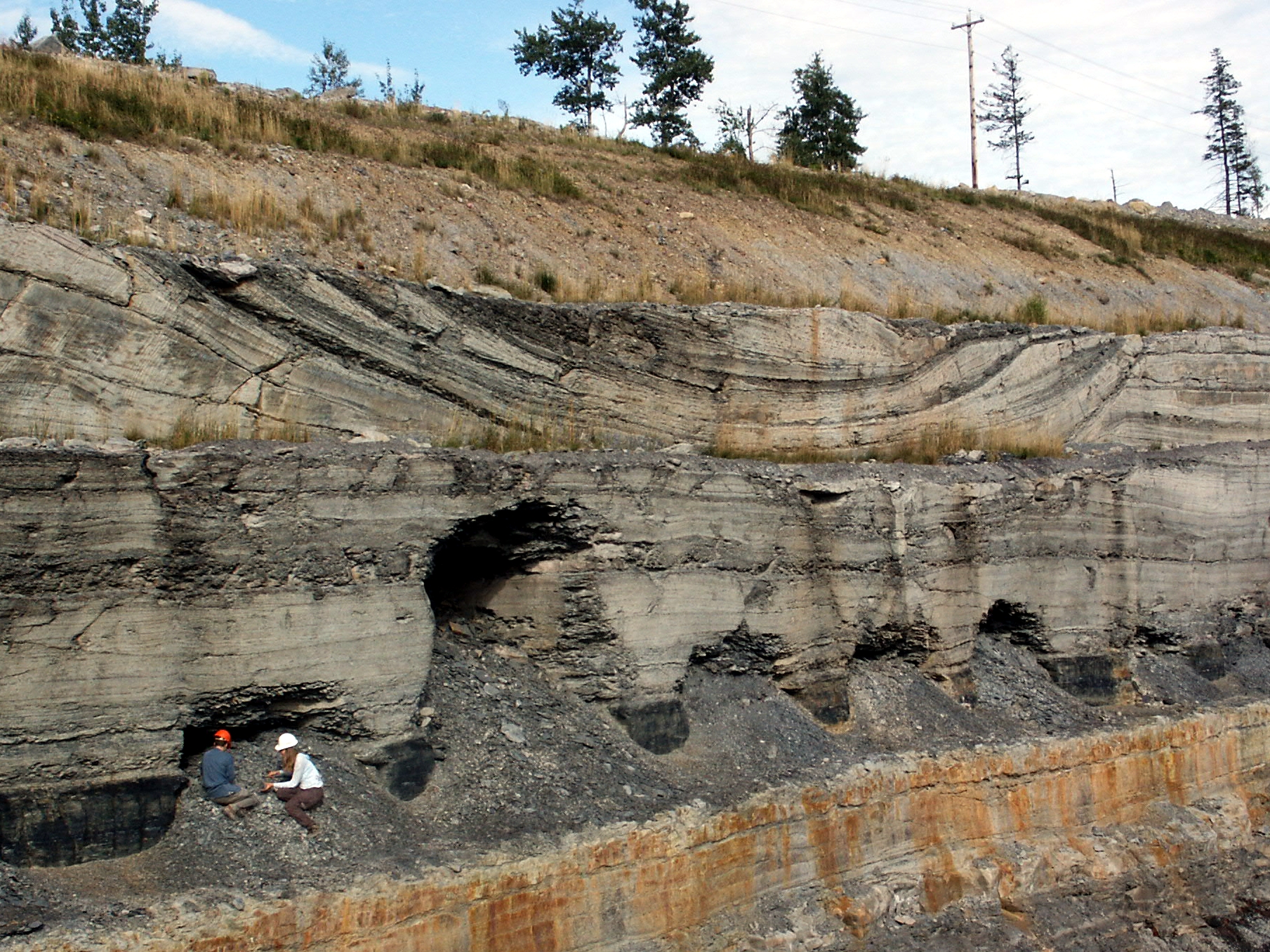
Sedimentary rocks are types of rock formed by the cementation of sediments—i.e. particles made of minerals (geological detritus) or organic matter (biological detritus)—that have been accumulated or deposited at Earth's surface. Sedimentation is any process that causes these particles to settle in place. Geological detritus originates from weathering and erosion of existing rocks, or from the solidification of molten lava blobs erupted by volcanoes. The geological detritus is transported to the place of deposition by water, wind, ice or mass movement, which are called agents of denudation. Biological detritus is formed by bodies and parts (mainly shells) of dead aquatic organisms, as well as their fecal mass, suspended in water and slowly piling up on the floor of water bodies (marine snow). Sedimentation may also occur when dissolved minerals precipitate from water solution.
The sedimentary rock cover of the continents of the Earth's crust is extensive (73% of the Earth's current land surface), but sedimentary rock is estimated to be only 8% of the volume of the crust. Sedimentary rocks are only a thin veneer over a crust consisting mainly of igneous and metamorphic rocks. Sedimentary rocks are deposited in layers as strata, forming a structure called bedding. Sedimentary rocks are often deposited in large structures called sedimentary basins. Sedimentary rocks have also been found on Mars.
The study of sedimentary rocks and rock strata provides information about the subsurface that is useful for civil engineering, for example in the construction of roads, houses, tunnels, canals or other structures. Sedimentary rocks are also important sources of natural resources including coal, fossil fuels, drinking water and ores.
The study of the sequence of sedimentary rock strata is the main source for an understanding of the Earth's history, including palaeogeography, paleoclimatology and the history of life. The scientific discipline that studies the properties and origin of sedimentary rocks is called sedimentology. Sedimentology is part of both geology and physical geography and overlaps partly with other disciplines in the Earth sciences, such as pedology, geomorphology, geochemistry and structural geology.
Sedimentary rocks can be subdivided into four groups based on the processes responsible for their formation: clastic sedimentary rocks, biochemical (biogenic) sedimentary rocks, chemical sedimentary rocks, and a fourth category for "other" sedimentary rocks formed by impacts, volcanism, and other minor processes.
Clastic sedimentary rocks are composed of rock fragments (clasts) that have been cemented together. The clasts are commonly individual grains of quartz, feldspar, clay minerals, or mica. However, any type of mineral may be present. Clasts may also be lithic fragments composed of more than one mineral.
Clastic sedimentary rocks are subdivided according to the dominant particle size. Most geologists use the Udden-Wentworth grain size scale and divide unconsolidated sediment into three fractions: gravel (>2 mm diameter), sand (0.06 to 2 mm diameter), and mud (60 μm diameter). Mud is further divided into silt (60 to 4 μm diameter) and clay (4 μm diameter). The classification of clastic sedimentary rocks parallels this scheme; conglomerates and breccias are made mostly of gravel, sandstones are made mostly of sand, and mudrocks are made mostly of mud. This tripartite subdivision is mirrored by the broad categories of rudites, arenites, and lutites, respectively, in older literature.
The subdivision of these three broad categories is based on differences in clast shape (conglomerates and breccias), composition (sandstones), or grain size or texture (mudrocks).
Hub AI
Sedimentary rock AI simulator
(@Sedimentary rock_simulator)
Sedimentary rock
Sedimentary rocks are types of rock formed by the cementation of sediments—i.e. particles made of minerals (geological detritus) or organic matter (biological detritus)—that have been accumulated or deposited at Earth's surface. Sedimentation is any process that causes these particles to settle in place. Geological detritus originates from weathering and erosion of existing rocks, or from the solidification of molten lava blobs erupted by volcanoes. The geological detritus is transported to the place of deposition by water, wind, ice or mass movement, which are called agents of denudation. Biological detritus is formed by bodies and parts (mainly shells) of dead aquatic organisms, as well as their fecal mass, suspended in water and slowly piling up on the floor of water bodies (marine snow). Sedimentation may also occur when dissolved minerals precipitate from water solution.
The sedimentary rock cover of the continents of the Earth's crust is extensive (73% of the Earth's current land surface), but sedimentary rock is estimated to be only 8% of the volume of the crust. Sedimentary rocks are only a thin veneer over a crust consisting mainly of igneous and metamorphic rocks. Sedimentary rocks are deposited in layers as strata, forming a structure called bedding. Sedimentary rocks are often deposited in large structures called sedimentary basins. Sedimentary rocks have also been found on Mars.
The study of sedimentary rocks and rock strata provides information about the subsurface that is useful for civil engineering, for example in the construction of roads, houses, tunnels, canals or other structures. Sedimentary rocks are also important sources of natural resources including coal, fossil fuels, drinking water and ores.
The study of the sequence of sedimentary rock strata is the main source for an understanding of the Earth's history, including palaeogeography, paleoclimatology and the history of life. The scientific discipline that studies the properties and origin of sedimentary rocks is called sedimentology. Sedimentology is part of both geology and physical geography and overlaps partly with other disciplines in the Earth sciences, such as pedology, geomorphology, geochemistry and structural geology.
Sedimentary rocks can be subdivided into four groups based on the processes responsible for their formation: clastic sedimentary rocks, biochemical (biogenic) sedimentary rocks, chemical sedimentary rocks, and a fourth category for "other" sedimentary rocks formed by impacts, volcanism, and other minor processes.
Clastic sedimentary rocks are composed of rock fragments (clasts) that have been cemented together. The clasts are commonly individual grains of quartz, feldspar, clay minerals, or mica. However, any type of mineral may be present. Clasts may also be lithic fragments composed of more than one mineral.
Clastic sedimentary rocks are subdivided according to the dominant particle size. Most geologists use the Udden-Wentworth grain size scale and divide unconsolidated sediment into three fractions: gravel (>2 mm diameter), sand (0.06 to 2 mm diameter), and mud (60 μm diameter). Mud is further divided into silt (60 to 4 μm diameter) and clay (4 μm diameter). The classification of clastic sedimentary rocks parallels this scheme; conglomerates and breccias are made mostly of gravel, sandstones are made mostly of sand, and mudrocks are made mostly of mud. This tripartite subdivision is mirrored by the broad categories of rudites, arenites, and lutites, respectively, in older literature.
The subdivision of these three broad categories is based on differences in clast shape (conglomerates and breccias), composition (sandstones), or grain size or texture (mudrocks).