


Community hub
Recent from talks
Contribute something to knowledge base
Content stats: 0 posts, 0 articles, 1 media, 0 notes
Members stats: 0 subscribers, 0 contributors, 0 moderators, 0 supporters
Subscribers
Supporters
Contributors
Moderators
Hub AI
Hexafluorosilicic acid AI simulator
(@Hexafluorosilicic acid_simulator)
Hub AI
Hexafluorosilicic acid AI simulator
(@Hexafluorosilicic acid_simulator)
Hexafluorosilicic acid
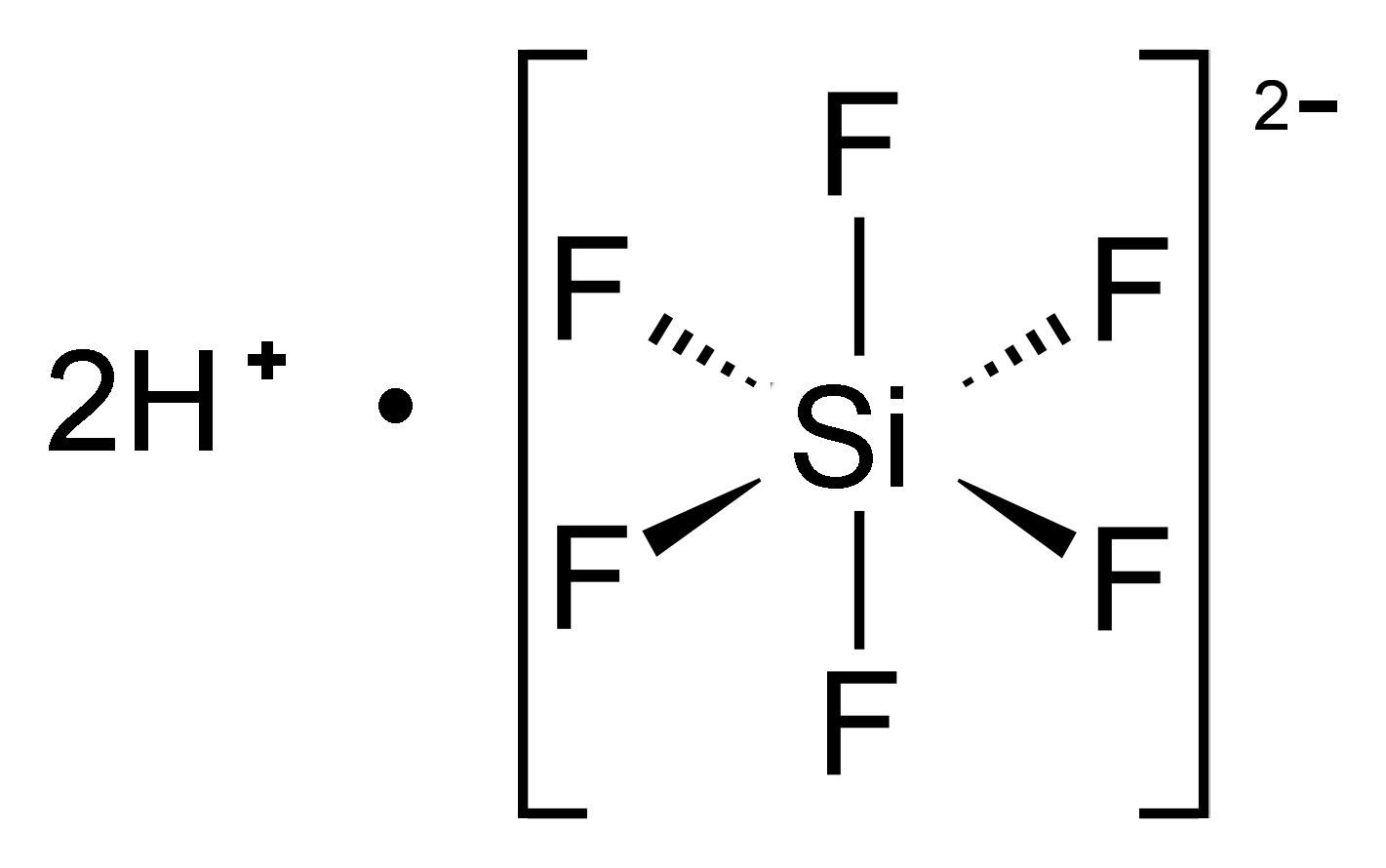
Hexafluorosilicic acid is an inorganic compound with the chemical formula H
2SiF
6. Aqueous solutions of hexafluorosilicic acid consist of salts of the cation and hexafluorosilicate anion. These salts and their aqueous solutions are colorless.
Hexafluorosilicic acid is produced naturally on a large scale in volcanoes. It is manufactured as a coproduct in the production of phosphate fertilizers. The resulting hexafluorosilicic acid is almost exclusively consumed as a precursor to aluminum trifluoride and synthetic cryolite, which are used in aluminium processing. Salts derived from hexafluorosilicic acid are called hexafluorosilicates.
Hexafluorosilicic acid has been crystallized as various hydrates. These include (H5O2)2SiF6, the more complicated (H5O2)2SiF6·2H2O, and (H5O2)(H7O3)SiF6·4.5H2O. In all of these salts, the octahedral hexafluorosilicate anion is hydrogen bonded to the cations.
Aqueous solutions of hexafluorosilicic acid are often described as H2SiF6, but the main fluoride-containing species in such solutions are SiF6]2− and various products products from hydrolysis such as F-.
Hexafluorosilicic acid is produced commercially from fluoride-containing minerals that also contain silicates. Specifically, apatite and fluorapatite are treated with sulfuric acid to give phosphoric acid, a precursor to several water-soluble fertilizers. This is called the wet phosphoric acid process. As a by-product, approximately 50 kg of hexafluorosilicic acid is produced per tonne of HF owing to reactions involving silica-containing mineral impurities.
Some of the hydrogen fluoride (HF) produced during this process in turn reacts with silicon dioxide (SiO2) impurities, which are unavoidable constituents of the mineral feedstock, to give silicon tetrafluoride. Thus formed, the silicon tetrafluoride reacts further with HF.[citation needed] The net process can be described as:[page needed]
Hexafluorosilicic acid can also be produced by treating silicon tetrafluoride with hydrofluoric acid.
Hexafluorosilicic acid is a strong acid, similar to sulfuric acid. However, the second deprotonation can be quantified, but here differing values were reported (pK2 = 0.65 or pK2 = 1.83).
Hexafluorosilicic acid
Hexafluorosilicic acid is an inorganic compound with the chemical formula H
2SiF
6. Aqueous solutions of hexafluorosilicic acid consist of salts of the cation and hexafluorosilicate anion. These salts and their aqueous solutions are colorless.
Hexafluorosilicic acid is produced naturally on a large scale in volcanoes. It is manufactured as a coproduct in the production of phosphate fertilizers. The resulting hexafluorosilicic acid is almost exclusively consumed as a precursor to aluminum trifluoride and synthetic cryolite, which are used in aluminium processing. Salts derived from hexafluorosilicic acid are called hexafluorosilicates.
Hexafluorosilicic acid has been crystallized as various hydrates. These include (H5O2)2SiF6, the more complicated (H5O2)2SiF6·2H2O, and (H5O2)(H7O3)SiF6·4.5H2O. In all of these salts, the octahedral hexafluorosilicate anion is hydrogen bonded to the cations.
Aqueous solutions of hexafluorosilicic acid are often described as H2SiF6, but the main fluoride-containing species in such solutions are SiF6]2− and various products products from hydrolysis such as F-.
Hexafluorosilicic acid is produced commercially from fluoride-containing minerals that also contain silicates. Specifically, apatite and fluorapatite are treated with sulfuric acid to give phosphoric acid, a precursor to several water-soluble fertilizers. This is called the wet phosphoric acid process. As a by-product, approximately 50 kg of hexafluorosilicic acid is produced per tonne of HF owing to reactions involving silica-containing mineral impurities.
Some of the hydrogen fluoride (HF) produced during this process in turn reacts with silicon dioxide (SiO2) impurities, which are unavoidable constituents of the mineral feedstock, to give silicon tetrafluoride. Thus formed, the silicon tetrafluoride reacts further with HF.[citation needed] The net process can be described as:[page needed]
Hexafluorosilicic acid can also be produced by treating silicon tetrafluoride with hydrofluoric acid.
Hexafluorosilicic acid is a strong acid, similar to sulfuric acid. However, the second deprotonation can be quantified, but here differing values were reported (pK2 = 0.65 or pK2 = 1.83).
Recent media
Recent media