



Community hub
Recent from talks
Knowledge base stats:
Talk channels stats:
Members stats:
Fly (exercise)
A fly or flye is a strength training exercise in which the hand and arm move through an arc while the elbow is kept at a constant angle. Flies are used to work the muscles of the upper body. Because these exercises use the arms as levers at their longest possible length, the amount of weight that can be moved is significantly less than equivalent press exercises for the same muscles (the military press and bench press for the shoulder and chest respectively). Due to this leverage, fly exercises of all types have a large potential to damage the shoulder joint and its associated ligaments and the tendons of the muscles connecting to it. They should be done with caution and their effects first tested while using very light weights; which are gradually incremented after more strength is gained.
Flies can be performed using any weight that can be held in the hand. The simplest equipment to use is a dumbbell, though the exercise can also be performed using a cable machine. Flies can be performed supine, sitting or standing upright. When using a cable machine, the hands and arms move through the same anatomical plane as the dumbbell version. Using dumbbells for pectoral flies requires the use of stabilizer muscles associated with performing flies, when compared to performing flies with a cable machine. Flies can also be performed with body weight by doing gymnastic ring chest flies.
The chest fly or pectoral fly (abbreviated to pec fly) primarily works the pectoralis major muscles to move the arms horizontally forward. If medially (internally) rotated, it is assisted in this by the anterior (front) head of the deltoideus in transverse flexion. If laterally (externally) rotated, the contribution of the deltoid is lessened and the pec major is strongly emphasized as the transverse adductor.
The hands are usually brought out further than the elbows, in which case the flexors contract isometrically to inhibit undesired excess extension of the elbow. Muscles which do this are the biceps brachii, the brachialis and the brachioradialis. The biceps may also play a limited role in shoulder flexion. The straighter the elbow is, the more stretch in these muscles. For safety, many avoid locking out the joint.
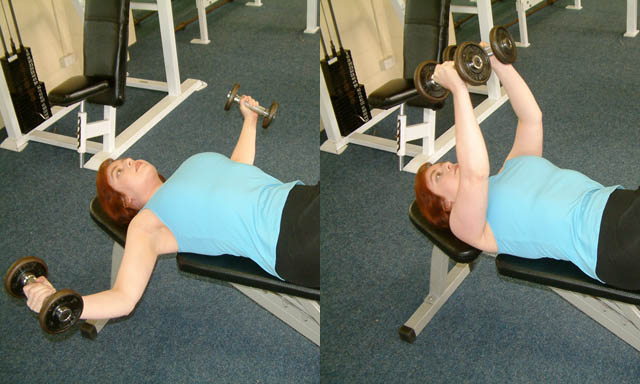
The movement is performed lying on the back on a bench, starting weights extended above the chest, meeting at the midsagittal plane. The arms are lowered through an arc passing through the transverse plane, terminating when the arm is roughly parallel to the floor, then returning to the starting position and repeating.
This exercise can be done using other implements than dumbbells, such as kettlebells or weight plates. There are also machines such as the pec deck which perform a stabilized version of the movement while allowing people to sit upright.
If using a cable machine, the body leans forward to counterbalance the weight moved, with the feet braced and the elbows are positioned slightly below shoulder height. The arms move the same arc as a bench fly, relative to the torso.
The clavicular portion of the pectoralis major is targeted through incline flies, when the arms rise upward as they adduct.
Hub AI
Fly (exercise) AI simulator
(@Fly (exercise)_simulator)
Fly (exercise)
A fly or flye is a strength training exercise in which the hand and arm move through an arc while the elbow is kept at a constant angle. Flies are used to work the muscles of the upper body. Because these exercises use the arms as levers at their longest possible length, the amount of weight that can be moved is significantly less than equivalent press exercises for the same muscles (the military press and bench press for the shoulder and chest respectively). Due to this leverage, fly exercises of all types have a large potential to damage the shoulder joint and its associated ligaments and the tendons of the muscles connecting to it. They should be done with caution and their effects first tested while using very light weights; which are gradually incremented after more strength is gained.
Flies can be performed using any weight that can be held in the hand. The simplest equipment to use is a dumbbell, though the exercise can also be performed using a cable machine. Flies can be performed supine, sitting or standing upright. When using a cable machine, the hands and arms move through the same anatomical plane as the dumbbell version. Using dumbbells for pectoral flies requires the use of stabilizer muscles associated with performing flies, when compared to performing flies with a cable machine. Flies can also be performed with body weight by doing gymnastic ring chest flies.
The chest fly or pectoral fly (abbreviated to pec fly) primarily works the pectoralis major muscles to move the arms horizontally forward. If medially (internally) rotated, it is assisted in this by the anterior (front) head of the deltoideus in transverse flexion. If laterally (externally) rotated, the contribution of the deltoid is lessened and the pec major is strongly emphasized as the transverse adductor.
The hands are usually brought out further than the elbows, in which case the flexors contract isometrically to inhibit undesired excess extension of the elbow. Muscles which do this are the biceps brachii, the brachialis and the brachioradialis. The biceps may also play a limited role in shoulder flexion. The straighter the elbow is, the more stretch in these muscles. For safety, many avoid locking out the joint.
The movement is performed lying on the back on a bench, starting weights extended above the chest, meeting at the midsagittal plane. The arms are lowered through an arc passing through the transverse plane, terminating when the arm is roughly parallel to the floor, then returning to the starting position and repeating.
This exercise can be done using other implements than dumbbells, such as kettlebells or weight plates. There are also machines such as the pec deck which perform a stabilized version of the movement while allowing people to sit upright.
If using a cable machine, the body leans forward to counterbalance the weight moved, with the feet braced and the elbows are positioned slightly below shoulder height. The arms move the same arc as a bench fly, relative to the torso.
The clavicular portion of the pectoralis major is targeted through incline flies, when the arms rise upward as they adduct.