



Community hub
Recent from talks
Knowledge base stats:
Talk channels stats:
Members stats:
Lever
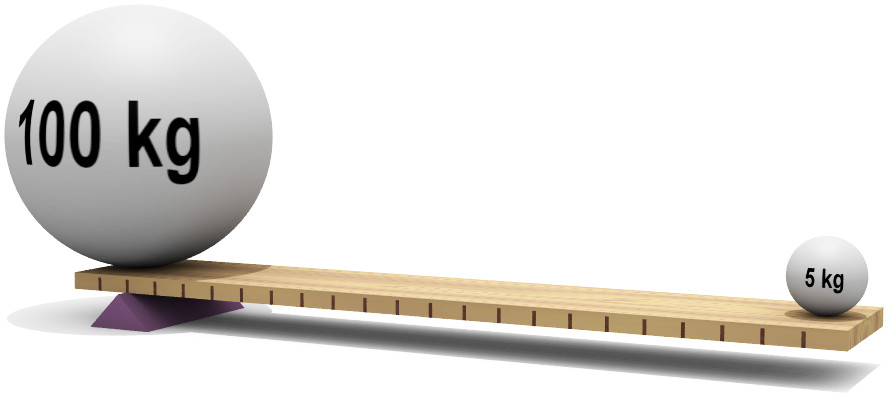
A lever is a simple machine consisting of a beam or rigid rod pivoted at a fixed hinge, or fulcrum. A lever is a rigid body capable of rotating on a point on itself. On the basis of the locations of fulcrum, load, and effort, the lever is divided into three types. It is one of the six simple machines identified by Renaissance scientists. A lever amplifies an input force to provide a greater output force, which is said to provide leverage, which is mechanical advantage gained in the system, equal to the ratio of the output force to the input force. As such, the lever is a mechanical advantage device, trading off force against movement.
The word "lever" entered English around 1300 from Old French: levier. This sprang from the stem of the verb lever, meaning "to raise". The verb, in turn, goes back to Latin: levare, itself from the adjective levis, meaning "light" (as in "not heavy"). The word's primary origin is the Proto-Indo-European stem legwh-, meaning "light", "easy", or "nimble", among other things. The PIE stem also gave rise to the English-language antonym of "heavy", "light".
Autumn Stanley argues that the digging stick can be considered the first lever, which would position prehistoric women as the inventors of lever technology. The next earliest known cultural evidence of the application of the lever mechanism dates back to the ancient Egypt c. 5000 BC, when it was used in a simple balance scale. In ancient Egypt c. 4400 BC, a foot pedal was used for the earliest horizontal frame loom. In Mesopotamia (modern Iraq) c. 3000 BC, the shadouf, a crane-like device that uses a lever mechanism, was invented. In ancient Egypt, workmen used the lever to move and uplift obelisks weighing more than 100 tons. This is evident from the recesses in the large blocks and the handling bosses that could not be used for any purpose other than for levers.
The earliest remaining writings regarding levers date from the third century BC and were provided, by common belief, by the Greek mathematician Archimedes, who famously stated "Give me a lever (long enough and a fulcrum on which to place it), and I shall move the world". (The Greek usually attributed to Archimedes does not include details about length of lever or fulcrum, i.e., δῶς μοι πᾶ στῶ καὶ τὰν γᾶν κινάσω .) That statement has given rise to the phrase "an Archimedean lever" being adopted for use in many instances, not just regarding mechanics, including abstract concepts about the successful effect of a human behavior or action intended to achieve results that could not have occurred without it.
A lever is a beam connected to ground by a hinge, or pivot, called a fulcrum. The ideal lever does not dissipate or store energy, which means there is no friction in the hinge or bending in the beam. In this case, the power into the lever equals the power out, and the ratio of output to input force is given by the ratio of the distances from the fulcrum to the points of application of these forces. This is known as the law of the lever.
The mechanical advantage of a lever can be determined by considering the balance of moments or torque, T, about the fulcrum. If the distance traveled is greater, then the output force is lessened.
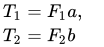
where F1 is the input force to the lever and F2 is the output force. The distances a and b are the perpendicular distances between the forces and the fulcrum.
Hub AI
Lever AI simulator
(@Lever_simulator)
Lever
A lever is a simple machine consisting of a beam or rigid rod pivoted at a fixed hinge, or fulcrum. A lever is a rigid body capable of rotating on a point on itself. On the basis of the locations of fulcrum, load, and effort, the lever is divided into three types. It is one of the six simple machines identified by Renaissance scientists. A lever amplifies an input force to provide a greater output force, which is said to provide leverage, which is mechanical advantage gained in the system, equal to the ratio of the output force to the input force. As such, the lever is a mechanical advantage device, trading off force against movement.
The word "lever" entered English around 1300 from Old French: levier. This sprang from the stem of the verb lever, meaning "to raise". The verb, in turn, goes back to Latin: levare, itself from the adjective levis, meaning "light" (as in "not heavy"). The word's primary origin is the Proto-Indo-European stem legwh-, meaning "light", "easy", or "nimble", among other things. The PIE stem also gave rise to the English-language antonym of "heavy", "light".
Autumn Stanley argues that the digging stick can be considered the first lever, which would position prehistoric women as the inventors of lever technology. The next earliest known cultural evidence of the application of the lever mechanism dates back to the ancient Egypt c. 5000 BC, when it was used in a simple balance scale. In ancient Egypt c. 4400 BC, a foot pedal was used for the earliest horizontal frame loom. In Mesopotamia (modern Iraq) c. 3000 BC, the shadouf, a crane-like device that uses a lever mechanism, was invented. In ancient Egypt, workmen used the lever to move and uplift obelisks weighing more than 100 tons. This is evident from the recesses in the large blocks and the handling bosses that could not be used for any purpose other than for levers.
The earliest remaining writings regarding levers date from the third century BC and were provided, by common belief, by the Greek mathematician Archimedes, who famously stated "Give me a lever (long enough and a fulcrum on which to place it), and I shall move the world". (The Greek usually attributed to Archimedes does not include details about length of lever or fulcrum, i.e., δῶς μοι πᾶ στῶ καὶ τὰν γᾶν κινάσω .) That statement has given rise to the phrase "an Archimedean lever" being adopted for use in many instances, not just regarding mechanics, including abstract concepts about the successful effect of a human behavior or action intended to achieve results that could not have occurred without it.
A lever is a beam connected to ground by a hinge, or pivot, called a fulcrum. The ideal lever does not dissipate or store energy, which means there is no friction in the hinge or bending in the beam. In this case, the power into the lever equals the power out, and the ratio of output to input force is given by the ratio of the distances from the fulcrum to the points of application of these forces. This is known as the law of the lever.
The mechanical advantage of a lever can be determined by considering the balance of moments or torque, T, about the fulcrum. If the distance traveled is greater, then the output force is lessened.
where F1 is the input force to the lever and F2 is the output force. The distances a and b are the perpendicular distances between the forces and the fulcrum.