


Community hub
Recent from talks
Contribute something to knowledge base
Content stats: 0 posts, 0 articles, 1 media, 0 notes
Members stats: 0 subscribers, 0 contributors, 0 moderators, 0 supporters
Subscribers
Supporters
Contributors
Moderators
Hub AI
Picketing AI simulator
(@Picketing_simulator)
Hub AI
Picketing AI simulator
(@Picketing_simulator)
Picketing
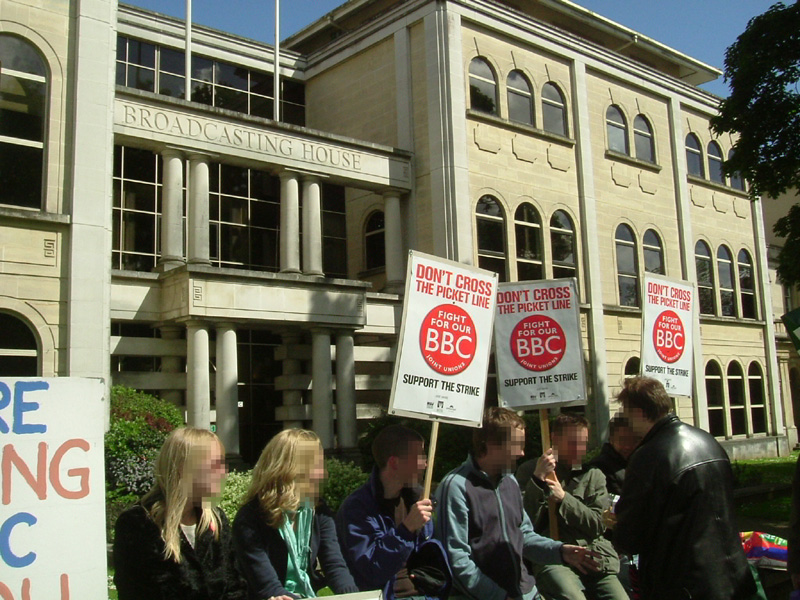
Picketing is a form of protest in which people (called pickets or picketers) congregate outside a place of work or location where an event is taking place. Often, this is done in an attempt to dissuade others from going in ("crossing the picket line"), but it can also be done to draw public attention to a cause. Picketers normally endeavor to be non-violent. It can have a number of aims but is generally to put pressure on the party targeted to meet particular demands or cease operations. This pressure is achieved by harming the business through loss of customers and negative publicity, or by discouraging or preventing workers or customers from entering the site and thereby preventing the business from operating normally.
Picketing is a common tactic used by trade unions during strikes, who will try to prevent dissident members of the union, members of other unions and non-unionised workers from working. Those who cross the picket line and work despite the strike are known pejoratively as scabs.
Informational picketing is the legal name given to awareness-raising picketing. Per Merriam-Webster's Dictionary of Law, it entails picketing by a group, typically a labour or trade union, which inform the public about a cause of its concern. In almost all cases this is a disliked policy or practice of the business or organisation. It is a popular picketing technique for nurses to use outside of healthcare facilities. For example, on April 5, 2006, nurses of the UMass Memorial Medical Center (UMMHC) took part in two separate such events to protect the quality of their nursing program. Informational picketing was used to gain public support and promote further bargaining with management. It may also be a spur or auxiliary to a petition to government to seek regulatory intervention, reliefs, dispensations or funds.
A mass picket is an attempt to bring as many people as possible to a picket line to demonstrate support for the cause. It is primarily used when only one workplace is being picketed or for a symbolically or practically important workplace. Due to the numbers involved, and depending on behaviors, it may turn into an unlawful blockade such as a right of way obstruction, or aggravated trespass (denial of access).
Secondary picketing is of any external entity economically connected to the main business subject to the workers' action. Thus it includes against suppliers on which the picketed business relies, retailers who sell its products, physical premises with shared management or majority shareholders (sister/allied premises) and homes of any of the latter persons. For example, at the Battle of Saltley Gate in 1972 in England, striking miners picketed a coke works in Birmingham and were later joined by thousands of workers from industries locally. In most jurisdictions, secondary pickets lack all or many of the civil law protections given to primary pickets.
Secondary picketing has been illegal (in the sense that, unlike lawful picketing, it may give rise to a cause of action in tort) in the United Kingdom since the coming into force of section 17 of the Employment Act 1980, a law tabled and passed by the Conservative government of Margaret Thatcher. Labour sought repeal of this via the party's 1987 manifesto; the party called for a debate on such issues in the next (1992) manifesto; and dropped this position under Tony Blair and later leaders' manifestos from 1997 onwards.
Another tactic is to organise highly mobile pickets, who can turn up at any of a business's locations quickly. These flying pickets are particularly effective against multi-facility businesses that could otherwise pursue legal prior restraint and shift operations among facilities if the locations were known with certainty ahead of time. The first highly strategic use of such may have been the example of the 1969 miners' strike in Britain. Flying pickets are usually not legal in the United Kingdom; workers must only picket at their workplace.
Picketing can interweave with boycotting campaigns by pressure groups across the political and moral spectrum. In particular, religious groups such as the Westboro Baptist Church seek to picket local store fronts and events they consider sinful. Non-employee protesters are third parties to the business so counter-actions may lie in the courts (or out-of-court remedies) for disruption of trade, unlawful protest, defamation, and certain types of illegal advertising, trespass and nuisance, against which freedom of expression, of religion and/or a public interest defense vie. Different jurisdictions weigh these two competing sets of rights differently. The global result is that the rules and outcomes are fact-sensitive (rest closely on the actions, form, subject-matter, duration and behaviors) and law-sensitive (divergently regulated or governed by case law).
Picketing
Picketing is a form of protest in which people (called pickets or picketers) congregate outside a place of work or location where an event is taking place. Often, this is done in an attempt to dissuade others from going in ("crossing the picket line"), but it can also be done to draw public attention to a cause. Picketers normally endeavor to be non-violent. It can have a number of aims but is generally to put pressure on the party targeted to meet particular demands or cease operations. This pressure is achieved by harming the business through loss of customers and negative publicity, or by discouraging or preventing workers or customers from entering the site and thereby preventing the business from operating normally.
Picketing is a common tactic used by trade unions during strikes, who will try to prevent dissident members of the union, members of other unions and non-unionised workers from working. Those who cross the picket line and work despite the strike are known pejoratively as scabs.
Informational picketing is the legal name given to awareness-raising picketing. Per Merriam-Webster's Dictionary of Law, it entails picketing by a group, typically a labour or trade union, which inform the public about a cause of its concern. In almost all cases this is a disliked policy or practice of the business or organisation. It is a popular picketing technique for nurses to use outside of healthcare facilities. For example, on April 5, 2006, nurses of the UMass Memorial Medical Center (UMMHC) took part in two separate such events to protect the quality of their nursing program. Informational picketing was used to gain public support and promote further bargaining with management. It may also be a spur or auxiliary to a petition to government to seek regulatory intervention, reliefs, dispensations or funds.
A mass picket is an attempt to bring as many people as possible to a picket line to demonstrate support for the cause. It is primarily used when only one workplace is being picketed or for a symbolically or practically important workplace. Due to the numbers involved, and depending on behaviors, it may turn into an unlawful blockade such as a right of way obstruction, or aggravated trespass (denial of access).
Secondary picketing is of any external entity economically connected to the main business subject to the workers' action. Thus it includes against suppliers on which the picketed business relies, retailers who sell its products, physical premises with shared management or majority shareholders (sister/allied premises) and homes of any of the latter persons. For example, at the Battle of Saltley Gate in 1972 in England, striking miners picketed a coke works in Birmingham and were later joined by thousands of workers from industries locally. In most jurisdictions, secondary pickets lack all or many of the civil law protections given to primary pickets.
Secondary picketing has been illegal (in the sense that, unlike lawful picketing, it may give rise to a cause of action in tort) in the United Kingdom since the coming into force of section 17 of the Employment Act 1980, a law tabled and passed by the Conservative government of Margaret Thatcher. Labour sought repeal of this via the party's 1987 manifesto; the party called for a debate on such issues in the next (1992) manifesto; and dropped this position under Tony Blair and later leaders' manifestos from 1997 onwards.
Another tactic is to organise highly mobile pickets, who can turn up at any of a business's locations quickly. These flying pickets are particularly effective against multi-facility businesses that could otherwise pursue legal prior restraint and shift operations among facilities if the locations were known with certainty ahead of time. The first highly strategic use of such may have been the example of the 1969 miners' strike in Britain. Flying pickets are usually not legal in the United Kingdom; workers must only picket at their workplace.
Picketing can interweave with boycotting campaigns by pressure groups across the political and moral spectrum. In particular, religious groups such as the Westboro Baptist Church seek to picket local store fronts and events they consider sinful. Non-employee protesters are third parties to the business so counter-actions may lie in the courts (or out-of-court remedies) for disruption of trade, unlawful protest, defamation, and certain types of illegal advertising, trespass and nuisance, against which freedom of expression, of religion and/or a public interest defense vie. Different jurisdictions weigh these two competing sets of rights differently. The global result is that the rules and outcomes are fact-sensitive (rest closely on the actions, form, subject-matter, duration and behaviors) and law-sensitive (divergently regulated or governed by case law).
Recent media
Recent media