Hubbry Logo
PicketingPicketingMain
Open search
Picketing
Community hub
Picketing
logo
8 pages, 0 posts
0 subscribers
Be the first to start a discussion here.
Picketing
Picketing
from Wikipedia

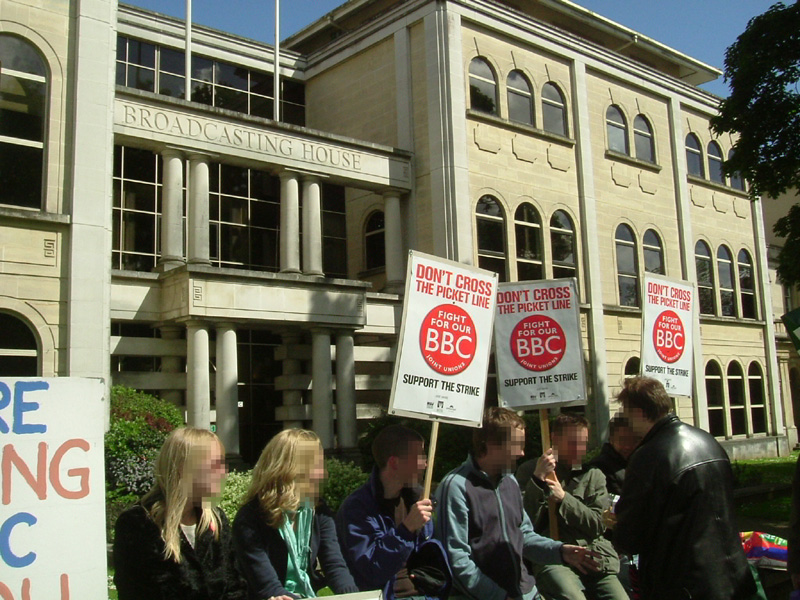
Employees of the BBC form a picket line during a strike in May 2005.

Picketing is a form of protest in which people (called pickets or picketers)[1] congregate outside a place of work or location where an event is taking place. Often, this is done in an attempt to dissuade others from going in ("crossing the picket line"), but it can also be done to draw public attention to a cause. Picketers normally endeavor to be non-violent. It can have a number of aims but is generally to put pressure on the party targeted to meet particular demands or cease operations. This pressure is achieved by harming the business through loss of customers and negative publicity, or by discouraging or preventing workers or customers from entering the site and thereby preventing the business from operating normally.

Picketing is a common tactic used by trade unions during strikes, who will try to prevent dissident members of the union, members of other unions and non-unionised workers from working. Those who cross the picket line and work despite the strike are known pejoratively as scabs.

Types of picket

[edit]
A rally of the trade union UNISON in Oxford during a strike on March 28, 2006, with members carrying picket signs.

Informational picketing is the legal name given to awareness-raising picketing. Per Merriam-Webster's Dictionary of Law, it entails picketing by a group, typically a labour or trade union, which inform the public about a cause of its concern.[2] In almost all cases this is a disliked policy or practice of the business or organisation. It is a popular picketing technique for nurses to use outside of healthcare facilities. For example, on April 5, 2006, nurses of the UMass Memorial Medical Center (UMMHC) took part in two separate such events to protect the quality of their nursing program.[3] Informational picketing was used to gain public support and promote further bargaining with management.[3] It may also be a spur or auxiliary to a petition to government to seek regulatory intervention, reliefs, dispensations or funds.

A mass picket is an attempt to bring as many people as possible to a picket line to demonstrate support for the cause. It is primarily used when only one workplace is being picketed or for a symbolically or practically important workplace. Due to the numbers involved, and depending on behaviors, it may turn into an unlawful blockade such as a right of way obstruction, or aggravated trespass (denial of access).

Secondary picketing is of any external entity economically connected to the main business subject to the workers' action. Thus it includes against suppliers on which the picketed business relies, retailers who sell its products, physical premises with shared management or majority shareholders (sister/allied premises) and homes of any of the latter persons. For example, at the Battle of Saltley Gate in 1972 in England, striking miners picketed a coke works in Birmingham and were later joined by thousands of workers from industries locally. In most jurisdictions, secondary pickets lack all or many of the civil law protections given to primary pickets.

Secondary picketing has been illegal (in the sense that, unlike lawful picketing, it may give rise to a cause of action in tort) in the United Kingdom since the coming into force of section 17 of the Employment Act 1980,[4][5] a law tabled and passed by the Conservative government of Margaret Thatcher. Labour sought repeal of this via the party's 1987 manifesto; the party called for a debate on such issues in the next (1992) manifesto; and dropped this position under Tony Blair and later leaders' manifestos from 1997 onwards.[6]

Another tactic is to organise highly mobile pickets, who can turn up at any of a business's locations quickly. These flying pickets are particularly effective against multi-facility businesses that could otherwise pursue legal prior restraint and shift operations among facilities if the locations were known with certainty ahead of time. The first highly strategic use of such may have been the example of the 1969 miners' strike in Britain.[7] Flying pickets are usually not legal in the United Kingdom; workers must only picket at their workplace.[8]

Picketing can interweave with boycotting campaigns by pressure groups across the political and moral spectrum. In particular, religious groups such as the Westboro Baptist Church seek to picket local store fronts and events they consider sinful. Non-employee protesters are third parties to the business so counter-actions may lie in the courts (or out-of-court remedies) for disruption of trade, unlawful protest, defamation, and certain types of illegal advertising, trespass and nuisance, against which freedom of expression, of religion and/or a public interest defense vie. Different jurisdictions weigh these two competing sets of rights differently. The global result is that the rules and outcomes are fact-sensitive (rest closely on the actions, form, subject-matter, duration and behaviors) and law-sensitive (divergently regulated or governed by case law).

Picketing by WBC in Topeka, with the group's signature multi-colored picket signs.

Disruptive picketing

[edit]

Disruptive picketing covers a wide variety of pickets:

  • Obstructive picketing which significantly physically narrows or stalls the flow of persons, goods or services into and out of the business.
  • Public order or highway offense picketing which due to behaviors, third-party supporters, or overspill meets with or is entitled to be met with police or local authority enforcement measures to limit its activities or street-side support.
  • Criminally violent or menacing picketing: use of force (battery and/or criminal damage), or reasonably perceptible and real threats of such (assault), to injure or sufficiently intimidate persons.[9]
    • At several pickets at the height of the UK miners' strike (1984–85), picketers pelted strikebreakers with stones, paint and brake fluid. Police arrested many of these picketers for offences against the person.[10][11]
  • Vexatious picketing which due to very high frequency causes severe loss of economic activity and/or reputation.

Obstructive picketing may be contrasted with non-obstructive picketing, in which the impact on the business or organization is likely to be limited to the presence nearby of a group of people close in number to the number of strikers, who have an informational picketing line, assembly or rally. It is possible, but rarely allowed in labor law globally, to have an informational picket in a public place of a business which has no simultaneous strike – i.e., a protest of workers outside of their shifts. In some sectors, the immediate financial impact of a non-obstructive picket could be negligible, and the longer-term impacts could include a human resources policy or public-facing policy enhancement and a consumer relations uplift.[clarification needed]

Legality

[edit]
Union members picketing National Labor Relations Board rulings outside the agency's Washington, D.C., headquarters in November 2007.

Picketing, as long as it does not cause obstruction to a highway or intimidation, is legal in many countries and in line with freedom of assembly laws, but many countries have restrictions on the use of picketing.

Legally defined, recognitional picketing is a method of picketing that applies economic pressure to an employer with the specific goal to force the employer to recognise the issues facing employees and address them by bargaining with a union.[12] In the US, this type of picketing, under Section 8(b)(7)(A) of the National Labor Relations Act, is typically illegal if representation is not relevant or is unquestionable.[13]

In the UK mass picketing was made illegal under the Trade Disputes and Trade Unions Act 1927, moved by the leaders of what would soon be National Labour, after the 1926 General Strike. Otherwise picketing was banned by the Liberal-tabled Criminal Law Amendment Act 1871 but is decriminalised by the Conservative-tabled Conspiracy and Protection of Property Act 1875.[14] The Trade Union and Labour Relations (Consolidation) Act 1992 gives protection, under civil law, for pickets who are acting in connection with an industrial dispute at or near their workplace who are using their picketing peacefully to obtain or communicate information or persuading any person to work or abstain from working. However, many employers seek specific injunctions to limit the effect of picketing by their door if they can evidence a high likelihood of intimidation or, in general, on non-peaceful behaviour and/or any that significant numbers of the picketers are or will in all likelihood be non-workers.[15]

In the US, any strike activity was hard to organise in the early 1900s, but picketing became more common after the Norris–La Guardia Act of 1932, which limited the ability of employers to gain injunctions to stop strikes, and further legislation to support the right to organise for unions. Mass picketing and secondary picketing was outlawed by the 1947 Taft–Hartley Act.[16] Some kinds of pickets are constitutionally protected.[17]

Viewing laws against stalking as potentially inconsistent with labor rights of picketing, the first anti-stalking law of the industrial world, made by California's lawmakers, inserted provisions that disapply many of its protections from "normal labor picketing", which has survived subsequent amendments.[18]

See also

[edit]

References

[edit]

Further reading

[edit]
[edit]
Revisions and contributorsEdit on WikipediaRead on Wikipedia
from Grokipedia

Picketing is a form of labor in which workers engaged in a dispute assemble outside an employer's place of , typically carrying signs to advertise their grievances, inform the public, and discourage or the entry of non-striking personnel. This tactic serves as a means of exerting economic pressure on by disrupting normal operations through peaceful , though it has historically involved varying degrees of .
Under the U.S. National Labor Relations Act, primary picketing—directed at the disputing employer—is generally lawful when conducted peacefully, but it is circumscribed by prohibitions on , blocking access, or extending to secondary targets like neutral businesses, which could constitute unlawful boycotts. Prior to , courts routinely issued injunctions against picketing, viewing it as a or , until the Norris-LaGuardia Act limited such judicial interventions and facilitated its use during the expansion of union organizing. Empirical analysis reveals picketing's potential effectiveness in curtailing business activity, with a recent study of grocery strikes finding it caused substantial reductions in store foot , thereby amplifying the strike's leverage. Notable controversies surrounding picketing stem from its coercive elements, including mass assemblies that impeded access and escalated to violence in some disputes, prompting reforms like those in the 1947 Taft-Hartley Act to curb secondary activities and ensure public order. While instrumental in advancing worker demands in key historical confrontations, such as early 20th-century industrial strikes, picketing's role has diminished amid declining union density and legal safeguards for employers, reflecting a balance between expression rights and economic continuity.

Definition and Fundamentals

Picketing constitutes a form of labor wherein individuals assemble outside a or related site to publicize grievances, typically through the display of signs, verbal exhortations, or mere intended to discourage entry or garner public attention. This tactic aims to inform passersby, potential customers, or fellow workers about disputes, such as disagreements or unfair practices, without necessarily involving a cessation of work by the participants. Unlike a , which entails a coordinated work stoppage by employees to withhold labor as leverage against an , picketing focuses on communicative conduct and can occur without employees abandoning their posts or even independently of any . Picketing further diverges from a , the latter being a concerted refusal by consumers or third parties to purchase or engage with targeted goods or services, often orchestrated remotely through campaigns rather than on-site . While picketing may seek to induce a by deterring customers at the point of entry, it remains a localized, visible act of persuasion rooted in proximity to the disputed site, whereas boycotts emphasize economic abstention absent physical assembly. In legal terms, picketing embodies "speech plus," merging protected expressive elements—such as placards conveying messages—with incidental conduct designed to influence behavior, as affirmed by the U.S. in Thornhill v. Alabama (1940), which invalidated a state ban on labor picketing as violative of the First Amendment when peacefully executed. This characterization underscores picketing's dual nature as both communicative and action-oriented, distinguishing it from pure speech while subjecting it to contextual scrutiny for any coercive elements.

Primary Objectives and Rationales

Picketing primarily serves to publicize labor disputes to the and potential stakeholders, thereby seeking to garner and pressure employers through heightened visibility of grievances such as demands or unfair practices. It also aims to deter replacement workers or non-striking employees from crossing the line, reinforcing internal among participants and discouraging scab labor that could undermine the strike's leverage. These objectives align with unions' efforts to amplify their position by signaling resolve without immediate violence. Underlying these aims are pragmatic incentives rooted in economic causation: picketing imposes on by disrupting operations and , compelling concessions through financial harm rather than mere . By targeting entry points, it functions as a credible mechanism, where the visible presence of protesters conveys sustained commitment, deterring and eroding profitability until demands are met. This pressure tactic exploits the employer's dependence on continuous labor and sales, prioritizing tangible incentives over abstract appeals to fairness. Empirical analysis of recent strikes confirms picketing's role in curtailing activity, with geolocation from 2023 events revealing an average 47% reduction in foot traffic at struck locations compared to seasonal baselines, alongside a 14% spillover decline at nearby non-striking sites. Such quantifiable disruptions underscore the causal link between picketing presence and economic deterrence, as reduced visits directly correlate with lost sales and heightened employer incentives to negotiate.

Historical Evolution

Origins in 19th-Century Labor Movements

Picketing emerged as a labor tactic during the in Britain and the , where rapid drew rural workers into factories and mines, exposing them to 12- to 16-hour shifts, child labor, and wage suppression amid that devalued skilled trades. In Britain, early forms appeared in the and textile disputes and the , which began among Staffordshire coal miners protesting wage reductions after economic slumps and poor harvests; workers assembled at pitheads to swear oaths against resuming work and obstructed access, effectively restricting labor supply to force employer concessions despite legal prohibitions on combinations. These actions, driven by exploitative conditions but strategically aimed at countering abundant semiskilled labor from rural migration, marked a transition from ad hoc riots to posted observers monitoring entrances for strikebreakers, though often entailing or violence against non-participants. By the , picketing had formalized in and railroad sectors as unions sought to monopolize workforce participation against rising competition from and technological displacement. The UK's Conspiracy and Protection of Property Act of 1875 legalized peaceful picketing for the first time, reflecting prior informal practices in strikes where workers patrolled sites to dissuade replacements, though courts previously viewed such assemblies as ; this shift acknowledged picketing's role in balancing employer power but retained restrictions on coercive elements. In the United States, the exemplified picketing's coercive dynamics, as approximately 100,000 workers halted operations on major lines like the & Ohio following repeated wage cuts—totaling 20-50% since the 1873 Panic—by forming crowds that blocked switches, yards, and tracks to prevent scab crews amid a labor surplus fueled by European immigration exceeding 2.8 million arrivals in the prior decade. Federal intervention with troops quelled the unrest, which caused over 100 deaths and highlighted picketing's evolution from observational posts to mass obstructions enforcing solidarity, often escalating to and clashes as strikers countered employers' divide-and-rule tactics.

20th-Century Developments and Key Events

The National Labor Relations Act of 1935, commonly known as the Wagner Act, significantly expanded workers' rights to engage in picketing as part of protected concerted activities, including strikes, by prohibiting employer interference and establishing the to enforce these protections. This legislation facilitated mass picketing in key industries, such as automobiles and steel, where unions leveraged picket lines to halt production and pressure employers during disputes. A prominent example was the 1936–1937 by against , involving over 100,000 participants; while the sit-down occupation prevented scab labor inside plants, external picket lines—often reinforced by family members, including children—maintained pressure and deterred replacements, contributing to the union's recognition after 44 days. These actions highlighted picketing's role in amplifying worker leverage amid , though they also sparked clashes with police and concerns over plant access blockages. Post-World War II strike waves from 1945 to 1946, involving over 4.6 million workers across coal, , auto, and rail sectors, intensified reliance on picketing to enforce demands for increases amid 18–25% , leading to widespread production halts and disruptions that fueled public and congressional backlash against perceived union excesses. In response, the Labor Management Relations Act of 1947, or Taft-Hartley Act, amended the Wagner Act by banning secondary picketing—where neutral employers are targeted to coerce primary disputants—and restricting mass pickets that impeded access or involved violence, aiming to balance worker rights with interstate commerce and public order after strikes idled key industries and eroded business confidence. The act's provisions, including requirements for cooling-off periods and injunctions against unlawful picketing, reflected causal tensions: unions' picket-enforced achieved gains like 18.5¢ hourly raises in , but at the cost of and political , as evidenced by over 5,000 strikes in 1946 alone straining national recovery. The 1959 steel strike by the , lasting 116 days and idling 500,000 workers with extensive picket lines at mills nationwide, exemplified ongoing frictions, as blockades disrupted interstate shipments of steel critical to manufacturing and defense, prompting President Eisenhower to invoke Taft-Hartley for an 80-day injunction after unions rejected mediation. Federal courts upheld the intervention via Steelworkers v. , ordering workers back amid evidence of commerce impairments exceeding $1 billion in lost output, underscoring picketing's potency in leveraging industry-wide solidarity while necessitating judicial curbs to avert broader economic paralysis. These events illustrated a mid-century pattern where legislative expansions under Wagner empowered picketing for bargaining power, only for subsequent restrictions like Taft-Hartley to mitigate risks to public welfare, prioritizing causal stability over unchecked disruption.

Post-2000 Trends and Adaptations

Amid declining union membership rates, which dropped to a record low of 9.9% in from higher levels earlier in the century, picketing practices have shifted toward shorter, more targeted actions to limit economic to participants. data reveal an uptick in major work stoppages beginning in 2018, with 33 such events in 2019 alone—the highest since 2001—but many resolved quickly, reflecting a broader trend where two-thirds of strikes end within seven days to pressure employers without extended worker losses. This adaptation prioritizes intermittent or one-day pickets, particularly in and service sector disputes from 2019 to , allowing sustained visibility while preserving striker finances through partial attendance or rapid negotiations. Unions have incorporated to enhance picketing's reach, enabling smaller physical groups to generate widespread public support and scrutiny of employers via online campaigns, thus diminishing reliance on mass assemblies. Digital tools like and facilitate real-time coordination and narrative shaping, as seen in "cyberpicket" strategies that extend traditional picketing into virtual spaces for broader amplification. This integration correlates with BLS-observed increases in stoppages from 2018 to 2022, where shorter physical pickets paired with online mobilization sustained pressure despite fewer prolonged on-site disruptions. Notable examples include the , a nine-day statewide action involving picket lines at schools and rallies at the state capitol, which secured a 5% pay raise for public employees through public sympathy rather than extended shutdowns. Similarly, the 2019 strike against featured targeted picketing at key plants over 40 days, yielding hikes and job commitments but incurring nearly $1 billion in lost worker s and broader supply chain interruptions, highlighting the trade-offs of even moderated durations. These cases underscore picketing's evolution toward precision and hybrid tactics, balancing leverage against the vulnerabilities of low union density.

Forms and Variations

Primary and Informational Picketing

Primary picketing consists of labor union members or striking employees assembling at or near the primary employer's premises to publicize a directly involving that employer, with the aim of informing the public of grievances and potentially discouraging patronage or business dealings with the targeted entity alone. This form is distinguished by its focus solely on the disputing employer, excluding neutral or secondary parties, and is protected as a fundamental concerted activity under Section 7 of the National Labor Relations Act (NLRA), which safeguards employees' rights to engage in such actions for mutual aid or protection. Courts have upheld primary picketing as lawful when conducted peacefully on or in non-trespassory manners, such as along sidewalks adjacent to the employer's site, without blocking access or engaging in violence. Informational picketing, often a non-disruptive variant of primary activity, involves distributing handbills, displaying banners, or to educate the public about ongoing labor issues—such as negotiations or representation campaigns—without explicitly calling for a cessation of or work stoppage at the site. Unlike traditional strike picketing, it emphasizes awareness over economic coercion, allowing employees to participate off-duty or during non-work hours to avoid interfering with operations. The U.S. Supreme Court's ruling in NLRB v. Fruit & Vegetable Packers Local 760 (1964), commonly referred to as the Tree Fruits doctrine, clarified permissible bounds by holding that consumer-oriented informational picketing at secondary retail locations is protected if limited to urging avoidance of the primary employer's specific products (e.g., handbills advising against purchasing struck apples), rather than the neutral seller's entire , thereby avoiding unlawful secondary boycott prohibitions under NLRA Section 8(b)(4). This product-specific standard prevents escalation to broader inducements against untargeted employers while preserving free speech in labor contexts. Both forms are subject to verifiable limits to ensure lawfulness: picketing must remain peaceful, avoiding mass assemblies that obstruct ingress or egress, and statements cannot include knowingly false or defamatory claims that harm the employer's reputation without basis, as truth serves as an absolute defense under general defamation principles, with labor-related speech afforded heightened First Amendment scrutiny requiring proof of actual malice for public figures. Violations, such as fraudulent misrepresentations of dispute facts, can lead to National Labor Relations Board (NLRB) remedies or state tort actions where federal preemption does not apply, emphasizing the need for factual accuracy in signage or materials. Empirical data from NLRB cases indicate that over 90% of primary picketing incidents investigated between 2010 and 2020 were deemed protected when confined to truthful, non-coercive expressions, underscoring their role as a baseline for lawful labor advocacy.

Secondary and Organizational Picketing

Secondary picketing refers to labor actions where a union targets a neutral or secondary —such as a supplier, , or contractor—with picketing intended to coerce that party into ceasing with the primary involved in a . This tactic extends pressure beyond the direct disputants by leveraging the secondary 's , potentially disrupting supply chains or markets without involving the secondary's own workers in the core conflict. Historically, such picketing amplified strike leverage through contagion effects, as seen in pre-1947 disputes where unions signaled affiliated groups to withhold services from general contractors, broadening economic impacts. Organizational picketing, by contrast, directs efforts at non-unionized workplaces to solicit employee support for union representation or to compel employer recognition of the union as agent. The (NLRB) has imposed limits on such activities when they pursue recognitional objectives without sufficient employee authorization, evolving from doctrines like Joy Silk Mills (1949), which initially favored union card majorities over elections unless employers demonstrated good-faith doubt, until its abandonment in in favor of secret ballots to mitigate risks. These restrictions aim to prevent undue pressure on employers or employees during organizing drives, distinguishing permissible informational appeals from coercive recognitional campaigns. The enactment of the Labor Management Relations Act (Taft-Hartley) in 1947, which prohibited secondary boycotts including related picketing under Section 8(b)(4), markedly diminished the prevalence of secondary actions by isolating disputes to primary sites and curbing their spread to neutral parties. This shift correlated with reduced nationwide strike disruptions, as pre-1947 patterns of industry-wide contagion—fueled by secondary pressures—gave way to more contained conflicts, evidenced by declining solidarity strike frequencies in post-war economic records.

Disruptive and Mass Picketing

Mass picketing refers to the concentration of large numbers of protesters, often hundreds or thousands, at entrances to physically impede access by employees, vehicles, or deliveries, distinguishing it from smaller, informational gatherings by its scale and intent to halt operations through sheer presence. This tactic emerged prominently in labor struggles, where unions deployed crowds to enforce strikes against employer resistance, frequently resulting in blocked gates and confrontations with security or police. A stark illustration occurred during the 1937 Little Steel strike at Republic Steel's plant, where union efforts to establish mass picket lines—despite a ruling deeming them legal—led to restrictions by police, culminating in the Memorial Day Massacre on May 30, when officers fired on approximately 1,500 unarmed demonstrators advancing toward the facility, killing ten and injuring dozens. Such events highlighted how mass assemblies could devolve into violence, with picketers arming themselves or clashing over access, prompting employers and authorities to view the practice as inherently coercive rather than expressive. Disruptive elements extend beyond stationary signage to include coordinated physical barriers, such as linking arms to form human walls obstructing ingress, persistent loud chanting or noisemaking to intimidate entrants, and surrounding vehicles to delay or prevent passage, tactics designed to amplify interference and pressure non-strikers. These methods often trigger judicial intervention, as state anti-injunction laws—modeled after federal precedents but with exceptions—permit courts to enjoin mass picketing when it involves obstruction, threats, or denial of access, preserving the right to while curbing escalatory conduct. Historical and legal analyses link mass picketing to elevated rates, with crowds facilitating both implicit and overt clashes that small pickets rarely provoke, ultimately contributing to legislative and judicial curbs by the late as unions shifted to less confrontational strategies under regulated frameworks.

United States Federal Framework

The National Labor Relations Act (NLRA), signed into law on July 5, 1935, establishes federal protection for employees' rights to engage in "concerted activities" under Section 7, which includes peaceful picketing aimed at collective bargaining or mutual aid among workers. This framework views picketing as a legitimate expression of labor grievances when non-coercive, but explicitly excludes acts involving violence, physical interference, or threats, classifying such conduct as unprotected and subject to employer discipline or legal remedies under Section 8's unfair labor practices provisions. The NLRA's intent, as articulated in its preamble, is to mitigate industrial strife by balancing worker organization rights against employer interests, without endorsing picketing that escalates into forcible disruption. Subsequent amendments via the Labor-Management Relations Act (Taft-Hartley Act), enacted on June 23, 1947, refined these protections by prohibiting unions from engaging in secondary boycotts under Section 8(b)(4), which bans picketing or other pressure tactics directed at neutral third parties to force them to cease business with a primary employer in a dispute. This restriction targets the causal chain of economic leverage extending beyond the immediate labor conflict, recognizing that such actions impose undue on uninvolved entities rather than resolving core employer-employee tensions. Taft-Hartley thus curtails expansive interpretations of picketing as pure speech, prioritizing prevention of indirect harms over unfettered protest. Judicial precedents reinforce these statutory limits by treating picketing as "speech plus"—expressive conduct amenable to regulation when it pursues unlawful ends or entails coercive elements. In Giboney v. Empire Storage & Ice Co. (336 U.S. 490, 1949), the upheld a state against union picketing seeking to compel an ice company to violate Missouri's antitrust laws by refusing sales to non-union peddlers, holding that First Amendment safeguards do not immunize picketing whose immediate objective contravenes valid economic regulations. The decision underscores that picketing's physical presence and inducement effects distinguish it from mere verbal advocacy, allowing federal and state authorities to enjoin it where necessary to avert antitrust violations or similar disruptions without offending constitutional free speech principles. The (NLRB), created by the NLRA, enforces this framework through administrative adjudication, issuing cease-and-desist orders, backpay awards, or bargaining mandates against unlawful picketing found to involve , massing that blocks access, or secondary aims. In cases of violations, the Board may also seek federal court injunctions under Section 10(j) to halt ongoing coercive picketing pending resolution, emphasizing remedies that restore the status quo disrupted by such tactics rather than endorsing them as absolute rights. This enforcement prioritizes empirical assessment of picketing's actual effects—such as impeded operations or intimidated workers—over abstract speech claims, aligning with the NLRA's goal of fostering stable .

State-Level and Right-to-Work Variations

In the United States, right-to-work (RTW) laws, enacted in 26 states as of 2025, prohibit union-security agreements that require employees to join a union or pay dues as a condition of employment. These statutes diminish the leverage of picketing by enabling employers to hire replacement workers who face no financial or membership penalties for crossing picket lines, thereby undermining the tactic's ability to deter operations during labor disputes. In non-RTW states, union-security clauses foster greater , as workers risk dues or membership status by ignoring pickets, amplifying economic pressure on employers. State-specific regulations further vary picketing constraints beyond federal baselines. For instance, multiple states, including , criminalize picketing or protesting at private residences with intent to harass or disturb occupants, aligning with precedents upholding content-neutral residential bans to protect privacy interests. Similarly, Alabama's 2025 legislation restricts group picketing near homes or , imposing penalties for blocking access or exceeding group size limits. Other jurisdictions, such as localities, enforce ordinances prohibiting targeted residential demonstrations outright. Trespass and public order statutes in various states limit mass picketing by prohibiting congregations that obstruct ingress-egress or access, with enforcement varying by local interpretation. In RTW states like and , these combined restrictions correlate with reduced strike efficacy, as employers more readily sustain operations amid fragmented adherence, evidenced by lower union organizing success and prolonged dispute resolutions compared to compulsory-unionism states. Overall, such variations prioritize individual worker autonomy and rights, constraining picketing's disruptive potential in jurisdictions favoring RTW policies.

Comparative International Approaches

In the , the Employment Act 1980, enacted under Thatcher's Conservative government, prohibited secondary picketing by deeming it unlawful inducement of , effectively criminalizing efforts to persuade non-striking workers at secondary sites to join disputes. This , aimed at curbing union militancy following the disruptive "" in 1978-1979, limited picketing primarily to the employer's premises and access points, with violations exposing unions to civil damages and injunctions. Subsequent legislation, including the Trade Union Act 2016, reinforced ballot requirements and economic deterrents like liability for strike losses, contributing to infrequent use; despite a 2022-2023 strike wave involving 2.66 million working days lost, picketing incidents remained confined and non-disruptive relative to historical norms, as unions prioritized protected actions to avoid penalties exceeding £1 million in some cases. Canada's labor laws, governed by provincial codes and the federal , afford broader protections for peaceful informational picketing tied to , but courts frequently issue injunctions against blockades or mass actions obstructing access, as seen in the 2022 Freedom Convoy protests where judges ordered cessation of border bridge occupations after five days, citing irreparable economic harm exceeding millions in daily trade disruptions. Such rulings underscore judicial prioritization of public order over extended protests, with participants facing charges for mischief and when pickets impede , reflecting a balance where economic continuity limits tactical escalation. In the , picketing regulations vary by member state but generally align with the Charter of Fundamental Rights' protections for assembly and strike rights, tempered by national prohibitions on coercive or secondary actions; for instance, and permit workplace pickets during lawful strikes but allow employer injunctions for blockades causing operational shutdowns, as evidenced by court interventions in transport disputes where damages claims deter prolonged disruptions. Market-oriented jurisdictions like those in the EU's northern states impose stricter periods and liability for losses, reducing picketing frequency compared to more permissive southern frameworks. Australia's authorizes protected picketing for enterprise agreement disputes but deems unprotected actions—those lacking secret ballots or exceeding scope—unlawful, enabling the to issue stop orders and courts to impose civil penalties up to AUD 18,000 per employee or AUD 900,000 per union for contraventions involving damage or . Employers must withhold at least four hours' pay for brief unprotected stoppages, creating strong financial disincentives; in practice, this framework confines picketing to targeted sites, with fines escalating for actions halting operations, as in sector cases where unprotected blockades led to multimillion-dollar liabilities.

Tactics and Implementation

Methods of Execution

Picketing operations typically rely on rotating shifts to ensure sustained presence at the targeted location, with participants organized into groups that alternate every two to four hours to prevent and maintain visibility throughout operational hours. Union representatives oversee coordination, often through sign-up sheets or assigned roles, enabling efficient deployment of members while minimizing disruptions to personal schedules. Central to execution are and visual aids, where picketers display hand-held placards or larger banners articulating precise demands, such as improved wages or working conditions, to communicate the dispute's nature to employees, customers, and the public. These signs are designed for clarity and impact, with hand-lettered versions sometimes preferred for their personal touch in outdoor settings. Techniques vary between stationary positioning, where lines form fixed barriers near entrances to impede visual access and convey resolve, and ambulatory approaches involving continuous marching or circuits around the perimeter to heighten visibility and dynamism. Vocal elements, such as chanting or use of bullhorns, may accompany either method to reinforce messages, though props like are less common and focused on non-confrontational emphasis. The core mechanism of picketing's execution—physical human presence—establishes psychological deterrents that reduce willingness to cross, as demonstrated in a 2022 analysis of the King Soopers grocery strike in , where picketed stores experienced an average 47% drop in foot traffic compared to predicted levels, based on mobile geolocation data and time-series modeling. This effect stems from the visible commitment of participants signaling potential social disapproval or disruption, thereby altering entry decisions without physical obstruction.

Integration with Strikes and Other Actions

Picketing frequently accompanies strikes to amplify their leverage, with protesters positioned at entrances to deter strikebreakers, suppliers, and deliveries, thereby compounding the production halt from withheld labor. In the 2019 strike against , which lasted 40 days and involved nearly 50,000 workers, picketing at 55 facilities blocked access and contributed to idling over 30 plants, slowing parts flows from suppliers in the and Mexico, and generating ripple effects including temporary layoffs at downstream firms. This integration creates synergies absent in isolated actions, as strikes generate internal costs via lost output while picketing externally targets observers and logistics; empirical analysis of retail strikes, for example, documents a 47% drop in visits at picketed sites during work stoppages, versus minimal standalone deterrence. Standalone picketing, by contrast, occurs in non-strike contexts like union organizing drives or secondary boycotts, focusing on informational appeals to bystanders without the baseline disruption of labor withdrawal, rendering it rarer and empirically weaker in coercing concessions. The distinction lies in burden allocation: strikes compel employer losses through direct , often at high cost to workers via forgone wages, whereas picketing redistributes pressure to third parties like customers or vendors, though combined use heightens overall efficacy at the risk of escalating confrontations or regulatory limits on access obstruction.

Empirical Impacts and Effectiveness

Economic Consequences

Picketing disrupts operations by physically impeding access to , leading to measurable reductions in and for targeted firms. Empirical analysis of strikes utilizing mobile geolocation reveals that stores with active picketing experience an average 47% drop in foot during the action, compared to a 14% decline at non-striking locations within the same chain, directly correlating with lost opportunities. This effect stems from picketers deterring customers and employees, amplifying opportunity costs beyond mere wage idling. In industrial sectors, picketing escalates interruptions, imposing substantial financial burdens on employers and ancillary businesses. During the , picketing at assembly plants of Ford, , and halted vehicle production, resulting in combined lost profits of $3.6 billion for the automakers—$1.7 billion for Ford, $1.1 billion for GM, and under $800 million for . The action's ripple effects extended to suppliers and firms, contributing an estimated $3.9 billion in broader U.S. economic losses by the strike's second week through idled capacity and deferred output. Third-party entities, including downstream suppliers and regional economies, bear indirect costs from picketing-induced halts, as production delays propagate through interdependent networks. For instance, the 2023 UAW picketing led to temporary layoffs at over 100 supplier facilities, curtailing their revenues and exacerbating short-term in affected communities. While some strikes accompanied by picketing yield employer concessions, such as wage adjustments, the net economic toll on businesses often exceeds these, with longitudinal data indicating persistent challenges for firms in recovering pre-dispute performance levels due to reputational and operational scarring.

Social and Operational Effects

Picketing frequently influences perception by heightening awareness of labor disputes, particularly in sectors affecting like , where it can evoke for workers due to the involvement of children and stakeholders. Studies on strikes, for instance, demonstrate that direct exposure to picketing correlates with increased support for the actions, as observers recognize the underlying grievances amid visible disruptions to schooling. This arises from framing pickets as for under-resourced goods, shifting narratives from criticism of educators to acknowledgment of systemic issues. However, extended picketing durations risk eroding this initial goodwill, as cumulative inconveniences foster frustration among bystanders and third parties reliant on uninterrupted services. on strike dynamics indicates that shorter actions, typically lasting 1-3 days, preserve public leverage by demonstrating resolve without excessive alienation, whereas prolonged efforts amplify perceptions of overreach. In high-profile cases like healthcare worker disputes, public sentiment remains favorable when tied to clear inequities but wanes if delays affect patient care, underscoring the need for calibrated timing to sustain broader backing. Operationally, picketing impedes facility access, resulting in service delays and logistical bottlenecks, such as slowed deliveries or halted production lines in and . In public-facing operations like transit or hospitals, crowds at entry points exacerbate these effects, potentially postponing critical activities and straining backup protocols. Safety concerns compound these disruptions, with dense picket lines elevating risks of traffic hazards, pedestrian accidents, and medical incidents amid volatile crowds, necessitating vigilant monitoring and . The proliferation of alternatives has further attenuated picketing's coercive potential, as non-essential employees bypass physical barriers via digital means, reducing on-site confrontations and overall pressure on employers.

Controversies and Critiques

Instances of Violence and Coercion

The Memorial Day Massacre on May 30, 1937, during the ' strike against in , involved police opening fire on approximately 500 unarmed steelworkers, family members, and supporters marching toward the plant to reinforce picket lines, resulting in 10 deaths and at least 84 injuries from gunfire and beatings. Official investigations attributed the deaths to police action against perceived threats from the crowd, though eyewitness accounts described the victims as non-violent picketers carrying signs and no weapons. In the led by the , multiple assaults targeted replacement drivers and trucks to disrupt operations, including the August 7 beating of Rod Carter in , where he was dragged from his vehicle by a group using an and fists, suffering severe injuries requiring hospitalization. Carter's civil lawsuit against the Teamsters resulted in a confidential settlement in 2001, with documents alleging union officials' in fostering a pattern of strike-related that included over 250 reported serious assaults nationwide during the action. Historical analyses of U.S. labor disputes indicate that mass picketing—concentrating large groups to physically obstruct entry points—creates dynamics prone to escalation, with implicit through blocking evolving into overt confrontations more frequently than in non-labor demonstrations due to direct economic stakes and access denial. Such tactics have been linked to elevated rates in strikes, as documented in cases where picketers surrounded vehicles or facilities, leading to physical altercations when non-strikers attempted to cross lines.

Debates on Free Speech Versus Economic Interference

In Thornhill v. (1940), the U.S. Supreme Court ruled that Alabama's blanket prohibition on labor picketing violated the First Amendment's protections for free speech and assembly, holding that peaceful picketing serves to publicize disputes and persuade the public without inherently constituting unprotected conduct. This decision established picketing as a form of expressive activity akin to speech, shielding it from broad state bans absent evidence of violence or other illegality. Critics of this expansive view, however, contend that picketing transcends pure expression by incorporating "plus factors" such as physical obstruction and psychological pressure, which generate externalities like disrupted commerce that pure speech does not. Legal analyses frame picketing as hybrid conduct where informational elements merge with coercive tactics, such as massing to deter customers or workers from crossing lines, thereby undermining claims to unqualified First Amendment immunity. This perspective draws on distinctions in jurisprudence between advocacy and actions that compel behavior through economic leverage, arguing that courts must weigh the causal role of intimidation over nominal speech intent. Opponents of unrestricted picketing emphasize its function as an economic instrument that parallels trespass or blockade, warranting limitations to safeguard property rights and neutral parties' freedoms. Under the National Labor Relations Act, secondary picketing—targeting non-involved employers—is curtailed precisely to avert coercive enmeshment of third parties in disputes, reflecting a congressional judgment that such tactics prioritize disruption over dialogue. Conservative legal commentators, building on precedents like , Inc. v. NLRB (1992), which barred non-employee union access to absent invitation, assert that picketing erodes owners' dominion over their premises, treating it as a easement claim rather than shielded assembly. Empirical assessments of picketing's mechanisms reinforce this coercive framing, indicating that its sway arises more from access denial and reputational deterrence than from persuasive content alone. Analyses of labor actions show that picket lines reduce entry rates by 20-50% through visibility and implied solidarity norms, effects persisting even when messages are absent or ignored, which causally links outcomes to pressure dynamics over informational exchange. Such findings challenge the purity of speech protections by highlighting how picketing's efficacy hinges on behavioral compulsion, justifying targeted regulations like time-place-manner restrictions or bans on residential targeting to mitigate undue interference without nullifying core expression.

Broader Societal and Third-Party Harms

Mass picketing often disrupts access to workplaces and public thoroughfares, imposing costs on customers and commuters uninvolved in the underlying . In cases where picketers congregate densely at entrances, they can deter or physically block entry, reducing facility usage and delaying services; courts have intervened to prohibit such obstructions, as in a 2011 Verizon strike where injunctions limited picketers to prevent blocking property access. A 2024 study of grocery store strikes quantified this effect, finding that picketing reduced foot traffic by up to 50% on strike days, depriving non-striking consumers of goods and contributing to broader supply shortages. These disruptions extend to public services, where picketing at transit hubs or essential infrastructure amplifies delays for third parties; for instance, (ILA) port strikes, involving picketing to enforce demands, have been projected to subtract $5-7 billion weekly from U.S. GDP through halted shipments, affecting importers, exporters, and downstream industries reliant on timely goods. Similarly, the 2022 blockades at Canada-U.S. border crossings during the Freedom Convoy protests—functioning akin to mass pickets by truckers opposing mandates—halted $3.9 billion in trade over several days, stranding commuters and disrupting automotive supply chains. Communities bear additional burdens, including lost wages for non-strikers via ripple effects like reduced business activity and interruptions; analyses of recent U.S. strikes document declines in local GDP and beyond the struck firm, impacting families and small enterprises dependent on uninterrupted . In union-dense sectors, recurrent picketing and strikes correlate with diminished capital investment, as firms factor in disruption risks, evidenced by lower growth and rates in historically union-militant regions like the . Labor advocates frame these externalities as necessary collateral for achieving wage justice and bargaining leverage, arguing that short-term disruptions yield long-term societal benefits through higher worker standards. Critics, drawing on , counter that such harms are disproportionate, with aggregate GDP losses from prolonged actions often exceeding localized gains; for example, worker-level financial assessments of strikes show net losses beyond durations of roughly 20-30 days, while broader studies highlight persistent drags on growth without commensurate offsets.

References

Add your contribution
Related Hubs
User Avatar
No comments yet.