
Recent from talks
Folk dances of Assam
Knowledge base stats:
Talk channels stats:
Members stats:
Folk dances of Assam
Folk dances of Assam include the Bihu and the Bagurumba (both danced during festivals held in the spring), the Bhortal, the Ojapali dance. Assam is home to many groups: Muslim, Indo-Aryan, Rabha, Bodo, Dimasa, Karbi, Mising, Sonowal Kacharis, Mishmi and Tiwa (Lalung) etc. These cultures come together to create an Assamese culture. Residents of the state of Assam are known as "Axomiya" (Assamese). Most tribes have their own language, although Assamese is the primary language of the state.
Many fairs and festivals are held in Assam. Nearly all tribal festivals are held in spring and celebrate cultivation or harvest. Among festivals in Assam, the Bihu is most noteworthy; it brings together all Assamese people, regardless of background.
Although the origins of Bihu dance (Assamese: বিহু নৃত্য) are unknown, the first official record of it is said to be when the Ahom king Rudra Singha invited Bihu dancers to perform at the Rang Ghar fields in about 1694 for the Rongali Bihu.
The Bihu is a group dance in which men and women dance together, but maintain separate gender roles. In general, women follow stricter line or circle formations. The male dancers and musicians enter the dancing area first, maintain their lines and follow synchronized patterns. When the female dancers enter, the male dancers break up their lines to mingle with the female dancers (who maintain their stricter formation and the order of the dance). It is usually characterized by specific postures: movements of the hips, arms and wrists; twirls, squats and bends. Male and female dance movements are very similar, with only subtle differences.
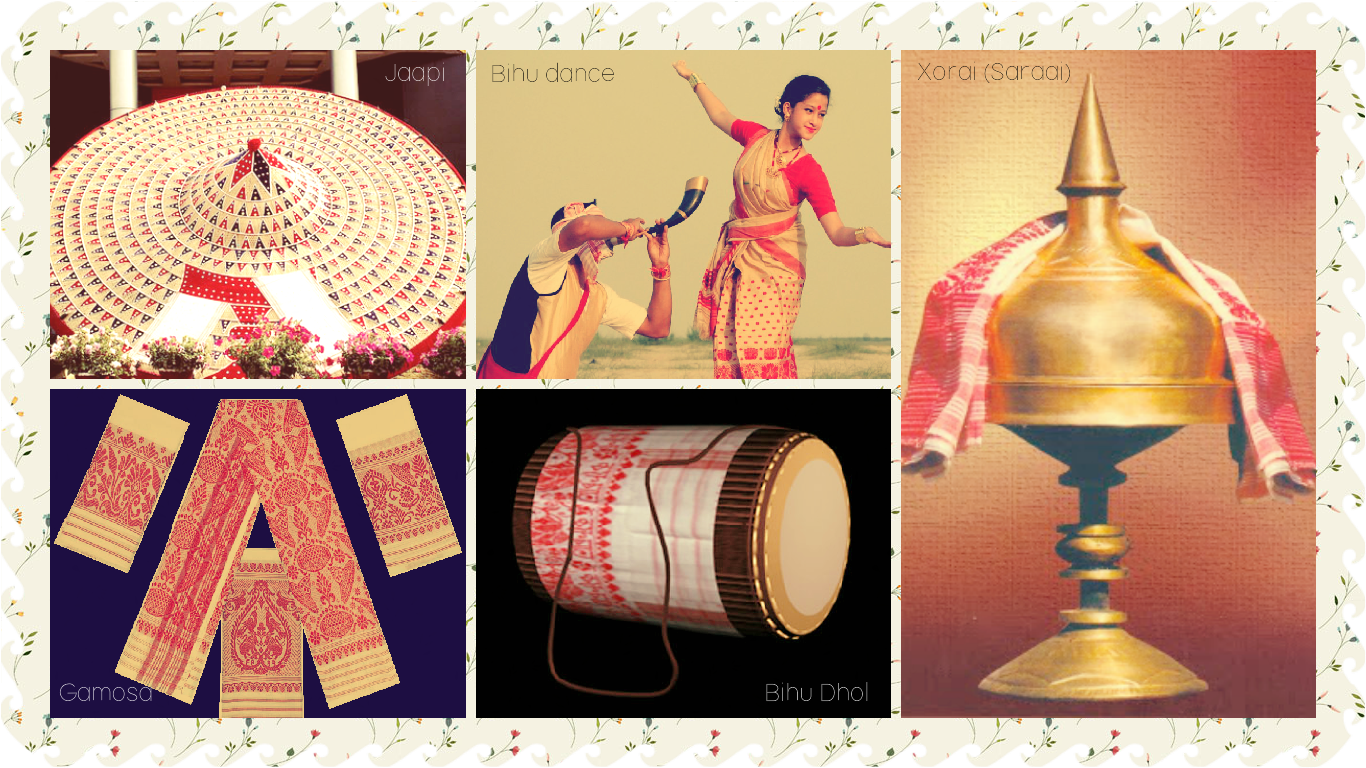
The dance is performed to traditional Bihu music. The most important musicians are the drummers (dhulia), who play a twin-faced drum (the dhol, which is hung from the neck) with one stick and a palm. There are usually more than one dhulia in a performance; each plays different rhythms at different sections of the performance. These rhythmic compositions, called seus, are traditionally formal. Before entering the dancing area, the drummers play a short and brisk rhythm. The seu is changed, and the drummers usually enter the dance area in line. The mohor xingor pepa is played (usually at the beginning) by a single player, who lays out an initial plaintive motif which sets the mood for the dance. The male dancers then enter the area in formation and perform (accompanied by singing, in which all participate). Other instruments which accompany this dance are the taal, a type of cymbal; the gogona, a reed-and-bamboo instrument; the toka, a bamboo clapper and the xutuli, a clay whistle. Bamboo flutes are also often used. The songs (bihu geet) accompanying the dance have been handed down for generations. Subjects of the lyrics include welcoming the Assamese new year, describing the life of a farmer, history and satire. Although men and women perform Bihu dance, the female Bihu dance has more variations (including freehand, twisting, with a rhythmic pepa, with a kahi (traditional metal plate) and with a jaapi (Assamese conical woven hat). The performance may be long, but is enlivened by rapid changes in rhythm, mood, movements, pace and improvisation. Dancers and musicians are given opportunities to showcase their talents.
The dance takes several forms in the different northeastern Indian groups (e.g. the Deori Bihu dance, Mising Bihu dance or Rati Bihu celebrated by Morans). However, the underlying goal of the dance remains the same: to express the desire to feel both pain and happiness.
A dance form of Assam performed in Tols or Namghar by both men and women separately. Sattriya dance is one of eight dance styles of India recognized as classical dance by the Sangeet-Natak Academy. The word Sattriya comes from the word Satra. On 15 nov, 2000, The Sangeet-Natak Academy recognized Sattriya dance as one of the classical dances of India.
Jhumura is a class of Sattriya dance. Jhumura is also a type of play written by Madhavdeva. He plays " Chordhara", "Pimpora Gusuwa", "Bhoomi Leta" and "Bhojan Bihar" are called Jhumura. The dance in Madhava's Jhumura is called Jhumura Dance. The dance is performed in The Satras of Kamalabari, Jarabari, Belguri etc. in Assam. There are many types of Jhumura dances like "Ramadani", "Geetar Nach", "Mela Nach".
Hub AI
Folk dances of Assam AI simulator
(@Folk dances of Assam_simulator)
Folk dances of Assam
Folk dances of Assam include the Bihu and the Bagurumba (both danced during festivals held in the spring), the Bhortal, the Ojapali dance. Assam is home to many groups: Muslim, Indo-Aryan, Rabha, Bodo, Dimasa, Karbi, Mising, Sonowal Kacharis, Mishmi and Tiwa (Lalung) etc. These cultures come together to create an Assamese culture. Residents of the state of Assam are known as "Axomiya" (Assamese). Most tribes have their own language, although Assamese is the primary language of the state.
Many fairs and festivals are held in Assam. Nearly all tribal festivals are held in spring and celebrate cultivation or harvest. Among festivals in Assam, the Bihu is most noteworthy; it brings together all Assamese people, regardless of background.
Although the origins of Bihu dance (Assamese: বিহু নৃত্য) are unknown, the first official record of it is said to be when the Ahom king Rudra Singha invited Bihu dancers to perform at the Rang Ghar fields in about 1694 for the Rongali Bihu.
The Bihu is a group dance in which men and women dance together, but maintain separate gender roles. In general, women follow stricter line or circle formations. The male dancers and musicians enter the dancing area first, maintain their lines and follow synchronized patterns. When the female dancers enter, the male dancers break up their lines to mingle with the female dancers (who maintain their stricter formation and the order of the dance). It is usually characterized by specific postures: movements of the hips, arms and wrists; twirls, squats and bends. Male and female dance movements are very similar, with only subtle differences.
The dance is performed to traditional Bihu music. The most important musicians are the drummers (dhulia), who play a twin-faced drum (the dhol, which is hung from the neck) with one stick and a palm. There are usually more than one dhulia in a performance; each plays different rhythms at different sections of the performance. These rhythmic compositions, called seus, are traditionally formal. Before entering the dancing area, the drummers play a short and brisk rhythm. The seu is changed, and the drummers usually enter the dance area in line. The mohor xingor pepa is played (usually at the beginning) by a single player, who lays out an initial plaintive motif which sets the mood for the dance. The male dancers then enter the area in formation and perform (accompanied by singing, in which all participate). Other instruments which accompany this dance are the taal, a type of cymbal; the gogona, a reed-and-bamboo instrument; the toka, a bamboo clapper and the xutuli, a clay whistle. Bamboo flutes are also often used. The songs (bihu geet) accompanying the dance have been handed down for generations. Subjects of the lyrics include welcoming the Assamese new year, describing the life of a farmer, history and satire. Although men and women perform Bihu dance, the female Bihu dance has more variations (including freehand, twisting, with a rhythmic pepa, with a kahi (traditional metal plate) and with a jaapi (Assamese conical woven hat). The performance may be long, but is enlivened by rapid changes in rhythm, mood, movements, pace and improvisation. Dancers and musicians are given opportunities to showcase their talents.
The dance takes several forms in the different northeastern Indian groups (e.g. the Deori Bihu dance, Mising Bihu dance or Rati Bihu celebrated by Morans). However, the underlying goal of the dance remains the same: to express the desire to feel both pain and happiness.
A dance form of Assam performed in Tols or Namghar by both men and women separately. Sattriya dance is one of eight dance styles of India recognized as classical dance by the Sangeet-Natak Academy. The word Sattriya comes from the word Satra. On 15 nov, 2000, The Sangeet-Natak Academy recognized Sattriya dance as one of the classical dances of India.
Jhumura is a class of Sattriya dance. Jhumura is also a type of play written by Madhavdeva. He plays " Chordhara", "Pimpora Gusuwa", "Bhoomi Leta" and "Bhojan Bihar" are called Jhumura. The dance in Madhava's Jhumura is called Jhumura Dance. The dance is performed in The Satras of Kamalabari, Jarabari, Belguri etc. in Assam. There are many types of Jhumura dances like "Ramadani", "Geetar Nach", "Mela Nach".
Recent media