


Community hub
Recent from talks
Contribute something to knowledge base
Content stats: 0 posts, 0 articles, 1 media, 0 notes
Members stats: 0 subscribers, 0 contributors, 0 moderators, 0 supporters
Subscribers
Supporters
Contributors
Moderators
Hub AI
Fomalhaut b AI simulator
(@Fomalhaut b_simulator)
Hub AI
Fomalhaut b AI simulator
(@Fomalhaut b_simulator)
Fomalhaut b
Fomalhaut b, formally named Dagon (/ˈdeɪɡən/), is an expanding dust cloud and former candidate planet observed near the A-type main-sequence star Fomalhaut, approximately 25 light-years away in the constellation of Piscis Austrinus. The object's discovery was initially announced in 2008 and confirmed in 2012 via images taken with the Advanced Camera for Surveys (ACS) on the Hubble Space Telescope. Under the working hypothesis that the object was a planet, it was reported in January 2013 that it had a highly elliptical orbit with a period of 1,700 Earth years. The object was one of those selected by the International Astronomical Union as part of NameExoWorlds, their public process for giving proper names to exoplanets. The process involved public nomination and voting for the new name. In December 2015, the IAU announced the winning name was Dagon.
The planetary hypothesis has since fallen out of favor; more gathered data suggested a dust or debris cloud is far more likely, and the object was placed on an escape trajectory. In 2023, a team of researchers used the James Webb Space Telescope's MIRI to probe the complex dust environment around the Fomalhaut. They discovered a new intermediate dust belt that might be shepherded by an unseen planet and suggested that the blob, Fomalhaut b, could have originated in this belt. The recent research of the Fomalhaut system used the JWST's NIRCam equipped with coronagraphs to probe the complex dust ring in different wavelengths of infrared light. The absence of detection in certain wavelengths support the idea that Fomalhaut b is not a massive planet but rather a dust cloud resulting from a collision among planetesimals.
The existence of a massive planet orbiting Fomalhaut was first inferred from Hubble observations published in 2005 that resolved the structure of Fomalhaut's massive, cold debris disk (or dust belt/ring). The belt is not centered on the star, and has a sharper inner boundary than would normally be expected. The initial theory was that a massive planet on a wide orbit but located interior to this debris ring could clear out parent bodies and dust in its vicinity, leaving the ring appearing to have a sharp inner edge and making it appear offset from the star.
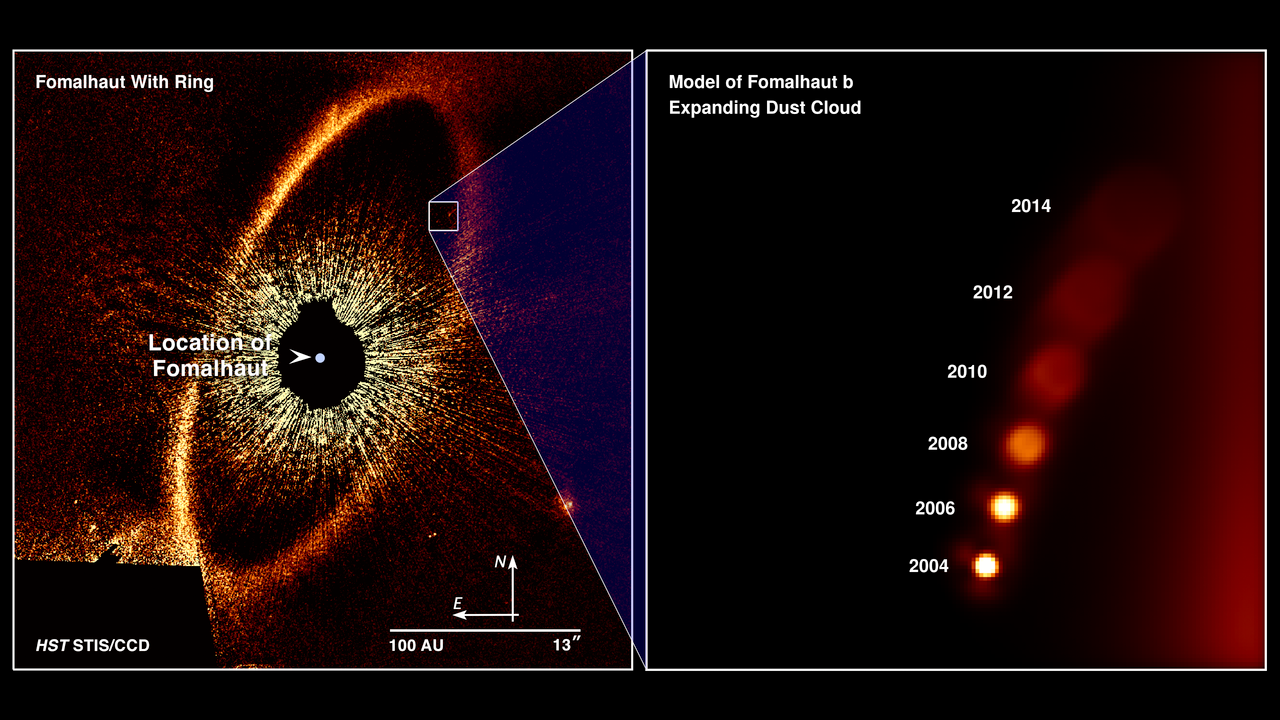
In May 2008, Paul Kalas, James Graham and their collaborators identified Fomalhaut b from Hubble/ACS images taken in 2004 and 2006 at visible wavelengths (i.e. 0.6 and 0.8 μm). NASA released the composite discovery photograph on November 13, 2008, coinciding with the publication of discovery by Kalas et al. in Science.
Kalas remarked, "It's a profound and overwhelming experience to lay eyes on a planet never before seen. I nearly had a heart attack at the end of May when I confirmed that Fomalhaut b orbits its parent star." In the image, the bright outer oval band is the dust ring, while the features inside of this band represent noise from scattered starlight.
In the discovery paper, Kalas and collaborators suggested that Fomalhaut b's emission originates from two sources: from circumplanetary dust scattering starlight and from planet thermal emission. Here, the former explains most of the 0.6 μm brightness and planet thermal emission contributes to much of the 0.8 μm brightness. Their non-detections with ground-based infrared data suggested that Fomalhaut b could not be more massive than about three times Jupiter's mass if it were a planet.
However, Fomalhaut b should be detectable in space-based infrared data if it is a planet and has a mass between 1–3 times Jupiter's mass. On the contrary, observations from the infrared-sensitive Spitzer Space Telescope failed to detect Fomalhaut b, implying that Fomalhaut b has less mass than Jupiter if it is a planet. Furthermore, although Fomalhaut b was thought to be a plausible explanation for Fomalhaut's eccentric debris ring, measurements in the Kalas et al. paper hinted that it was moving too fast (i.e. not apsidally aligned) for this explanation to work. Finally, researchers analyzing September–October 2011 data from the ALMA for Fomalhaut's debris ring suggested an alternate hypothesis: that the ring could be shaped by much smaller, shepherding planets, neither of which needed to be Fomalhaut b. These results invoked skepticism about Fomalhaut b's status as an extrasolar planet.
On October 24, 2012, a team led by Thayne Currie at the University of Toronto announced the first independent recovery of Fomalhaut b and revived the claim that Fomalhaut b was a planet. They reanalyzed the original Hubble data using new, more powerful algorithms for separating planet light from starlight and confirmed that Fomalhaut b does exist. They also provided a new detection of Fomalhaut b at 0.4 μm. They modeled the optical detection and infrared upper limits for Fomalhaut b, showing that Fomalhaut b's emission can be completely explained by starlight scattered by small dust and arguing that this dust surrounds an unseen planetary-mass object. Thus, they consider Fomalhaut b to plausibly be a "planet identified from direct imaging" even if Fomalhaut b is not, strictly speaking, a directly imaged planet insofar as the light does not come from a planetary atmosphere.
Fomalhaut b
Fomalhaut b, formally named Dagon (/ˈdeɪɡən/), is an expanding dust cloud and former candidate planet observed near the A-type main-sequence star Fomalhaut, approximately 25 light-years away in the constellation of Piscis Austrinus. The object's discovery was initially announced in 2008 and confirmed in 2012 via images taken with the Advanced Camera for Surveys (ACS) on the Hubble Space Telescope. Under the working hypothesis that the object was a planet, it was reported in January 2013 that it had a highly elliptical orbit with a period of 1,700 Earth years. The object was one of those selected by the International Astronomical Union as part of NameExoWorlds, their public process for giving proper names to exoplanets. The process involved public nomination and voting for the new name. In December 2015, the IAU announced the winning name was Dagon.
The planetary hypothesis has since fallen out of favor; more gathered data suggested a dust or debris cloud is far more likely, and the object was placed on an escape trajectory. In 2023, a team of researchers used the James Webb Space Telescope's MIRI to probe the complex dust environment around the Fomalhaut. They discovered a new intermediate dust belt that might be shepherded by an unseen planet and suggested that the blob, Fomalhaut b, could have originated in this belt. The recent research of the Fomalhaut system used the JWST's NIRCam equipped with coronagraphs to probe the complex dust ring in different wavelengths of infrared light. The absence of detection in certain wavelengths support the idea that Fomalhaut b is not a massive planet but rather a dust cloud resulting from a collision among planetesimals.
The existence of a massive planet orbiting Fomalhaut was first inferred from Hubble observations published in 2005 that resolved the structure of Fomalhaut's massive, cold debris disk (or dust belt/ring). The belt is not centered on the star, and has a sharper inner boundary than would normally be expected. The initial theory was that a massive planet on a wide orbit but located interior to this debris ring could clear out parent bodies and dust in its vicinity, leaving the ring appearing to have a sharp inner edge and making it appear offset from the star.
In May 2008, Paul Kalas, James Graham and their collaborators identified Fomalhaut b from Hubble/ACS images taken in 2004 and 2006 at visible wavelengths (i.e. 0.6 and 0.8 μm). NASA released the composite discovery photograph on November 13, 2008, coinciding with the publication of discovery by Kalas et al. in Science.
Kalas remarked, "It's a profound and overwhelming experience to lay eyes on a planet never before seen. I nearly had a heart attack at the end of May when I confirmed that Fomalhaut b orbits its parent star." In the image, the bright outer oval band is the dust ring, while the features inside of this band represent noise from scattered starlight.
In the discovery paper, Kalas and collaborators suggested that Fomalhaut b's emission originates from two sources: from circumplanetary dust scattering starlight and from planet thermal emission. Here, the former explains most of the 0.6 μm brightness and planet thermal emission contributes to much of the 0.8 μm brightness. Their non-detections with ground-based infrared data suggested that Fomalhaut b could not be more massive than about three times Jupiter's mass if it were a planet.
However, Fomalhaut b should be detectable in space-based infrared data if it is a planet and has a mass between 1–3 times Jupiter's mass. On the contrary, observations from the infrared-sensitive Spitzer Space Telescope failed to detect Fomalhaut b, implying that Fomalhaut b has less mass than Jupiter if it is a planet. Furthermore, although Fomalhaut b was thought to be a plausible explanation for Fomalhaut's eccentric debris ring, measurements in the Kalas et al. paper hinted that it was moving too fast (i.e. not apsidally aligned) for this explanation to work. Finally, researchers analyzing September–October 2011 data from the ALMA for Fomalhaut's debris ring suggested an alternate hypothesis: that the ring could be shaped by much smaller, shepherding planets, neither of which needed to be Fomalhaut b. These results invoked skepticism about Fomalhaut b's status as an extrasolar planet.
On October 24, 2012, a team led by Thayne Currie at the University of Toronto announced the first independent recovery of Fomalhaut b and revived the claim that Fomalhaut b was a planet. They reanalyzed the original Hubble data using new, more powerful algorithms for separating planet light from starlight and confirmed that Fomalhaut b does exist. They also provided a new detection of Fomalhaut b at 0.4 μm. They modeled the optical detection and infrared upper limits for Fomalhaut b, showing that Fomalhaut b's emission can be completely explained by starlight scattered by small dust and arguing that this dust surrounds an unseen planetary-mass object. Thus, they consider Fomalhaut b to plausibly be a "planet identified from direct imaging" even if Fomalhaut b is not, strictly speaking, a directly imaged planet insofar as the light does not come from a planetary atmosphere.
Recent media
Recent media