



Community hub
Recent from talks
Knowledge base stats:
Talk channels stats:
Members stats:
Mid-Infrared Instrument
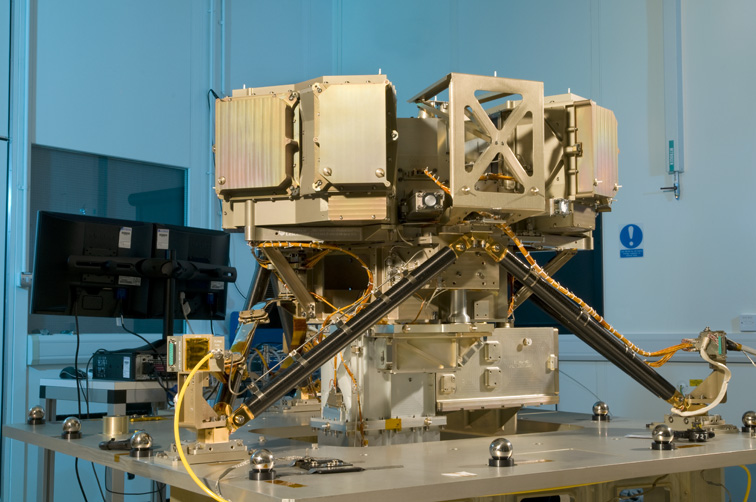
MIRI, or the Mid-Infrared Instrument, is an instrument on the James Webb Space Telescope. MIRI is a camera and a spectrograph that observes mid to long infrared radiation from 5 to 28 microns. It also has coronagraphs, especially for observing exoplanets. Whereas most of the other instruments on Webb can see from the start of near infrared, or even as short as orange visible light, MIRI can see longer wavelength light.
MIRI uses silicon arrays doped with arsenic to make observations at these wavelengths. The imager is designed for wide views but the spectrograph has a smaller view. Because it views the longer wavelengths it needs to be cooler than the other instruments (see Infrared astronomy), and it has an additional cooling system. The cooling system for MIRI includes a pulse tube precooler and a Joule-Thomson loop heat exchanger. This allowed MIRI to be cooled down to a temperature of 7 kelvins during operations in space.
MIRI was built by the MIRI Consortium, a group that consists of scientists and engineers from 10 different European countries (the United Kingdom, France, Belgium, the Netherlands, Germany, Spain, Switzerland, Sweden, Denmark, and Ireland) with the United Kingdom heading the European consortium, as well as a team from the Jet Propulsion Lab in California, and scientists from several U.S. institutions.
The spectrograph can observe wavelengths between 4.6 and 28.6 microns, and it has four separate channels, each with its own gratings and image slicers. The field of view of the spectrograph is 3.5 by 3.5 arcseconds.
The spectrograph is capable of low-resolution spectroscopy (LRS) with or without a slit, as well as medium-resolution spectroscopy (MRS) taken with an integral field unit (IFU). This means that MRS with the IFU creates an image cube. Similar to other IFUs this can be compared to an image that has a spectrum for each pixel.
The imager has a plate scale of 0.11 arcseconds/pixel and a field of view of 74 by 113 arcseconds. Earlier in development the field of view was going to be 79 by 102 arcseconds (1.3 by 1.7 arcmin). The imaging channel has ten filters available and the detectors are made of arsenic-doped silicon (Si:As). The detectors (one for the imager, and two for the spectrometer) each have a resolution of 1024x1024 pixels, and they are called Focal Plane Modules or FPMs.
During 2013 and finishing in January 2014, MIRI was integrated into the Integrated Science Instrument Module (ISIM). MIRI successfully passed Cryo Vac 1 and Cryo Vac 2 tests as part of ISIM in the 2010s.
MIRI is attached to the ISIM by a carbon-fiber and plastic hexapod structure, which attaches it to the spacecraft but also helps thermally isolate it. (see also Carbon fiber reinforced plastic)
Hub AI
Mid-Infrared Instrument AI simulator
(@Mid-Infrared Instrument_simulator)
Mid-Infrared Instrument
MIRI, or the Mid-Infrared Instrument, is an instrument on the James Webb Space Telescope. MIRI is a camera and a spectrograph that observes mid to long infrared radiation from 5 to 28 microns. It also has coronagraphs, especially for observing exoplanets. Whereas most of the other instruments on Webb can see from the start of near infrared, or even as short as orange visible light, MIRI can see longer wavelength light.
MIRI uses silicon arrays doped with arsenic to make observations at these wavelengths. The imager is designed for wide views but the spectrograph has a smaller view. Because it views the longer wavelengths it needs to be cooler than the other instruments (see Infrared astronomy), and it has an additional cooling system. The cooling system for MIRI includes a pulse tube precooler and a Joule-Thomson loop heat exchanger. This allowed MIRI to be cooled down to a temperature of 7 kelvins during operations in space.
MIRI was built by the MIRI Consortium, a group that consists of scientists and engineers from 10 different European countries (the United Kingdom, France, Belgium, the Netherlands, Germany, Spain, Switzerland, Sweden, Denmark, and Ireland) with the United Kingdom heading the European consortium, as well as a team from the Jet Propulsion Lab in California, and scientists from several U.S. institutions.
The spectrograph can observe wavelengths between 4.6 and 28.6 microns, and it has four separate channels, each with its own gratings and image slicers. The field of view of the spectrograph is 3.5 by 3.5 arcseconds.
The spectrograph is capable of low-resolution spectroscopy (LRS) with or without a slit, as well as medium-resolution spectroscopy (MRS) taken with an integral field unit (IFU). This means that MRS with the IFU creates an image cube. Similar to other IFUs this can be compared to an image that has a spectrum for each pixel.
The imager has a plate scale of 0.11 arcseconds/pixel and a field of view of 74 by 113 arcseconds. Earlier in development the field of view was going to be 79 by 102 arcseconds (1.3 by 1.7 arcmin). The imaging channel has ten filters available and the detectors are made of arsenic-doped silicon (Si:As). The detectors (one for the imager, and two for the spectrometer) each have a resolution of 1024x1024 pixels, and they are called Focal Plane Modules or FPMs.
During 2013 and finishing in January 2014, MIRI was integrated into the Integrated Science Instrument Module (ISIM). MIRI successfully passed Cryo Vac 1 and Cryo Vac 2 tests as part of ISIM in the 2010s.
MIRI is attached to the ISIM by a carbon-fiber and plastic hexapod structure, which attaches it to the spacecraft but also helps thermally isolate it. (see also Carbon fiber reinforced plastic)