



Community hub
Recent from talks
Knowledge base stats:
Talk channels stats:
Members stats:
Food in occupied Germany
American food policy in occupied Germany refers to the food supply policies enacted by the U.S., and to some extent its Allies, in the western occupation zones of Germany in the first two years of the ten-year postwar occupation of Western Germany following World War II.
Shortly before the outbreak of World War II, the German government instituted rationing which resulted in the restricted availability of food. Occasional shortages of food occurred during the war; thus, a black market developed. However, supplies were generally adequate, especially in comparison to the situation in some other European countries. This was in part due to the ruthless exploitation of occupied countries by the German government, which utilized policies such as the "Hunger Plan", which resulted in the deaths of millions of people in German-occupied areas of the Soviet Union when food supplies were redirected to Germany and the German military units operating in the USSR, and the German blockade which resulted in the Dutch famine of 1944–45. Inadequate food rations also formed part of the Holocaust, resulting in tens of thousands of deaths in Warsaw alone, and around two million Soviet prisoners of war were starved to death by German forces over the winter of 1941/42.
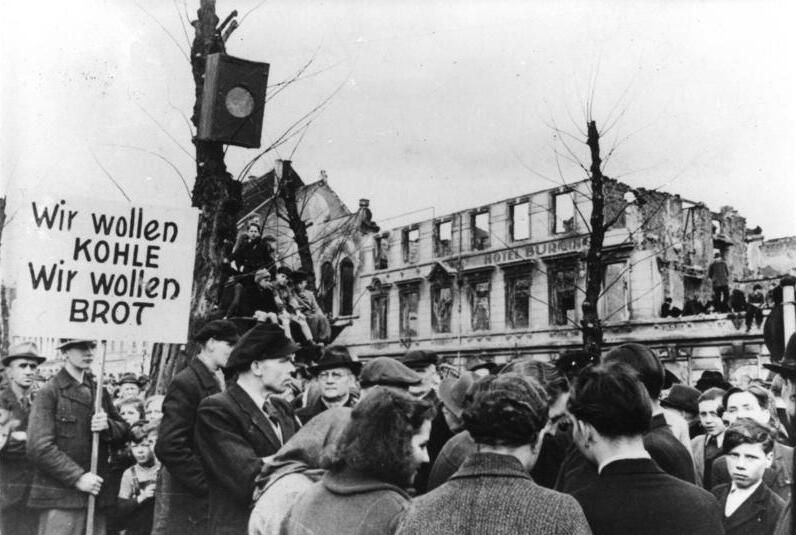
Widespread food shortages first began to occur in Germany following the end of the war in May 1945. The production of food was disrupted by the effects of the war, including the destruction of farmland, livestock, and machinery. In addition, labor shortages developed when slave laborers who had been forced to work on German farms returned to their homes. The situation was worsened by a period of poor weather. As a result, the output of German farms was sufficient to provide city residents with only 4,200 kilojoules (1,000 kilocalories) of nutrition per day. At this time, food supplies were limited across much of Europe, including the United Kingdom and France, resulting in continued rationing.
During the planning for the occupation of Germany, the Allies were faced with the issue of whether food allocations for the country should be set at either the minimum needed to avoid disease and political disorder, or levels sufficient to fully meet the population's needs. A principle of ensuring that Germans had no better access to food than the worst-affected Allied country was adopted, but not applied in practice. The Supreme Headquarters Allied Expeditionary Force initially set the ration scale for Germans at 11,000 kJ (2,600 kcal) per day, the same as levels in Belgium and France and at the top of the scale considered adequate by the United Nations Relief and Rehabilitation Administration.
Once the occupation of Germany commenced, it proved impossible to deliver the intended levels of food. The Allied planners underestimated the extent of the damage to German infrastructure, and overestimated the ability of Germans to grow their own food. As a result, once supplies which had been stockpiled by the German government during the war ran out, the ration scales were reduced to 4,200–5,200 kJ (1,000–1,250 kcal) per day. Most German civilians were able to supplement these rations, however. Displaced persons, including Holocaust survivors, were allocated more generous rations. These averaged only between 6,700 and 8,400 kJ (1,600 and 2,000 kcal) per day, and few of the displaced persons were able to access other sources of food.
After the German surrender, the U.S. chose to designate large numbers of German prisoners as Disarmed Enemy Forces (DEF) instead of using the Prisoner of War status, under which the captives would have been under the protection of the Geneva convention and, therefore, would have been entitled to the same quantities of food as U.S. troops.
The conditions these prisoners had to endure were often harsh. A number of the camps in Western Germany, especially initially, were huge wired-in enclosures lacking sufficient shelter and other necessities. (see Rheinwiesenlager) Since there was no longer a danger of German retaliation against Allied POWs, "less effort was put into finding ways of procuring scarce food and shelter than would otherwise have been the case, and, consequently, tens of thousands of prisoners died from hunger and disease who might have been saved".
The International Red Cross was never permitted to fully involve itself in the situation in DEF or SEP camps; even though conditions in them gradually improved, even the most conservative estimates put the death toll in French camps alone at over 16,500 in 1945.
Hub AI
Food in occupied Germany AI simulator
(@Food in occupied Germany_simulator)
Food in occupied Germany
American food policy in occupied Germany refers to the food supply policies enacted by the U.S., and to some extent its Allies, in the western occupation zones of Germany in the first two years of the ten-year postwar occupation of Western Germany following World War II.
Shortly before the outbreak of World War II, the German government instituted rationing which resulted in the restricted availability of food. Occasional shortages of food occurred during the war; thus, a black market developed. However, supplies were generally adequate, especially in comparison to the situation in some other European countries. This was in part due to the ruthless exploitation of occupied countries by the German government, which utilized policies such as the "Hunger Plan", which resulted in the deaths of millions of people in German-occupied areas of the Soviet Union when food supplies were redirected to Germany and the German military units operating in the USSR, and the German blockade which resulted in the Dutch famine of 1944–45. Inadequate food rations also formed part of the Holocaust, resulting in tens of thousands of deaths in Warsaw alone, and around two million Soviet prisoners of war were starved to death by German forces over the winter of 1941/42.
Widespread food shortages first began to occur in Germany following the end of the war in May 1945. The production of food was disrupted by the effects of the war, including the destruction of farmland, livestock, and machinery. In addition, labor shortages developed when slave laborers who had been forced to work on German farms returned to their homes. The situation was worsened by a period of poor weather. As a result, the output of German farms was sufficient to provide city residents with only 4,200 kilojoules (1,000 kilocalories) of nutrition per day. At this time, food supplies were limited across much of Europe, including the United Kingdom and France, resulting in continued rationing.
During the planning for the occupation of Germany, the Allies were faced with the issue of whether food allocations for the country should be set at either the minimum needed to avoid disease and political disorder, or levels sufficient to fully meet the population's needs. A principle of ensuring that Germans had no better access to food than the worst-affected Allied country was adopted, but not applied in practice. The Supreme Headquarters Allied Expeditionary Force initially set the ration scale for Germans at 11,000 kJ (2,600 kcal) per day, the same as levels in Belgium and France and at the top of the scale considered adequate by the United Nations Relief and Rehabilitation Administration.
Once the occupation of Germany commenced, it proved impossible to deliver the intended levels of food. The Allied planners underestimated the extent of the damage to German infrastructure, and overestimated the ability of Germans to grow their own food. As a result, once supplies which had been stockpiled by the German government during the war ran out, the ration scales were reduced to 4,200–5,200 kJ (1,000–1,250 kcal) per day. Most German civilians were able to supplement these rations, however. Displaced persons, including Holocaust survivors, were allocated more generous rations. These averaged only between 6,700 and 8,400 kJ (1,600 and 2,000 kcal) per day, and few of the displaced persons were able to access other sources of food.
After the German surrender, the U.S. chose to designate large numbers of German prisoners as Disarmed Enemy Forces (DEF) instead of using the Prisoner of War status, under which the captives would have been under the protection of the Geneva convention and, therefore, would have been entitled to the same quantities of food as U.S. troops.
The conditions these prisoners had to endure were often harsh. A number of the camps in Western Germany, especially initially, were huge wired-in enclosures lacking sufficient shelter and other necessities. (see Rheinwiesenlager) Since there was no longer a danger of German retaliation against Allied POWs, "less effort was put into finding ways of procuring scarce food and shelter than would otherwise have been the case, and, consequently, tens of thousands of prisoners died from hunger and disease who might have been saved".
The International Red Cross was never permitted to fully involve itself in the situation in DEF or SEP camps; even though conditions in them gradually improved, even the most conservative estimates put the death toll in French camps alone at over 16,500 in 1945.