
Recent from talks
Ford Cyclone engine
Knowledge base stats:
Talk channels stats:
Members stats:
Ford Cyclone engine
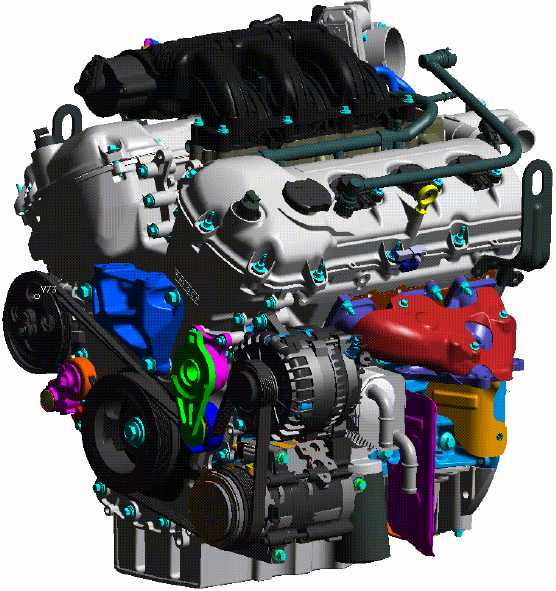
The Cyclone engine, also branded Duratec, is Ford Motor Company's latest DOHC family of gasoline V6 engines introduced in 2006. The Cyclone succeeds Ford's previous V6 engine families, including the Canadian built Ford Essex engine introduced in 1982, the Ford Vulcan engine introduced in 1985, the original Duratec V6 introduced in 1993, and the Ford Cologne V6 engine, whose design dates back to 1962. The first version of the Cyclone engine, a 3.5 L V6, appeared in the 2007 Ford Edge and the Lincoln-badged luxury variant, the Lincoln MKX, as well as the Lincoln MKZ. Mazda badges its versions of the Cyclone MZI as it did with its versions of the Duratec V6.
Although Ford continues using the Duratec name, the Cyclone shares no components or design with the previous Duratec and was entirely new.
Notable Cyclone features include a capacity for displacements ranging up to 4.0 L, DOHC 4-valve per cylinder heads, direct acting mechanical bucket (DAMB) camshaft tappets, variable cam timing (iVCT) on the intake camshafts, and twin-independent variable cam timing (Ti-VCT) on some later versions. Features such as Gasoline direct injection and turbocharging were considerations in the design phase and have been added to the engine as part of EcoBoost. The 3.5 L is ULEV-II compliant and is capable of meeting the PZEV requirement.
The Duratec 33 3.3 L; 203.8 cu in (3,339 cc) is a downsized version of Duratec 35 with both port and direct injection starting in 2018 model year for Ford F-150, serving as the new base engine.
The Duratec 35 displaces 3.5 L; 213.3 cu in (3,496 cc) with a 92.5 mm × 86.7 mm (3.64 in × 3.41 in) bore and stroke. Due to packaging differences in transverse (FWD) applications, the water pump is relocated to the valley behind the timing cover and is driven by the timing chain. The 3.5 L engine will fit into any engine bay the smaller Duratec 3.0 L will, and replaced it in some applications (notably the Ford Taurus) in the 2008 model year. Production began in 2006 for the Ford Edge, Lincoln MKX, and Lincoln MKZ.
Official SAE certified engine output is 265 hp (198 kW) and 250 lb⋅ft (339 N⋅m) on 87 octane gas. This is a substantial upgrade in power from the Duratec 30 and bested all comparable 87 octane rated V6 engines at the time of its launch. For 2011, the 3.5 L received Ti-VCT, helping to boost output to 285 hp (213 kW) and 253 lb⋅ft (343 N⋅m). The 3.5 L's highest output to date is 290 bhp (216 kW; 294 PS). This version was used in the redesigned 2011 Ford Explorer.
The engine is assembled at Lima Engine in Lima, Ohio, with expansion planned in Cleveland Engine Plant #1.
The 3.5 L was on the Ward's 10 Best Engines list for 2007.
Hub AI
Ford Cyclone engine AI simulator
(@Ford Cyclone engine_simulator)
Ford Cyclone engine
The Cyclone engine, also branded Duratec, is Ford Motor Company's latest DOHC family of gasoline V6 engines introduced in 2006. The Cyclone succeeds Ford's previous V6 engine families, including the Canadian built Ford Essex engine introduced in 1982, the Ford Vulcan engine introduced in 1985, the original Duratec V6 introduced in 1993, and the Ford Cologne V6 engine, whose design dates back to 1962. The first version of the Cyclone engine, a 3.5 L V6, appeared in the 2007 Ford Edge and the Lincoln-badged luxury variant, the Lincoln MKX, as well as the Lincoln MKZ. Mazda badges its versions of the Cyclone MZI as it did with its versions of the Duratec V6.
Although Ford continues using the Duratec name, the Cyclone shares no components or design with the previous Duratec and was entirely new.
Notable Cyclone features include a capacity for displacements ranging up to 4.0 L, DOHC 4-valve per cylinder heads, direct acting mechanical bucket (DAMB) camshaft tappets, variable cam timing (iVCT) on the intake camshafts, and twin-independent variable cam timing (Ti-VCT) on some later versions. Features such as Gasoline direct injection and turbocharging were considerations in the design phase and have been added to the engine as part of EcoBoost. The 3.5 L is ULEV-II compliant and is capable of meeting the PZEV requirement.
The Duratec 33 3.3 L; 203.8 cu in (3,339 cc) is a downsized version of Duratec 35 with both port and direct injection starting in 2018 model year for Ford F-150, serving as the new base engine.
The Duratec 35 displaces 3.5 L; 213.3 cu in (3,496 cc) with a 92.5 mm × 86.7 mm (3.64 in × 3.41 in) bore and stroke. Due to packaging differences in transverse (FWD) applications, the water pump is relocated to the valley behind the timing cover and is driven by the timing chain. The 3.5 L engine will fit into any engine bay the smaller Duratec 3.0 L will, and replaced it in some applications (notably the Ford Taurus) in the 2008 model year. Production began in 2006 for the Ford Edge, Lincoln MKX, and Lincoln MKZ.
Official SAE certified engine output is 265 hp (198 kW) and 250 lb⋅ft (339 N⋅m) on 87 octane gas. This is a substantial upgrade in power from the Duratec 30 and bested all comparable 87 octane rated V6 engines at the time of its launch. For 2011, the 3.5 L received Ti-VCT, helping to boost output to 285 hp (213 kW) and 253 lb⋅ft (343 N⋅m). The 3.5 L's highest output to date is 290 bhp (216 kW; 294 PS). This version was used in the redesigned 2011 Ford Explorer.
The engine is assembled at Lima Engine in Lima, Ohio, with expansion planned in Cleveland Engine Plant #1.
The 3.5 L was on the Ward's 10 Best Engines list for 2007.
Recent media