Hubbry Logo
TurbochargerTurbochargerMain
Open search
Turbocharger
Community hub
Turbocharger
logo
8 pages, 0 posts
0 subscribers
Be the first to start a discussion here.
Turbocharger
Turbocharger
from Wikipedia

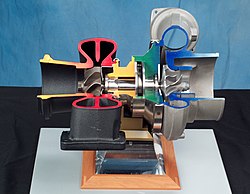
A turbocharger (item 10) on a piston engine

In an internal combustion engine, a turbocharger (also known as a turbo or a turbosupercharger) is a forced induction device that compresses the intake air, forcing more air into the engine in order to produce more power for a given displacement.[1][2]

Turbochargers are distinguished from superchargers in that a turbocharger is powered by the kinetic energy of the exhaust gases, whereas a supercharger is mechanically powered, usually by a belt from the engine's crankshaft.[3] However, up until the mid-20th century, a turbocharger was called a "turbosupercharger" and was considered a type of supercharger.[4]

History

[edit]

Prior to the invention of the turbocharger, forced induction was only possible using mechanically-powered superchargers. Use of superchargers began in 1878, when several supercharged two-stroke gas engines were built using a design by Scottish engineer Dugald Clerk.[5] Then in 1885, Gottlieb Daimler patented the technique of using a gear-driven pump to force air into an internal combustion engine.[6]

The 1905 patent by Alfred Büchi, a Swiss engineer working at Sulzer is often considered the birth of the turbocharger.[7][8][9] This patent was for a compound radial engine with an exhaust-driven axial flow turbine and compressor mounted on a common shaft.[10][11] The first prototype was finished in 1915 with the aim of overcoming the power loss experienced by aircraft engines due to the decreased density of air at high altitudes.[12][13] However, the prototype was not reliable and did not reach production.[12] Another early patent for turbochargers was applied for in 1916 by French steam turbine inventor Auguste Rateau, for their intended use on the Renault engines used by French fighter planes.[10][14] Separately, testing in 1917 by the National Advisory Committee for Aeronautics (NACA) and Sanford Alexander Moss showed that a turbocharger could enable an engine to avoid any power loss (compared with the power produced at sea level) at an altitude of up to 4,250 m (13,944 ft) above sea level.[10] The testing was conducted at Pikes Peak in the United States using the Liberty L-12 aircraft engine.[14]

The first commercial application of a turbocharger was in June 1924 when the first heavy duty turbocharger, model VT402, was delivered from the Baden works of Brown, Boveri & Cie, under the supervision of Alfred Büchi, to SLM, Swiss Locomotive and Machine Works in Winterthur.[15] This was followed very closely in 1925, when Alfred Büchi successfully installed turbochargers on ten-cylinder diesel engines, increasing the power output from 1,300 to 1,860 kilowatts (1,750 to 2,500 hp).[16][17][18] This engine was used by the German Ministry of Transport for two large passenger ships called the Preussen and Hansestadt Danzig. The design was licensed to several manufacturers and turbochargers began to be used in marine, railcar and large stationary applications.[13]

Turbochargers were used on several aircraft engines during World War II, beginning with the Boeing B-17 Flying Fortress in 1938, which used turbochargers produced by General Electric.[10][19] Other early turbocharged airplanes included the Consolidated B-24 Liberator, Lockheed P-38 Lightning, Republic P-47 Thunderbolt and experimental variants of the Focke-Wulf Fw 190.

The first practical application for trucks was realized by Swiss truck manufacturing company Saurer in the 1930s. BXD and BZD engines were manufactured with optional turbocharging from 1931 onwards.[20] The Swiss industry played a pioneering role with turbocharging engines as witnessed by Sulzer, Saurer and Brown, Boveri & Cie.[21][22]

Automobile manufacturers began research into turbocharged engines during the 1950s; however, the problems of "turbo lag" and the bulky size of the turbocharger were not able to be solved at the time.[8][13] The first turbocharged cars were the short-lived Chevrolet Corvair Monza and the Oldsmobile Jetfire, both introduced in 1962.[23][24]

The turbo succeeded in motorsport, but took its time. The 1968 Indianapolis 500 was the first to be won with a turbocharged engine; turbos have won on the fast oval track ever since. Porsche pioneered turbos in engines derived from the 1963 Porsche 911, which had an air-cooled flat six engine just like the Chevrolet Corvair, but got turbocharged ten years later. Porsche 935 and Porsche 936 won both kinds of Sportcars World Championships in 1976, as well as the Le Mans 24h, proving that they could be reliable and fast. In Formula One, capacity was limited to only 1.5 litre, with the first race victories coming in the late 1970s, and the first F1 World Championship in 1983, with a BMW M10-based 4-cylinder engine that dates back to 1961.

Turbodiesel passenger cars appeared in the 1970s, with the Mercedes 300 D. Greater adoption of turbocharging in passenger cars began in the 1980s, as a way to increase the performance of smaller displacement engines.[10]

Design

[edit]
Turbocharger components

Like other forced induction devices, a compressor in the turbocharger pressurises the intake air before it enters the inlet manifold.[25] In the case of a turbocharger, the compressor is powered by the kinetic energy of the engine's exhaust gases, which is extracted by the turbocharger's turbine.[26][27]

The main components of the turbocharger are:

Turbine

[edit]
Turbine section of a Garrett GT30 with the turbine housing removed

The turbine section (also called the "hot side" or "exhaust side" of the turbo) is where the rotational force is produced, in order to power the compressor (via a rotating shaft through the center of a turbo). After the exhaust has spun the turbine, it continues into the exhaust piping and out of the vehicle.

The turbine uses a series of blades to convert kinetic energy from the flow of exhaust gases to mechanical energy of a rotating shaft (which is used to power the compressor section). The turbine housings direct the gas flow through the turbine section, and the turbine itself can spin at speeds of up to 250,000 rpm.[28][29] Some turbocharger designs are available with multiple turbine housing options, allowing a housing to be selected to best suit the engine's characteristics and the performance requirements.

A turbocharger's performance is closely tied to its size,[30] and the relative sizes of the turbine wheel and the compressor wheel. Large turbines typically require higher exhaust gas flow rates, therefore increasing turbo lag and increasing the boost threshold. Small turbines can produce boost quickly and at lower flow rates, since it has lower rotational inertia, but can be a limiting factor in the peak power produced by the engine.[31][32] Various technologies, as described in the following sections, are often aimed at combining the benefits of both small turbines and large turbines.

Large diesel engines often use a single-stage axial inflow turbine instead of a radial turbine.[33]

Twin-scroll

[edit]

A twin-scroll turbocharger uses two separate exhaust gas inlets, to make use of the pulses in the flow of the exhaust gasses from each cylinder.[34] In a standard (single-scroll) turbocharger, the exhaust gas from all cylinders is combined and enters the turbocharger via a single intake, which causes the gas pulses from each cylinder to interfere with each other. For a twin-scroll turbocharger, the cylinders are split into two groups in order to maximize the pulses. The exhaust manifold keeps the gases from these two groups of cylinders separated, then they travel through two separate spiral chambers ("scrolls") before entering the turbine housing via two separate nozzles. The scavenging effect of these gas pulses recovers more energy from the exhaust gases, minimizes parasitic back losses and improves responsiveness at low engine speeds.[35][36]

Another common feature of twin-scroll turbochargers is that the two nozzles are different sizes: the smaller nozzle is installed at a steeper angle and is used for low-rpm response, while the larger nozzle is less angled and optimised for times when high outputs are required.[37]

Variable-geometry

[edit]
Cutaway view of a Porsche variable-geometry turbocharger

Variable-geometry turbochargers (also known as variable-nozzle turbochargers) are used to alter the effective aspect ratio of the turbocharger as operating conditions change. This is done with the use of adjustable vanes located inside the turbine housing between the inlet and turbine, which affect flow of gases towards the turbine. Some variable-geometry turbochargers use a rotary electric actuator to open and close the vanes,[38] while others use a pneumatic actuator.

If the turbine's aspect ratio is too large, the turbo will fail to create boost at low speeds; if the aspect ratio is too small, the turbo will choke the engine at high speeds, leading to high exhaust manifold pressures, high pumping losses, and ultimately lower power output. By altering the geometry of the turbine housing as the engine accelerates, the turbo's aspect ratio can be maintained at its optimum. Because of this, variable-geometry turbochargers often have reduced lag, a lower boost threshold, and greater efficiency at higher engine speeds.[30][31] The benefit of variable-geometry turbochargers is that the optimum aspect ratio at low engine speeds is very different from that at high engine speeds.

Electrically-assisted turbochargers

[edit]

An electrically-assisted turbocharger combines a traditional exhaust-powered turbine with an electric motor, in order to reduce turbo lag. Recent advancements in electric turbocharger technology,[when?] such as mild hybrid integration,[39] have enabled turbochargers to start spooling before exhaust gases provide adequate pressure. This can further reduce turbo lag[40] and improve engine efficiency, especially during low-speed driving and frequent stop-and-go conditions seen in urban areas. This differs from an electric supercharger, which solely uses an electric motor to power the compressor.

Compressor

[edit]
Compressor section of a Garrett GT30 with the compressor housing removed

The compressor draws in outside air through the engine's intake system, pressurises it, then feeds it into the combustion chambers (via the inlet manifold). The compressor section of the turbocharger consists of an impeller, a diffuser, and a volute housing. The operating characteristics of a compressor are described by the compressor map.

Ported shroud

[edit]

Some turbochargers use a "ported shroud", whereby a ring of holes or circular grooves allows air to bleed around the compressor blades. Ported shroud designs can have greater resistance to compressor surge and can improve the efficiency of the compressor wheel.[41][42]

Center hub rotating assembly

[edit]

The center housing rotating assembly (CHRA) houses the shaft that connects the turbine to the compressor. A lighter shaft can help reduce turbo lag.[43] The CHRA also contains a bearing to allow this shaft to rotate at high speeds with minimal friction.

Some CHRAs are water-cooled and have pipes for the engine's coolant to flow through. One reason for water cooling is to protect the turbocharger's lubricating oil from overheating.

Supporting components

[edit]
Schematic of a typical turbo petrol engine

The simplest type of turbocharger is the free floating turbocharger.[44] This system would be able to achieve maximum boost at maximum engine revs and full throttle, however additional components are needed to produce an engine that is driveable in a range of load and rpm conditions.[44]

Additional components that are commonly used in conjunction with turbochargers are:

  • Intercooler - a radiator used to cool the intake air after it has been pressurised by the turbocharger[45]
  • Water injection - spraying water into the combustion chamber, in order to cool the intake air[46]
  • Wastegate - many turbochargers are capable of producing boost pressures in some circumstances that are higher than the engine can safely withstand, therefore a wastegate is often used to limit the amount of exhaust gases that enter the turbine
  • Blowoff valve - to prevent compressor stall when the throttle is closed

Turbo lag and boost threshold

[edit]

Turbo lag refers to delay – when the engine rpm is within the turbocharger's operating range – that occurs between pressing the throttle and the turbocharger spooling up to provide boost pressure.[47][48] This delay is due to the increasing exhaust gas flow (after the throttle is suddenly opened) taking time to spin up the turbine to speeds where boost is produced.[49] The effect of turbo lag is reduced throttle response, in the form of a delay in the power delivery.[50] Superchargers do not suffer from turbo lag because the compressor mechanism is driven directly by the engine.

Methods to reduce turbo lag include:[citation needed]

  • Lowering the rotational inertia of the turbocharger by using lower radius parts and ceramic and other lighter materials
  • Changing the turbine's aspect ratio (A/R ratio)
  • Increasing upper-deck air pressure (compressor discharge) and improving wastegate response
  • Reducing bearing frictional losses, e.g., using a foil bearing rather than a conventional oil bearing
  • Using variable-nozzle or twin-scroll turbochargers
  • Decreasing the volume of the upper-deck piping
  • Using multiple turbochargers sequentially or in parallel
  • Using an antilag system
  • Using a turbocharger spool valve to increase exhaust gas flow speed to the (twin-scroll) turbine
  • Using a butterfly valve to force exhaust gas through a smaller passage in the turbo inlet
  • Electric turbochargers[51] and hybrid turbochargers.

A similar phenomenon that is often mistaken for turbo lag is the boost threshold. This is where the engine speed (rpm) is currently below the operating range of the turbocharger system, therefore the engine is unable to produce significant boost. At low rpm, the exhaust gas flow rate is unable to spin the turbine sufficiently.

The boost threshold causes delays in the power delivery at low rpm (since the unboosted engine must accelerate the vehicle to increase the rpm above the boost threshold), while turbo lag causes delay in the power delivery at higher rpm.

Use of several turbochargers

[edit]

Some engines use several turbochargers, usually to reduce turbo lag, increase the range of rpm where boost is produced, or simplify the layout of the intake/exhaust system. The most common arrangement is twin turbochargers, however triple-turbo or quad-turbo arrangements have been occasionally used in production cars.

Turbocharging versus supercharging

[edit]

The key difference between a turbocharger and a supercharger is that a supercharger is mechanically driven by the engine (often through a belt connected to the crankshaft) whereas a turbocharger is powered by the kinetic energy of the engine's exhaust gas.[52] A turbocharger does not place a direct mechanical load on the engine, although turbochargers place exhaust back pressure on engines, increasing pumping losses.[52]

Supercharged engines are common in applications where throttle response is a key concern, and supercharged engines are less likely to heat soak the intake air.

Twincharging

[edit]

A combination of an exhaust-driven turbocharger and an engine-driven supercharger can mitigate the weaknesses of both.[53] This technique is called twincharging.

Applications

[edit]
A medium-sized six-cylinder marine diesel-engine, with turbocharger and exhaust in the foreground

Turbochargers have been used in the following applications:

In 2017, 27% of vehicles sold in the US were turbocharged.[55] In Europe 67% of all vehicles were turbocharged in 2014.[56] Historically, more than 90% of turbochargers were diesel, however, adoption in petrol engines is increasing.[57] The companies which manufacture the most turbochargers in Europe and the U.S. are Garrett Motion (formerly Honeywell), BorgWarner and Mitsubishi Turbocharger.[2][58][59]

Safety

[edit]

Turbocharger failures and resultant high exhaust temperatures are among the causes of car fires.[60]

Failure of the seals will cause oil to leak into the exhaust system causing blue-gray smoke or a runaway diesel.

See also

[edit]

References

[edit]
Revisions and contributorsEdit on WikipediaRead on Wikipedia
from Grokipedia
A turbocharger is a device that enhances the power output and efficiency of an by using the engine's exhaust gases to drive a , which in turn powers a to force additional air into the . This process, known as turbocharging, allows the to burn more fuel per cycle without increasing its physical size, thereby improving performance while potentially reducing fuel consumption. The concept of the turbocharger was invented by Swiss engineer Alfred J. Büchi, who patented the design in 1905 and built the first functional prototype in 1915 to boost power. Initially applied to large diesel engines for marine and locomotive use in the 1920s, turbochargers gained prominence during for aviation applications, where they helped maintain engine performance at high altitudes. Post-war advancements led to their adoption in automotive engines starting in the early 1960s, first in the United States and subsequently in , and by the 1980s, they became common in passenger cars for better acceleration and emissions compliance. At its core, a turbocharger consists of a wheel connected by a shaft to a wheel, housed within a single unit; the extracts energy from hot exhaust gases to spin the , which draws in and compresses ambient air before delivering it to the engine's manifold. Key supporting components include a to regulate boost pressure and prevent over-speeding, intercoolers to cool the for denser charge, and bearings to support the high-speed rotating assembly, which can exceed RPM. Modern variants, such as variable-geometry turbochargers (VGTs), adjust vane angles to optimize across a wider range of speeds, reducing turbo lag—the delay in boost response at low RPMs. Turbochargers offer significant benefits, including up to 40% increases in and improved fuel economy by recovering exhaust energy that would otherwise be lost. They are widely used in and diesel engines across automotive, heavy-duty , marine, and sectors, contributing to stricter emissions standards through more complete ; however, challenges like and under extreme conditions continue to drive ongoing research.

History

Early Inventions and Prototypes

The turbocharger concept originated with Swiss engineer Alfred Büchi, who filed a in 1905 for an exhaust-driven turbine connected to a to supercharge internal combustion engines, specifically targeting diesel applications. This design aimed to recover waste exhaust energy to boost engine power and efficiency, marking the foundational idea for modern turbocharging. During the , Büchi collaborated with Sulzer Brothers to develop and test early prototypes, demonstrating a 40% increase in turbocharged diesel engines between 1911 and 1915 amid efforts to enhance propulsion for marine vessels, including experimental applications in diesel engines for and locomotives. By the early , progress accelerated with Brown Boveri producing the first heavy-duty turbocharger (model VT402) in 1924 for large diesel engines, and the conducting tests on two-stroke diesel locomotives that same year. These prototypes were primarily constant-pressure systems suited to low-speed, high-displacement diesels, with initial installations on marine vessels like the German liners Preussen and Hansestadt Danzig in 1926, where they delivered 2,400 horsepower compared to 1,750 horsepower from naturally aspirated counterparts. Early turbocharger designs encountered substantial hurdles due to material limitations, as available metals and bearings lacked sufficient resistance to endure exhaust temperatures exceeding 800–900°C, restricting boost levels and reliability to low-pressure operations in stationary and marine settings. These constraints often resulted in thermal and short component lifespans, delaying widespread adoption until metallurgical advances in nickel-based alloys improved durability. A pivotal advancement came during with the integration of turbo-superchargers into engines, exemplified by the 9-cylinder radial engine, which powered bombers like the and maintained 1,200 horsepower at high altitudes through exhaust-driven turbochargers. This implementation overcame prior material challenges via reinforced alloys and intercooling, enabling sustained performance above 25,000 feet.

Commercial Adoption and Evolution

The commercial adoption of turbochargers began in the mid-20th century, primarily in diesel engines for heavy-duty commercial vehicles, where their ability to boost without significantly increasing size proved advantageous for trucking applications. In 1954, manufacturers such as MAN and introduced the first production trucks equipped with turbocharged diesel engines, marking a pivotal shift toward widespread use in the commercial sector to improve and hauling capacity on long-haul routes. This early integration in diesel trucks laid the groundwork for broader automotive applications, as turbochargers addressed the limitations of naturally aspirated engines in demanding industrial environments. The transition to passenger cars accelerated in the 1960s, with the 1962 F-85 becoming the first to feature a turbocharged , a 215-cubic-inch V8 producing 215 horsepower through Garrett's T05 turbocharger. Although initial adoption in gasoline passenger cars was limited due to challenges like turbo lag and reliability, the 1970s oil crises of 1973 and 1979 catalyzed renewed interest, as automakers pursued downsizing and improved economy to meet rising energy costs and emerging regulations. Saab pioneered consumer-friendly turbo technology with the 1978 Turbo, the first production car to incorporate a for boost control, delivering 135 horsepower from a 2.0-liter inline-four while enhancing drivability in everyday vehicles. By the 1980s, turbochargers gained traction in gasoline engines across brands like (with the 1975 911 Turbo) and , driven by the need for performance without excessive displacement amid stringent standards. Advancements in the and focused on enhancing reliability and performance through superior materials and electronic integration, enabling turbochargers to handle higher temperatures and boost levels in both diesel and gasoline applications. Turbine wheels increasingly utilized 713C, a nickel-based offering exceptional heat resistance up to 1,000°C, while compressor wheels adopted introduced in the to reduce weight and inertia for faster spool-up. Concurrently, electronic controls revolutionized operation; SAE research from 1990 demonstrated model-based systems for variable geometry turbochargers (VGTs), allowing precise boost management via engine control units to minimize lag and optimize air-fuel ratios across operating ranges. These innovations supported the proliferation of turbocharged engines in mainstream vehicles, with Garrett and supplying units for millions of annual productions by the mid-. In the 2010s and up to 2025, turbochargers have evolved to integrate with hybrid powertrains and support aggressive engine downsizing for emissions compliance, particularly under Euro 6 standards (introduced 2014) and Euro 7 regulations (effective from July 2025 for light-duty new type approvals and phased through 2027 for heavy-duty). As of mid-2025, hybrid-electric vehicles accounted for 34.7% of new car registrations in the EU, with turbochargers integral to many downsized engines in these systems. Downsized turbocharged engines, often paired with mild-hybrid systems, enable three-cylinder units to deliver four-cylinder performance while reducing CO2 emissions by up to 20% compared to larger naturally aspirated counterparts, as seen in Volkswagen's 1.0-liter TSI and Ford's EcoBoost families. Electric-assisted turbochargers, like Garrett's e-Turbo launched in production hybrids by , use 48-volt motors to eliminate lag and recover energy, further aligning with electrification trends and Euro 7's tighter limits. By 2025, around 40% of new European vehicles are projected to feature turbochargers, underscoring their role in bridging internal combustion and full electrification.

Fundamentals

Definition and Basic Operation

A turbocharger is a device that increases an internal combustion 's power output by forcing extra air into the , utilizing from the engine's exhaust gases to compress air and thereby enabling greater fuel without enlarging the . This system enhances the engine's beyond 100%, allowing it to ingest more per cycle than naturally aspirated engines. In basic operation, exhaust gases from the engine's process flow into the turbocharger's housing, where they impinge upon the , causing it to rotate at high speeds—up to 350,000 RPM in some designs. The is connected via a shaft to a in the housing; as the spins, it drives the to draw in ambient air through the , compress it to higher and , and discharge it toward the . The is typically routed through an (or charge-air cooler) to reduce its temperature and further increase before entering the engine's , where it mixes with for . Post-, the expanded exhaust gases exit the , releasing their energy to sustain the cycle. This process follows a single-stage turbocharger flow path: ambient air enters the inlet, gets compressed and cooled via the , flows into the cylinders for , and the resulting exhaust drives the before exiting the tailpipe. The primary benefit is improved , where a smaller-displacement can achieve performance comparable to a larger naturally aspirated one, often doubling horsepower with a ratio of around 2 while maintaining reasonable economy.

Thermodynamic Principles

The turbocharger recovers energy from the engine's exhaust gases through a adapted from the , in which the expands the hot, high-pressure exhaust to extract work that drives the connected , thereby increasing the pressure of the air supplied to the engine cylinders. This adaptation enables efficient utilization of otherwise wasted exhaust thermal and , improving overall engine power output without additional fuel consumption. A key parameter in turbocharger performance is the compressor pressure ratio, defined as PR=P2P1PR = \frac{P_2}{P_1}, where P2P_2 is the outlet pressure and P1P_1 is the pressure; this ratio quantifies the boost in air and directly influences engine . The isentropic efficiency of the , ηc=T2sT1T2T1\eta_c = \frac{T_{2s} - T_1}{T_2 - T_1}, compares the ideal temperature rise for a reversible (T2sT_{2s}) to the actual temperature rise (T2T1T_2 - T_1), highlighting losses due to irreversibilities such as and in real gas compression. Similarly, the turbine isentropic efficiency is given by ηt=T3T4T3T4s\eta_t = \frac{T_3 - T_4}{T_3 - T_{4s}}, where T3T_3 and T4T_4 are the actual and outlet temperatures, and T4sT_{4s} is the ideal isentropic outlet temperature, measuring the effectiveness of expansion against ideal conditions. These efficiencies typically range from 70% to 85% in modern turbochargers. Boost pressure, the elevated intake manifold pressure achieved by the compressor (often 1.5 to 3 times ambient), enhances flow into the for greater combustion potential and power density. Backpressure, the elevated exhaust pressure upstream of the , arises from the restriction imposed by the and must be minimized to avoid pumping losses in the cylinders while sufficient to drive the effectively. Optimal turbocharger performance requires matching the and maps—graphs of versus pressure ratio at constant speeds—to the 's operating envelope, ensuring the selected components operate within high-efficiency islands across typical load and speed ranges for balanced energy transfer.

Design and Components

Turbine Section

The turbine in a turbocharger serves as the exhaust-side component that extracts energy from the engine's hot exhaust gases to drive the wheel, enabling induction for improved and power output. This energy conversion occurs through the expansion of high-pressure, high-temperature exhaust gases across the wheel, which rotates at speeds up to 250,000 RPM, transferring via a shared shaft to the . The prioritizes durability under extreme conditions, including gas temperatures exceeding 800°C and rapid thermal cycling. The wheel and typically employ a radial inflow design, where exhaust gases enter the radially and flow inward toward the wheel's hub, directing high-velocity gases onto the wheel blades for efficient generation. This configuration excels in compact automotive applications due to its high and ability to handle variable exhaust flow rates. The , often featuring 10-12 curved blades, is precision-cast to minimize aerodynamic losses, while the 's scroll-shaped accelerates the gas flow to optimize incidence angles on the blades. Materials for the wheel include advanced alloys like gamma titanium aluminide (TiAl), which offers a low density of approximately 4 g/cm³—about half that of traditional nickel-based superalloys—while maintaining high at elevated temperatures of 850°C or higher. TiAl's use reduces rotational inertia, aiding quicker spool-up, and has been implemented in production turbochargers since the late . Turbine designs vary to match engine characteristics and operating ranges. Fixed-geometry turbines use a constant area, providing reliable performance in steady-state conditions but limited adaptability to varying exhaust pulses. Twin-scroll turbines address this by incorporating a divided that separates exhaust pulses from banks (e.g., 1-4 and 2-3 firing orders in a four-cylinder ), directing them into independent scrolls to minimize interference and enhance drive at low speeds. This separation amplifies pulse energy, improving low-end and boost response compared to single-scroll designs. Variable-geometry turbines (VGT) further expand versatility with adjustable vanes positioned around the inlet, which pivot via an actuator-linked ring to alter the angle and effective flow area. At low RPMs, closed vanes increase exhaust velocity for faster spool-up; at high RPMs, they open to reduce backpressure and accommodate higher flow, enabling a broader curve across 1500-5000 RPM. VGTs, originally developed for diesel engines, now appear in applications for enhanced . Electrically-assisted variants, known as hybrid e-turbos, integrate a high-speed (often 48V) directly onto the shaft to provide supplemental during low-exhaust-flow conditions, such as startup or deceleration. This eliminates traditional turbo lag by spinning the preemptively, recovering during overrun for battery recharge in mild-hybrid systems. Adopted widely in 2020s production vehicles like Porsche's 911 hybrids and various European diesel-electric powertrains, e-turbos boost low-end and support emissions compliance through precise boost control. The shaft connects directly to the shaft in the center housing, ensuring synchronized rotation without intermediate gearing. Turbine efficiency is influenced by the housing's A/R ratio, defined as the inlet cross-sectional area divided by the radius from the turbine centerline to the center of that area, which governs exhaust flow characteristics and matching to needs. A smaller A/R (e.g., 0.6) restricts flow to build higher tangential at the , promoting quicker spool-up and low-RPM at the cost of top-end flow capacity. Conversely, a larger A/R (e.g., 1.0) allows greater mass flow for high-RPM power but delays initial boost buildup. Optimal A/R selection balances these traits, often tailored via to achieve 70-80% efficiency across the map.

Compressor Section

The compressor in a turbocharger is a centrifugal device designed to increase the density of intake air by raising its pressure before it enters the engine's combustion chambers. It consists primarily of an impeller and a diffuser, with the impeller mounted on a shaft connected to the turbine. As the impeller rotates at high speeds, it draws ambient air axially into its center and accelerates it radially outward through curved blades, imparting kinetic energy to the airflow. The adjacent diffuser, typically a vaned or vaneless passage surrounding the impeller, then decelerates the high-velocity air, converting its kinetic energy into static pressure via the principles of diffusion. This process enables the engine to receive a greater mass of air per cycle, enhancing power output without proportionally increasing fuel consumption. A key design feature of modern turbocharger compressors is the ported shroud, integrated into the compressor housing to mitigate surge—a form of aerodynamic that occurs at low mass flow rates, where leads to pressure fluctuations, reversed airflow, and potential mechanical damage. The ported shroud incorporates circumferential slots or recesses near the that recirculate low-momentum air from the shroud surface back to the inducer region, stabilizing the flow and extending the compressor's operable range toward lower flows. This casing treatment shifts the surge boundary leftward on performance maps, improving low-speed boost response and overall drivability, though it may slightly reduce peak due to the recirculation losses. Compressor impellers are typically constructed from aluminum alloys, such as or forged variants like C355 or 2618, selected for their favorable strength-to-weight ratio, resistance, and ability to withstand the centrifugal stresses at operational speeds exceeding 150,000 RPM and up to 250,000 RPM in high-performance applications. These materials enable lightweight construction—often under 1 kg for automotive wheels—reducing rotational inertia and allowing quicker spool-up while maintaining structural integrity under the extreme aerodynamic loads. Advanced manufacturing techniques, including or CNC from billet stock, ensure precise geometries that optimize . Operational limits of the are defined by its , a graphical representation plotting pressure ratio against corrected , with multiple constant-speed lines illustrating islands and boundaries. The surge line marks the left boundary, representing the minimum stable flow rate beyond which aerodynamic initiates surge cycles; operation left of this line risks violent pressure oscillations and system damage. Conversely, the choke line delineates the right boundary, indicating the maximum flow capacity where the passages become sonic and plummets below 58%, limiting high-flow performance and potentially causing . These lines guide turbocharger matching to requirements, ensuring the operating envelope avoids while maximizing boost across the speed range.

Center Housing Rotating Assembly

The Center Housing Rotating Assembly (CHRA) serves as the core interconnecting element of a turbocharger, housing the rotating components that transmit power from the turbine wheel to the compressor wheel while maintaining structural integrity under extreme operational conditions. It encapsulates the shaft wheel assembly, bearings, and associated seals within a central , enabling high-speed rotation essential for efficient energy transfer. Key components of the CHRA include the central shaft, typically constructed from forged for strength and , which connects the and wheels at its ends. The wheel, driven by exhaust gases, and the wheel, which compresses air, are mounted on this shaft in an overhung configuration. Supporting these are journal bearings, which handle radial loads, and thrust bearings, which manage axial forces from the wheels; ball bearings may also be used in some designs for reduced and faster response. The center housing itself, often made of or aluminum, encloses these elements and includes provisions for oil and flow. Balancing of the CHRA is critical to minimize during operation, achieved through precision machining and dynamic balancing techniques that ensure the rotating assembly operates smoothly above its first and second critical speeds. This flexible rotor design accommodates whirl and synchronous inherent to high-speed rotation, with thrust bearings specifically countering axial loads from gas forces on the wheels. Improper balancing can lead to premature wear or . Sealing within the CHRA prevents oil leakage into the exhaust or paths and blocks gas ingress into the bearing area, utilizing dynamic differential systems that rely on shaft rotation. seals or labyrinth configurations at the and ends, combined with oil throwers and thrust collars, direct oil outward via for collection and drainage, avoiding traditional lip seals due to high temperatures and speeds. These seals maintain separation between the hot section, oil-lubricated center, and cool section. Typical specifications for the CHRA include shaft diameters varying by turbocharger size and application, with rotational speeds reaching up to 220,000 RPM in modern designs. Common failure modes involve bearing , often resulting from or insufficient , which can cause scoring, excessive clearance, and eventual shaft imbalance or .

Supporting Systems

Lubrication and Cooling

Turbochargers rely on for of the center rotating assembly, where the circulates through the bearings to reduce and dissipate generated by high-speed . This , typically a multi-grade synthetic such as SAE 5W-20, is supplied from the 's sump via the main pump, entering the turbocharger at pressures ranging from 2 to 6 bar to ensure adequate flow for bearing support. The 's , which decreases with temperature (e.g., from 85 cP at 25°C to 7.9 cP at 100°C), must balance film strength for reduction with sufficient flow to prevent starvation under load. The return of lubricated oil from the turbocharger to the engine sump is facilitated by a scavenge or drain system, which relies on gravity and engine vacuum to prevent oil accumulation in the center housing. Inadequate drainage can lead to oil pooling, increased crankcase pressure, seal failures, and oil leakage into the intake or exhaust, potentially causing smoke, contamination, or bearing damage. Proper oil drain line sizing (typically 1/2 to 3/4 inch diameter) and routing below the turbo center line are essential for effective scavenging. To address post-shutdown heat soak, where residual heat from the turbine housing can raise center housing temperatures above 300°F (150°C), many modern turbochargers incorporate water-cooling jackets surrounding the bearing cartridge. These jackets integrate directly into the engine's circuit, using a 50/50 water-antifreeze mixture circulated at around 196°F (91°C) to absorb and transfer heat away, potentially lowering peak temperatures by up to 90°F (50°C). Without such cooling, excessive heat can lead to oil coking, where the degrades into carbon deposits that restrict seals and accelerate bearing wear. Common integration challenges include ensuring synchronized flow from shared engine oil and systems, as mismatched pressures or temperatures can exacerbate oil coking at sustained high temperatures exceeding 600°C. Recent advancements leverage synthetic oils, which offer superior thermal stability and oxidation resistance compared to mineral oils, extending turbocharger life in high-temperature environments by minimizing deposit formation. Additionally, some designs incorporate integrated or auxiliary oil pumps to maintain post-shutdown flow, enhancing and reducing on bearings.

Wastegate and Bypass Mechanisms

Wastegate mechanisms are essential components in turbocharged engines, designed to regulate boost pressure by diverting excess exhaust gases away from the wheel, thereby preventing overboost and potential engine damage. These valves open when boost pressure exceeds a predetermined threshold, allowing exhaust flow to the and limit its rotational speed. This ensures the turbocharger operates within safe parameters while maintaining optimal . Wastegates are classified as internal or external based on their integration with the turbocharger assembly. An internal wastegate is integrated directly into the turbine housing of the turbocharger, featuring a compact flapper connected to a via a crank arm and rod end. This design diverts exhaust gases through a dedicated passage within the housing, bypassing the . Internal wastegates are reliable and cost-effective for applications requiring moderate boost levels, such as up to approximately 35-40 horsepower per square inch of turbine cross-section, but they are limited by smaller valve sizes that restrict exhaust flow capacity and can lead to slower response times and increased backpressure. In contrast, an external is a separate unit mounted on the or upstream of the , connected via a dedicated dump tube that routes bypassed exhaust directly to the downpipe. This configuration allows for larger diameters—typically 38 mm to 60 mm or more—enabling higher flow rates and quicker, smoother actuation with reduced and heat buildup in the . External wastegates are preferred for high-performance applications exceeding the capabilities of internal designs, offering better control over boost in setups producing over 500 horsepower, though they require additional fabrication and for installation. Water-cooling options further enhance their durability in demanding environments. Complementing wastegates on the side, blow-off valves (BOVs), also known as compressor valves, serve as relief devices to manage excess when the closes suddenly, such as during lift-off. Installed between the outlet and body—ideally downstream of the —the BOV vents pressurized air to the atmosphere or recirculates it, preventing , which could otherwise cause reverse , stall the , and damage the turbocharger. Unlike wastegates, which control exhaust-side boost via turbine diversion, BOVs focus on protecting the by rapidly releasing , ensuring smooth operation and longevity. Both mechanisms rely on similar principles of boost opposing spring force to actuate the . Traditional wastegate actuators are pneumatic, utilizing a diaphragm-based where a spring provides preload to keep the closed against a boost signal from the manifold. The spring preload determines the base boost threshold—typically set via interchangeable springs rated from 3 to 14 psi—below which the remains shut, allowing full exhaust flow to the . As boost builds and exceeds the spring force, it acts on the diaphragm to open the , bypassing excess exhaust and stabilizing in a closed-loop feedback manner. This self-regulating design is simple and robust but can be less precise under varying loads due to reliance on mechanical and pneumatic signals alone. Modern systems increasingly employ electronic actuators for enhanced precision, replacing or augmenting pneumatic setups with DC motor-driven mechanisms controlled by the engine control unit (ECU). These actuators receive real-time inputs from sensors monitoring boost, throttle position, and engine speed, allowing the ECU to modulate valve position dynamically—opening it earlier for anti-lag strategies or fine-tuning for emissions compliance. Electronic wastegates eliminate the need for boost reference hoses and solenoids, reducing complexity while enabling boost levels up to 50 psi with sub-50 ms response times, improving transient performance and fuel efficiency. However, they require compatible ECU tuning and electrical integration, making them common in OEM applications from manufacturers like BorgWarner and Garrett.

Performance Characteristics

Turbo Lag and Boost Threshold

Turbo lag refers to the delay in throttle response experienced in turbocharged engines, specifically the time required for the turbocharger's assembly to accelerate from idle speeds to the point where it generates significant boost pressure in the intake manifold. This phenomenon arises because the must first be driven by exhaust gases to spool up, and insufficient exhaust flow at low engine speeds prolongs the process. Typically, turbo lag durations range from 0.5 to 2 seconds, depending on the turbo design and engine conditions, leading to a noticeable during . The boost threshold is the minimum engine RPM at which the turbocharger begins to produce positive manifold , marking the onset of effective supercharging. For street-oriented turbochargers, this threshold commonly falls between 1500 and 2500 RPM, below which the engine operates without meaningful boost and relies on naturally aspirated power. At RPMs below this point, volume is inadequate to overcome the turbine's , resulting in minimal output. Several factors contribute to turbo lag and the positioning of the boost threshold, primarily the rotational inertia of the turbocharger's assembly—including the turbine and compressor wheels—which resists acceleration until sufficient exhaust energy is available. Exhaust backpressure also plays a role, as higher restrictions in the exhaust system reduce the net energy transferred to the turbine, delaying spool-up. Additionally, the compressor's aerodynamic load adds to the time needed to achieve full rotational speed. The spool-up curve describes this progressive build: boost pressure starts near zero at the threshold RPM, then rises nonlinearly as exhaust flow increases with engine speed, reaching peak values at higher RPMs where the turbo operates most efficiently, often visualized as a sigmoid-shaped response on performance graphs. Mitigation strategies focus on reducing these delays, such as employing lighter materials in the rotating assembly—like or for turbine wheels—to lower and enable faster acceleration to boost threshold. Ball-bearing center housings further minimize friction compared to traditional journal bearings, shortening spool-up times by up to 50% in some s. Variable geometry turbochargers can also aid by adjusting vane angles to optimize exhaust flow at low speeds, though their primary benefits are detailed in turbine considerations.

Multi-Stage and Sequential Configurations

Multi-stage turbocharger configurations employ multiple turbochargers to enhance engine performance across a broader range of operating conditions, particularly addressing the turbo lag inherent in single-turbo setups by providing quicker response at low engine speeds and higher boost at elevated speeds. In parallel systems, two identically sized turbochargers operate simultaneously, each typically dedicated to one bank of cylinders in V-configuration engines, allowing for high airflow capacity and balanced exhaust distribution to minimize lag while supporting substantial power output. For instance, BMW's N63 in its N-series lineup utilizes a parallel twin-turbo arrangement where each turbocharger is driven by exhaust from one cylinder bank, enabling efficient boost delivery of up to 523 horsepower in applications like the X5 and 7 Series models. Sequential configurations, in contrast, pair a smaller turbocharger for low-RPM operation with a larger one for high-RPM performance, activating the primary small unit first to reduce lag before engaging the secondary larger unit via bypass valves as engine speed increases. This setup optimizes in mid-sized engines, such as those in the 1.6L to 3.0L diesel range, by staging boost buildup without overwhelming the smaller turbo at idle. Compound or multi-stage series configurations arrange turbochargers in tandem, with a large low-pressure (LP) turbo compressing intake air that then feeds a smaller high-pressure (HP) turbo, multiplying overall boost pressure for extreme applications while maintaining efficiency across the compressor maps of both units. In diesel truck engines, such as those from in heavy-duty on-highway vehicles, compound systems deliver compounded boost exceeding 50 psi, enhancing for hauling while improving fuel economy through optimized from exhaust gases. These setups, first commercialized for high-altitude trucks in the early 2000s, use the LP stage for volume and the HP stage for density, avoiding the need for intercoolers in some variants. Recent advancements as of 2025 include integration of electric-assisted turbochargers in multi-stage systems to further minimize lag and support alternative fuels like hydrogen, as seen in Garrett's two-stage setups for H2-ICE engines. Control of these multi-stage systems relies on electronic control units (ECUs) integrated with actuators and valves, such as exhaust bypass valves and wastegates, to manage transitions between turbo operations based on parameters like engine speed, load, and throttle position. In sequential setups, the ECU modulates solenoid valves to route exhaust flow, ensuring smooth handover from the small to the large turbo without surge or excessive backpressure, while in compound systems, it fine-tunes wastegate duty cycles to balance pressures across stages for stable boost control.

Comparisons with Other Technologies

Turbocharging vs. Supercharging

Turbochargers and superchargers both function as forced induction devices to increase engine power by compressing intake air, but they differ fundamentally in their drive mechanisms. A turbocharger harnesses the energy from exhaust gases to spin a turbine connected to a compressor, recovering what would otherwise be wasted heat and kinetic energy from the engine's exhaust stream. In contrast, a supercharger is mechanically driven by the engine's crankshaft via a belt, directly consuming a portion of the engine's output power—typically 10-20%—to operate the compressor, which introduces parasitic losses. This exhaust-driven approach makes turbochargers "free" in terms of additional mechanical input, while superchargers impose a direct efficiency penalty on the engine. The advantages and disadvantages of each system stem from these drive differences. Turbochargers excel in , particularly at higher speeds where exhaust flow is abundant, allowing for better overall without drawing power from the ; however, they suffer from turbo lag, a delay in boost buildup at low RPMs due to the time needed to spool the . Superchargers provide instantaneous response and consistent boost across the RPM range, making them ideal for applications requiring immediate power, but they reduce net by parasitically loading the , leading to higher fuel consumption under boost. Additionally, superchargers generate more heat in the charge due to their mechanical compression, often necessitating intercooling, whereas turbochargers can achieve cooler, denser air with proper sizing. In terms of power delivery, turbocharged engines exhibit a delayed torque curve, with boost—and thus power—ramping up progressively as exhaust energy increases with RPM, resulting in a peaky powerband suited to high-speed performance. Supercharged engines, by contrast, deliver linear and immediate boost proportional to engine speed, providing flatter torque curves from low RPMs for more responsive acceleration. Regarding efficiency, turbochargers generally yield higher overall engine efficiency compared to equivalently boosted supercharged setups, primarily by utilizing exhaust energy to avoid the parasitic drag of mechanical drive. This makes turbocharging preferable for fuel-economy-focused applications, though superchargers may edge out in transient response scenarios.

Twincharging Systems

Twincharging systems integrate a and a on the same to leverage the strengths of both technologies, providing immediate boost at low engine speeds from the belt-driven supercharger while relying on the exhaust-driven turbocharger for efficiency at higher speeds. In typical configurations, the supercharger handles initial air compression to eliminate turbo lag during low-RPM operation, after which a diverts airflow to the turbocharger as it spools up, allowing the supercharger to disengage and reduce parasitic losses. This sequential operation ensures smooth transitions and optimal performance across the RPM range. The primary benefits of twincharging include enhanced low-end and responsiveness without sacrificing high-RPM power or fuel economy, as the provides instant boost while the turbocharger maintains under load. For instance, Volvo's Drive-E T6 engines, such as the 2.0-liter inline-four in models like the XC90, use a Roots-type for low-RPM spool-up starting immediately at idle, transitioning to a single turbocharger above 1,500 RPM via an electromagnetic bypass valve, resulting in up to 316 horsepower and improved drivability. This setup not only mitigates turbo lag but also supports better compared to larger naturally aspirated engines, with highway ratings around 29 in certain applications. Volkswagen and also popularized twincharging in their 1.4 TSI engines (introduced in 2006), which combined a Roots and turbocharger for compact power delivery in models like the and A1, achieving up to 180 horsepower from 1.4 liters. Historically, twincharging gained prominence in the through rally applications, exemplified by the S4's 1.8-liter inline-four engine, which combined a for low-speed response and a turbocharger for peak power, producing 250 horsepower in road-going Stradale variants and over 480 horsepower in competition trim. This innovative design, the first production car to feature both chargers, allowed the mid-engine layout to deliver exceptional acceleration and handling in Group B . More recently, similar principles appear in performance-oriented road cars, though adoption remains limited. Despite these advantages, twincharging introduces significant drawbacks, including increased system complexity from additional components like bypass valves and intercoolers, which demand precise for reliable operation. The added and requirements pose packaging challenges in compact engine bays, while higher and costs deter widespread use compared to single-charger setups. These factors contribute to reliability concerns under prolonged high-stress conditions, limiting twincharging to niche high-performance applications.

Applications

Automotive Engines

In automotive applications, turbochargers are widely integrated into and diesel engines across cars, trucks, and motorcycles to enhance power output, improve , and meet emissions standards. By forcing additional air into the , turbochargers enable engine downsizing—using smaller displacement engines that deliver performance comparable to larger naturally aspirated units—while reducing weight and friction losses. This approach has become standard in passenger vehicles and heavy-duty trucks, where delivery and responsiveness are critical for everyday driving and hauling. Gasoline direct injection (GDI) turbocharged engines exemplify downsizing in light-duty vehicles, combining turbocharging with precise fuel delivery directly into the cylinders to minimize knock and support higher compression ratios for better . Ford's EcoBoost family, such as the 3.5-liter V6 in the F-150 pickup, replaces larger V8s with turbo-GDI setups that provide superior (up to 510 lb-ft in high-output variants) and towing capacity while achieving significant fuel savings, typically 10-20% compared to larger naturally aspirated V8s, through reduced displacement and optimized combustion. Similarly, Volkswagen's TSI engines, like the EA211 1.4-liter variant, employ variable-geometry turbos and Miller-cycle timing to yield 10% efficiency gains, powering models such as the with responsive acceleration and lower CO2 emissions. These systems dominate modern sedans and SUVs, enabling compliance with stringent fuel economy regulations without sacrificing drivability. In diesel engines for heavy-duty trucks, turbochargers are essential for maximizing low-end , which supports efficient load-hauling and downspeeding to conserve . The Cummins ISX15 engine, common in Class 8 tractors, uses a variable-geometry turbo (VGT) with electric actuation to deliver 1,450–1,750 lb-ft of as early as 1,150 rpm, enabling higher braking horsepower and up to 6% better economy through precise exhaust flow control. This configuration allows operators to maintain highway speeds with heavier payloads, reducing operational costs in fleets. Motorcycles, such as certain high-performance models from various manufacturers, have adopted compact turbo setups for boosted mid-range power in sport-touring applications. Racing applications push turbochargers to extreme limits with high-boost configurations tailored for peak power. In Formula 1, post-2014 regulations introduced 1.6-liter V6 hybrid turbo units, where an (MGU-H) directly assists the turbo to eliminate lag and recover exhaust energy, contributing to over 1,000 hp (approximately 1,014 bhp) total output under strict fuel limits of 100 kg per race. favors twin-turbo arrangements on big-block engines, capable of sustaining over 60 psi boost to generate 3,500+ horsepower for quarter-mile runs under 4 seconds, with ball-bearing designs ensuring rapid spool for launch dominance. Looking toward 2025, trends in automotive turbocharging emphasize through 48V mild-hybrid systems paired with electric turbochargers (e-turbos), which use battery power to provide instant boost and eliminate traditional lag. These setups, as seen in prototypes from suppliers like , integrate 48V e-turbos to enhance in downsized engines, potentially improving by up to 40% while supporting broader hybridization in passenger cars and light trucks. As of late 2025, 48V e-turbo systems have entered production in select European models, aligning with updated emissions regulations. Adoption is accelerating due to regulatory pressures for lower emissions, with projections estimating the 48V system market reaching $72.5 billion by 2034.

Industrial and Aviation Uses

In industrial settings, turbochargers enhance the performance of diesel generators by compressing intake air to increase power output and , allowing these units to meet high-demand requirements in sectors like and . For instance, turbocharged diesel engines in generators can achieve up to 30% higher power output compared to naturally aspirated counterparts, with efficiency improvements of 5-10% supporting reliable backup power for . In marine applications, turbochargers are integral to low-speed two-stroke diesel engines, such as those developed by MAN B&W, where they recover exhaust energy to boost scavenging and combustion efficiency in large systems. These engines, often exceeding 80 MW in power, utilize constant-pressure turbocharging to optimize consumption and reduce emissions in oceangoing vessels. The MAN B&W designs, including the TCX series, support two-stage turbocharging for four-stroke variants, enabling flexible operation across varying loads. Heavy machinery like excavators and locomotives employs variable-geometry turbochargers (VGTs) to adapt to fluctuating loads and altitudes, adjusting vane positions to optimize exhaust flow and minimize turbo lag. In excavators, VGTs improve low-speed for digging operations while reducing noise and fuel use, as seen in systems from manufacturers like Xugong that integrate rotary compressors with adjustable geometry. For locomotives, VGT technology in diesel engines enhances during acceleration and grade climbing, providing better air-fuel ratios and emission control under heavy-duty cycles. In , turbo-compound engines recover exhaust energy mechanically through additional turbines geared to the , boosting efficiency in propeller-driven aircraft beyond . The Wright R-3350 Turbo Compound, for example, added up to 20% more power via this system, powering aircraft like the and achieving over 7.5 million flight hours. Earlier, during , the utilized an exhaust-driven turbo-supercharger system to maintain high-altitude performance, with the turbocharger located aft of the pilot to compress intake air up to 2.5 times sea-level density. In modern jet units (APUs), compact assemblies function similarly to turbochargers by compressing air for bleed supply and electrical generation, as in Pratt & Whitney's PW901 series that derives from cores. Specialized high-altitude turbochargers in engines counteract loss by maintaining , often up to 25,000 feet, through controls that regulate boost. These systems integrate with from stages in or jet environments to support anti-ice and , ensuring operational reliability in thin air. For instance, bleed air extraction from the engine's compressor aids in modulating turbocharger performance during climbs, preventing overboost at varying altitudes.

Safety and Maintenance

Operational Hazards

Operational hazards associated with turbochargers primarily arise from failures or malfunctions during engine operation, potentially leading to severe engine damage or safety risks. These include overboost conditions, heat-related fires, bearing failures, and , each stemming from specific operational stresses or component issues. Overboost occurs when the turbocharger generates excessive beyond the engine's design limits, often due to malfunction, intake restrictions, or electronic control errors. This uncontrolled boost can cause abnormal in the s, resulting in engine knock or , where the air-fuel mixture ignites prematurely and violently. Such detonation generates shock waves that stress pistons, rings, and cylinder walls, potentially leading to catastrophic engine failure if not addressed. In turbocharged engines, high cylinder temperatures exacerbate this risk, as excessive boost raises combustion pressures and heat loads. Heat-related fires, commonly known as "turbo fires," pose a significant ignition when leaks from the turbocharger contact hot exhaust components. Failed seals or restricted drain lines allow lubricating to escape into the turbine housing or , where surface temperatures can exceed 600°C, causing immediate ignition. This has led to over 20 documented incidents in compressor and generator systems, where feeds directly into the exhaust, producing flames that can spread to adjacent lines or compartments. The risk is heightened during prolonged high-load operation or improper shutdowns, as residual sustains combustion. Bearing failure in turbochargers often results from oil starvation, , or excessive heat, leading to rapid wear and potential shaft rupture. Operating at speeds up to 170,000 RPM with inadequate causes the shaft to seize or wobble, resulting in contact with the and eventual breakage. This catastrophic rupture propels metal into the engine's system and , contaminating components and causing secondary damage such as scored cylinders or blocked passages. In severe cases, the failure propagates to the or wheels, amplifying the hazard. Compressor surge manifests as an unstable airflow reversal in the compressor, producing a characteristic audible "whoosh" or fluttering sound, typically during sudden throttle closure under boost. This condition arises from mismatched airflow demands, where intake pressure exceeds engine consumption, stalling the compressor wheel and causing violent pressure fluctuations. Repeated surge episodes impose cyclic stresses on the compressor blades and bearings, leading to fatigue cracks, wheel imbalance, or outright fracture, which can further damage downstream intercoolers or piping. Prolonged exposure significantly shortens turbocharger lifespan by accelerating wear on thrust surfaces.

Preventive Measures and Diagnostics

Basic visual and auditory checks without advanced tools provide an initial diagnostic step for turbocharger issues, particularly in diesel vehicles. Inspect the air filter for excessive dirt and replace if needed, typically every 10,000 to 20,000 km, to avoid restricted airflow that strains the turbo. Examine turbo and intercooler hoses for cracks, looseness, or oil leaks, tightening clamps as required; whistling during acceleration often indicates a boost leak. Replace the fuel filter every 20,000 to 40,000 km in high-mileage applications to ensure clean fuel delivery and prevent related performance degradation. Listen for abnormal noises by accelerating in neutral; excessive whistling or chirping may signal bearing wear or other turbo problems. To ensure the and safe operation of a turbocharger, implementing routine preventive measures is essential, beginning with proper cooldown procedures after high-load driving. Allowing the to for 30 to 60 seconds post-operation enables the turbocharger to gradually reduce its rotational speed while maintaining oil circulation, thereby preventing oil coking in the bearings and oil lines where residual heat could otherwise cause deposits to form and restrict flow. This practice is particularly critical in applications involving frequent , as abrupt shutdowns can lead to accelerated wear on the and components. Regular inspections form the cornerstone of proactive maintenance, with oil analysis serving as a primary diagnostic tool to detect early signs of internal wear. By sampling engine and testing for elevated levels of metal particles—such as iron, , or aluminum from bearings and shafts—technicians can identify turbocharger degradation before it results in failure. Complementing this, boost pressure logging through (OBD-II) interfaces allows real-time monitoring of manifold absolute pressure () sensors, which track turbo output against expected values to flag anomalies like underboost or overboost conditions. These inspections should occur at manufacturer-recommended intervals, typically every 30,000 to 60,000 miles, alongside standard oil changes to sustain adequate lubrication. For enhanced monitoring and prevention, aftermarket upgrades such as intercoolers and boost gauges can significantly improve system reliability. Larger aftermarket intercoolers reduce air temperatures more effectively than stock units, minimizing heat stress on the turbocharger and preventing that could damage components under sustained boost. Similarly, dedicated boost gauges provide precise, continuous readings of turbo , enabling drivers and mechanics to detect irregularities like pressure drops indicative of leaks or issues far sooner than standard indicators. These modifications are especially beneficial in performance-oriented setups, where they help maintain optimal operating parameters and avert premature failure. When diagnosing potential turbocharger issues, specialized tests target common failure points for efficient resolution. Smoke tests involve introducing non-toxic smoke into the intake system under pressure to visually identify boost leaks in hoses, connections, or seals, allowing for quick pinpointing and repair without disassembly. For detecting rotor imbalance, vibration analysis employs sensors to measure and patterns on the turbo , revealing irregularities such as bearing or damage through spectral analysis that correlates vibrations to rotational speeds. These diagnostics, often conducted during routine servicing or in response to symptoms like unusual , enable targeted interventions to restore balance and prevent cascading damage.

References

Add your contribution
Related Hubs
User Avatar
No comments yet.