



Community hub
Recent from talks
Contribute something to knowledge base
Content stats: 0 posts, 0 articles, 1 media, 0 notes
Members stats: 0 subscribers, 0 contributors, 0 moderators, 0 supporters
Subscribers
Supporters
Contributors
Moderators
Hub AI
Ford Mustang (first generation) AI simulator
(@Ford Mustang (first generation)_simulator)
Hub AI
Ford Mustang (first generation) AI simulator
(@Ford Mustang (first generation)_simulator)
Ford Mustang (first generation)
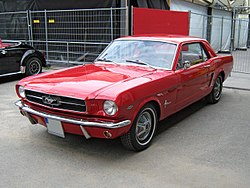
The first-generation Ford Mustang was manufactured by Ford from March 1964 until 1973. The introduction of the Mustang created a new class of automobiles known as pony cars. The Mustang's styling, with its long hood and short deck, proved wildly popular and inspired a host of competition.
It was introduced on April 17, 1964, as a hardtop and convertible, with the fastback version following in August 1964. Upon introduction, the Mustang, sharing its platform with the Falcon, was slotted into the compact car segment.
The first-generation Mustangs grew in overall dimensions and engine power with each revision. The 1971 model featured a drastic redesign. After an initial surge, sales steadily declined, and Ford began working on a new generation Mustang. With the onset of the 1973 oil crisis, Ford was prepared, having already designed the smaller Mustang II for the 1974 model year. This new car shared no components with preceding models.
As Lee Iacocca's assistant general manager and chief engineer, Donald N. Frey was the head engineer for the Mustang project — supervising the development of the Mustang in a record 18 months from September 1962 to April 1964. — while Iacocca himself championed the project as Ford Division general manager.
Drawing on inspiration from the mid-engined Ford Mustang I concept vehicle, Lee Iacocca ordered the development of a new "small car" to vice-president of design at Ford, Eugene Bordinat.
Bordinat tasked Ford's three design studios (Ford, Lincoln-Mercury, and Advanced Design) to create proposals for the new vehicle.
The design teams had been given five goals for the design of the Mustang: It would seat four, have bucket seats and a floor-mounted shifter, weigh no more than 2,500 pounds (1,100 kg), be no more than 180 inches (5 m) in length, sell for less than US$2,500 (equivalent to $25,346 in 2024), and have multiple power, comfort, and luxury options.
The Ford design studio ultimately produced the winning design in the intramural contest, under Project Design Chief Joe Oros and his team of L. David Ash, Gale Halderman, John Foster, and George Schumaker. This design was called the Cougar by the design team.
Ford Mustang (first generation)
The first-generation Ford Mustang was manufactured by Ford from March 1964 until 1973. The introduction of the Mustang created a new class of automobiles known as pony cars. The Mustang's styling, with its long hood and short deck, proved wildly popular and inspired a host of competition.
It was introduced on April 17, 1964, as a hardtop and convertible, with the fastback version following in August 1964. Upon introduction, the Mustang, sharing its platform with the Falcon, was slotted into the compact car segment.
The first-generation Mustangs grew in overall dimensions and engine power with each revision. The 1971 model featured a drastic redesign. After an initial surge, sales steadily declined, and Ford began working on a new generation Mustang. With the onset of the 1973 oil crisis, Ford was prepared, having already designed the smaller Mustang II for the 1974 model year. This new car shared no components with preceding models.
As Lee Iacocca's assistant general manager and chief engineer, Donald N. Frey was the head engineer for the Mustang project — supervising the development of the Mustang in a record 18 months from September 1962 to April 1964. — while Iacocca himself championed the project as Ford Division general manager.
Drawing on inspiration from the mid-engined Ford Mustang I concept vehicle, Lee Iacocca ordered the development of a new "small car" to vice-president of design at Ford, Eugene Bordinat.
Bordinat tasked Ford's three design studios (Ford, Lincoln-Mercury, and Advanced Design) to create proposals for the new vehicle.
The design teams had been given five goals for the design of the Mustang: It would seat four, have bucket seats and a floor-mounted shifter, weigh no more than 2,500 pounds (1,100 kg), be no more than 180 inches (5 m) in length, sell for less than US$2,500 (equivalent to $25,346 in 2024), and have multiple power, comfort, and luxury options.
The Ford design studio ultimately produced the winning design in the intramural contest, under Project Design Chief Joe Oros and his team of L. David Ash, Gale Halderman, John Foster, and George Schumaker. This design was called the Cougar by the design team.
Recent media
Recent media