



Community hub
Recent from talks
Contribute something to knowledge base
Content stats: 0 posts, 0 articles, 1 media, 0 notes
Members stats: 0 subscribers, 0 contributors, 0 moderators, 0 supporters
Subscribers
Supporters
Contributors
Moderators
Hub AI
Forward-looking infrared AI simulator
(@Forward-looking infrared_simulator)
Hub AI
Forward-looking infrared AI simulator
(@Forward-looking infrared_simulator)
Forward-looking infrared
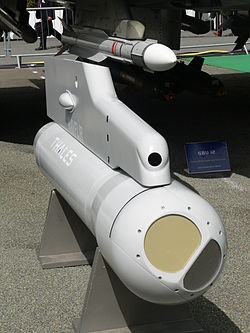
Forward-looking infrared (FLIR) cameras, typically used on military and civilian aircraft, use a thermographic camera that senses infrared radiation.
The sensors installed in forward-looking infrared cameras, as well as those of other thermal imaging cameras, use detection of infrared radiation, typically emitted from a heat source (thermal radiation), to create an image assembled for video output.
They can be used to help pilots and drivers steer their vehicles at night and in fog, or to detect warm objects against a cooler background. The wavelength of infrared that thermal imaging cameras detect is 3 to 12 μm and differs significantly from that of night vision, which operates in the visible light and near-infrared ranges (0.4 to 1.0 μm).
Infrared light falls into two basic ranges: long-wave and medium-wave. Long-wave infrared (LWIR) cameras, sometimes called "far-infrared", operate at 8 to 12 μm and can see heat sources, such as hot engine parts or human body heat, several kilometers away. Longer-distance viewing is made more difficult with LWIR because the infrared light is absorbed, scattered, and refracted by air and by water vapor.
Some long-wave cameras require their detector to be cryogenically cooled, typically for several minutes before use, although some moderately sensitive infrared cameras do not require this. Many thermal imagers, including some forward-looking infrared cameras (such as some LWIR enhanced vision systems (EVS)) are also uncooled.
Medium-wave (MWIR) cameras operate in the 3–5 μm range. These can see almost as well, since those frequencies are less affected by water-vapor absorption, but generally require a more expensive sensor array, along with cryogenic cooling.
Many camera systems use digital image processing to improve the image quality. Infrared imaging sensor arrays often have wildly inconsistent sensitivities from pixel to pixel, due to limitations in the manufacturing process. To remedy this, the response of each pixel is measured at the factory, and a transform, most often linear, maps the measured input signal to an output level.
Some companies offer advanced "fusion" technologies that blend a visible-spectrum image with an infrared-spectrum image to produce better results than a single-spectrum image alone.
Forward-looking infrared
Forward-looking infrared (FLIR) cameras, typically used on military and civilian aircraft, use a thermographic camera that senses infrared radiation.
The sensors installed in forward-looking infrared cameras, as well as those of other thermal imaging cameras, use detection of infrared radiation, typically emitted from a heat source (thermal radiation), to create an image assembled for video output.
They can be used to help pilots and drivers steer their vehicles at night and in fog, or to detect warm objects against a cooler background. The wavelength of infrared that thermal imaging cameras detect is 3 to 12 μm and differs significantly from that of night vision, which operates in the visible light and near-infrared ranges (0.4 to 1.0 μm).
Infrared light falls into two basic ranges: long-wave and medium-wave. Long-wave infrared (LWIR) cameras, sometimes called "far-infrared", operate at 8 to 12 μm and can see heat sources, such as hot engine parts or human body heat, several kilometers away. Longer-distance viewing is made more difficult with LWIR because the infrared light is absorbed, scattered, and refracted by air and by water vapor.
Some long-wave cameras require their detector to be cryogenically cooled, typically for several minutes before use, although some moderately sensitive infrared cameras do not require this. Many thermal imagers, including some forward-looking infrared cameras (such as some LWIR enhanced vision systems (EVS)) are also uncooled.
Medium-wave (MWIR) cameras operate in the 3–5 μm range. These can see almost as well, since those frequencies are less affected by water-vapor absorption, but generally require a more expensive sensor array, along with cryogenic cooling.
Many camera systems use digital image processing to improve the image quality. Infrared imaging sensor arrays often have wildly inconsistent sensitivities from pixel to pixel, due to limitations in the manufacturing process. To remedy this, the response of each pixel is measured at the factory, and a transform, most often linear, maps the measured input signal to an output level.
Some companies offer advanced "fusion" technologies that blend a visible-spectrum image with an infrared-spectrum image to produce better results than a single-spectrum image alone.
Recent media
Recent media